Tag: House of Deputies

  • House of Deputies President bids farewell

    House of Deputies President bids farewell

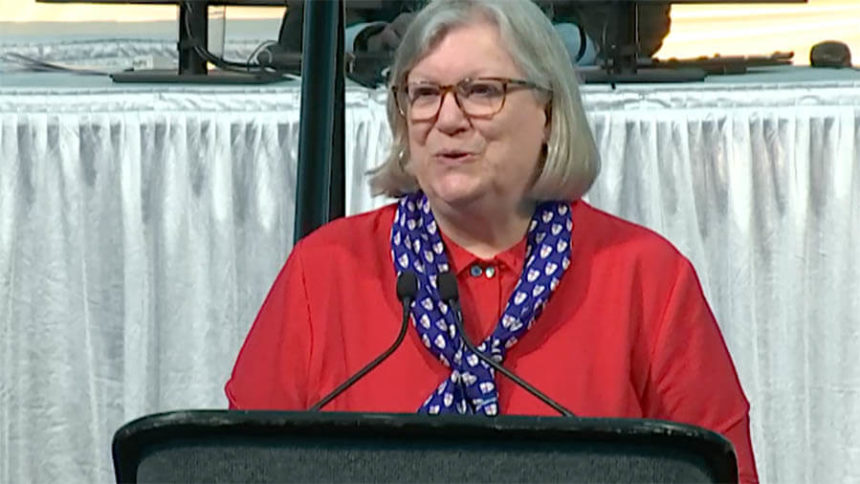
    [Episcopal News Service — Baltimore, Maryland] In the final moments of her service as president of the House of Deputies on July 11, 2022, the Rev. Gay Clark Jennings described her journey to leadership in The Episcopal Church and urged deputies to embrace the generational change that is taking place and to stay committed to working for structural change to make the church more inclusive.

    Jennings preached her final sermon as president during Morning Prayer on July 9.

    She was elected president of the House of Deputies at the 77th General Convention in 2012 and was unopposed for reelection in 2015 and 2018. She is the third woman, and the first ordained woman, to hold the position since General Convention was created in 1785.

    Giving thanks for what has happened

    In her remarks, she gave a special thanks to her husband, Albert, for his support of her ministry of leadership, and to their son, Sam. She said her beloved daughter, Lee, died 12 years ago, “I know how proud she would be.”

    You will be in a House of Deputies that the founders of this church quite literally could not have imagined.

    The Rev. Gay Clark Jennings

    Jennings told deputies that she has sought to empower new leadership throughout her presidency, just as former House of Deputies President Pamela Chinnis did in 1994 in asking Jennings, then a second-term deputy, to serve as a press briefing officer and later as chair of the Committee on Canons. It was in that role, Jennings said, “I discovered I like to be called Madame Chair.”

    The House of Deputies is an engine for renewal and reform

    Jennings said she shared her story not only to reminisce but to remind those assembled of “the way that the House of Deputies, General Convention after General Convention, serves as an engine of renewal and reform and resurgence for our church.”

    She noted that she was handing the president’s gavel to a new president, Julia Ayala Harris, and the House of Deputies then would be led by two women of color.  Ayala Harris is Latina, and newly elected vice president the Rev. Rachel Taber-Hamilton is Shackan First Nation. “You will be in a House of Deputies that the founders of this church quite literally could not have imagined,” she said.

    Jennings added, “This kind of change, this seismic, generational-shifting, paradigm-straddling change, is a cause for enormous celebration.” However, she warned, “It is not enough simply to appoint and elect young people and people of color to lead you. You must also support them, encourage them and work with them to change the structures and the systems that perpetuate racism and misogyny that is still endemic in our church.”

    She noted especially passage by this General Convention of Resolution A125, which creates the Episcopal Coalition for Racial Equity and Justice. This action, Jennings said, “provides the opportunity to change the structures of the church to be more committed to racial justice and equity, to root out as the systemic racism that too often prevails.”

    President Jennings honored for her work

    A resolution honoring Jennings’ service to the House of Deputies was passed earlier in the session by standing ovation. The resolution then was sent to the House of Bishops for final approval, where it also was passed with sustained applause.

    —Melodie Woerman is a member of the ENS General Convention news team and is the former director of communications for the Diocese of Kansas.

    General Convention of the Episcopal Church

    What happens at General Convention?

    The legislative process of General Convention is an expression of The Episcopal Church’s belief that, under God, the Church is ordered and governed by its people: laity, deacons, priests, and bishops.

    The General Convention is the Church’s highest temporal authority. As such, it has the following power:

    • Amend the Constitution and Canons of the Episcopal Church
    • Amend the Book of Common Prayer and to authorize other liturgical texts
    • Adopt the budget for the Church
    • Create covenants and official relationships with other branches of the Church
    • Determine requirements for its clergy and other leaders
    • Elect its officers, members of the Executive Council, and certain other groups
    • Delegate responsibilities to the Interim Bodies of The Episcopal Church
    • Carry out various other responsibilities and authority
    The Episcopal Church of the Redeemer: Worshiping God, living in community, reaching out to the world.

    Church of the Redeemer

    Church of the Redeemer: Worshiping God, living in community, and reaching out to the world around us. We are an Episcopal Church serving north King County and south Snohomish County. We welcome you be with us as we walk the way of Jesus.

    Church of the Redeemer is at 6220 Northeast 181st Street in Kenmore, Washington. We are a short distance north of Bothell Way, near the Burke-Gilman Trail. The entrance looks like a gravel driveway. The campus is larger on the inside than it is on the outside. And we managed to hide a large building on the side of a hill that is not easily seen from the street.

    The Episcopal Church welcomes you.

  • Julia Ayala Harris elected president of HOD

    Julia Ayala Harris elected president of HOD

    [Episcopal News Service – Baltimore, Maryland] The House of Deputies elected Julia Ayala Harris, lay deputy from Oklahoma, as its new president during its morning session on July 9, 2022, at the 80th General Convention of the Episcopal Church.

    Ayala Harris, elected on the third ballot, will succeed the Rev. Gay Clark Jennings, who is finishing up her third and final term. After the vote, Jennings invited Ayala Harris to come to the front of the convention hall and address the House of Deputies. She was joined there by the rest of the Oklahoma delegation.

    Keep being the church geek that you are. Dolly Parton has the saying ‘figure out who you are and then do it on purpose.’ Be a church geek on purpose.

    Julia Ayala Harris

    “I am unbelievably honored to be able to follow President Jennings,” Ayala Harris said. She thanked the deputies for electing her while describing herself as a “church geek.”

    “You have sent the message to church geeks everywhere; that if you try hard and you read the canons and you read all the minutes, that you can actually make a huge difference on this church,” she said.

    “And I want to give a shout out to the church geeks at home watching that I saw on Twitter this morning. I [too] been there watching General Convention, thinking someday I’ll be a deputy, someday I’ll be on a legislative committee. And I think this is speaking to you that you will someday be here doing this with us. Keep being the church geek that you are. Dolly Parton has the saying ‘figure out who you are and then do it on purpose.’ Be a church geek on purpose.”

    Ayala Harris offers thanks

    Ayala Harris also thanked the other four deputies who stood for election. “I want to express my deepest gratitude to the other candidates on this historic slate,” she said. “It is a brave and vulnerable and I applaud all of us for doing this in such a way that I think inspires our church as we move into the future. Thank you all for saying yes to this call.”

    Ayala Harris will take over for Jennings when the final gavel sounds in the House of Deputies on July 11. Each president is limited to three consecutive three-year terms. Jennings has served one year longer than expected because the pandemic prompted a one-year postponement of the 80th General Convention.

    “I don’t think anyone will be able to fill your shoes,” Ayala Harris told Jennings. “Thank you for your faithful service to this church, to your own vision and to all the change that you are brought for justice, for inclusion, for Jesus.”

    Ayala Harris thanked her family members, whom she said watching over the internet. “Thank you for supporting me and believing in me when I didn’t believe in myself. Even though you don’t know what that ‘president of House of Deputies’ is or does.”

    Then she told the house, “get ready to roll up your sleeves because we got a lot of work to do between now and the 81st General Convention,” which convenes in the summer of 2024.

    Youngest, most diverse slate

    Deputies elected Ayala Harris from the youngest, most diverse slate ever presented to the house for the presidential election. She led on each of the first two ballots and was elected on the third ballot with 417 votes, 21 more than were needed.

    The other four candidates were the Rev. Devon Anderson, rector of Trinity Episcopal Church in Excelsior, Minnesota; the Rev. Edwin Johnson, rector of St. Mary’s Episcopal Church in Dorchester, Massachusetts; Ryan Kusumoto, a deputy from the Diocese of Hawai’i, and the Very Rev. Ward Simpson, dean of Calvary Cathedral in Sioux Falls, South Dakota.

    The role of the president of the House of Deputies

    The president’s role has been changing since 1964, when the convention gave the position a three-year term instead of simply being elected to preside during convention. In addition to chairing the House of Deputies during convention, the president also is canonically required to serve as vice chair of Executive Council and vice president of the Domestic and Foreign Missionary Society, or DFMS, the nonprofit corporate entity through which The Episcopal Church owns property and does business. He or she has a wide swath of appointment powers. The president also travels around the church, speaking at conferences and other gatherings and meeting with deputies and other Episcopalians.

    After the election, Ayala Harris told Episcopal News Service that increasing the diversity of interim bodies will be one of her immediate priorities, as she pushes for greater inclusion of people of color, non-English speakers, people with disabilities and LGBTQ+ Episcopalians in the church’s governance.

    She brings her own experience to that work, as a working-class Latina who came to the Episcopal Church as an adult after being raised in the Roman Catholic Church. Though not a “cradle” Episcopalian, she has spent the past 21 years getting involved in Episcopal Church governance at all levels, including most recently as a member of Executive Council, the church’s governing body between meetings of General Convention. She also has spent the past 20 years working professionally in the nonprofit sector.

    “I am overwhelmed by everyone’s support,” she told ENS.

    Vice presidential election

    The deputies will elect their vice-president July 10. The only candidate to come forward publicly for vice president is the Rev. Rachel Taber-Hamilton, Diocese of Olympia, though others could declare their candidacies by 6 p.m. July 9.

    The two positions, filled by election during each meeting of convention, cannot be held by members of the same order, clergy or lay. Because Ayala Harris is a layperson, only clergy deputies can be on the ballot for vice president.

    This also will be the first time the House of Deputies has elected a new president since the 79th General Convention in 2018 approved a financial compensation plan for the position. Previously an uncompensated volunteer, the president is now considered a contractual employee and paid a fee for her work, set annually by Executive Council.

    Jennings’ compensation is set at $223,166 for 2022, making her the lowest paid of the church’s officers. The president is considered an independent contractor and receives no employee benefits, though the position has a travel budget and a paid assistant.

    The vice president remains an unpaid volunteer position.


    Outgoing President Jennings

    Jennings, in her sermon for Morning Prayer earlier on July 9, referenced the decision by the 79th General Convention to compensate the person who holds the position of president. She credited that change for producing “the youngest and most diverse slate in the church’s history.” Encouraging generational change in church leadership is one of her proudest accomplishments as president, she said. She also mentioned the 2015 General Convention vote for marriage equality and the church’s #MeToo work in 2018 as highlights during her tenure.

    After Ayala Harris’ election, Jennings shared a story from her own childhood, about how she once was in a second-grade play and got to act the role of the Ugly Duckling’s mother.

    “Lame duck, quack quack quack,” she joked. “But there’s still a few more days of work to do.”

    —The Rev. Mary Frances Schjonberg retired in July 2019 as senior editor and reporter for Episcopal News Service. David Paulsen is an editor and reporter for Episcopal News Service. He can be reached at dpaulsen@episcopalchurch.org.

    PHOD Election Results and Acceptance Speech From President-Elect Julia Harris – #GC80 Clips

    General Convention of the Episcopal Church

    What happens at General Convention?

    The legislative process of General Convention is an expression of The Episcopal Church’s belief that, under God, the Church is ordered and governed by its people: laity, deacons, priests, and bishops.

    The General Convention is the Church’s highest temporal authority. As such, it has the following power:

    • Amend the Constitution and Canons of the Episcopal Church
    • Amend the Book of Common Prayer and to authorize other liturgical texts
    • Adopt the budget for the Church
    • Create covenants and official relationships with other branches of the Church
    • Determine requirements for its clergy and other leaders
    • Elect its officers, members of the Executive Council, and certain other groups
    • Delegate responsibilities to the Interim Bodies of The Episcopal Church
    • Carry out various other responsibilities and authority
    The Episcopal Church of the Redeemer: Worshiping God, living in community, reaching out to the world.

    Church of the Redeemer

    Church of the Redeemer: Worshiping God, living in community, and reaching out to the world around us. We are an Episcopal Church serving north King County and south Snohomish County. We welcome you be with us as we walk the way of Jesus.

    Church of the Redeemer is at 6220 Northeast 181st Street in Kenmore, Washington. We are a short distance north of Bothell Way, near the Burke-Gilman Trail. The entrance looks like a gravel driveway. The campus is larger on the inside than it is on the outside. And we managed to hide a large building on the side of a hill that is not easily seen from the street.

    The Episcopal Church welcomes you.

  • President Jennings supports Texan transgender rights in letter

    President Jennings supports Texan transgender rights in letter

    The Rev. Gay Clark Jennings is President of the House of Deputies of the General Convention of the Episcopal Church. This letter supporting Texan transgender rights was published on the House of Deputies website on February 24, 2022.

    President Jennings responds to Texas governor’s “cruel” letter

    Dear Deputies and Alternate Deputies,

    As you may have heard by now, Texas Governor Greg Abbott issued a letter Tuesday to state health agencies saying that medical treatments provided to transgender adolescents—widely considered the standard of care in medical circles—should be classified as “child abuse” under existing state law and reported as such.

    While it is not clear whether this order is enforceable, it is nonetheless a reprehensible statement that puts some of the most vulnerable children in our society, and their families, in grave danger. Denying the full humanity of transgender people, putting beloved children of God at risk, and threatening to separate loving families is cruel and antithetical to the way of Jesus.

    We must do all we can to protect the children whom Governor Abbott has targeted to advance his own political standing and, more broadly, to stop the wave of anti-transgender legislation sweeping across the United States.

    The General Convention of the Episcopal Church first called for equal protection under the law for gay and lesbian people in 1976 with Resolution A071 and expanded the call for equal protection to include transgender people in 2009 with Resolution D012. Subsequent conventions have reaffirmed these calls and passed numerous resolutions supporting the lives and ministries of transgender people in the church and the world.

    In March 2016, Presiding Bishop Michael Curry and I were lead signers on an amicus brief signed by 1,800 clergy and religious leaders in a U.S. Supreme Court case that sought, unsuccessfully, to restrict transgender people’s use of public restrooms. Later that year, we wrote to the church expressing our opposition to a so-called “bathroom bill” in North Carolina. And in 2017, as our church was preparing for the 79th General Convention in Austin, we twice wrote to Joe Strauss, a Republican legislator who was then speaker of the Texas House of Representatives, praising his opposition to Governor Abbott’s repeated attempts to pass a bathroom bill in Texas and asking him to spare us the difficult choice of reconsidering the location of convention. Thankfully, the bill did not pass.

    Our church’s progress in recognizing transgender people as beloved children of God has at times been too slow, and it is not yet complete. But the progress we have made is due in large part to the work of TransEpiscopal, and I commend you to their website and Facebook page.

    Last month, Executive Council heard from transgender, nonbinary and gender non-conforming Episcopalians who gave us a sense of the work that our church must still undertake. “I invite my beloved Episcopal Church to live fully into the stances, canonical changes and statements we have made over the years,” Deputy Cameron Partridge of the Diocese of California told the Executive Council. “These moves we have made at churchwide and diocesan levels and parish levels truly matter and I’m profoundly grateful for them. And I want to see them lived into consistently at all levels of our church’s life, especially the congregational level.”

    The situation in Texas is particularly egregious, but transgender children and their families all across the country have been under heightened attack since last year. The Human Rights Campaign reports that more anti-transgender legislation was filed at the state level in 2021 than at any time in modern history and predicts that 2022 will “eclipse even the brutality of last year.”

    No matter where transgender children of God are under threat, the Episcopal Church must stand with them in love and solidarity. To ensure that we are a church in which vulnerable people are not only welcomed, but also protected, Episcopalians must respond with our voices, our votes and our prayers. Here are four things we can all do:

    • Write your senators and tell them to pass the Equality Act, which would for the first time include sexual orientation and gender identity alongside race, gender, religion, national origin, age, and disability as protected classes where federal law bans discrimination.
    • Make it clear that your diocese, your congregation and your community welcome transgender people and their families and will strive to protect them. Where this is not the case, work to make it so.
    • Advocate against anti-transgender legislation when it comes before your state legislature. Write to your state elected officials and tell them that you support the dignity and equality of transgender people because of your faith, not in spite of it.
    • And please join me in praying for transgender children in Texas, for their parents and caretakers, and for all transgender people everywhere who face discrimination, intolerance, and bigotry.

    Faithfully,

    The Rev. Gay Clark Jennings
    President, House of Deputies

    The Rev. Gay Clark Jennings

    The Rev. Gay Clark Jennings

    The Rev. Gay Clark Jennings was elected president of the House of Deputies by her peers at the 77th General Convention of the Episcopal Church in 2012, and at the 78th General Convention in 2015, she was reelected by acclamation. She is the first ordained woman to hold the position.

    As president, Gay is committed to fostering a new generation of leaders in the Episcopal Church and encouraging the church’s work for justice through the actions of General Convention and the work of Episcopalians throughout the church. She works closely with the elected and appointed leaders who serve the church between conventions, with more than 850 members of the House of Deputies, and with the presiding bishop and other church leaders.

    Read more about the President of the House of Deputies.

    Church of the Redeemer

    Church of the Redeemer: Worshiping God, living in community, and reaching out to the world around us. We are an Episcopal Church serving north King County and south Snohomish County, Washington. As you travel your road, go with friends walking the way of Jesus at Redeemer.

    Church of the Redeemer is at 6220 Northeast 181st Street in Kenmore, Washington. We are a short distance north of Bothell Way, near the Burke-Gilman Trail. The entrance looks like a gravel driveway. The campus is larger on the inside than it is on the outside. And we managed to hide a large building on the side of a hill that is not easily seen from the street.

    The Episcopal Church welcomes you.

The 2nd Sunday after Pentecost (Year A), June 7, 2026. Services at 8:00 am (no music) and 10:30 (music).