Tag: racial violence

  • Church leaders lament deaths in Buffalo

    Church leaders lament deaths in Buffalo

    First is a news release from Episcopal News Service about the mass deaths in Buffalo, New York. It has reactions from church leaders at the national a locally from Buffalo, New York.

    This is followed by a pastoral statement by Bishop Greg Rickel of the Diocese of Olympia.

    Episcopal leaders join outcry and lament over racist rampage in Buffalo that left 10 dead

    [Episcopal News Service] Episcopal leaders are condemning a deadly, racist rampage at a Buffalo, New York, supermarket and joining in prayers for the victims and their families as hate-crime charges loom for the 18-year-old suspect in the shooting.

    Payton S. Gendron, who lives 200 miles from Buffalo near the central New York city of Binghamton, is accused of opening fire at a Tops store in a largely Black neighborhood of Buffalo, killing 10 and injuring three people, all but two of them Black. Law enforcement officials have called it “straight up, a racially motivated hate crime,” and a 180-page manifesto attributed to Gendron alludes to the false, racist conspiracy theory that a coordinated “replacement” of white Americans by people of color is underway.

    Bishop Sean Rowe, Bishop Provisional of Western New York

    “While we wait to learn more about this unthinkable situation, I ask you to join me in praying for those who have died, for those who are injured and suffering, and for the families and loved ones whose lives will never be the same,” Bishop Sean Rowe said in a written statement after the massacre. ”Please pray, too, for the man who committed this horrific act, and for everyone whose mind and soul is twisted toward the evil of gun violence by racism.”

    Rowe, the bishop diocesan of Northwestern Pennsylvania, also serves as bishop provisional of the Buffalo-based Diocese of Western New York through a partnership between the two dioceses. “Racial hatred has no place in our churches or our communities,” Rowe said. “Here in the dioceses of Northwestern Pennsylvania and Western New York, we are committed to dismantling white supremacy and systemic racism, and we stand in solidarity with the Black community, which today has once again paid an unthinkable price for the twin evils of racism and gun violence.

    Please accept YouTube cookies to play this video. By accepting you will be accessing content from YouTube, a service provided by an external third party.

    YouTube’s privacy policy

    If you accept this notice, your choice will be saved and the page will refresh.


    Presiding Bishop Michael Curry

    Presiding Bishop Michael Curry, who grew up in Buffalo and whose father was rector of St. Philip’s Episcopal Church, a historically black congregation in the city, released a statement May 16 saying his “heart is heavy” at the news of the attack near where he and his childhood friends once rode their bikes. He offered prayers for the victims’ families and gratitude for the police officers who stopped further carnage.

    Read: Presiding Bishop Michael Curry’s full statement.

    “The loss of any human life is tragic, but there was deep racial hatred driving this shooting, and we have got to turn from the deadly path our nation has walked for much too long,” Curry said. “Bigotry-based violence — any bigotry at all — against our siblings who are people of color, Jewish, Sikh, Asian, trans, or any other group, is fundamentally wrong. As baptized followers of Jesus of Nazareth, we are called to uphold and protect the dignity of every human child of God, and to actively uproot the white supremacy and racism deep in the heart of our shared life.

    Parish and diocesan response

    On May 15, Rowe led a short prayer service with Denise Clarke-Merriweather, a member of St. Philip’s. The prayer service, livestreamed on Zoom and Facebook, incorporated the Litany in the Wake of a Mass Shooting, which was developed by Bishops United Against Gun Violence after six people were killed at a Sikh temple in Wisconsin in 2012. It is updated regularly with additional prayers for the victims of new mass shootings in the United States.

    On May 16, the two partner dioceses’ Commission to Dismantle Racism and Discrimination issued a statement lamenting the Buffalo attack, calling it “another reminder of the forces of evil that plague our country requiring the acknowledgement of ongoing traumatization due to racism and discrimination.”

    “While we extend our deepest condolences, we know that a commitment to faith-based action is needed now, more than ever,” the commission said. “Please join us in the concerted effort to promote justice, peace, and love within every aspect of our lives in dedication to our deceased and injured neighbors, as well as all individuals who have been victimized as a result of racial discrimination.”

    https://www.facebook.com/stphilipsbuffalo/photos/a.361482310546382/5747762885251604/

    The person charged with the crime

    Gendron has been charged locally with first-degree murder, and the FBI is investigating the attack as a possible hate crime. Gendron, dressed in tactical gear and carrying an assault weapon, is accused of arriving at the Buffalo supermarket midafternoon May 14 and shooting four people in the parking lot before continuing into the store and firing on shoppers and employees. A security guard who returned fire was among those shot and killed.

    Officials said Gendron livestreamed the attack on the website Twitch before Buffalo police responded and persuaded Gendron to surrender.

    The attack, by a gunman reportedly driven by white supremacist ideology, has drawn comparisons to other racially and ethnically motivated massacres, including the 2015 shooting at Mother Emanuel African Episcopal Church in Charleston, South Carolina, that killed nine Black church members; the 2018 shooting at Tree of Life Synagogue in Pittsburgh, Pennsylvania, that killed 11 worshipers, and the 2019 shooting at a Walmart in El Paso, Texas, that killed 23 people, most of them Latino.

    About the victims

    One of the 10 fatal victims in Buffalo, 86-year-old Ruth Whitfield, had stopped at Tops for groceries while on her way home from visiting her husband, who lives in a nursing home. “That day was like any other day for my mom,” son Garnell Whitfield said at a family news conference May 16. “She encountered this evil, hateful – she didn’t deserve that. She didn’t deserve that. Nobody deserves that.”

    Whitfield, a former Buffalo police commissioner, issued an emotional, impassioned plea for solutions to the continued threat of racist violence like the attack that killed his mother. “What are we going to do to change it?” he said. “This is our mother; this is our lives! We need help. We’re asking you to help us. Help us change this. This can’t keep happening.”

    https://www.facebook.com/watch/?v=2188636457954369

    The Rev. Steve Lane, priest-in-charge at St. Philip’s, serves as a chaplain for Buffalo police officers and responded to the shooting site later in the day May 14. About half of the department was on the scene by then, but the victims’ families had left, Lane told Episcopal News Service. He praised the officers for their ability to “provide a calm presence in the middle of a crazy crisis.”

    Lane also acknowledged his unusual role as a white priest of a historically Black congregation. Since the attack, he has reached out to members of St. Philip’s. “I have some parishioners who shop there, and we have parishioners who knew people who were shot there,” Lane said, but no one from the congregation was at Tops when the shooting happened.

    Lane said the reaction of many St. Philip’s parishioners, in addition to grief for the victims, has been a solemn weariness at yet another case of racist violence targeting Black victims. “This has happened before, and it has happened again,” he said.

    —David Paulsen is an editor and reporter for Episcopal News Service. He can be reached at dpaulsen@episcopalchurch.org.

    Bishop Rickel’s Statement on the Shootings in Buffalo, NY

    Like you, I was horrified to learn of the racist act of terror and violence that claimed the lives of 10 innocent people on Saturday in Buffalo, NY, injuring three more. White supremacy—in all its forms—continues to perpetuate violence and trauma in Black communities, and we must continually work to dismantle racism in our communities, in our churches, and in our own lives.

    I grieve with those families who have lost someone this weekend, and I ask you to join me in prayer for the victims and their families. I also urge you to consider visiting Bishops United Against Gun Violence for resources to help you take action in advocating for sensible gun reform.

    Finally, I leave you with the words of our Presiding Bishop as he reflects on this act of violence in a neighborhood he knows so well: Pastoral statement on mass shooting in Buffalo from Episcopal Church Presiding Bishop Michael Curry.

    [The Rt. Rev. Gregory Rickel is Bishop Diocesan of the Diocese of Olympia in western Washington State.]
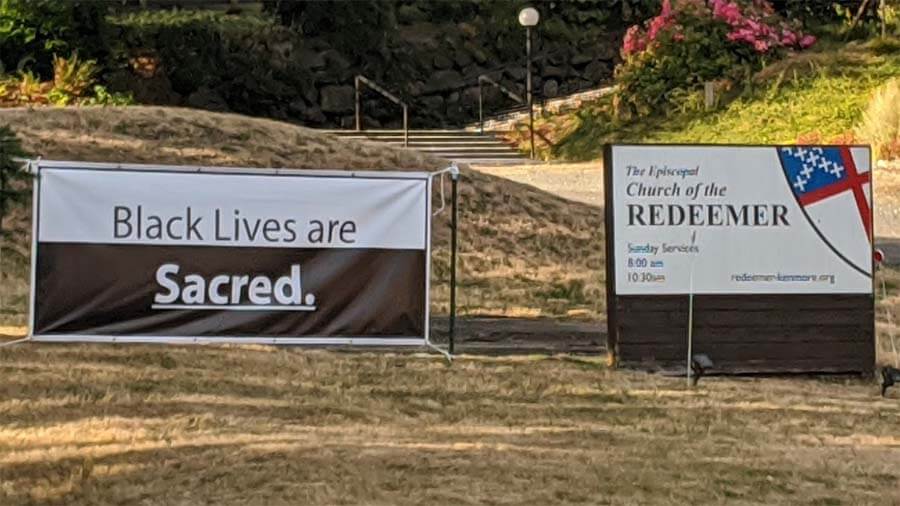
    Black lives are sacred. Church of the Redeemer.

    Church of the Redeemer

    Welcome to Church of the Redeemer: Worshiping God, living in community, and reaching out to the world. We are an Episcopal Church serving north King County and south Snohomish County, Washington. As you travel your road, go with friends walking the way of Jesus at Redeemer.

    Church of the Redeemer is at 6220 Northeast 181st Street in Kenmore, Washington. We are a short distance north of Bothell Way, near the Burke-Gilman Trail. The entrance looks like a gravel driveway. The campus is larger on the inside than it is on the outside. And we managed to hide a large building on the side of a hill that is not easily seen from the street.

    The Episcopal Church welcomes you.
  • Bishop Rickel’s statement on HBCU bomb threats

    Bishop Rickel’s statement on HBCU bomb threats

    As many of you are well aware by now, yesterday, on the first of February and the first day of Black History Month, several of our historically Black colleges and universities (HBCUs) were terrorized with bomb threats. Sadly, this incarnates the reality that we still have a long collective way to go to reach Beloved Community and that any notion that we can now stop talking, working, and struggling toward it is an illusion.

    I want to say first how sorry I am to our African American and Black siblings who feel the terror of such acts and to all the BIPOC community as well. Second, I want to encourage all of you to be proactive in speaking out against this, and also to be working to change it.

    Another concrete thing that I was going to put before you and ask of you, even before the sad events of yesterday, was to consider a gift to the HBCUs. Below, you will find a link to our Presiding Bishop’s invitation to give to the Absalom Jones fund in support of our HBCUs. You will also find instructions that will help facilitate your generosity both to economically assist these fine institutions but now, even more, to stand in solidarity with them. I gave today! Please pray for those who live in fear and anxiety due to such acts, and for those who feel the need to perpetrate them. Pray for our human family.

    Presiding Bishop Curry invites gifts to Absalom Jones Fund for Episcopal HBCUs.

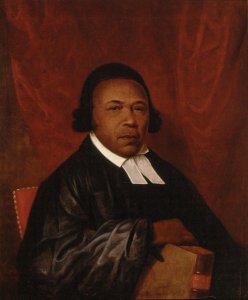
    Absalom Jones painted by Raphaelle Peale

    Giving the full history: Who owned Absalom Jones?

    Absalom Jones is one of the Episcopal Church’s and our nation’s most heroic founding fathers, and on February 13, we commemorate blessed Absalom, the first black priest and founder of the first black congregation in the Episcopal Church. Absalom Jones had been born into slavery in 1746 and achieved his own freedom in 1784. But, from whom?

    I know it’s awkward at this time of celebration to acknowledge the man who enslaved Absalom. But the 2006 General Convention mandated that the Episcopal Church give a “full, faithful and informed account of our history” with slavery. So, the time is right to remember that the man he called “master” for 38 years was Benjamin Wynkoop vestrymen, warden and benefactor of Christ Church and St. Peter’s in Philadelphia, our Church’s two historic congregations that helped give birth both to the nation and the Episcopal Church. May a fair accounting of Jones’ and Wynkoop’s history as slave and master provide Episcopalians today with the insight to overcome the legacies of a racist past infecting our society, and beloved Church, still.

    Absalom was not given the last name of Jones when born on the plantation of Wynkoop’s parents in Sussex, Delaware. At an early age, he was taken from the fields and came to work in the house. When Wynkoop chose to farm no longer, but to make his way as a merchant, he sold Absalom’s mother and six siblings, and brought the 16-year-old Absalom as his slave to Philadelphia in 1762.

    Upon arriving in Philadelphia, Wynkoop began attending the newly constructed St. Peter’s, built when Christ Church had become fully subscribed; Christ Church and St. Peter’s were one parish church in two congregations.

    Wynkoop’s business was successful, and how not? Absalom labored from dawn to dusk, he reported, often till midnight. Not only staffed by slave labor, the store sold the fruits of slave labor: “rum, molasses, coffee, chocolate, pepper, and other groceries.” According to a biographer, Wynkoop was a “prompt contributor to worthy causes” through his gains reaped by the labor of others. A major donor in the parish, Wynkoop was elected to the common Vestry of Christ Church and St. Peter’s in 1769.

    According to Absalom’s own autobiographical sketch, Wynkoop permitted him to attend a school for blacks, possibly one in Christ Church conducted by the Bray Associates (another history that needs a full accounting). Absalom married a slave, Mary, whose master was Wynkoop’s neighbor and fellow parishioner at St. Peter’s. Absalom took on the cause of Mary’s freedom. With the skills learned in school, he wrote the case and raised the necessary money to purchase her freedom, which her master accepted. Absalom remained a slave.

    When General Howe marched his British troops into Philadelphia in the autumn of 1777, Wynkoop temporarily fled. Absalom could have easily taken refuge with and received freedom from the British. But he stayed in the Wynkoop’s store. Mary was now free, he had a family that he would not abandon, and a house he had built that he rented to free blacks, saving the money. “I made application to my master in 1778 to purchase my own freedom,” he wrote, “but this was not granted.”

    “My desire for freedom increased,” he wrote, because he feared that, while a slave, his house might be taken by Wynkoop. He made “many applications to [Wynkoop] for liberty to purchase my freedom,” but Wynkoop wouldn’t budge. Why couldn’t Wynkoop breath the air of freedom rich and redolent in Philadelphia? Why did his Church, that had many abolitionists as members, remain silent? Those are the questions we are obligated to ask now.

    On October 1, 1784, Absalom recounts with a charity surprising that Wynkoop, “generously gave me a manumission.” Then, Absalom freely took the surname Jones, uniquely American and sounding nothing like the Dutch Wynkoop.

    Within three years, Absalom Jones co-founded the Free African Society. In 1792, he led his congregation from St. George’s Methodist Church and founded St. Thomas, which then in 1794 affiliated with the Episcopal Diocese, and the African Episcopal Church of St. Thomas was born. But what of Benjamin Wynkoop? He becomes warden of Christ Church and St. Peter’s during these formative years of the Episcopal Church, but little detail of his life remains. The most interesting detail is from Absalom Jones.

    After his manumission, he writes, “I have ever since continued in [Wynkoop’s] service at good wages, and I still find it my duty, both late and early, to be industrious to improve the little estate that a kind Providence has put in my hands.”

    I leave to historians the interpretation of the meaning or importance of Absalom Jones continuing to work for Benjamin Wynkoop, building a relationship of some warmth and forbearance such that Wynkoop’s respect for Jones was quoted in Jones’ obituary in 1818. But I challenge myself, and the tour guides at Christ Church who will tell Wynkoop’s history of slaveholding this year to some 100,000 school children, not to jump to the conclusion of a happy ending to a slavery story in our beloved Episcopal Church. I hope that Jones and Wynkoop truly enjoyed the embrace of reconciliation, but take that possibility as a challenge today to reconcile our present Church with its own history with slavery. Might we be guided by the wisdom of theologian Miroslav Volf: “Remembering well is one key to redeeming the past; and the redemption of the past is itself nestled in the broader story of God’s restoring of our broken world to wholeness — a restoration that includes the past, present, and future.”

    Absalom Jones wrote that the motivation for founding the African Episcopal Church of St. Thomas was “to encourage us to arise out of the dust and shake ourselves, and throw off that servile fear, that the habit of oppression and bondage trained us up in.” That same habit of oppression and bondage will continue to infect the Episcopal Church until we tell our complete history with slavery. I pray we, as a Church, arise out of the dust and shake ourselves, and give an informed account of the slaveholders in our past, and not just the slaves.

    [This article from the Episcopal Church website.]

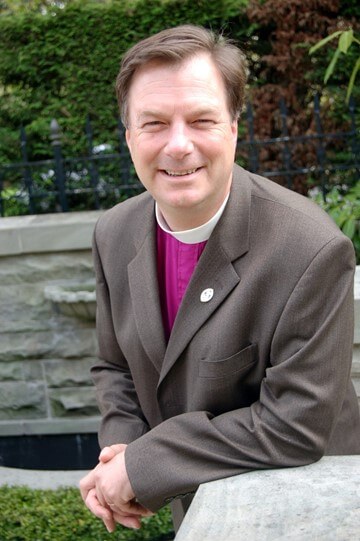
    Bishop Greg Rickel

    The Rt. Rev. Gregory H. Rickel was elected bishop on May 12, 2007, and became the eighth Bishop of Olympia in September 2007. He embraces radical hospitality that welcomes all, no matter where they find themselves on their journey of faith. He envisions a church that is a safe and authentic community in which to explore God’s infinite goodness and grace as revealed in the life and continuing revelation of Jesus Christ.

    Church of the Redeemer

    Welcome to Church of the Redeemer: Worshiping God, living in community, and reaching out to the world. We are an Episcopal Church serving north King County and south Snohomish County, Washington. As you travel your road, go with friends walking the way of Jesus at Redeemer.

    Church of the Redeemer is at 6220 Northeast 181st Street in Kenmore, Washington. We are a short distance north of Bothell Way, near the Burke-Gilman Trail. The entrance looks like a gravel driveway. The campus is larger on the inside than it is on the outside. And we managed to hide a large building on the side of a hill that is not easily seen from the street.

    The Episcopal Church welcomes you.
     

  • Bishops respond to verdict in Ahmaud Arbery case

    Bishops respond to verdict in Ahmaud Arbery case

    Presiding Bishop Michael Curry, Bishop Gregory Rickel, and bishops in Georgia respond to verdict in Ahmaud Arbery case from Georgia.

    Presiding Bishop Michael Curry in choir dress

    Presiding Bishop Michael Curry responds to verdict in Ahmaud Arbery case

    While nothing will return Ahmaud Arbery to his loved ones, our justice system has held three men accountable for hunting down and killing a Black man who did nothing but go for a run in a predominately white neighborhood, and I give thanks for this outcome. My prayers are with Arbery’s family as they continue to grieve his loss.

    Even so, our work as followers of Jesus, as a church, and as a nation, continues; we cannot rest until these modern embodiments of terror against any human child of God are no more. We must labor on for racial healing and reconciliation in each of our hearts—and in our society. We must reimagine and advocate against systems, laws, and policies that encourage vigilantism and diminish human life, because all people should be treated with the dignity, love, and respect that is due children of God.

    Presiding Bishop Michael Curry responds to verdict in Ahmaud Arbery case (English and Español). The Most Rev. Michael Curry is the Presiding Bishop and Primate of the Episcopal Church.

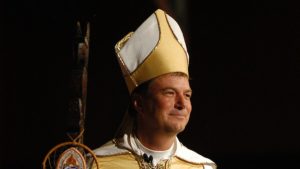
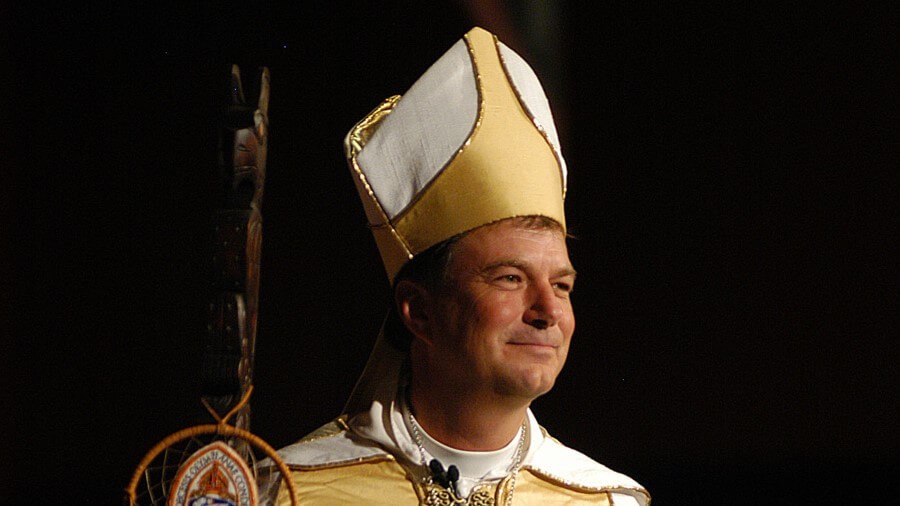
    Bishop Greg Rickel wearing cope and mitre

    Bishop Greg Rickel statement on the verdict in the Ahmaud Arbery case

    Today, the jury in the Ahmad Arbery trial has returned its verdict and found the men responsible for Arbery’s death guilty on nearly all counts. While this verdict does not, as our Presiding Bishop has said, bring Ahmaud Arbery back to his family and loved ones, it does provide a measure of justice from a system that has too often denied justice to our BIPOC siblings.

    I echo the prayers and pleas of our Presiding Bishop and the Episcopal and Lutheran bishops of Georgia in their statements following the verdict [below]. I commend them to you. The joint statement from the Georgia bishops is especially good and also provides some very good resources, including a link to the resource library of the Center for Racial Healing.

    There is much work still to be done in reforming our justice system, and quite frankly much of that work is inside ourselves, for as many of you have reminded me over this past week, we humans make up, implement, and oversee this system. Much work remains to be done in each of our hearts to dismantle our own racism and bring about healing and reconciliation. When this happens I do believe any unbalanced and/or unjust system can and will change. I most definitely include myself as one that continues to need work and most likely will the remainder of my life. I ask you to pray for everyone involved in this case, their families, and for the repose of the soul of Ahmaud Arbery.

    Bishop Rickel’s Statement on the Verdict in the Ahmad Arbery Case. The Rt. Rev. Gregory Rickel is the Bishop of the Diocese of Olympia.

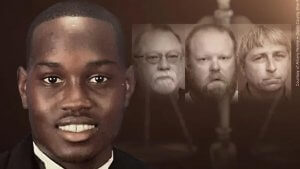
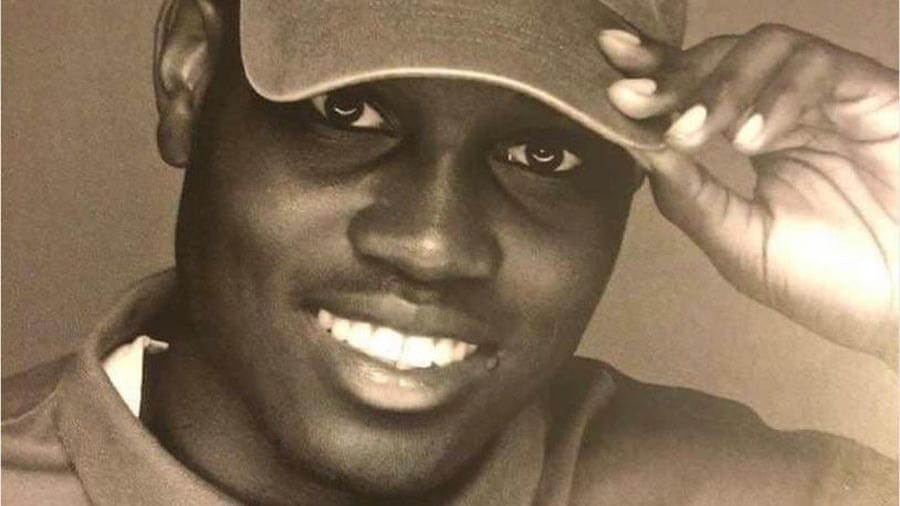
    Ahmaud Arbery shown with his murderers. Photos courtesy of Ahmaud family and Glynn County Sheriff's Office

    Episcopal and Lutheran bishops in Georgia respond to the verdict in the McMichaels-Bryan trial

    The jury charged with handing down a verdict in the case of three men accused of murder for their roles in the death of Ahmaud Arbery issued its decision today finding Travis McMichael guilty of malice murder and other charges, Gregory McMichael guilty of felony murder and other charges, and Roddie Bryan guilty of felony murder and other charges. We give thanks for the dedicated work of the judge and jurors who served in a charged atmosphere with intense public scrutiny. Any verdict arrives too late to offer true justice in this case. Ahmaud Arbery is dead, and the court cannot return him to his family. Nonetheless, this moment is an important one.

    We prayed for the court to bring earthly justice and the court has acted. But it took a public outcry and the release of video of the incident to force the system into action. The three men who are now convicted of crimes were initially shielded from facing their accusers in court. Until we can bring equity to the system that initially protected them, the rest of us will not have done what we can to create the just society for which we long. Our country has not dealt with the racism built into the system at its founding and perpetuated until this day. Living into our faith means addressing directly any sin we see in our lives and in our communities. Divisions around the human-made concept of race are an offense against our faith which teaches that all people are made in God’s image and likeness. Jesus taught us to love God and love our neighbor as ourselves. Through his parable of the Good Samaritan, Jesus made it clear that all are our neighbors. Any racial divide breaks the heart of God.

    One bright spot of hope we have seen emerge following Ahmaud’s tragic death has been the interfaith group of clergy in Glynn County. Their clarion call for justice after the video surfaced was critical in getting attention to this case. They followed this call by engaging in candid conversations that drew them together even as other forces could have deepened divisions. Participants included clergy from all five Episcopal Churches in the county and those of many other denominations, as well as leaders of Jewish and Muslim congregations. News stories have often quoted the clergy who were consistently engaged, offering a non-anxious presence on the courthouse grounds. They have witnessed to the dream of God: all of us becoming beloved community, not divided by ethnicity, but united in our common humanity. We know that long after the cameras and reporters are gone, the clergy in Glynn County will still be working together toward that dream.

    We hope not just for good to overcome evil, but for God to redeem even the worst tragedies and the gravest injustices. While the court has acted, the work of healing and justice remains. Maya Angelou said, “Do the best you can until you know better. Then when you know better, do better.”

    The Episcopal Diocese of Georgia offers the following resources: ​​Resources for Racial Healing and Justice.

    The Southern Synod of the Evangelical Lutheran Church in America offers resources: Racial Justice.

    The Episcopal Diocese of Atlanta’s resources can be found at the Absalom Jones Center for Racial Healing: Our Virtual Resource Library.

    It does not take an evil person to do an evil act. Murder is evil. Ahmaud’s killing was evil. But we need to guard against demonizing anyone or denying their basic humanity. The accused have been convicted. They will serve their sentences and need our prayers that they may be awakened to repentance. In this, as with all of us, we pray that God will bring all who are guilty to repentance and amendment of life and give us all hope for the future. In that spirit, we offer this prayer:

    Eternal God, we give thanks for the judge and jurors charged with bringing earthly justice in the death of Ahmaud Arbery. Be with the Arbery family and all in the Brunswick and Glynn County Community as they seek further healing. Be with Gregory, Travis, and Roddie and their families as they serve their sentences and work toward their own repentance. Be with all of us as we seek repentance and healing for ourselves, one another, and our communities. Give us all the grace to hunger and thirst for your righteousness that we may work together to become the beloved community to which you call us. This we ask for the sake of your Son our Savior, Jesus Christ, who with you and the Holy Spirit lives and reigns now and forever. Amen.

    May God grant us grace to see the healing needed in our lives, our families, and our communities.

    In Christ,

    The Rt. Rev. Frank S. Logue, Bishop of the Episcopal Diocese of Georgia
    The Rt. Rev. Rob C. Wright, Bishop of the Episcopal Diocese of Atlanta
    The Rev. Kevin L. Strickland, Bishop of the Southeastern Synod, Evangelical Lutheran Church in America

    Episcopal and Lutheran bishops in Georgia respond to the verdict in the McMichaels-Bryan trial

    Early morning mist in the Memorial Garden at Church of the Redeemer

    Church of the Redeemer

    Church of the Redeemer: Worshiping God, living in community, and reaching out to the world around us. We are an Episcopal Church serving north King County and south Snohomish County, Washington. As you travel your road, go with friends walking the way of Jesus at Redeemer.

    Church of the Redeemer is at 6220 Northeast 181st Street in Kenmore, Washington. The campus is a short distance north of Bothell Way, near the Burke-Gilman Trail. The entrance looks like a gravel driveway. The campus is larger on the inside than it is on the outside. And we managed to hide a large building on the side of a hill that is not easily seen from the street.

    The Episcopal Church welcomes you.
  • Bishop Rickel’s Statement on the Kyle Rittenhouse Verdict

    Bishop Rickel’s Statement on the Kyle Rittenhouse Verdict

    Bishop Rickel’s Statement on the Kyle Rittenhouse Verdict
    Declaración del Obispo Rickel sobre el veredicto en el caso de Kyle Rittenhouse

    Dear Ones,

    I was saddened to learn of the verdict today in the trial of Kyle Rittenhouse, the young man who traveled to Kenosha, Wisconsin, last year and fatally shot two people, seriously injuring a third. The incident brought to the surface many of the issues that our country wrestles with—and all-too-often attempts to ignore—around racial justice, white vigilantism, and gun violence. Rittenhouse came to Kenosha, heavily armed, as part of a mob of white men to stop the protests for racial justice and took two lives. Under the auspices of protecting property, he came prepared to commit violent acts and did just that. As the prosecutor stated, there is a difference in defending yourself from violence perpetrated against you, and you creating the situation in order for you to do it—or more specifically, “You lose the right to self-defense when you’re the one who brought the gun, when you are the one creating the danger, when you’re the one provoking other people.”

    As the verdict came in today, it has been widely observed that we have two legal systems in this country—one for white men, and one for everyone else. Many have suggested that if Rittenhouse had been Black, the verdict would have been drastically different. I would go further—when you watch the videos of that night, I would say if Rittenhouse had been Black, he most likely would not have come out of that night alive. A young white man brazenly carrying an automatic weapon through city streets was virtually ignored by law enforcement. Had it been a Black man, I do believe the result would be drastically different.

    In these same days we are witnessing the trial of the ambush of Ahmaud Arbery, a Black man, in Brunswick, Georgia. And even with all the accused admitting that Arbery was unarmed and ultimately not threatening them, and all evidence pointing to Arbery trying to flee the scene unarmed, this case hangs in this unjust balance as well. In both cases, we see self-appointed vigilante’s taking justice into their own hands. And folks, if it can happen to these folks, it can just as easily happen to any of us.

    But, the point is, mostly, it doesn’t. Especially if we are white, if we are privileged, if we have enough money to defend ourselves. We simply must do better, and we must be better.

    This comes only one day after a judge in New York “prayed” about the sentencing of a young white man who had pleaded guilty to charges rape, sexual abuse, and sexual harassment and only gave the man probation because he said that prison time “wasn’t appropriate” (Judge ‘Prayed’ About It and Decided That Prison Time for Admitted Rapist of Teen Girls ‘Isn’t Appropriate’).

    We know that incarceration rates for Black Americans is five times the rate of white Americans, and for Latin Americans it is 1.3 times higher (The Color of Justice: Racial and Ethnic Disparity in State Prisons). According to the ACLU, women who kill their abusers will spend an average of 15 years in prison, while men who kill their spouses spend two to six years in prison (Women Serve Longer Prison Sentences After Killing Abusers: When men kill the women they’re abusing, statistics say they get out sooner). Men from Indigenous communities are four times more likely to be incarcerated than white men, while Indigenous women are six time more likely (Indigenous Communities and Mass Incarceration).

    Justice is supposed to be blind, but time and time again, our justice system has been proven to favor white men. It is severely out of balance.

    I pray for all involved in this case, including Kyle Rittenhouse. I pray for all the victims of gun violence. I pray for our country and for our justice system. There is so much that needs to change. Let’s engage and act so that we may see a more just system going forward. To get involved in making our criminal justice system equitable, you can see what steps The Episcopal Church’s Office of Government Relations recommends here: Get Involved with Criminal Justice Reform.

    Blessings,

    +Greg

    Bishop Greg Rickel

    Bishop Greg Rickel

    The Rt. Rev. Gregory H. Rickel was elected bishop on May 12, 2007, and became the eighth Bishop of Olympia in September 2007. He embraces radical hospitality that welcomes all, no matter where they find themselves on their journey of faith. He envisions a church that is a safe and authentic community in which to explore God’s infinite goodness and grace as revealed in the life and continuing revelation of Jesus Christ.

    Diocese of Olympia

    The Episcopal Diocese of Olympia

    The Episcopal Diocese of Olympia traces its history to the establishment of the Missionary Jurisdiction of the Oregon and Washington Territories in 1853. We are also known as the Episcopal Church in Western Washington.

    Admitted by General Convention in 1910, the Diocese of Olympia is made up of more than 26,000 Episcopalians in more than 100 worshiping communities through Western Washington. Our geographic area stretches south from Canada to Oregon and west from the foothills of the Cascade Mountains to the Pacific Ocean.

    Through worship we do the following:

    • Affirm our faith
    • Pray together
    • Reconcile together
    • Share peace and thanksgiving together
    • Gain strength and renewal through Eucharist
    • Prepare ourselves to minister to the world

    We share hope in God’s incredibly extensive grace to forgive all repentant people.

    Our congregations cover a whole range of sizes and stages of development. Several affiliated institutions and numerous outreach and social justice ministries as well as a number of multicultural ministries are supported by the whole diocese.

    Church of the Redeemer

    Church of the Redeemer: Worshiping God, living in community, and reaching out to the world around us. We are an Episcopal Church serving north King County and south Snohomish County, Washington. As you travel your road, go with friends walking the way of Jesus at Redeemer.

    Church of the Redeemer is at 6220 Northeast 181st Street in Kenmore, Washington. We are a short distance north of Bothell Way, near the Burke-Gilman Trail. The entrance looks like a gravel driveway. The campus is larger on the inside than it is on the outside. And we managed to hide a large building on the side of a hill that is not easily seen from the street.

    The Episcopal Church welcomes you.
Participants in the pageant on Sunday, January 4, 2025, should be present by 9:30 am. 

2nd Sunday in Lent (Year A), March 1, 2026. Services at 8:00 am (no music) and 10:30 (music). Christian education for children and adults at 9:15 am. 

Episcopal Church of the Redeemer
Privacy Overview

Cookie information is stored in your browser and performs functions such as recognizing you when you return to our website and helping our team to understand which pages of the website are visited. We aren't using cookies to determine your web browsing habits, but others can.