
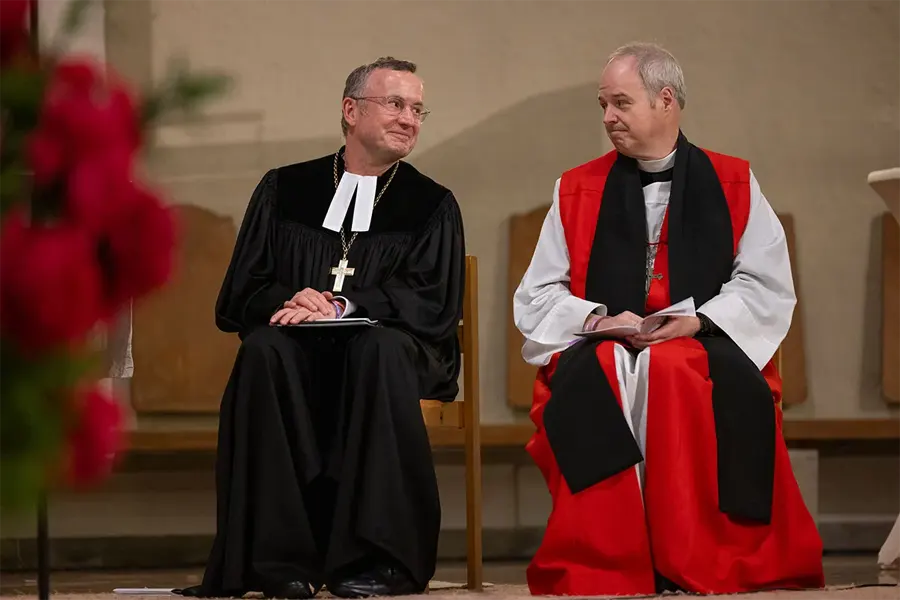
[Episcopal News Service] Presiding Bishop Sean Rowe and Bishop Christian Kopp, head of the Evangelical Lutheran Church in Bavaria, signed the Augsburg Agreement on June 7 following a Pentecost-eve Eucharist at St. Matthew’s Lutheran Church in Munich, Germany.
The full-communion agreement, also referred to as “Sharing the Gifts of Communion,” was a decade in the making, with former Presiding Bishop Katharine Jefferts Schori and former head of the Bavarian church, Bishop Heinrich Bedford-Strohm, starting the conversation in 2013 so “that our two churches might find a path toward deeper relationship.”
The agreement establishes “a new foundation for ecumenical relationships between Lutheran and Anglican Churches,” according to the text.
Sermon about the agreement
In his sermon, the presiding bishop referenced the Holy Spirit – who appeals to people in their diversity who speak different languages and come from different places – and who comes as an advocate to bind human beings to one another and “prove wrong” the ways of the world that seek to divide rather than unite them.
“Today, as we sign the declaration of full communion between the Evangelical Lutheran Church in Bavaria and The Episcopal Church, we too are proving wrong the ways of the world. We have worked long and hard to finalize this agreement, and along the way we have reached across our differences to deepen our appreciation of one another and the ways we have served God over time,” Rowe said.
“Our theologies may have differed over the course of our histories, but we are united in our desire to offer to the world a model of leadership that is, in today’s world, deeply countercultural. We share the belief that we must place the needs of the most vulnerable, the rejected, and the marginalized at our center, and that this gospel imperative must shape the way we lead and the choices we make as institutions.”
Ecumenism, by definition, implies that Christians form relationships and work together in common mission and toward unity. Full-communion partnerships allow members of both churches to receive the sacraments in the other body … allow for interchangeability of clergy, allowing them to officiate at services and celebrate the sacraments with equal authority in either church. Since the 1970s, the Episcopal and Lutheran churches in Bavaria have been worshipping and praying together. The agreement marked a meaningful step forward between the two churches, formalizing the longstanding relationship.
“Christians live together in a worldwide community in the name of Jesus Christ. This community needs vivid signs of interaction, fellowship and mutual commitment. I’m very glad that our churches are currently living this communion in such a lively and respectful way,” Kopp told ENS. “I’m deeply moved that we are now, and will continue in the future, to share the Holy Supper together. I’m also eagerly looking forward to everything we will do together in the future — for peace in our countries and for the visible impact of the Christian faith in the lives of many people around the world.”
Bavaria is one of 16 states, the largest geographically, in Germany. The Evangelical Lutheran Church in Bavaria is part of the larger Protestant Church in Germany. The Convocation of Episcopal Churches in Europe has 23 congregations, parishes and missions across Europe. In Bavaria, it has one congregation in Munich, Church of the Ascension, and two smaller missions, St. Boniface in Augsburg and St. James the Less in Nuremberg. The missions meet in Lutheran churches.
Full communion agreements
In The Episcopal Church, full communion agreements require changes to its canons (Title 1, Canon 20, Section 1). The 81st General Convention adopted Resolution A037 authorizing the agreement. The Evangelical Lutheran Church in Bavaria’s synod adopted its resolution in 2022.
“Agreements like the one we have signed with our Bavarian Lutheran siblings are hopeful signs of unity as we witness so much fragmentation around us. In a time when our circles of belonging have become increasingly like-minded, Christians are called to a John 17 model of unity for the sake of the Gospel,” said the Rev. Margaret Rose, ecumenical and interreligious deputy to the presiding bishop. “I look forward to how we will share our gifts of diversity, build bridges and work together for the flourishing of all.”
The Episcopal Church has full-communion agreements with the following:
- Evangelical Lutheran Church in America
- The Moravian Church-Northern and Southern Provinces
- The Mar Thomas Syrian Church of Malabar, India
- The Old Catholic Churches of the Union of Utrecht
- The Philippine Independent Church
- The Church of Sweden
- The Evangelical Lutheran Church in Canada
Although the conversation between the Episcopal and the Bavarian churches began in 2013, the dialogue became official in 2018. The key question for this ecumenical relationship was the theology of ordained ministry, and particularly, the role of bishops in succession.
The presence of “the historic episcopate, locally adapted in the methods of its administration” is one of the requirements outlined in the Chicago-Lambeth Quadrilateral, which is the framework for how The Episcopal Church and other denominations can reach full communion.
During an online hearing before the 81st General Convention voted to adopt the resolution authorizing the full-communion agreement, theologian Oliver Schuegraf, an honorary canon theologian of Coventry Cathedral in England who helped draft the Augsburg Agreement, described the episcopate in the Lutheran body as “historic and an evangelical”; historic, in that it is passed down over time, and evangelical, in which preaching the Gospel has taken place unbroken from generation to generation. “It is absolutely clear that we have episcopé” he said, although it is exercised both by bishops and other church structures.
The agreement called on existing documents, like “Porvoo Common Statement,” “Called to Common Mission,” and the “Waterloo Declaration,” and was adapted to Bavaria and the German context. Before the 2024 General Convention vote, the 79th General Convention approved the dialogue.
“Churches rarely make decisions quickly. The Episcopal Church’s full-communion agreement with the Evangelical Church in Bavaria is a happy exception,” Jefferts Schori told ENS.
“In spite of distinct geographic and linguistic differences, we have come to agreement and pledged to work together for the good of God’s people. Although ecumenical conversations began in the Reformation some 500 years ago, the initiative to seek this full-communion agreement bore fruit in about 15 years. Give thanks for the focused and clarifying work of the ecumenists in each church, who have helped us all to see God’s ever-new creative possibilities!”
-Lynette Wilson is a reporter and managing editor of Episcopal News Service. She can be reached at lwilson@episcopalchurch.org.
Church of the Redeemer
Church of the Redeemer: Worshiping God, living in community, and reaching out to the world around us. We are an Episcopal Church serving north King County and south Snohomish County, Washington. As you travel your road, go with friends walking the way of Jesus at Redeemer.
Church of the Redeemer is at 6220 Northeast 181st Street in Kenmore, Washington. The campus is a short distance north of Bothell Way, near the Burke-Gilman Trail. The entrance looks like a gravel driveway. The campus is larger on the inside than it is on the outside. And we managed to hide a large building on the side of a hill that is not easily seen from the street.
The Episcopal Church welcomes you.