
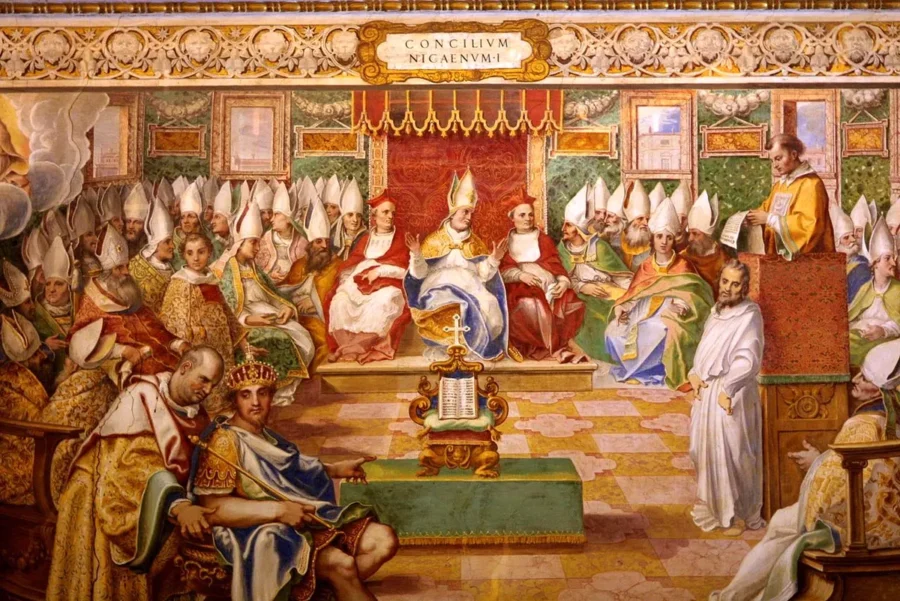
[Episcopal News Service] When some 200 bishops and the hundreds of others who accompanied them arrived at the town of Nicaea in modern-day Turkey in 325, they had before them two tasks:
- Define Jesus’ nature in relationship to God.
- Establish a common date when Christians around the world would celebrate Easter.
A variety of 1,700th anniversary resources are available:
What happened at Nicaea
While the latter task when to celebrate Easter still is part of ongoing discussions, the assembled bishops at the first ecumenical council of the Christian church hammered out a description of Jesus. 1,700 years later, that description of Jesus remains part of the Nicene Creed. The Episcopal Church says that a statement of faith on Sundays and other major feast days .
What the bishops did was to define “what we mean when we say God,” the Rev. Kara Slade, told Episcopal News Service. She is a theologian who is part of the Episcopal chaplaincy at Princeton University, told Episcopal News Service.
And just as each sport has a governing body that sets the rules, she said the Council of Nicaea established “the language for what we as Christians, ecumenically, mean when we say God, as Father, Son and Holy Spirit.” It also is a recitation of “the Good News, of who God is for us.”
Marking the anniversary in the Episcopal Church
Events marking the 1,700th anniversary have taken place this year across The Episcopal Church. For example, on January 19, 2025, the Cathedral of St. John the Divine in New York City helped kick off events marking the anniversary year with an Evensong service. The then-dean, the Very Rev. Patrick Malloy, told ENS the church “was chartered specifically to focus on Christian unity” and thus was selected for a service during the annual Week of Prayer for Christian Unity.
More recently, Slade offered a lecture on the creed at St. Paul’s Cathedral in Oklahoma City, Oklahoma, on June 15, 2025, part of an ongoing series the cathedral is presenting, with additional lectures later this year. Oklahoma Bishop Poulson Reed also offered his own reflections.
Wisconsin Bishop Matthew Gunter offered a series of written teachings about the Nicene Creed to his diocese in June 2025.
Why the Council of Nicaea happened
Back in the fourth century, the Roman Emperor Constantine, who only 12 years earlier had become a Christian, called, paid for and attended the Council of Nicaea. The Rev. Rebecca Lyman, professor emerita of history at the Church Divinity School of the Pacific in Berkeley, California, told ENS by email that he did this “to ensure the end of Christian quarreling in the Eastern [Roman] Empire and thus pray for the stability of his reign.”
The quarrel centered on how the church should described the relationship between Jesus the Son and God the Father, especially considering its inheritance of the Jewish belief in monotheism. Arius, a presbyter in Alexandria, publicly preached that God created Jesus, while stating that he was of a different nature than any other part of creation. Many others, who objected to his description of Jesus, considered Arius a heretic.
Lyman, in entries she wrote about the Council of Nicaea for the St. Andrews Encyclopedia of Theology, noted, “After weeks of negotiation, the council succeeded in producing a common theological statement to bring unity—or at least stabilize conflict—among the bishops.”
Results of the Council of Nicaea

That statement, which forms much of today’s Nicene Creed, described Jesus as “the Son of God, begotten from the Father, only begotten, that Is from the substance of the Father; God from God, Light from Light, true God from true God, begotten, not made, consubstantial with the Father…”.
But, as Lyman wrote to ENS, “It took 50 years and several theological moves to have the creed (with slight modifications) accepted by the Eastern and Western church.”
What the bishops didn’t say much about was the Holy Spirit, since at that time it wasn’t as debated as the nature of Jesus. The second ecumenical council in 381, the Council of Constantinople, added language about the Spirit and its co-divinity with the Father and Son to the creed. It sometimes now is referred to as the Nicene-Constantinopolitan Creed.
What resulted in the fourth century from these two councils, Lyman said, was “the painful construction of the doctrine of the Trinity.”
In his “Commentary on the American Prayer Book,” the late Rev. Marion Hatchett said the first time the Nicene Creed was used in connection with the Eucharist likely was in the late fifth or early sixth century.
Filioque (and the Son) added to the creed
In the sixth century, what would become a rift between the Eastern church based in Constantinople, and the Western church based in Rome, took place with the insertion of a statement about the Holy Spirit into the creed by the Council of Toledo, Spain, in 589. Until then, the creed stated that the Holy Spirit “proceeds from the Father.” The council inserted “and the Son” after the word “Father,” an addition known today as the filioque clause. The Western church accepted this insertion. The Eastern church does not recognize it.
The council did establish a single date for Easter—the first Sunday after the full moon following the spring equinox. However, that unanimity was in doubt after 1582. Pope Gregory XIII created a new calendar, called the Gregorian calendar in his own honor. That calendar adjusted the Julian calendar to correct how it counted the length of a year. Western churches adopted this Gregorian calculation. Many Eastern churches kept to the old Julian calculation. This can result in Easter varying between the two dates by as much as five weeks.
The impact of the Nicene Creed today
Slade said that the creed remains important for Episcopalians because “it gets right to the heart of what we’re doing as Christians. It’s the summary of the Christian faith.”
She is aware that for many, reciting the Nicene Creed may not hold their full attention. “Maybe you’re still thinking about the sermon” that comes right before it. “Maybe you’re thinking ahead to the Eucharist or to who you have to say hello to at the Peace.”
But paraphrasing the theologian Augustine, she said, “When you say your creed, render it back to God.” Doing that gives worshipers a chance to reaffirm it as “a statement of Good News” and an acknowledgement of who God is.
Importance for unity
The Rev. Margaret Rose, The Episcopal Church’s ecumenical and interreligious deputy to the presiding bishop, told ENS that the Nicene Creed was a topic of conversation at the June meeting of the World Council of Churches Central Committee, of which she is a member, in Johannesburg, South Africa.
One of the things they discussed was who wasn’t at the Council of Nicaea. “There were no women,” Rose noted, even though Paul in Galatians 3:28 “said in Christ, ‘there is neither male nor female.’”
The creed remains important to Christians today, Rose said, “because it was about the unity of the church.” For her, in defining the nature of God as a relationship between Father, Son and Holy Spirit, it shows “the Trinity as community and is a model for who we are together.”
Basis of unity
When The Episcopal Church was establishing how it would engage in relationships with other churches, the House of Bishops in 1886 developed a four-fold framework for ecumenical discussion, with one of the elements being acceptance of “the Nicene Creed as the rule of faith.” When the Lambeth Conference of 1888 reaffirmed that framework, it became known as the Chicago-Lambeth Quadrilateral.
The Episcopal Church and eight partner churches has this as the basis of full-communion relationships between them. This includes the latest, the Evangelical Lutheran Church in Bavaria, signed with the Episcopal Church on June 7, 2025.
Common date for Easter
The question of one Easter date for all Christians is again under discussion. This is, in part, because the dates for Eastern and Western Christians happened to coincide in 2017 and in 2025). They will again in 2028, 2031 and 2034.
Earlier this year, the late Pope Francis reaffirmed the Roman Catholic Church’s willingness to accept a proposal for a common Easter date for all Christians.
Filioque clause (and the Son)
In 1988, the Lambeth Conference attempted to address the centuries of disunity caused by the filioque clause when it recommended to provinces of the Anglican Communion omit the clause in future liturgical revisions that include the Nicene Creed.
The Episcopal Church’s 1994 General Convention adopted a resolution to omit that the clause “at the next revision of the Book of Common Prayer.” Recent actions by General Convention make such a revision unlikely in the near future.
In 2018, General Convention authorized creation of the Task Force on Liturgical and Prayer Book Revision, and the 2022 convention directed the Standing Commission on Liturgy and Music “to continue the work of liturgical and Prayer Book revision.”
The most recent General Convention in 2024 adopted a constitutional change that defines the Book of Common Prayer to include authorized liturgical materials that aren’t printed in prayer books in use.
The Book of Common Prayer has not undergone a full-scale revision since 1979. That process, to revise the 1928 version, began in 1967.
— Melodie Woerman is an Episcopal News Service freelance reporter based in Kansas.
Church of the Redeemer
Church of the Redeemer: Worshiping God, living in community, and reaching out to the world around us. We are an Episcopal Church serving north King County and south Snohomish County, Washington. As you travel your road, go with friends walking the way of Jesus at Redeemer.
Church of the Redeemer is at 6220 Northeast 181st Street in Kenmore, Washington. The campus is a short distance north of Bothell Way, near the Burke-Gilman Trail. The entrance looks like a gravel driveway. The campus is larger on the inside than it is on the outside. And we managed to hide a large building on the side of a hill that is not easily seen from the street.
The Episcopal Church welcomes you.