
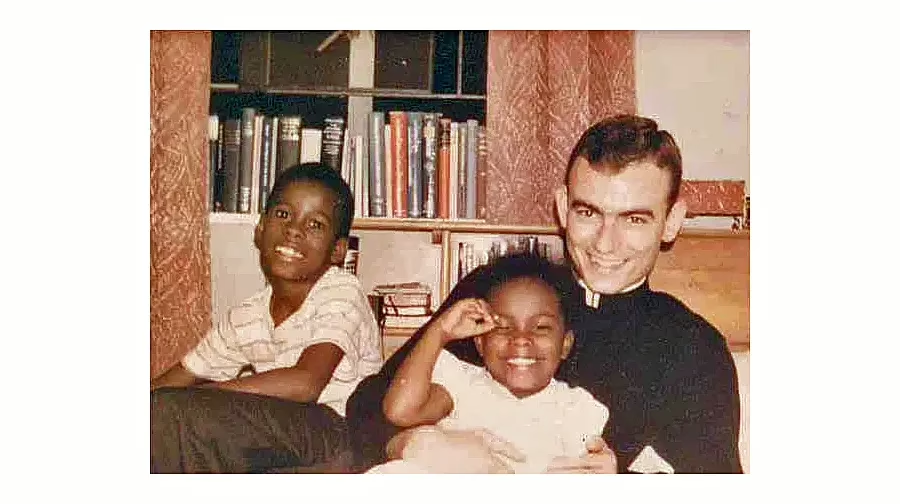
[Episcopal News Service — Dyer, Indiana] Nearly 60 years after Jonathan Myrick Daniels was killed by a white special deputy sheriff from Lowndes County, Alabama, hundreds of Episcopalians – including clergy, seminarians and lay people – and civil rights activists will gather and march in Hayneville to commemorate the Episcopal seminarian and other martyrs of the Civil Rights Movement in the state.
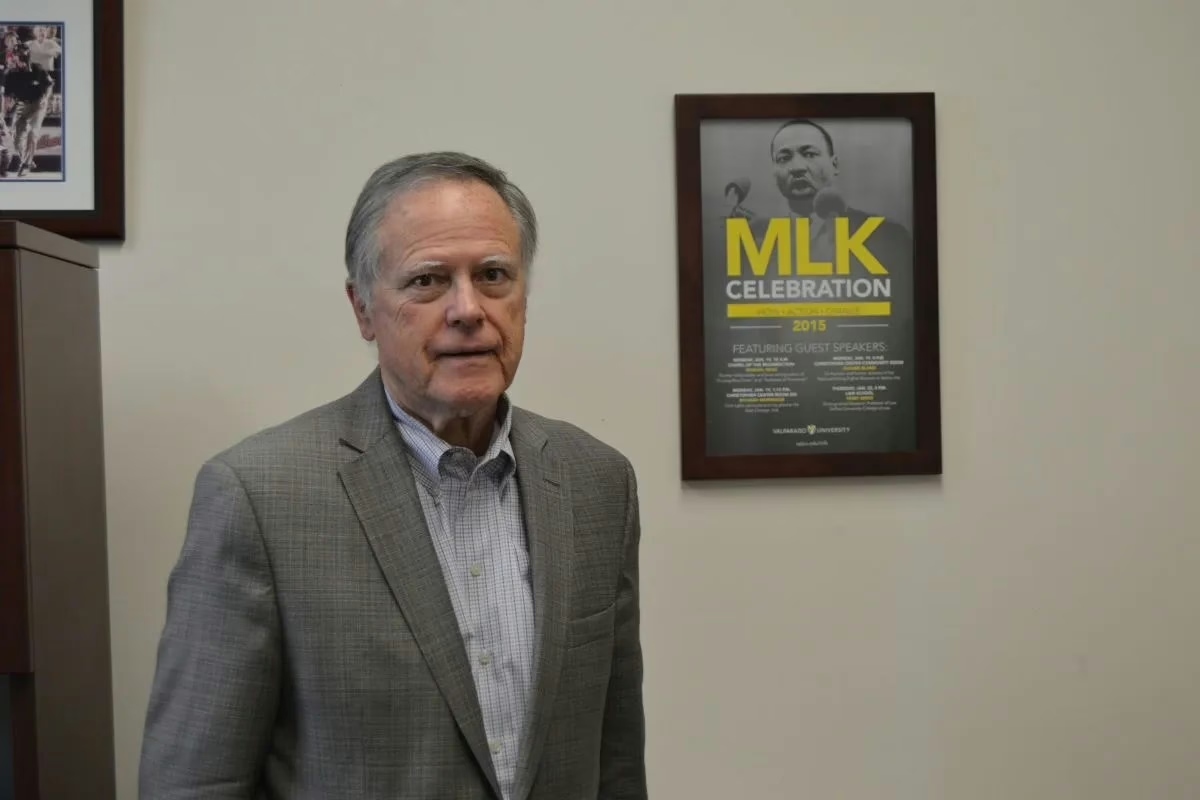
“Jonathan’s actions were very much an act of faith, there was no doubt about it,” Richard Morrisroe, a white former Catholic priest from Chicago, Illinois, who witnessed Daniels’ martyrdom, told Episcopal News Service during an August 5, 2025, in-person interview here.
Like Daniels, Morrisroe was a civil rights activist. He walked with the Rev. Martin Luther King Jr. in Chicago and in Selma. Today, Morrisroe is 86 years old and lives with his wife, Sylvia Morrisroe, in East Chicago, Indiana.
Pilgrimage to Hayneville
Since 1998, the Diocese of Alabama has honored Daniels by organizing an annual pilgrimage to Hayneville with support from the Pensacola, Florida-based Diocese of the Central Gulf Coast. The pilgrimage usually takes place on or around Daniels’ feast day, August 14 in The Episcopal Church.
“Even before the pilgrimage started, people from the Southern Poverty Law Center’s headquarters in Montgomery and locals did different things to honor Jonathan,” Morrisroe said. “The pilgrimage in the way that it is now is a very good thing.”
August 9, 2025, is the scheduled date for this year’s pilgrimage. However, a group of youth pilgrims will gather the evening before at the Episcopal Church of the Ascension in Montgomery.
Also, some pilgrims from Episcopal Divinity School will gather the evening before at St. John’s Episcopal Church in Montgomery for a special dinner. Ruby Sales, the person Daniels shielded from gunfire, will be the guest speaker. Morrisroe also was scheduled to speak at the dinner, but he’s unable to travel due to health issues.
After the dinner, Episcopal Divinity School will host the public “Walk With Me” vigil commemorating the 60th anniversary of Daniels’ martyrdom at St. John’s. The Rev. Kelly Brown Douglas, canon theologian of Washington National Cathedral, will speak. Ashley M. Jones, Alabama’s poet laureate, also will speak at the vigil.
On the 9th, the pilgrims will gather at the Lowndes County Courthouse Square and march to the following:
- The jail where Daniels, Morrisroe, and other arrested civil rights activists were held.
- The site where Daniels was later killed.
- The courtroom where his killer was acquitted.
After the procession, the pilgrims will gather inside the courthouse for a worship service. Former Presiding Bishop Michael Curry will preach.
Daniels’ martyrdom shaped Morrisroe’s life
Morrisroe – who also was shot by the same man who killed Daniels – said his shooting and Daniels’ martyrdom have greatly shaped his life.
“We knew going in that there was a risk of violence, but I never expected to actually get shot and to witness someone getting killed being part of the Civil Rights Movement,” Morrisroe said.
What happened that day
Daniels, a white 26-year-old originally from Keene, New Hampshire, was a seminarian at the Episcopal Theological School in Cambridge, Massachusetts, which today is Episcopal Divinity School based in New York City. While a seminarian, he was actively involved in civil rights work. In 1965, he met Morrisroe at the ninth annual Southern Christian Leadership Conference in Birmingham, which took place August 9-13.
After the conference, on August 14, Daniels and Morrisroe joined a group of protesters in Fort Deposit to picket whites-only stores. Following arrest and transport in a garbage truck, all protestors went to a jail without air conditioning in Hayneville, less than 25 miles southwest of Montgomery.
After release from jail on August 20, Daniels and Morrisroe accompanied two Black teenage protesters, Sales and Joyce Bailey, to nearby Varner’s Cash Store to purchase sodas.
“It was late August in Alabama. I remember it was very, very hot that day,” Morrisroe said.
As the group neared the store, Tom Coleman confronted them and attempted to shoot the teenagers. Daniels shielded Sales from Coleman’s shotgun blast, taking the fatal wound himself. Morrisroe grabbed Bailey and they ran off together. He survived his shot in the back. Morrisroe then spent several years relearning how to walk and coping with post-traumatic stress disorder.
What happened to Morrisroe
“I remember going to Montgomery Baptist Hospital in a hearse. Jonathan was below me, lying dead, and I was alive in a kind of gurney or something,” Morrisroe said. “They dropped me off at the emergency room, and I waited there for about, maybe an hour-and-a-half in the hearse without much attention. …A Catholic priest from that area came in and anointed me and convinced a military doctor – Dr. Charles Cox – to put together a group of six doctors. They spent 11 hours keeping me alive as they removed the bullet that had landed in my spine.”
Morrisroe eventually transferred to a hospital in Oak Park, Illinois, where he remained hospitalized until February 1966. While hospitalized, he missed Coleman’s trial at the Lowndes County Courthouse. An all-white grand jury acquitted Coleman of manslaughter charges.
“The closest I ever got to interacting with Tom Coleman since the shooting was when my daughter went down to Lowndes County with some nuns who had an outreach ministry not too far from Hayneville,” said Morrisroe. He left the priesthood in 1972 after years of therapy recovering from the injuries he suffered from Coleman’s gunshot. Then Morrisroe worked in city planning and in academia until he retired. “Some people pointed out his house to her. She was tempted to knock on his door and identify herself, but she never did that. And then he died a couple of years later.”
Daniel’s addition to the Episcopal calendar
At the 1991 General Convention in Phoenix, Arizona, Morrisroe testified in favor of Daniels’ sainthood in front of the House of Bishops. Typical observance of feast days is on the saints’ death anniversaries. Morrisroe said August 14 – the day of Daniels’ arrest – was designated Daniels’ feast day instead of the 20th because August 20 is already observed as the Feast of St. Bernard of Clairvaux.
Morrisroe told ENS that when he met Daniels at the conference, he didn’t expect their lives would be forever changed in the coming days.
“Everything Daniels did was rooted in his faith – I can’t stress it enough.” Morrisroe said.
Shireen Korkzan is a reporter and assistant editor for Episcopal News Service. Reached her at skorkzan@episcopalchurch.org.
Church of the Redeemer
Church of the Redeemer: Worshiping God, living in community, and reaching out to the world around us. We are an Episcopal Church serving north King County and south Snohomish County, Washington. As you travel your road, go with friends walking the way of Jesus at Redeemer.
Church of the Redeemer is at 6220 Northeast 181st Street in Kenmore, Washington. The campus is a short distance north of Bothell Way, near the Burke-Gilman Trail. The entrance looks like a gravel driveway. The campus is larger on the inside than it is on the outside. And we managed to hide a large building on the side of a hill that is not easily seen from the street.
The Episcopal Church welcomes you.