
Floods began impacting western Washington in the second week of December 2025. Episcopal Relief & Development quickly engaged staff at Diocesan House to ask “How can we help?”
Raising aid
Within the first 48 hours, diocesan staff members Canon Cristi Chapman and Michael Seewer worked up a plan with Race Hodges of Episcopal Relief and Development. By the following Monday, the Diocese of Olympia received a $20,000 grant to support relief efforts in western Washington. The diocese made this money available to anyone in Western Washington affected by the floods, whether Episcopalian or not.
As people communicated impact from the floods to the Diocese, other donations came pouring in. Current total is just under $14,000, making the total amount of relief money to just under $34,000. Additional money is still being received.
In working with Episcopal Relief, diocesan staff identified a strategy. To get the money into the hands of those who need it quickly, a Flood Impact Form was created.
In the days that followed, the impacts of the flood continued to change on a daily and sometimes hourly basis. Michael Seewer began working with clergy in the regions affected. The diocese shared contact information of those who had requested support with the local clergy. Those clergy assembled quickly to begin contacting affected families and issuing gift cards.
Where people need help
The damage and need for relief communicated to the diocese has been widespread. It ranges along the I-5 corridor from as far south as Lewis County to as far north as Whatcom County.
Lewis County
“In the eastern part of Lewis County, [we are aware of] 11 families impacted by the flooding who are in the Red Cross Program, plus at least 10 more families who are living in their flooded RVs,” said the Rev. Kay Flores, rector of St. Timothy, Chehalis.
Whatcom County
In Whatcom County, the Rev. Dr. Jane Maynard, priest in charge of Christ Church, Blaine, has been working with the Whatcom Long Term Recovery Group to get assistance to as many of the 800 families on their list as possible.
Skagit and Snohomish Counties
We have received reports of some of the areas of greatest need are along the Skagit and Snohomish Rivers. Flooding affected communities from Mt. Vernon to Hamilton along the Skagit River. Communities affected along the Snohomish River are from Snohomish and Monroe.
In Mt. Vernon, the Rev. Dennis Taylor, deacon at St. Paul’s, Mt. Vernon, has been assisted by a team of volunteers from the parish. They assist in getting relief money in the hands of dozens of families along the Skagit River. When reaching out to the people who contacted the Diocese for assistance, those families often shared information about other families they knew who also could use assistance.
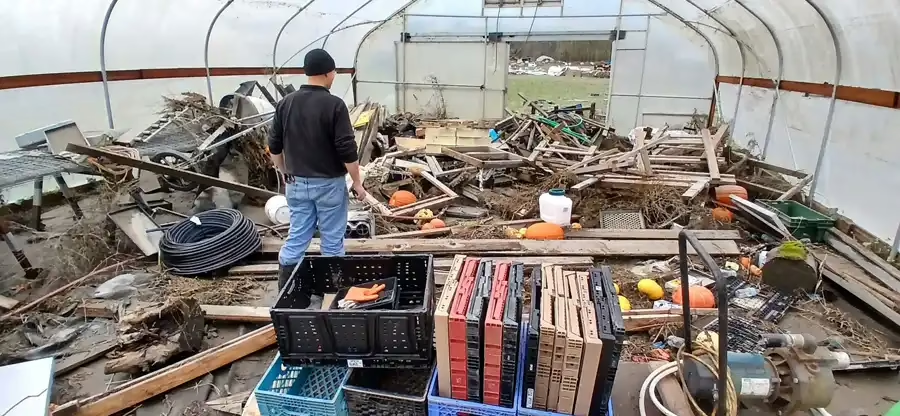
Along the Snohomish River, Chinook Farms was hit particularly hard. The food bank at Holy Cross, Redmond, is in a partnership with Chinook Farms. Most of the farm was destroyed. The need here is particularly great. Working with the Rev. Jim Eichner, associate rector at Holy Cross, we have been able to provide financial support to approximately 30 families. In addition, we provided access to power washers for clean up and money to assist in rebuilding two greenhouses.
Help for Holden Village, outside of western Washington
We have even been able to provide support to those on the other side of the Cascades in the Diocese of Spokane. In particular, we provided help to those evacuated to Chelan from Holden Village. We have been working with the Rev. Paul Palumbo, Pastor of Lake Chelan Lutheran Church, to provide assistance to approximately 18 families impacted in that community.
The future
We continue to learn of more families who could use assistance in the recovery after the flood. Diocesan staff continues to engage with clergy across the diocese to follow up with those with destroyed homes, and whose communities have suffered.
Thanks to the generosity of dozens of people across the Diocese who helped raise the additional $14,000. With this money, we have been able to provide financial assistance to over 130 families. This number will likely continue to increase.
If you’d like to make a donation to additional relief money, on the Diocesan Give page:
- From Giving Options, select Other Donations.
- In Designation Specification, type this: Flood Relief
Feel free to reach out to Michael Seewer if you have any questions.
Episcopal Relief & Development
Since 1940, Episcopal Relief & Development has been helping facilitate transformative, lasting change worldwide. When working alongside communities and our network of partners, Gifts for Life have the power to make a tangible difference. These symbolic gifts are based on the three key priorities of community development that have proven to be most effective in our 80+ years of faith-based work.

Diocese of Olympia
The Episcopal Diocese of Olympia traces its history to the establishment of the Missionary Jurisdiction of the Oregon and Washington Territories in 1853. General Convention admitted the diocese in 1910.
The Diocese of Olympia has more than 26,000 Episcopalians in more than 100 worshiping communities through Western Washington. Our geographic area stretches south from Canada to Oregon and west from the foothills of the Cascade Mountains to the Pacific Ocean.

Church of the Redeemer
Church of the Redeemer: Worshiping God, living in community, and reaching out to the world around us. We are an Episcopal Church serving north King County and south Snohomish County, Washington. As you travel your road, go with friends walking the way of Jesus at Redeemer.
Church of the Redeemer is at 6220 Northeast 181st Street in Kenmore, Washington. The campus is a short distance north of Bothell Way, near the Burke-Gilman Trail. The entrance looks like a gravel driveway. The campus is larger on the inside than it is on the outside. And we managed to hide a large building on the side of a hill that is not easily seen from the street.
The Episcopal Church welcomes you.