
This is the weekly bulletin insert from Sermons That Work.
The Feast of William White
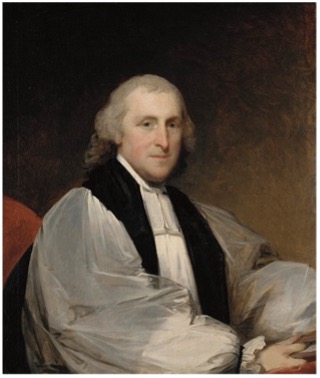
On July 17, the Episcopal Church commemorates William White:
- First bishop of Pennsylvania
- First and fourth presiding bishop of The Episcopal Church
- First and fourth president of the House of Deputies
- United States Senate chaplain
He stands as a foundational figure in the history of The Episcopal Church, shepherding our particular expression of Anglicanism through and beyond the wake of the American Revolution.
White was born in Philadelphia and educated at the College of Philadelphia, now the University of Pennsylvania, graduating in 1765. In 1770, he sailed to England for his diaconal ordination, returning again in 1772 for his priestly ordination. Christ Church, Philadelphia, called White to become rector. The Continental Congress called White to be its chaplain.
Deeply rooted in both Anglican tradition and early American ideals, White saw the need for an autonomous church that would retain historic faith and order while adapting to a completely new, democratic context. He wrote and distributed a pamphlet, “The Case of The Episcopal Churches in the United States Considered,” which envisioned a church governed not by bishops alone but with broad lay and clerical participation. This was a radical idea for its time, though. of course, White proposed it within the other social constraints of the time. His vision was one of shared authority, unity in diversity, and responsive leadership.
In 1787, White again traveled to England to be consecrated bishop. He eventually took his seat in Pennsylvania.
White became the first presiding bishop of The Episcopal Church in 1789. At that time, it was a position that rotated between the existing bishops (there were only three). In 1795, the Church adjusted the position to be the most senior bishop in the House of Bishops.
White’s time was marked by a growing church that established an American line of bishops. He participated in the consecration of more than two dozen colleagues.
He ordained Absalom Jones, the first African American priest in The Episcopal Church. And he presided over a church that struggled to find a foothold as an institution tethered to English spirituality as other formal connections frayed and snapped.
In this era with the questioning of institutions and shifting authority, we do well to recall a bishop who helped build something lasting, not by power alone, but by patience, prayer, and a commitment to the truth.
Collect for the Feast of William White
O Lord, who in a time of turmoil and confusion raised up your servant William White to lead your church into ways of stability and peace; Hear our prayer, and give us wise and faithful leaders, that, through their ministry, your people may be blessed and your will be done; through Jesus Christ our Lord, who lives and reigns with you and the Holy Spirit, one God, for ever and ever. Amen.
Weekly bulletin inserts
This weekly bulletin insert provides information about the history, music, liturgy, mission, and ministry of The Episcopal Church. For more information, please contact us at stw@episcopalchurch.org.
Sermons That Work
For more than 20 years, Sermons That Work, a ministry of The Episcopal Church’s Office of Communication, has provided free sermons, Bible studies, bulletin inserts, and other resources that speak to congregations across the Church. Our writers and readers come from numerous and varied backgrounds. Small house churches, sprawling cathedrals, and everything between use the resources that Sermons That Work provides.
Church of the Redeemer
Church of the Redeemer: Worshiping God, living in community, and reaching out to the world around us. We are an Episcopal Church serving north King County and south Snohomish County, Washington. As you travel your road, go with friends walking the way of Jesus at Redeemer.
Church of the Redeemer is at 6220 Northeast 181st Street in Kenmore, Washington. The campus is a short distance north of Bothell Way, near the Burke-Gilman Trail. The entrance looks like a gravel driveway. The campus is larger on the inside than it is on the outside. And we managed to hide a large building on the side of a hill that is not easily seen from the street.
The Episcopal Church welcomes you.