Category: Parish Life

News stories about parish life at Church of the Redeemer.

  • The organ at Church of the Redeemer

    The organ at Church of the Redeemer

    “Brave servants of Christ who in the Redeemer’s Name have founded a church, may you never lose the zeal which prompted this new venture, but ever retain the courage to bear all things, the confidence to hope all things, and a love that endures and is kind.” —The Rev. Arnold Krone, 1947

    This describes the initial organ installation and later improvements at Church of the Redeemer. A large portion of the information comes from “A Sense of Place” by Eleanor Pachaud, and “An Involved Parish” by Derek Schwede found in Redeemer: The First Fifty Years. Additional information came from the Pipe Organ Database of the Organ Historical Society. There was light editing to make it easier to read in an online format.

    This is one of several posts celebrating the 75th anniversary of Church of the Redeemer.

    Pipe display: Photograph by William J. Bunch

    The original organ installation

    Three months after the dedication of the new building, on March 5, 1965, Father Coulter signed the purchase order for our organ through Balcolm and Vaughan Pipe Organs, Inc.

    The pipe organ was funded by a donation from parishioners Robert and Eleanor Dent, and the ceremonial Spanish Trumpets were given by Father Coulter. Parish funds covered the construction of the choir platform and the construction of the organ chamber.

    The organ and its installation would cost $16,579.84. The organ had a grand total of 22 ranks, 34 stops, and 1,279 pipes.

    Responsibility of work

    The contract that was signed stated that Balcolm and Vaughan was responsible for the installation, tuning, and finishing, making certain that the instrument was completely ready to play. Redeemer was responsible for everything else:

    The Church is to be responsible for preparing the space necessary for the organ, blower, and console. The church is also to install suitable electrical service and wiring starters from the blower motor and rectifier to the console, and to supply any openings for cable, tin line, and interior entry, at a time designated by the organ builders. If the blower must be in a remote location, the church also assumes responsibility for such tin line work.

    In essence, we had to do all of the electrical and architectural work necessary to install the organ. Because of this, there were a few minor details that were ignored.

    • The organ chamber, for instance, was built without formal plans, was never certified by an engineer, and was never determined to comply with local building codes.
    • Another oversight was the electrical wiring for the light on the console. This problem could not be fixed by Balcolm and Vaughan because it was not in their contract; and there was no appropriate outlet for lights. This problem was solved by means of an extension cord to a nearby outlet, and was finally wired properly in 1994, after the church was informed that the thirty-year-old extension cord did not meet electrical code standards.

    Despite the delays, the organ was constructed in about ten months’ time, and the dedication was held on December 19, 1965, one year after the completion of the building.

    Dedication

    The ceremony was led by Bishop Ivol Curtis and Father Coulter and included both the dedication of the organ and the confirmation of over thirty people. As a celebration of the new organ, a recital was included in the ceremony with pieces by J, S. Bach, Dietrich Buxtehude, Louis Claude Daquin, Valentin Rathgeber, Jean Langlais, Dom Paul Benoit, Francis Jackson, and Henry Purcell.

    The recital was played by Eugene M, Nye, the tonal director of Balcolm and Vaughan Organs.
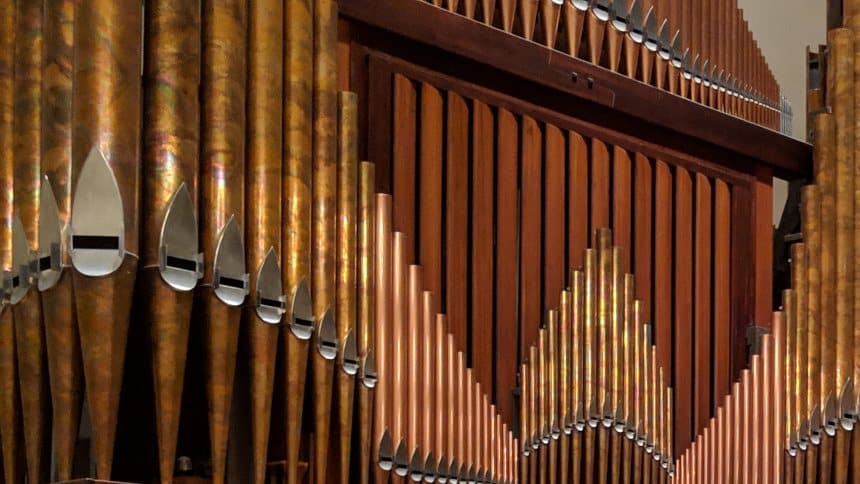
    Organ pipes

    Organ renovations

    Redeemer’s own musical instrument, the organ, was never fully completed. Though many parts of it had been replaced and repaired since 1987 (including a re-voicing of the instrument in 1988), many parts of the organ continued to wear out and become unusable.

    The renovation of the organ began with the work of a committee in 1995, which included Don Bentley, Bill Bissell, Peter Camp, Walter Knowles, Laina Molbak, Allen Moses, Doug Oles, and Randie Sidlinger.

    Options considered

    The committee looked at the present condition of the organ and evaluated several possible courses of action, including:

    • Removing the organ and replacing it with either a new pipe or electronic organ.
    • Renovating the organ and making major improvements.
    • Making only minor modifications to keep the organ playable.
    • Doing nothing at all.

    After many meetings, the committee recommended a plan which would:

    • Remove the organ from its present location.
    • Rebuild large portions of the organ’s action while preserving most of the organ’s original pipework.
    • Reinstall the organ in a floor-standing case.

    This change in position would improve the organ as an instrument to help lead congregational singing, by focusing the organ’s tone. In addition, providing swell enclosures on some ranks would allow more control over the volume.

    The firm of Bond Organ Builders in Portland, Oregon, was chosen to carry out the work.

    Fundraising

    The 1996 Parish Festival served as the official start of the fundraising campaign and featured a hymn-sing accompanied by a portable organ built by Bond Organ Builders. The successful fund drive ended in the late fall of 1996 after raising over $180,000, which is more than the present building cost at the time of its construction.

    The funds were once again provided entirely by members of the parish in donations of many sizes. The donations included a few large contributions, but the bulk of the money was given by the average members and families of the parish.

    The contract to renovate the organ was signed on Palm Sunday 1997, and construction began in early summer of that year.

    Dedication

    The 50th anniversary remembrance was published before the renovations were completed on the organ, so it did not cover its dedication. However, the Pipe Organ Database has information on the dedication:

    The organ was dedicated on February 22, 1998, in an evensong service which began with 30 minutes of organ music played by Music Director/Organist, and Associate Rector Rev. Walter Knowles. The music performed in this pre-evensong recital was chosen to demonstrate the wide range of sound the renewed organ is capable of.

    Organ Specifications for each build

    Here are the organ specifications for each build: Balcom & Vaughan initial installation, Bond rebuild, and Bond new console.
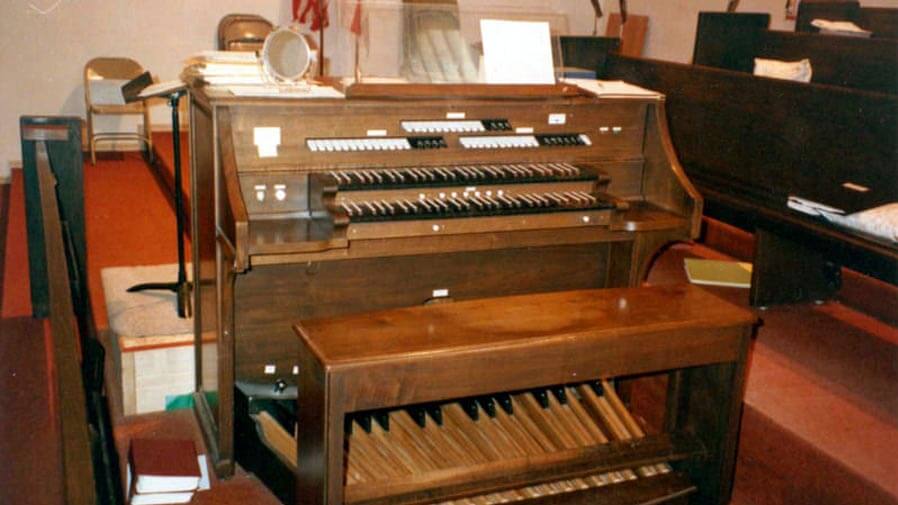
    Original console photograph by James Stettner in Organ Historical Society database.

    Initial installation

    Balcom & Vaughan Pipe Organs, Opus 739, 1965, – Original Specifications (Information from the Pipe Organ Database of the Organ Historical Society)

    Technical Details

    • Chests: Electro-pneumatic (EP)
    • 22 ranks. 1,279 pipes. 3 divisions. 2 manuals. 18 stops. 34 registers.

    Divisions

    • Chest Type(s): Electro-pneumatic (EP) chests

    Console

    • Manuals: 2
    • Divisions: 3
    • Stops: 18
    • Registers: 34
    • Position: Console in fixed position, left.
    • Manual Compass: 61
    • Pedal Compass: 32
    • Key Action: Electrical connection from key to chest.
    • Stop Action: Electric connection between stop control and chest.
    • Console Style: Traditional style with roll top.
    • Stop Controls: Stop keys above top manual.
    • Combination Action: Adjustable combination pistons.
    • Swell Control Type: No enclosed divisions.
    • Pedalboard Type: Concave radiating pedalboard meeting AGO Standards.
    • Has Crescendo Pedal
    • Has Combination Action Thumb Pistons
    • Has Coupler Reversible Toe Pistons
    Division LengthNamePipes
    Hauptwerk8Prestant49
    8Rohr Floete61
    8Spitz Gamba (OW)
    4Oktav61
    4Spill Pfeife61
    2-2/3Quint (OW)12
    2Flach Floete61
    1-3/5Terz (OW)
    IVFourniture  19-22-26-29244
    8Spanische Trompete61
    8Cromorne61
     Chimes (prep)
     Haupt. to Haupt. 16′ 
     Haupt. Unison Off 8′ 
     Haupt. to Haupt. 4′ 
    1blank, black stoptablet 
    Oberwerk8Gedackt Floete61
    8Spitz Gamba61
    8Schwebung (tc)49
    4Weit Prinzipal61
    4Quintade61
    2Gemshorn61
    1-1/3Nasat61
    8Fagott61
     Tremulant 
     Zimbelstern 
    8Spanische Trompete (HW)
     Ober. to Ober. 16′ 
     Ober. Unison Off 8′ 
     Ober. to Ober. 4′ 
     1 blank, black stoptablet 
    Pedal16Subbass (OW)12
    16Zart Bass
    8Kupfer Prinzipal32
    8Gedackt (OW)
    8Spitz Gamba (OW)
    4Koral Bass12
    4Spill Floete (HW)
    2Hell Pfeife (HW)
    IIQuint Mixtur  22-2664
    16Fagott Bass12
    8Fagott (OW)
    4Fagott (OW)
    4Cromorne (HW)
     1 blank, black stoptablet 

    The totally unenclosed organ was located at the rear of the church, cantilevered high off of the back wall.

    On the Hauptwerk, notes 1-12 of the 8′ Prestant are borrowed from the Pedal 8′ Kupfer Prinzipal, which forms the primary portion of the façade. The 8′ Spanische Trompete is mounted en-chamade off of the back wall above the other pipework. The 2-2/3′ Quint is a 12-pipe bass extension of the Oberwerk 1-1/3′ Nasat. The 1-3/5′ Terz is derived from the Oberwerk 2′ Gemshorn. The Terz plays for 57 notes before breaking back to 3-1/5′ pitch on note A 58.

    On the Pedal, the Pedal 16′ Subbass is an extension of the Oberwerk 8′ Gedackt Floete. The pipes are made of mahogany and were built in the Balcom & Vaughan shop. The 16′ Zart Bass is the same as the 16′ Subbass, but with notes 1-12 on soft wind. The 2′ Hell Pfeife is a borrow of the Hauptwerk 2′ Flach Floete.

    The Zimbelstern of 4 bells has a speed control with a toggle switch. In the center position, the zimbelstern is off even when the stoptablet is registered. In the left position, it plays on fast, and in the right position it plays on slow.

    The console manuals are reverse color with ebony naturals, and sharps of rosewood with ivory caps.

    Sources: Balcom & Vaughan opus list and files; and James R. Stettner on December 16, 2012.

    Organ photograph by James R. Stettner in the Organ Historical Society database.

    Bond rebuild and console

    Balcom & Vaughan Pipe Organs, Opus 739, 1965; Bond Pipe Organs, 1998, Rebuild with Additions (Information from the Pipe Organ Database of the Organ Historical Society). In this rebuild, the original console was retained until 2014. The console replacement changed the stoplist.

    Technical Details

    • Chests: Slider with direct-electric pull-downs (externally mounted)
    • 25 ranks. 1,404 pipes. 3 divisions. 2 manuals. 21 stops. 27 registers.

    Main

    • Manuals: 2
    • Divisions: 3
    • Stops: 21
    • Registers: 27
    • Position: Movable console.
    • Manual Compass: 61
    • Pedal Compass: 32
    • Key Action: Electrical connection from key to chest.
    • Stop Action: Electric connection between stop control and chest.
    • Console Style: Traditional style without cover.
    • Stop Controls: Stop keys above top manual.
    • Combination Action: Adjustable combination pistons.
    • Swell Control Type: Balanced swell shoes/pedals, AGO standard placement.
    • Pedalboard Type: Concave radiating pedalboard meeting AGO Standards.
    • Has Combination Action Thumb Pistons
    • Has Combination Action Toe Pistons
    • Has Coupler Reversible Toe Pistons

    Divisions

    • Chest Type(s): Slider with direct-electric pull-downs (externally mounted) chests
    • Position: In a gallery-level case at the rear of the room.
    DivisionLengthNamePipes
    Hauptwerk8Prestant49
    8Rohr Floete61
     Blank 
    4Oktav61
    4Spill Pfeife61
    2-2/3Quint12
    2Flach Floete61
    1-3/5Terz
    IVFourniture  19-22-26-29244
    8Fagott (OW)
     Zimbelstern
     Haupt. to Haupt. 16′ 
     Haupt. Unison Off 8′ 
     Haupt. to Haupt. 4′ 
     1 blank, black stoptablet 
    Oberwerk8Gedackt Floete61
    8Spitz Gamba61
    8Schwebung (tc)49
    4Weit Prinzipal61
    4Quintade61
    2Gemshorn61
     Blank 
    8Trumpet61
    8Fagott61
    8Cromorne61
     Tremulant 
     Ober. to Ober. 16′ 
     Ober. Unison Off 8′ 
     Ober. to Ober. 4′ 
     1 blank, black stoptablet 
    Pedal16Principal32
    16Subbass32
    8Kupfer Prinzipal12
    8Gedackt12
     Blank 
    4Koral Bass32
     Blank 
     Blank 
    IIQuint Mixtur  22-2664
    16Fagott Bass12
    8Fagott (OW)
     Blank 
     Blank 
     1 blank, black stoptablet 

    This organ as originally built by Balcom & Vaughan was also located at the rear of the church and was cantilevered high off of the back wall.

    In the rebuild work by Bond Pipe Organs, the original cantilevered chests were removed, and the organ was placed in a new free-standing case of dark Peruvian walnut – styled after Greene & Greene.

    Existing pipework was rescaled, revoiced, and the wind pressure was raised. The manual divisions were placed atop new electro-pneumatic, slider windchests with electric slider motors. Only the 8′ Fagott, which is borrowed to the Hauptwerk, is located on an electro-pneumatic unit chest.

    The lower façade is comprised entirely of Pedal pipes. The flamed copper pipes at the corner and in the center are from the 16′ Principal/ 8′ Kupfer Prinzipal unit of 44 pipes, which are entirely new. The polished copper pipes between the center and corners are 30 pipes from the 4′ Koral Bass. Pipes 31 and 32 are directly behind the façade on the right side. The first 6 pipes of the Pedal 16′ Subbass are in the side façades. 12 of the 32 16′ Subbass pipes are from the Balcom and Vaughan instrument. The entire Pedal division is diatonically divided with the left side being the C side and the right side being the sharp (♯) side. The Pedal II Quint Mixtur is on the right side between the façade and the swellbox, and is on a chromatic chest. The unenclosed 16′ Fagott Bass extension is on the left side between the façade and the swell-box. The entire Pedal division is on electro-pneumatic unit chests. The pedal is prepared for the addition of a 16′ Posaune.

    The Oberwerk is housed in the new swellbox which is surrounded by the pedal division. All three original reeds from the Balcom & Vaughan were moved to the enclosed Oberwerk during the rebuild. The Oberwerk is prepared for the addition of    a III Scharf.

    The Hauptwerk is located atop the Oberwerk swellbox and has all 61 pipes of the 8′ Prestant in the façade with the other ranks behind it. The 1-3/5′ Terz is new pipework – the old one having been derived from the OW 2′ Gemshorn. The Hauptwerk is prepared for the addition of a 2′ Super Octav and an 8′ Trumpet.

    The Zimbelstern of 4 bells has a speed control with a toggle switch. In the center position, the zimbelstern is off even when the stoptablet is registered. In the left position, it plays on fast, and in the right position it plays on slow.

    The original console was retained. The manuals are reverse color with ebony naturals, and sharps of rosewood with ivory caps.

    Sources: Bond opus list and files; and from James R. Stettner, December 16, 2012.
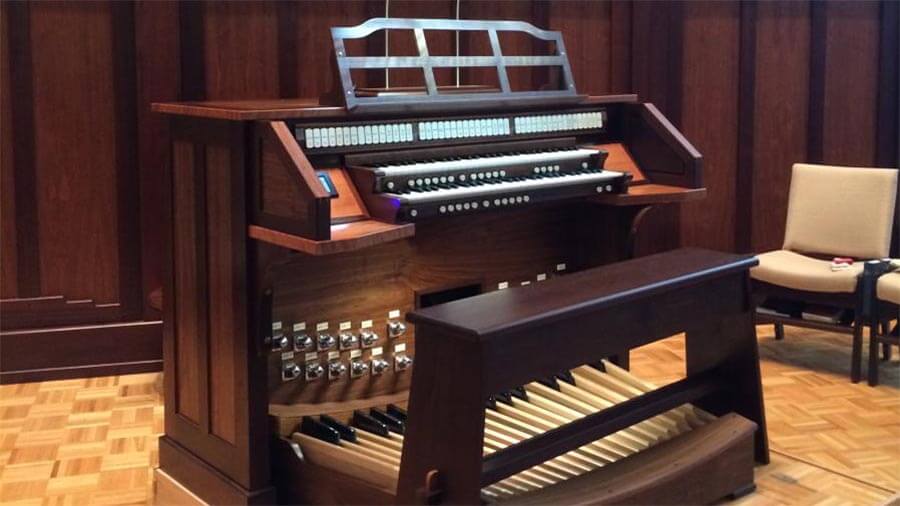
    Console photograph by John Stump from the Organ Historical Society database.

    2014 console replacement

    Bond Pipe Organs Inc. (2014), originally Balcom & Vaughan Pipe Organs (Opus 739, 1965). (Information from the Pipe Organ Database of the Organ Historical Society).

    Bond’s rebuild in 1998 retained the original 1965 console. A new console and switching system have now been installed. The stoplist has been slightly revised and the new control system provides multiple-memory combination action with sequencer, record-playback, and transposer. Some preparations for future additions are included. The console is of Peruvian walnut with madrone accents.

    Technical Details

    • Chests: Slider with electro-pneumatic (EP) pallets (Blackinton-type)
    • 25 ranks. 1,404 pipes. 3 divisions. 2 manuals. 21 stops. 27 registers.

    Console

    • Manuals: 2
    • Divisions: 3
    • Stops: 21
    • Registers: 27
    • Position: Movable console.
    • Manual Compass: 61
    • Pedal Compass: 32
    • Key Action: Electrical connection from key to chest.
    • Stop Action: Electric connection between stop control and chest.
    • Console Style: Traditional style without cover.
    • Stop Controls: Tilting/rocking tablets above top manual.
    • Combination Action: Adjustable combination pistons.
    • Swell Control Type: Balanced swell shoes/pedals, AGO standard placement.
    • Pedalboard Type: Concave radiating pedalboard meeting AGO Standards.
    • Has Tutti Reversible Thumb Pistons
    • Has Tutti Reversible Toe Pistons
    • Has Combination Action Thumb Pistons
    • Has Combination Action Toe Pistons
    • Has Coupler Reversible Thumb Pistons
    • Has Coupler Reversible Toe Pistons
    • Has a Piston Sequencer
    Division LengthNamePipes
    Great8Principal61
    8Rohrflöete61
    4Octave61
    4Spillpfeife61
    2-2/3Nasat12
    2Superoctave61
    1-3/5Terz61
     Mixture IV244
    8Fagott (swell)
     Zimbelstern4 bells
     Great to Great 16′ 
     Great Unison Off 
     Great to Great 4′ 
     Swell to Great 16 
     Swell to Great 8 
     Swell to Great 4 
    Swell8Gedacktflöete61
    8Spitz Gamba61
    8Schwebung (tc)49
    4Weit Prinzipal61
    4Quintade61
    2Gemshorn61
     Sharf III183 pipes
    16Fagott73
    8Trumpet61
    8FagottExt.
    8Krummhorn61
     Tremulant 
     Swell to Swell 16′ 
     Swell Unison Off 
     Swell to Swell 4′ 
    Pedal32ResultantFrom Subbass
    16Principal44
    16Subbass44
    8OctaveExt.
    8Choral bassExt.
     Mixture II64
    16FagottFrom Swell
    8FagottFrom Swell
    4FagottFrom Swell
     Great to Pedal 8’ 
     Great to Pedal 4’ 
     Swell to Pedal 8’ 
     Swell to Pedal 4’12
    Church of the Redeemer logo

    Church of the Redeemer

    Welcome to Church of the Redeemer: Worshiping God, living in community, and reaching out to the world. We are an Episcopal Church serving north King County and south Snohomish County, Washington. As you travel your road, go with friends walking the way of Jesus at Redeemer.

    Church of the Redeemer is at 6220 Northeast 181st Street in Kenmore, Washington. We are a short distance north of Bothell Way, near the Burke-Gilman Trail. The entrance looks like a gravel driveway. The campus is larger on the inside than it is on the outside. And we managed to hide a large building on the side of a hill that is not easily seen from the street.

    The Episcopal Church welcomes you.
  • Constructing the current church building

    Constructing the current church building

    “Brave servants of Christ who in the Redeemer’s Name have founded a church, may you never lose the zeal which prompted this new venture, but ever retain the courage to bear all things, the confidence to hope all things, and a love that endures and is kind.” —The Rev. Arnold Krone, 1947

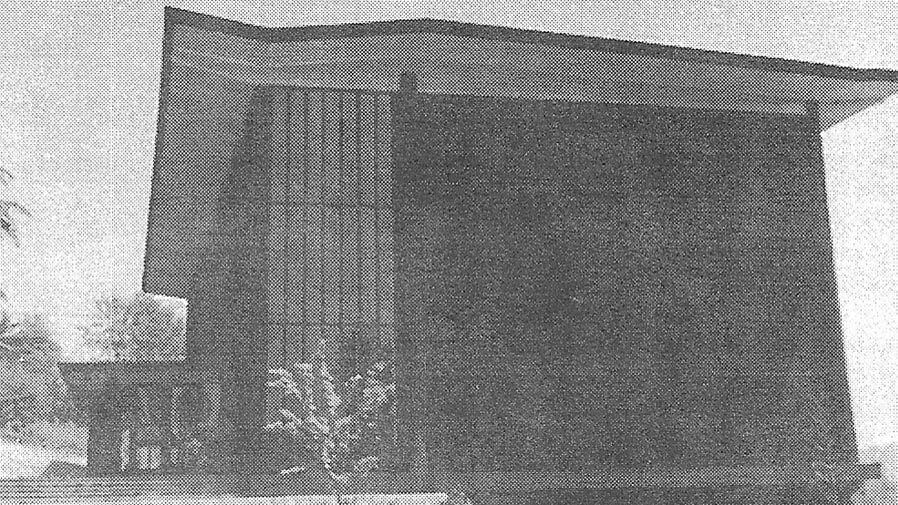
    This describes the construction of the current church building by congregants of Church of the Redeemer completed in 1964. The text (with light editing to work better in an online format) and pictures were taken from “A Sense of Place” by Eleanor Pachaud, found in Redeemer: The First Fifty Years.

    This is one of several posts celebrating the 75th anniversary of Church of the Redeemer.

    Building the current church building

    On May 5, 1957, the Reverend C. Roy Coulter became the new vicar at Redeemer. He had previously held the position of curate at Trinity Episcopal in Seattle, and would take the place of the Reverend Richard McGinnis, who would go to Trinity Episcopal to serve in Father Coulter’s former position.

    Before coming to Redeemer, Father Coulter spent a summer working for St. Paul’s Episcopal Church in Seattle, and some time doing missionary work in Haiti. He was twenty-six years old upon coming to Redeemer.

    Building fund created

    On a financial note, during the end of 1955, we held a congregation-wide canvass to start a building fund. This canvass was the last major capital funds drive at Redeemer until the renovation of the pipe organ, over forty years later.

    For this canvass, the slogan was “We know that our greatest need is not…’how much our church needs,’ but rather ‘how much we need to give,’” It was a three-year process where the head of each family sat down with a Canvass Leader to discuss how much of a financial sacrifice was to be made, since this sacrifice would strengthen the faith of both the family and the church.

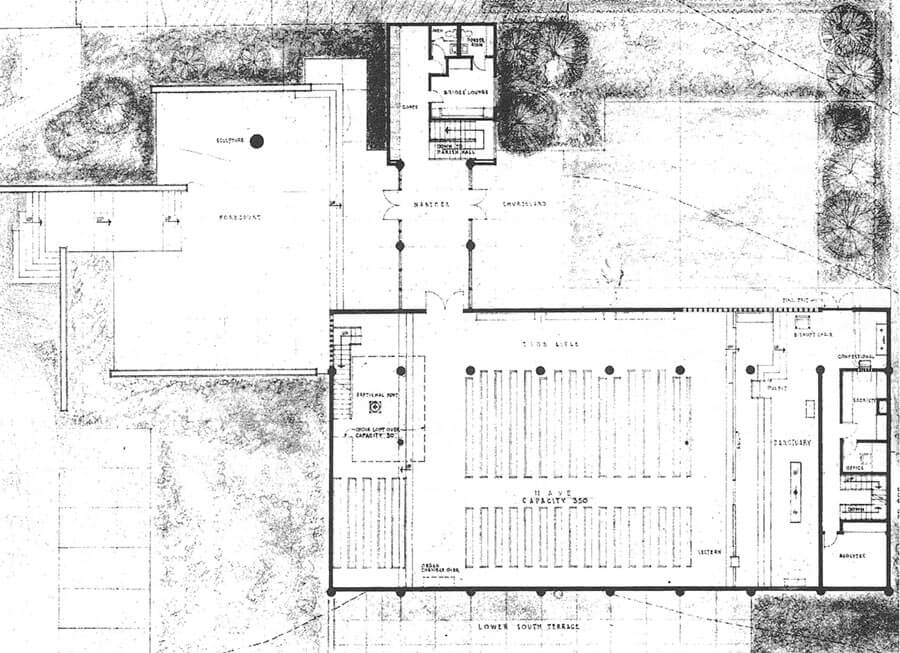
    Original proposed design for Church of the Redeemer by Roland Terry.

    Designing the new building

    On June 16, 1960, we received the opportunity to put the fruits of our capital funds drive to their intended use: the architectural firm of Terry and Moore sent Redeemer a letter proposing to set up a contract for the construction of a new building.

    The firm included as a partner the noted Seattle architect, Roland Terry, who had been responsible for the architectural planning of several Seattle-area buildings, including the Canlis Restaurant on Queen Anne, and the residence of Seattle Times owner William Blethen.

    They also said that they had always wanted to design a church, and this was the perfect opportunity.

    A year later, an estimate and a contract had been drawn up. The original cost estimate specified $144,140 for the building development, $10,300 for the property development, and $5,000 for special artwork (like the doves that are currently in the baptistry.) The total estimate was for $159,440.

    Less than a month after this figure was drawn up, Father Coulter received a letter from the bishop:

    [The diocese is] much concerned with the talk of a building to cost between $150,000 and $200,000 when not more than $25,000, if that, is available in cash and not actually enough to pay the architect. Since Redeemer is a mission, any such outlay of costs must be cleared with [the bishop], the Department of Missions, and both the Bishop’s Committee and the architect ought to understand clearly that no contracts can be signed except with the approval of the Diocesan Council on the recommendation of the Department of Missions.

    Obviously, this was no small matter, and it appeared that Redeemer was about to take a plunge into deep debt. The contract was signed anyway.

    Later, in an attempt to control the debt, some modifications were made to the original architectural design.

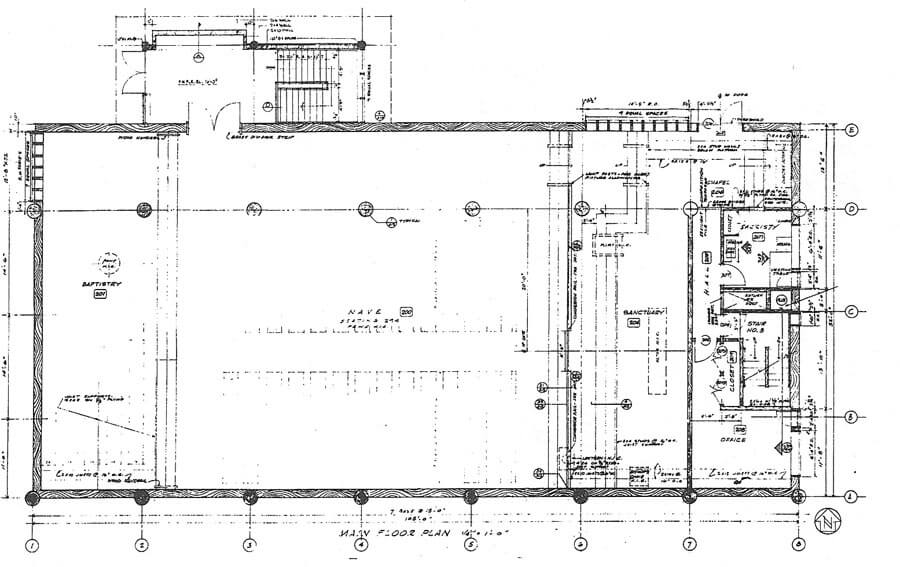
    • The height of the building was lowered by five feet, and its length was shortened by fifteen feet, roughly the distance between two columns in the sanctuary.
    • The choir loft was taken out (it would have sat about ten feet below where the organ loft is now), as well as the stairway that was supposed to go up to it. This stair would have been where the baptistry is now, and the baptistry would have been under the choir loft.
    • The narthex was also redesigned, eliminating an extra set of restrooms and coatroom space.

    These changes lowered the cost to about $114,000.

    In the spring of 1964, construction began, against the diocese’s wishes. Construction took roughly nine months with the help of hours and hours of volunteer time by the congregation.

    Revised plan for Church of the Redeemer by Roland Terry.

    Building the new building

    Because of its unique design, the construction project faced its own set of challenges. The huge wooden pillars extend from the foundation to the roof and are constructed from single trees. Each pillar was hand-picked and approved at the mill by Roland Terry. Since the pillars had to be put into place first, there was a short period before the structure was sufficiently braced when, in the words of one observer, “if there had been a windstorm, the building would probably have fallen down. “

    Once the main building was in place, the next task was to gather all of the furnishings necessary to turn the large, vacant building into a house of worship. Many of these where donated or built on volunteer time.

    One especially important volunteer was Robert Thompson. He served as the design coordinator and the building committee chairman. He personally designed the pulpit, altar, lectern, cross, wall sconces, and lighting fixtures.

    The altar, altar rail, and lectern were all donated by Bill Martin, a member of the congregation at the time.

    The cross from the old building was transferred to the chapel of the new building, and a large, sixteen-foot gold-painted wooden cross was hung above the altar.

    All of the pews were donated as memorials, and an anonymous donor donated the large bronze bowl that sits in the baptistry. The bowl was cast in the fifteenth century for Lorenzo de Medici and it bears his portrait and coat of arms.

    The planting and landscaping outside the building was provided by Laina and Egon Molbak, founders of Molbak’s Greenhouse and longtime members of the mission.

    The final major contribution was made by one family who pledged $16,000 for a full-range twenty-two rank organ to be built two years later. A smaller six-rank organ was donated for temporary use at the dedication.

    Congregation at the dedication of the current church building.

    Dedicating the new building

    The dedication of the new building was on Sunday, December 20th, 1964. It was a huge affair described by articles in Eastside newspapers, with no less than five members of the clergy present for the occasion.

    • The bishop, The Right Reverend Ivol Curtis, presided over the ceremony
    • The Reverend Roy Coulter, vicar of the mission
    • The Venerable Paul Langpaap, the rector of Trinity Parish Church and Archdeacon of Seattle
    • The Reverend Ernest Radcliffe, curate of St. Paul’s in Seattle
    • The Reverend John Thomas, the vicar of St. John’s in Gig Harbor

    The junior and senior wardens of Redeemer also participated.

    At the end of the dedication, people who walked outside the church noticed a large plume of smoke rising from somewhere towards Lake Washington. It was later revealed that the smoke came from a destructive fire at the Lake Forest Park Clubhouse—the mission’s original home.

    Church of the Redeemer logo

    Church of the Redeemer

    Welcome to Church of the Redeemer: Worshiping God, living in community, and reaching out to the world. We are an Episcopal Church serving north King County and south Snohomish County, Washington. As you travel your road, go with friends walking the way of Jesus at Redeemer.

    Church of the Redeemer is at 6220 Northeast 181st Street in Kenmore, Washington. We are a short distance north of Bothell Way, near the Burke-Gilman Trail. The entrance looks like a gravel driveway. The campus is larger on the inside than it is on the outside. And we managed to hide a large building on the side of a hill that is not easily seen from the street.

    The Episcopal Church welcomes you.
  • Constructing the old church building

    Constructing the old church building

    “Brave servants of Christ who in the Redeemer’s Name have founded a church, may you never lose the zeal which prompted this new venture, but ever retain the courage to bear all things, the confidence to hope all things, and a love that endures and is kind.” —The Rev. Arnold Krone, 1947

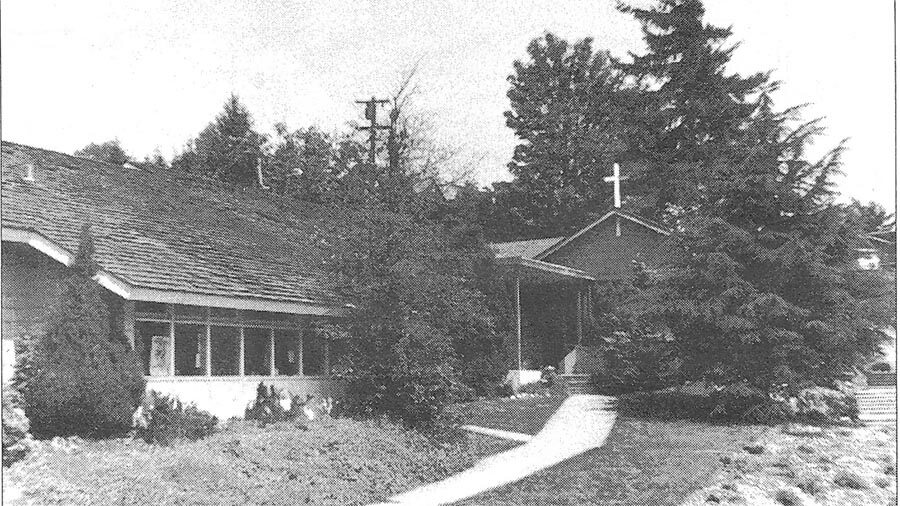
    This describes the construction of the old church building by congregants of Church of the Redeemer in 1950-1952. This gave the congregation a place to hold services, a parish hall, office space, and classroom space. This building is still in use (Education Building and church office), although the parish hall building has been removed. The text and pictures were taken from “A decade of beginnings” by Scott Daniel, found in Redeemer: The First Fifty Years.

    This is one of several posts celebrating the 75th anniversary of Church of the Redeemer.

    Building the old church building

    At the Annual Meeting of February 19, 1950, Father Markgraf was already preparing future building plans. It was hoped that the church could erect an entirely new and original building to free up the former Lutheran hall for the church school and to accommodate parish expansion. On February 28, this plan was approved by the Bishop’s Committee, on the condition that the fee for the architect would not exceed $100. The plan was accepted in place of one which would merely have enlarged the hall already in use.

    True to form, the mission once more lost its priest. Father Markgraf moved south to California on September 1, 1950, leaving the Church of the Redeemer and St. John’s, Kirkland, under the guidance of the newly-appointed Reverend Alfred L. Griffiths. It was unfortunate that Father Markgraf chose to leave before the new building, his brainchild, was completed in February of 1952.

    The 1952 building and parish Hall when opened.

    The completion of the new building was a monumental achievement for the church. Designed by Seattle architect Robert Durham, the new building was capable of accommodating 100 people and was designed for easy expansion in case of a major growth in population. The building was constructed in three stages, beginning with the construction of the main worship area, continuing with the construction of classroom space (which now holds Redeemer’s nursery and parish office), and finishing with the construction of a breezeway addition. This breezeway connected the new building and the old Lutheran parish hall, which was pressed into service once again as a nursery, kitchen and fellowship hall.

    Now the church had a home to call its own, a home which it built with its own hands, a home of which it could truly feel proud. This home was the culmination of seven years of hard work starting with the first few pioneers of the Lake Forest Park clubhouse, and ending with the men and women of the Church of the Redeemer. The church was just a mission at the time, but we were as strong in unity and action as any church could be. The people were truly blessed, not only by God, but by their own work and sacrifices for the good of the church.

    Church of the Redeemer logo

    Church of the Redeemer

    Welcome to Church of the Redeemer: Worshiping God, living in community, and reaching out to the world. We are an Episcopal Church serving north King County and south Snohomish County, Washington. As you travel your road, go with friends walking the way of Jesus at Redeemer.

    Church of the Redeemer is at 6220 Northeast 181st Street in Kenmore, Washington. We are a short distance north of Bothell Way, near the Burke-Gilman Trail. The entrance looks like a gravel driveway. The campus is larger on the inside than it is on the outside. And we managed to hide a large building on the side of a hill that is not easily seen from the street.

    The Episcopal Church welcomes you.
  • Land purchase by Church of the Redeemer in 1949

    Land purchase by Church of the Redeemer in 1949

    “Brave servants of Christ who in the Redeemer’s Name have founded a church, may you never lose the zeal which prompted this new venture, but ever retain the courage to bear all things, the confidence to hope all things, and a love that endures and is kind.” —The Rev. Arnold Krone, 1947

    This describes the land purchase by congregants of Church of the Redeemer in 1949 where the church campus is today. The purchase allowed moving from Sunday-only use at the clubhouse of the Lake Forest Park Civic Club to a facility dedicated for church use. The text and picture were taken from “A decade of beginnings” by Scott Daniel, found in Redeemer: The First Fifty Years.

    This is one of several posts celebrating the 75th anniversary of Church of the Redeemer.

    Land purchase for Redeemer

    The church began to mature a little in 1949. By the Annual Meeting of January 9, 1949, the church had selected the property on which it was to build its facilities. All that was left to do was to approve and perform the official purchase. There was a large problem with this: acquiring the land and building on would entail a large amount of fundraising, which still needed to be done. Though the church had overcome the major hurdle of property selection, it was by no means out of the woods.

    To address this problem, the church established a Building Fund Campaign. Members were asked to pledge gifts of money towards the purchase of the church land from the Squires Investment Company. People were to be contacted during the services and, for those absent on the given days, by canvassers over the phones. The Bishop’s Committee set a goal of $800 for this project.

    By February 20 another major obstacle had been cleared. First Lutheran Church, located nearby, had recently finished using its church hall, and Redeemer seized this opportunity to buy the building. The plan was to purchase and move the hall in one piece onto the land they were about to acquire. This deal was agreeable to both the Lutheran church and the Church of the Redeemer. The purchase of the hall was finalized in March of 1949 and announced in the joint newsletter of Church of the Redeemer and St. John’s, Kirkland. These missions had been joined by the Bishop due to their small size, so they shared many things, including priests and newsletters. Seemingly, the only thing separate about them was locale. However, once each gained enough of a following, it was assured chat they both would be granted their autonomy.

    Later that year, the property for the church was purchased from the Squires Investment Company. The property consisted of five lots and was the perfect place on which to erect the purchased hall. The only major job that remained was to move the recently purchased Lutheran church hall to the even-more-recently-purchased property. In late 1949, the Lutheran parish hall was trucked through the streets of Kenmore and unloaded on the present property. Although this endeavor provided the church with a place of its own, it was not the solution the mission was looking for.

    Church of the Redeemer logo

    Church of the Redeemer

    Welcome to Church of the Redeemer: Worshiping God, living in community, and reaching out to the world. We are an Episcopal Church serving north King County and south Snohomish County, Washington. As you travel your road, go with friends walking the way of Jesus at Redeemer.

    Church of the Redeemer is at 6220 Northeast 181st Street in Kenmore, Washington. We are a short distance north of Bothell Way, near the Burke-Gilman Trail. The entrance looks like a gravel driveway. The campus is larger on the inside than it is on the outside. And we managed to hide a large building on the side of a hill that is not easily seen from the street.

    The Episcopal Church welcomes you.
  • First service of Church of the Redeemer

    First service of Church of the Redeemer

    “Brave servants of Christ who in the Redeemer’s Name have founded a church, may you never lose the zeal which prompted this new venture, but ever retain the courage to bear all things, the confidence to hope all things, and a love that endures and is kind.” —The Rev. Arnold Krone, 1947

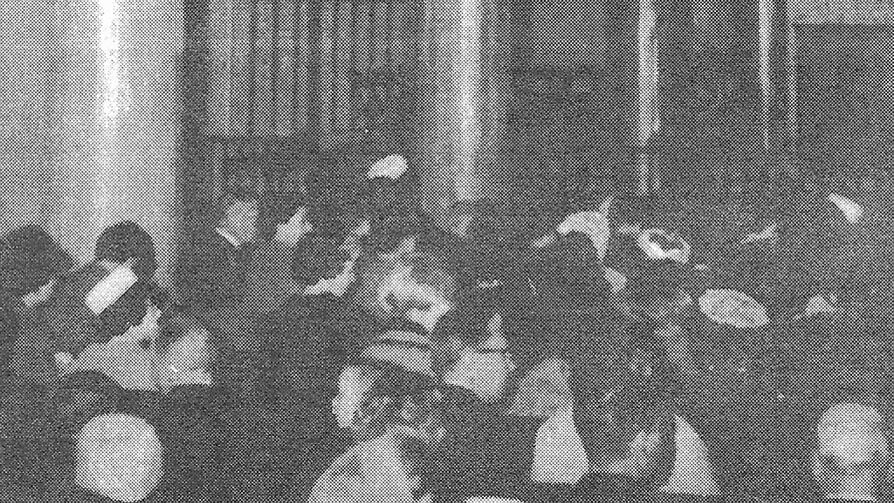
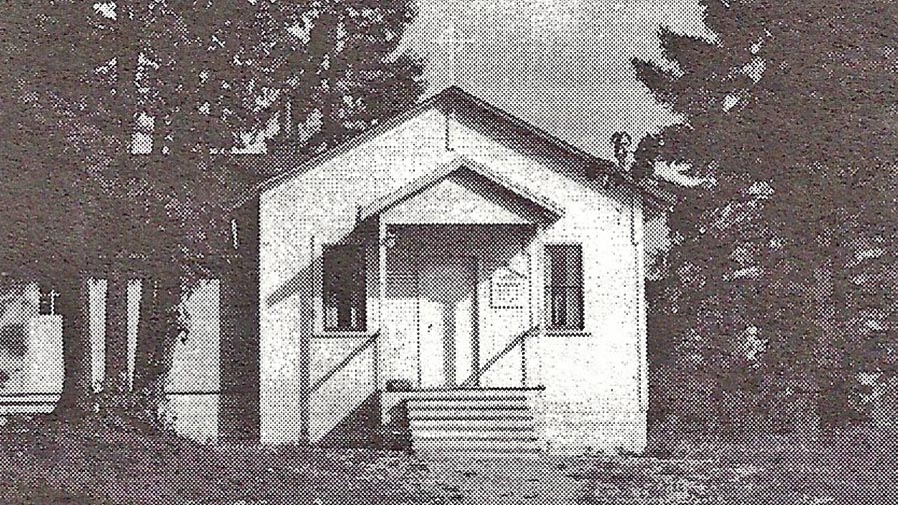
    This describes the first service of Church of the Redeemer on Quinquagesima Sunday, February 16, 1947, at the former clubhouse of the Lake Forest Park Civic Club. It is taken from the chapter “Redeemer before Redeemer,” written by Margaret Banks in about 1960. She was the historiographer and one of the founders of the congregation. This is from Redeemer: The First Fifty Years.

    This is one of several posts celebrating the 75th anniversary of Church of the Redeemer.

    First hymn at the first service for Redeemer

    The first service

    Few services will ever be more joyous for those persons present than the first service of Church of the Redeemer,

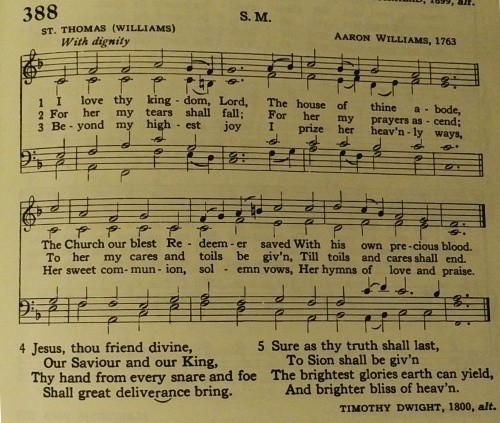
    First they surprised and delighted the Bishop by having a cross, movable altar rails, and kneeling benches ready for use. Mrs. Banks had made the rails and had a cabinetmaker friend make a wooden cross, mounted on a three-step base, which Mr. Banks gilded. The kneeling benches had been given to them by the disbanded group which formerly had met in the clubhouse. An oak table belonging to the club was pushed against the natural stone fireplace. The gray stone formed a background for the cross and improvised altar. Mrs. Stanley was on hand to help prepare the vessels and linens brought by Bishop Huston and candles were used in brass candlesticks loaned by Mrs. Mohr. Flowers, altar rails, kneeling benches and chair were in place when the Bishop arrived. Mr. Mohr had typed service sheets and in planning the service according to Prayer Book rubrics, one hymn was:

    I love Thy Kingdom, Lord,
    The house of thine abode,
    The Church our blest Redeemer saved
    With His own precious blood.

    Then when they knelt at the altar for the Holy Eucharist they were deeply moved and grateful, and felt they were especially under Our Blessed Lord’s care. After the service Bishop Huston asked those interested in forming a mission to remain. Almost everyone present did so, and he talked to them of the need for the spread of Christ’s Kingdom on Earth and said each one should consider himself a missionary. “But do not approach those who already have a church home, ” he said. “There are enough unchurched persons to fill this church and more. I have no patience with sheep stealers. ” Then he asked that all those seriously interested sign a formal petition. Fifteen happy but humble persons petitioned “Reverend Father in God….We put ourselves in your charge and will reverently obey your authority…”

    Petition to create Church of the Redeemer

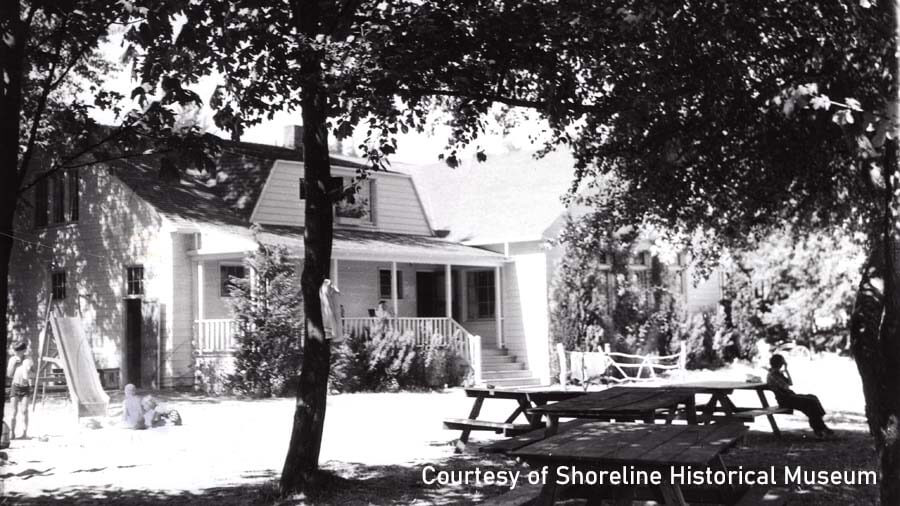
    The picture of the club house is how it looked in 1947. It is courtesy of the Shoreline Historical Museum. Earlier pictures show it a dark color in black and white photos, possibly brown. This original club house building burned down the same time the dedication service for the current Redeemer church building was happening.

    Church of the Redeemer logo

    Church of the Redeemer

    Welcome to Church of the Redeemer: Worshiping God, living in community, and reaching out to the world. We are an Episcopal Church serving north King County and south Snohomish County, Washington. As you travel your road, go with friends walking the way of Jesus at Redeemer.

    Church of the Redeemer is at 6220 Northeast 181st Street in Kenmore, Washington. We are a short distance north of Bothell Way, near the Burke-Gilman Trail. The entrance looks like a gravel driveway. The campus is larger on the inside than it is on the outside. And we managed to hide a large building on the side of a hill that is not easily seen from the street.

    The Episcopal Church welcomes you.
  • Staff changes at Church of the Redeemer

    Staff changes at Church of the Redeemer

    Several key staff changes are taking place in January 2022 at Church of the Redeemer in Kenmore, Washington.

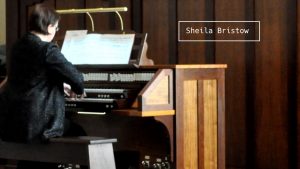
    Sheila Bristow

    Sheila Bristow

    As the book of Ecclesiastes says, “To every time there is a season, and a time to every purpose under heaven.” And now it is time for us to say goodbye to our Organist and Choirmaster, Sheila Bristow.

    Sheila has been offered a wonderful opportunity at another church and has decided, after much discernment, to accept this new call, beginning in February.

    Sheila’s last Sunday at Redeemer will be January 23.

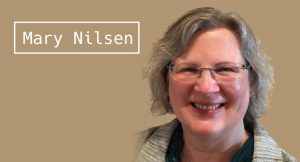
    Mary Nilsen

    Mary Nilsen

    This month will also mark a change in the Children and Family Ministry program at Redeemer. Due to a serious health issue, Mary Nilsen has resigned her position as Coordinator of the program to focus fully on extensive treatment ahead and regaining her health. This change will include Mary and Eivind leaving Redeemer to be able to worship closer to their home. Mary plans to report on the program at the Annual Meeting on the January 23.

    Church of the Redeemer

    Church of the Redeemer: Worshiping God, living in community, and reaching out to the world around us. We are an Episcopal Church serving north King County and south Snohomish County. We welcome you be with us as we walk the way of Jesus.

    Church of the Redeemer is at 6220 Northeast 181st Street in Kenmore, Washington. We are a short distance north of Bothell Way, near the Burke-Gilman Trail. The entrance looks like a gravel driveway. The campus is larger on the inside than it is on the outside. And we managed to hide a large building on the side of a hill that is not easily seen from the street.

    The Episcopal Church welcomes you.
  • In-person service cancellation for January 9-23, 2022

    In-person service cancellation for January 9-23, 2022

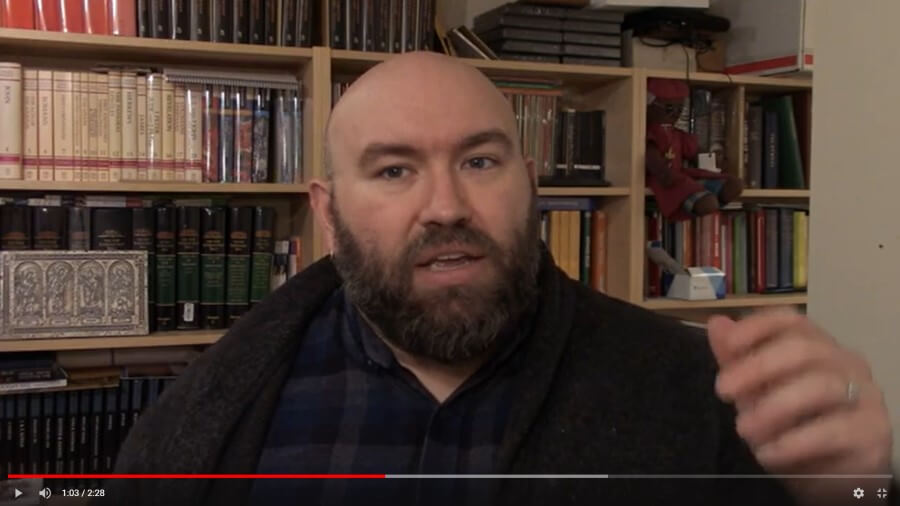
    This is Fr. Jed Fox’s announcement regarding a temporary cancellation of in-person worship services at Church of the Redeemer.

    Please accept YouTube cookies to play this video. By accepting you will be accessing content from YouTube, a service provided by an external third party.

    YouTube’s privacy policy

    If you accept this notice, your choice will be saved and the page will refresh.

    Hi, I’m Father Jed, the Rector of the Church of the Redeemer in Kenmore, Washington.

    I’m coming to you today with some news that I was hoping I wouldn’t have to do again. But if you’ve looked at the news and at the COVID numbers in King County, you’d probably guess what it might be.

    Because of the Omnicom variant, and its very high transmissibility and the damage it can do to communities in a very short amount of time, we are going to suspend in-person worship at the Church of the Redeemer for the next three Sundays. So that is January 9th, January 16th, and January 23rd.

    Now there is a hidden silver lining in that January 23rd is our annual meeting. And if you were planning on attending the Church of the Redeemer in-person on the 23rd and worrying how you’re going to get home by 11:30 for the virtual annual meeting, you don’t have to worry about that anymore!

    But joking aside, this is something that I was hoping we would not have to do, but this is where we’re at and this is the right thing to do to keep our community safe and to do our part to keep the greater community as safe and healthy as possible.

    I hope that it will only be for three weeks. My prayer is that it will only be for three weeks, and if and when it ends, I will look forward to putting out another video saying that, “Hey, we’re returning to in-person worship,” at that point.

    I hope also that in the very near future, I’ll have some other good news to share, and that will be coming to you again very soon with that good news.

    But until then, please know that you all are in my prayers. And I hope that I, and everyone at the Church of the Redeemer is in yours as well. God willing, this will come to an end, and we will be able to see each other again.

    And until then, may God’s blessing me with you. Christ’s peace be with you and the Spirit’s out-pouring be with you. Amen.

    The Rev. Jedediah (Jed) Fox

    The Rev. Jedediah (Jed) Fox has been the rector of Church of the Redeemer since January 2015. Prior to being called to Redeemer, Fr. Jed served as curate and assistant at The Church of St. Michael and St. George in St. Louis, Missouri, and was a seminarian at the Church of St. Mary the Virgin while attending the General Theological Seminary. Fr. Jed was raised at St. Peter’s Cathedral in Helena, Montana.

    Jed, along with his family, enjoy being outdoors, reading, and travel. He has also tried his hand at woodworking, various musical instruments, and triathlon.

    You may contact Fr. Jed at rector@redeemer-kenmore.org.

    Church of the Redeemer

    Welcome to Church of the Redeemer: Worshiping God, living in community, and reaching out to the world. We are an Episcopal Church serving north King County and south Snohomish County, Washington. As you travel your road, go with friends walking the way of Jesus at Redeemer.

    Church of the Redeemer is at 6220 Northeast 181st Street in Kenmore, Washington. We are a short distance north of Bothell Way, near the Burke-Gilman Trail. The entrance looks like a gravel driveway. The campus is larger on the inside than it is on the outside. And we managed to hide a large building on the side of a hill that is not easily seen from the street.

    The Episcopal Church welcomes you.
  • My church: stewardship campaign for 2022

    My church: stewardship campaign for 2022

    This is the 2022 pledge card and stewardship message from Church of the Redeemer in Kenmore, Washington.

    Church School participating in the offertory procession in 2018

    Father Jed speaks about stewardship

    I would say that it has been a strange year, but that seems alike a vast understatement. Nearly 24 months into a worldwide pandemic, having a stewardship campaign in the midst of Advent and Christmas is just one more odd thing piled upon many others.

    Many people call this the season of giving, so it seems like a good time to talk about financial stewardship and giving to Church of the Redeemer as part of our giving back to God in gratitude.

    St. Paul tells us that God loves a cheerful giver, not to remind us that God plays favorites, but that God’s love resides in us more fully, more completely, when we give as God does gladly, exuberantly even, and of course abundantly.

    I hope that you will join me in giving back to God and God’s work, and especially in that work at Church of the Redeemer – and having a little fun with this year’s pledge card.

    Please return your pledge card to Church of the Redeemer by January 9, 2022. Returning pledge cards early will make it easier for us to plan our ministry for the coming year.

    Father Jed Fox

    Sunday service in the Memorial Garden in 2021

    Stewardship pledge card

    In each text box, type what word you think belongs in the blank in the following line.

    When I tell people that I attend Church of the Redeemer they always seem a little __________ .
    “That ________ church in Kenmore…
    …that looks like a ____________ ?” they ask. “What’s that place like?”
    I ________ tell them that Redeemer…
    …is a really _________ church and…
    …the people are _____________ , too.
    Even the priests and staff are _____________ .
    When I explain what I like best about Redeemer, I mention the _______________ …
    …and the ________________ .
    That’s what makes it such a ______________ place for me.
    They exclaim, ” ___________________, …
    …it sounds like a _________________ church! What does it take to make it happen?”
    “Well, we need ________________ people…”
    …and a [an] _______________ budget of $280,525.00,” I answer.
    “Reaching that goal will require a 11% increase in our pledging this year as a parish. And I realize that without my _____________________ ,…
    …the church couldn’t possibly ________________…
    …such __________________ ministries.
    And that’s why this year, I’m going to _______________ pledge…
    $_________________ to Church of the Redeemer for 2022.
    As part of my commitment to Redeemer and the work of God, I also want to be ___________________ …
    …to be involved in __________________ …
    …and _____________________ as we move back into the building in 2022.
    I ___________________ look forward to being part of…
    …this __________________ church community in 2022.” “Wow,” they say, “I think I’m coming to church with you this Sunday!”
    Name
    Email

    A copy of the pledge card should arrive to you by email. Please sign and return a copy to Redeemer.

    Bishop Rickel at reception after service in 2021

    Church of the Redeemer

    Welcome to Church of the Redeemer: Worshiping God, living in community, and reaching out to the world. We are an Episcopal Church serving north King County and south Snohomish County, Washington. As you travel your road, go with friends walking the way of Jesus at Redeemer.

    Church of the Redeemer is at 6220 Northeast 181st Street in Kenmore, Washington. We are a short distance north of Bothell Way, near the Burke-Gilman Trail. The entrance looks like a gravel driveway. The campus is larger on the inside than it is on the outside. And we managed to hide a large building on the side of a hill that is not easily seen from the street.

    The Episcopal Church welcomes you.
  • 2021 Stewardship Campaign with Susan Switzer

    2021 Stewardship Campaign with Susan Switzer

    This is Susan Switzer speaking on behalf of the 2021 Stewardship Campaign at Church of the Redeemer.

    Please accept YouTube cookies to play this video. By accepting you will be accessing content from YouTube, a service provided by an external third party.

    YouTube’s privacy policy

    If you accept this notice, your choice will be saved and the page will refresh.

    Hi, my name is Susan Switzer and I have been a member of Redeemer my entire life. During these past two years during the pandemic, it’s become really clear to me what is important to me about Redeemer and why I continue to pledge. The first is that Redeemer is a place for me to continue to grow my faith, but it has also been a constant during the pandemic that I can rely on weekly for my worship services, be it remotely or in person now. And having that constant has been very comforting during the pandemic.

    The second is our congregation. We have an extremely supportive and encouraging congregation. And during the pandemic, I have been lucky enough to be in a small group that has met weekly via Zoom, and it has become a place where I know I can receive encouragement and support. And they are some of the people that I have seen the most of during the pandemic and has become something that I look forward to every week.

    The third is the outreach that our church has done, has always done, and has continued to do helping those who in our own community have been experiencing housing insecurity: being able to help with food, with back-to-school supplies. All those things have been important, not only to me, but also to my children to help others who may be in need.

    So, these are the reasons that I pledged to Redeemer: so that we continue to be a place for people to receive comfort, to receive help, and for us to be able to help and serve each other and our local community.

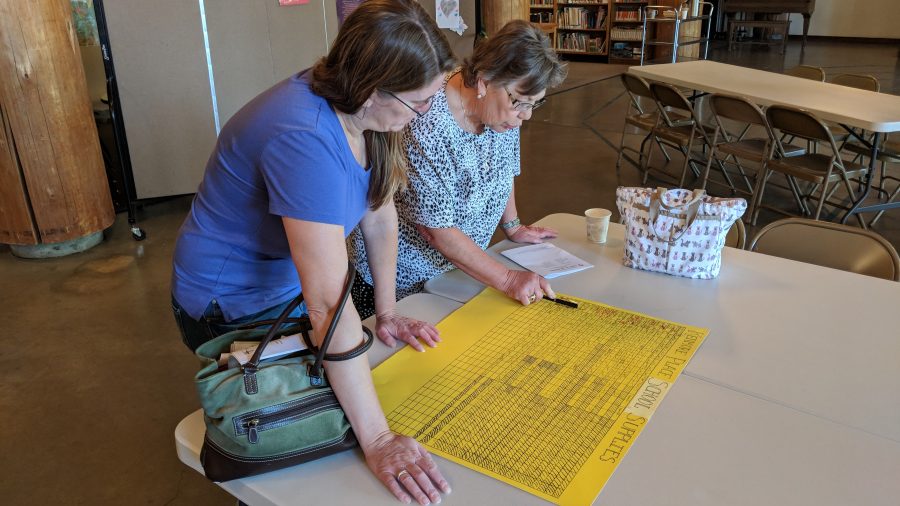
    Susan Switzer and Deb Randall reviewing the requests and items donated on Sunday, September 2, 2018, for the 2018 School Supply Drive
    Susan Switzer and Deb Randall reviewing the requests and items donated on Sunday, September 2, 2018, for the 2018 School Supply Drive

    Church of the Redeemer

    Welcome to Church of the Redeemer: Worshiping God, living in community, and reaching out to the world. We are an Episcopal Church serving north King County and south Snohomish County, Washington. As you travel your road, go with friends walking the way of Jesus at Redeemer.

    Church of the Redeemer is at 6220 Northeast 181st Street in Kenmore, Washington. We are a short distance north of Bothell Way, near the Burke-Gilman Trail. The entrance looks like a gravel driveway. The campus is larger on the inside than it is on the outside. And we managed to hide a large building on the side of a hill that is not easily seen from the street.

    The Episcopal Church welcomes you.
  • 2021 Stewardship Campaign with Fr. Jed Fox

    2021 Stewardship Campaign with Fr. Jed Fox

    Introducing the 2021 Stewardship Campaign at Church of the Redeemer is our rector, the Rev. Jed Fox.

    Please accept YouTube cookies to play this video. By accepting you will be accessing content from YouTube, a service provided by an external third party.

    YouTube’s privacy policy

    If you accept this notice, your choice will be saved and the page will refresh.

    Hi, I’m Father Jed Fox, Rector of the Church of the Redeemer in Kenmore, Washington. I want to wish you a happy Advent and a happy stewardship season.

    It might seem a little strange to be doing stewardship in Advent, but maybe it makes a little bit of sense. After all this is considered by many to be a season of giving and, as Christians, we often give in response to God’s gift to us. The gift of Jesus that we celebrate in this coming season of the Incarnation. The season that we look to with expectancy in Advent.

    We give in gratitude.

    And one of the reasons that I am giving this year is in gratitude for all of you at the Church of the Redeemer.

    As many of, you know, my father died tragically in October and since his death, through the grief that my family and I have been working through, the Church of the Redeemer has been a great font of grace and love and support to us as we have moved through the grief process. We’re so grateful for all of you who have reached out, who have shared your condolences and your prayers, who have prayed for us as we live in our grief.

    Giving is, at its very essence, a response with all that we have in all that we are to the gift that God has given us of our life and especially of Jesus. And we give back to God and God’s work, all of it, but especially this year, my family will be giving to Redeemer in gratitude for all that Redeemer has given us.

    I hope that you will join us in this, in the steward[ship], in this giving in stewardship season. You should be receiving a letter and a pledge card in the mail.

    It’s going to be a little bit different this year. We’re going to have a little bit of fun with our pledge card this year. So please be on the lookout for that. And I hope that you will join with us in a season of expectation in this Advent, a season of giving in this pledge campaign, and that you will know God’s grace and mercy and love in your life and the life of those around you.

    Amen.

    Giving Thanks

    Church of the Redeemer

    Welcome to Church of the Redeemer: Worshiping God, living in community, and reaching out to the world. We are an Episcopal Church serving north King County and south Snohomish County, Washington. As you travel your road, go with friends walking the way of Jesus at Redeemer.

    Church of the Redeemer is at 6220 Northeast 181st Street in Kenmore, Washington. We are a short distance north of Bothell Way, near the Burke-Gilman Trail. The entrance looks like a gravel driveway. The campus is larger on the inside than it is on the outside. And we managed to hide a large building on the side of a hill that is not easily seen from the street.

    The Episcopal Church welcomes you.

Funeral for the Rev. Canon John Fergueson, Saturday, March 2, 2026, at 10:00 am in Church of the Redeemer. Additional parking available at The Vine Church across 181st Street from Redeemer.

The 6th Sunday of Easter (Year A), May 10, 2026. Services at 8:00 am (no music) and 10:30 (music). Xristos Kuxwoo-digoot! Xegaa-kux Kuxwoo-digoot!

Episcopal Church of the Redeemer
Privacy Overview

Cookie information is stored in your browser and performs functions such as recognizing you when you return to our website and helping our team to understand which pages of the website are visited. We aren't using cookies to determine your web browsing habits, but others can.