This is the discussion that took place when choosing Church of the Redeemer as the name for the new mission congregation that the North Shore Episcopal Fellowship was starting in 1947. The text (with light editing) was taken from “Redeemer before Redeemer” by Margaret Banks, found in Redeemer: The First Fifty Years.
This is one of several posts celebrating the 75th anniversary of Church of the Redeemer.
Naming Church of the Redeemer
They met again on February 10, [1947,] with many things to plan….
They felt they should choose a name at this meeting, as the first service was to be on the following Sunday and somehow it did not occur to them that they could start services without a name.
They recalled the advice Bishop Huston had given, and sure enough, someone felt there was no name like Saint James, the name of a church they loved in the East. Church of the Redeemer and St. Michael and All Angels also were suggested, as being completely different from any in the diocese at that time, or the Roman Catholic ones.
All were discussed and then voted on by written ballot. The count was four for Saint James, four for Church of the Redeemer. A little more discussion followed, and no one seemed inclined to move any action co break the tie.
Mr. Mohr called Diana, the Banks’ 12-year-old daughter, who had been reading in a corner of the room. She came forward.
“Diana,” said Mr. Mohr, “we are trying to decide the name for this new mission we are starting. Now, this church is more your church than ours, because you and your sister, Karen, and your friends will be here attending it after all of us are gone, So I feel it only fair that you should have a voice in naming the mission. Of these two names, which do you prefer?”
Diana stood still a moment, thinking it over in her serious child’s way, and then she said, “I like Church of the Redeemer. “
A short discussion followed as to whether the name should be “Church of the Redeemer” or “[Church of] Our Redeemer.” Mr. Mohr said that many other churches carried the name as “Our” and he said, “I always have felt that this implied an attempt at exclusiveness, as though claiming Him for theirs alone.” So, it was thought best to leave it as the Church of the Redeemer.
Church of the Redeemer
Welcome to Church of the Redeemer: Worshiping God, living in community, and reaching out to the world. We are an Episcopal Church serving north King County and south Snohomish County, Washington. As you travel your road, go with friends walking the way of Jesus at Redeemer.
Church of the Redeemer is at 6220 Northeast 181st Street in Kenmore, Washington. We are a short distance north of Bothell Way, near the Burke-Gilman Trail. The entrance looks like a gravel driveway. The campus is larger on the inside than it is on the outside. And we managed to hide a large building on the side of a hill that is not easily seen from the street.
This describes the initial organ installation and later improvements at Church of the Redeemer. A large portion of the information comes from “A Sense of Place” by Eleanor Pachaud, and “An Involved Parish” by Derek Schwede found in Redeemer: The First Fifty Years. Additional information came from the Pipe Organ Database of the Organ Historical Society. There was light editing to make it easier to read in an online format.
This is one of several posts celebrating the 75th anniversary of Church of the Redeemer.
The original organ installation
Three months after the dedication of the new building, on March 5, 1965, Father Coulter signed the purchase order for our organ through Balcolm and Vaughan Pipe Organs, Inc.
The pipe organ was funded by a donation from parishioners Robert and Eleanor Dent, and the ceremonial Spanish Trumpets were given by Father Coulter. Parish funds covered the construction of the choir platform and the construction of the organ chamber.
The organ and its installation would cost $16,579.84. The organ had a grand total of 22 ranks, 34 stops, and 1,279 pipes.
Responsibility of work
The contract that was signed stated that Balcolm and Vaughan was responsible for the installation, tuning, and finishing, making certain that the instrument was completely ready to play. Redeemer was responsible for everything else:
The Church is to be responsible for preparing the space necessary for the organ, blower, and console. The church is also to install suitable electrical service and wiring starters from the blower motor and rectifier to the console, and to supply any openings for cable, tin line, and interior entry, at a time designated by the organ builders. If the blower must be in a remote location, the church also assumes responsibility for such tin line work.
In essence, we had to do all of the electrical and architectural work necessary to install the organ. Because of this, there were a few minor details that were ignored.
The organ chamber, for instance, was built without formal plans, was never certified by an engineer, and was never determined to comply with local building codes.
Another oversight was the electrical wiring for the light on the console. This problem could not be fixed by Balcolm and Vaughan because it was not in their contract; and there was no appropriate outlet for lights. This problem was solved by means of an extension cord to a nearby outlet, and was finally wired properly in 1994, after the church was informed that the thirty-year-old extension cord did not meet electrical code standards.
Despite the delays, the organ was constructed in about ten months’ time, and the dedication was held on December 19, 1965, one year after the completion of the building.
Dedication
The ceremony was led by Bishop Ivol Curtis and Father Coulter and included both the dedication of the organ and the confirmation of over thirty people. As a celebration of the new organ, a recital was included in the ceremony with pieces by J, S. Bach, Dietrich Buxtehude, Louis Claude Daquin, Valentin Rathgeber, Jean Langlais, Dom Paul Benoit, Francis Jackson, and Henry Purcell.
The recital was played by Eugene M, Nye, the tonal director of Balcolm and Vaughan Organs.
Organ renovations
Redeemer’s own musical instrument, the organ, was never fully completed. Though many parts of it had been replaced and repaired since 1987 (including a re-voicing of the instrument in 1988), many parts of the organ continued to wear out and become unusable.
The renovation of the organ began with the work of a committee in 1995, which included Don Bentley, Bill Bissell, Peter Camp, Walter Knowles, Laina Molbak, Allen Moses, Doug Oles, and Randie Sidlinger.
Options considered
The committee looked at the present condition of the organ and evaluated several possible courses of action, including:
Removing the organ and replacing it with either a new pipe or electronic organ.
Renovating the organ and making major improvements.
Making only minor modifications to keep the organ playable.
Doing nothing at all.
After many meetings, the committee recommended a plan which would:
Remove the organ from its present location.
Rebuild large portions of the organ’s action while preserving most of the organ’s original pipework.
Reinstall the organ in a floor-standing case.
This change in position would improve the organ as an instrument to help lead congregational singing, by focusing the organ’s tone. In addition, providing swell enclosures on some ranks would allow more control over the volume.
The firm of Bond Organ Builders in Portland, Oregon, was chosen to carry out the work.
Fundraising
The 1996 Parish Festival served as the official start of the fundraising campaign and featured a hymn-sing accompanied by a portable organ built by Bond Organ Builders. The successful fund drive ended in the late fall of 1996 after raising over $180,000, which is more than the present building cost at the time of its construction.
The funds were once again provided entirely by members of the parish in donations of many sizes. The donations included a few large contributions, but the bulk of the money was given by the average members and families of the parish.
The contract to renovate the organ was signed on Palm Sunday 1997, and construction began in early summer of that year.
Dedication
The 50th anniversary remembrance was published before the renovations were completed on the organ, so it did not cover its dedication. However, the Pipe Organ Database has information on the dedication:
The organ was dedicated on February 22, 1998, in an evensong service which began with 30 minutes of organ music played by Music Director/Organist, and Associate Rector Rev. Walter Knowles. The music performed in this pre-evensong recital was chosen to demonstrate the wide range of sound the renewed organ is capable of.
Organ Specifications for each build
Here are the organ specifications for each build: Balcom & Vaughan initial installation, Bond rebuild, and Bond new console.
Pedalboard Type: Concave radiating pedalboard meeting AGO Standards.
Has Crescendo Pedal
Has Combination Action Thumb Pistons
Has Coupler Reversible Toe Pistons
Division
Length
Name
Pipes
Hauptwerk
8
Prestant
49
8
Rohr Floete
61
8
Spitz Gamba (OW)
—
4
Oktav
61
4
Spill Pfeife
61
2-2/3
Quint (OW)
12
2
Flach Floete
61
1-3/5
Terz (OW)
—
IV
Fourniture 19-22-26-29
244
8
Spanische Trompete
61
8
Cromorne
61
Chimes (prep)
—
Haupt. to Haupt. 16′
Haupt. Unison Off 8′
Haupt. to Haupt. 4′
1
blank, black stoptablet
Oberwerk
8
Gedackt Floete
61
8
Spitz Gamba
61
8
Schwebung (tc)
49
4
Weit Prinzipal
61
4
Quintade
61
2
Gemshorn
61
1-1/3
Nasat
61
8
Fagott
61
Tremulant
Zimbelstern
8
Spanische Trompete (HW)
—
Ober. to Ober. 16′
Ober. Unison Off 8′
Ober. to Ober. 4′
1 blank, black stoptablet
Pedal
16
Subbass (OW)
12
16
Zart Bass
—
8
Kupfer Prinzipal
32
8
Gedackt (OW)
—
8
Spitz Gamba (OW)
—
4
Koral Bass
12
4
Spill Floete (HW)
—
2
Hell Pfeife (HW)
—
II
Quint Mixtur 22-26
64
16
Fagott Bass
12
8
Fagott (OW)
—
4
Fagott (OW)
—
4
Cromorne (HW)
—
1 blank, black stoptablet
The totally unenclosed organ was located at the rear of the church, cantilevered high off of the back wall.
On the Hauptwerk, notes 1-12 of the 8′ Prestant are borrowed from the Pedal 8′ Kupfer Prinzipal, which forms the primary portion of the façade. The 8′ Spanische Trompete is mounted en-chamade off of the back wall above the other pipework. The 2-2/3′ Quint is a 12-pipe bass extension of the Oberwerk 1-1/3′ Nasat. The 1-3/5′ Terz is derived from the Oberwerk 2′ Gemshorn. The Terz plays for 57 notes before breaking back to 3-1/5′ pitch on note A 58.
On the Pedal, the Pedal 16′ Subbass is an extension of the Oberwerk 8′ Gedackt Floete. The pipes are made of mahogany and were built in the Balcom & Vaughan shop. The 16′ Zart Bass is the same as the 16′ Subbass, but with notes 1-12 on soft wind. The 2′ Hell Pfeife is a borrow of the Hauptwerk 2′ Flach Floete.
The Zimbelstern of 4 bells has a speed control with a toggle switch. In the center position, the zimbelstern is off even when the stoptablet is registered. In the left position, it plays on fast, and in the right position it plays on slow.
The console manuals are reverse color with ebony naturals, and sharps of rosewood with ivory caps.
Sources: Balcom & Vaughan opus list and files; and James R. Stettner on December 16, 2012.
Bond rebuild and console
Balcom & Vaughan Pipe Organs, Opus 739, 1965; Bond Pipe Organs, 1998, Rebuild with Additions (Information from the Pipe Organ Database of the Organ Historical Society). In this rebuild, the original console was retained until 2014. The console replacement changed the stoplist.
Technical Details
Chests: Slider with direct-electric pull-downs (externally mounted)
Swell Control Type: Balanced swell shoes/pedals, AGO standard placement.
Pedalboard Type: Concave radiating pedalboard meeting AGO Standards.
Has Combination Action Thumb Pistons
Has Combination Action Toe Pistons
Has Coupler Reversible Toe Pistons
Divisions
Chest Type(s): Slider with direct-electric pull-downs (externally mounted) chests
Position: In a gallery-level case at the rear of the room.
Division
Length
Name
Pipes
Hauptwerk
8
Prestant
49
8
Rohr Floete
61
Blank
4
Oktav
61
4
Spill Pfeife
61
2-2/3
Quint
12
2
Flach Floete
61
1-3/5
Terz
—
IV
Fourniture 19-22-26-29
244
8
Fagott (OW)
—
Zimbelstern
—
Haupt. to Haupt. 16′
Haupt. Unison Off 8′
Haupt. to Haupt. 4′
1 blank, black stoptablet
Oberwerk
8
Gedackt Floete
61
8
Spitz Gamba
61
8
Schwebung (tc)
49
4
Weit Prinzipal
61
4
Quintade
61
2
Gemshorn
61
Blank
8
Trumpet
61
8
Fagott
61
8
Cromorne
61
Tremulant
Ober. to Ober. 16′
Ober. Unison Off 8′
Ober. to Ober. 4′
1 blank, black stoptablet
Pedal
16
Principal
32
16
Subbass
32
8
Kupfer Prinzipal
12
8
Gedackt
12
Blank
4
Koral Bass
32
Blank
Blank
II
Quint Mixtur 22-26
64
16
Fagott Bass
12
8
Fagott (OW)
—
Blank
Blank
1 blank, black stoptablet
This organ as originally built by Balcom & Vaughan was also located at the rear of the church and was cantilevered high off of the back wall.
In the rebuild work by Bond Pipe Organs, the original cantilevered chests were removed, and the organ was placed in a new free-standing case of dark Peruvian walnut – styled after Greene & Greene.
Existing pipework was rescaled, revoiced, and the wind pressure was raised. The manual divisions were placed atop new electro-pneumatic, slider windchests with electric slider motors. Only the 8′ Fagott, which is borrowed to the Hauptwerk, is located on an electro-pneumatic unit chest.
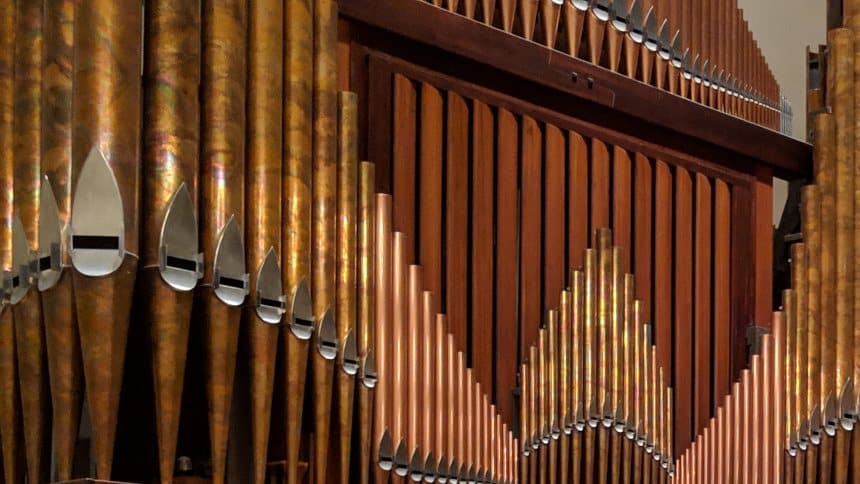
The lower façade is comprised entirely of Pedal pipes. The flamed copper pipes at the corner and in the center are from the 16′ Principal/ 8′ Kupfer Prinzipal unit of 44 pipes, which are entirely new. The polished copper pipes between the center and corners are 30 pipes from the 4′ Koral Bass. Pipes 31 and 32 are directly behind the façade on the right side. The first 6 pipes of the Pedal 16′ Subbass are in the side façades. 12 of the 32 16′ Subbass pipes are from the Balcom and Vaughan instrument. The entire Pedal division is diatonically divided with the left side being the C side and the right side being the sharp (♯) side. The Pedal II Quint Mixtur is on the right side between the façade and the swellbox, and is on a chromatic chest. The unenclosed 16′ Fagott Bass extension is on the left side between the façade and the swell-box. The entire Pedal division is on electro-pneumatic unit chests. The pedal is prepared for the addition of a 16′ Posaune.
The Oberwerk is housed in the new swellbox which is surrounded by the pedal division. All three original reeds from the Balcom & Vaughan were moved to the enclosed Oberwerk during the rebuild. The Oberwerk is prepared for the addition of a III Scharf.
The Hauptwerk is located atop the Oberwerk swellbox and has all 61 pipes of the 8′ Prestant in the façade with the other ranks behind it. The 1-3/5′ Terz is new pipework – the old one having been derived from the OW 2′ Gemshorn. The Hauptwerk is prepared for the addition of a 2′ Super Octav and an 8′ Trumpet.
The Zimbelstern of 4 bells has a speed control with a toggle switch. In the center position, the zimbelstern is off even when the stoptablet is registered. In the left position, it plays on fast, and in the right position it plays on slow.
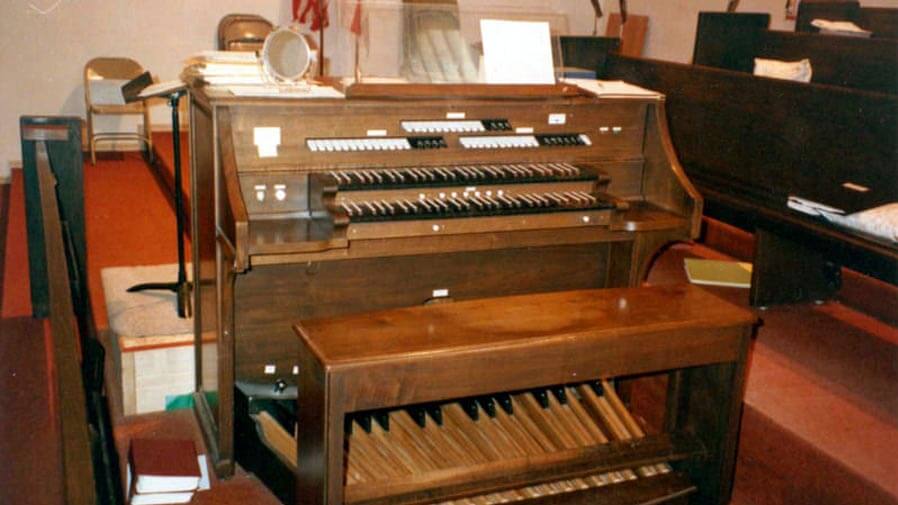
The original console was retained. The manuals are reverse color with ebony naturals, and sharps of rosewood with ivory caps.
Sources: Bond opus list and files; and from James R. Stettner, December 16, 2012.
2014 console replacement
Bond Pipe Organs Inc. (2014), originally Balcom & Vaughan Pipe Organs (Opus 739, 1965). (Information from the Pipe Organ Database of the Organ Historical Society).
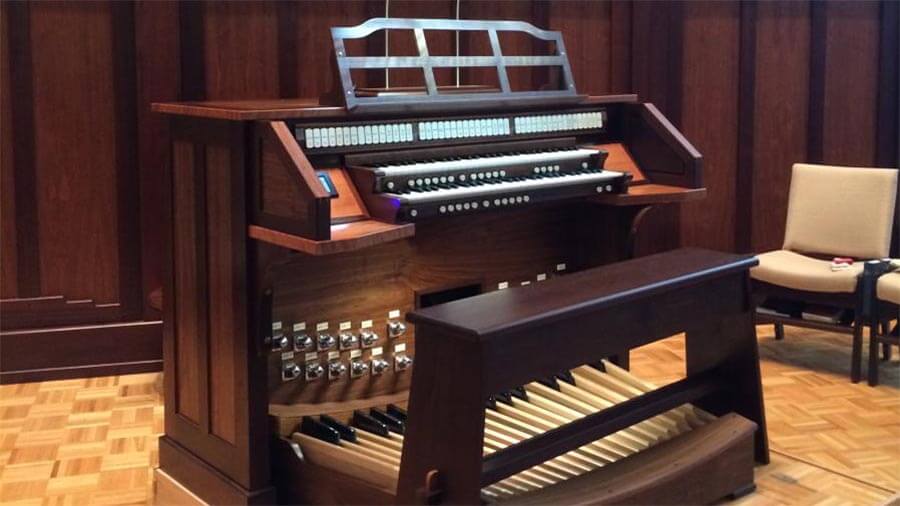
Bond’s rebuild in 1998 retained the original 1965 console. A new console and switching system have now been installed. The stoplist has been slightly revised and the new control system provides multiple-memory combination action with sequencer, record-playback, and transposer. Some preparations for future additions are included. The console is of Peruvian walnut with madrone accents.
Technical Details
Chests: Slider with electro-pneumatic (EP) pallets (Blackinton-type)
Swell Control Type: Balanced swell shoes/pedals, AGO standard placement.
Pedalboard Type: Concave radiating pedalboard meeting AGO Standards.
Has Tutti Reversible Thumb Pistons
Has Tutti Reversible Toe Pistons
Has Combination Action Thumb Pistons
Has Combination Action Toe Pistons
Has Coupler Reversible Thumb Pistons
Has Coupler Reversible Toe Pistons
Has a Piston Sequencer
Division
Length
Name
Pipes
Great
8
Principal
61
8
Rohrflöete
61
4
Octave
61
4
Spillpfeife
61
2-2/3
Nasat
12
2
Superoctave
61
1-3/5
Terz
61
Mixture IV
244
8
Fagott (swell)
—
Zimbelstern
4 bells
Great to Great 16′
Great Unison Off
Great to Great 4′
Swell to Great 16
Swell to Great 8
Swell to Great 4
Swell
8
Gedacktflöete
61
8
Spitz Gamba
61
8
Schwebung (tc)
49
4
Weit Prinzipal
61
4
Quintade
61
2
Gemshorn
61
Sharf III
183 pipes
16
Fagott
73
8
Trumpet
61
8
Fagott
Ext.
8
Krummhorn
61
Tremulant
Swell to Swell 16′
Swell Unison Off
Swell to Swell 4′
Pedal
32
Resultant
From Subbass
16
Principal
44
16
Subbass
44
8
Octave
Ext.
8
Choral bass
Ext.
Mixture II
64
16
Fagott
From Swell
8
Fagott
From Swell
4
Fagott
From Swell
Great to Pedal 8’
Great to Pedal 4’
Swell to Pedal 8’
Swell to Pedal 4’
12
Church of the Redeemer
Welcome to Church of the Redeemer: Worshiping God, living in community, and reaching out to the world. We are an Episcopal Church serving north King County and south Snohomish County, Washington. As you travel your road, go with friends walking the way of Jesus at Redeemer.
Church of the Redeemer is at 6220 Northeast 181st Street in Kenmore, Washington. We are a short distance north of Bothell Way, near the Burke-Gilman Trail. The entrance looks like a gravel driveway. The campus is larger on the inside than it is on the outside. And we managed to hide a large building on the side of a hill that is not easily seen from the street.
This describes the construction of the current church building by congregants of Church of the Redeemer completed in 1964. The text (with light editing to work better in an online format) and pictures were taken from “A Sense of Place” by Eleanor Pachaud, found in Redeemer: The First Fifty Years.
This is one of several posts celebrating the 75th anniversary of Church of the Redeemer.
Building the current church building
On May 5, 1957, the Reverend C. Roy Coulter became the new vicar at Redeemer. He had previously held the position of curate at Trinity Episcopal in Seattle, and would take the place of the Reverend Richard McGinnis, who would go to Trinity Episcopal to serve in Father Coulter’s former position.
Before coming to Redeemer, Father Coulter spent a summer working for St. Paul’s Episcopal Church in Seattle, and some time doing missionary work in Haiti. He was twenty-six years old upon coming to Redeemer.
Building fund created
On a financial note, during the end of 1955, we held a congregation-wide canvass to start a building fund. This canvass was the last major capital funds drive at Redeemer until the renovation of the pipe organ, over forty years later.
For this canvass, the slogan was “We know that our greatest need is not…’how much our church needs,’ but rather ‘how much we need to give,’” It was a three-year process where the head of each family sat down with a Canvass Leader to discuss how much of a financial sacrifice was to be made, since this sacrifice would strengthen the faith of both the family and the church.
Designing the new building
On June 16, 1960, we received the opportunity to put the fruits of our capital funds drive to their intended use: the architectural firm of Terry and Moore sent Redeemer a letter proposing to set up a contract for the construction of a new building.
The firm included as a partner the noted Seattle architect, Roland Terry, who had been responsible for the architectural planning of several Seattle-area buildings, including the Canlis Restaurant on Queen Anne, and the residence of Seattle Times owner William Blethen.
They also said that they had always wanted to design a church, and this was the perfect opportunity.
A year later, an estimate and a contract had been drawn up. The original cost estimate specified $144,140 for the building development, $10,300 for the property development, and $5,000 for special artwork (like the doves that are currently in the baptistry.) The total estimate was for $159,440.
Less than a month after this figure was drawn up, Father Coulter received a letter from the bishop:
[The diocese is] much concerned with the talk of a building to cost between $150,000 and $200,000 when not more than $25,000, if that, is available in cash and not actually enough to pay the architect. Since Redeemer is a mission, any such outlay of costs must be cleared with [the bishop], the Department of Missions, and both the Bishop’s Committee and the architect ought to understand clearly that no contracts can be signed except with the approval of the Diocesan Council on the recommendation of the Department of Missions.
Obviously, this was no small matter, and it appeared that Redeemer was about to take a plunge into deep debt. The contract was signed anyway.
Later, in an attempt to control the debt, some modifications were made to the original architectural design.
The height of the building was lowered by five feet, and its length was shortened by fifteen feet, roughly the distance between two columns in the sanctuary.
The choir loft was taken out (it would have sat about ten feet below where the organ loft is now), as well as the stairway that was supposed to go up to it. This stair would have been where the baptistry is now, and the baptistry would have been under the choir loft.
The narthex was also redesigned, eliminating an extra set of restrooms and coatroom space.
These changes lowered the cost to about $114,000.
In the spring of 1964, construction began, against the diocese’s wishes. Construction took roughly nine months with the help of hours and hours of volunteer time by the congregation.
Building the new building
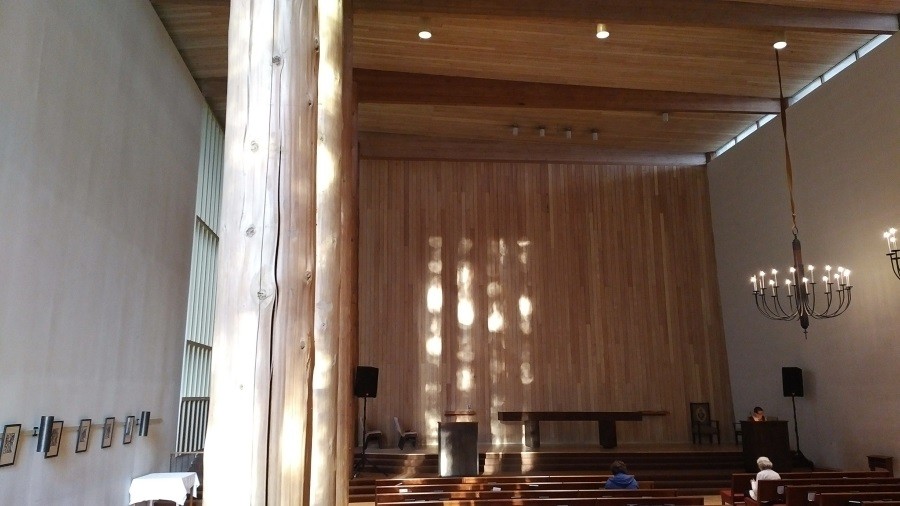
Because of its unique design, the construction project faced its own set of challenges. The huge wooden pillars extend from the foundation to the roof and are constructed from single trees. Each pillar was hand-picked and approved at the mill by Roland Terry. Since the pillars had to be put into place first, there was a short period before the structure was sufficiently braced when, in the words of one observer, “if there had been a windstorm, the building would probably have fallen down. “
Once the main building was in place, the next task was to gather all of the furnishings necessary to turn the large, vacant building into a house of worship. Many of these where donated or built on volunteer time.
One especially important volunteer was Robert Thompson. He served as the design coordinator and the building committee chairman. He personally designed the pulpit, altar, lectern, cross, wall sconces, and lighting fixtures.
The altar, altar rail, and lectern were all donated by Bill Martin, a member of the congregation at the time.
The cross from the old building was transferred to the chapel of the new building, and a large, sixteen-foot gold-painted wooden cross was hung above the altar.
All of the pews were donated as memorials, and an anonymous donor donated the large bronze bowl that sits in the baptistry. The bowl was cast in the fifteenth century for Lorenzo de Medici and it bears his portrait and coat of arms.
The planting and landscaping outside the building was provided by Laina and Egon Molbak, founders of Molbak’s Greenhouse and longtime members of the mission.
The final major contribution was made by one family who pledged $16,000 for a full-range twenty-two rank organ to be built two years later. A smaller six-rank organ was donated for temporary use at the dedication.
Dedicating the new building
The dedication of the new building was on Sunday, December 20th, 1964. It was a huge affair described by articles in Eastside newspapers, with no less than five members of the clergy present for the occasion.
The bishop, The Right Reverend Ivol Curtis, presided over the ceremony
The Venerable Paul Langpaap, the rector of Trinity Parish Church and Archdeacon of Seattle
The Reverend Ernest Radcliffe, curate of St. Paul’s in Seattle
The Reverend John Thomas, the vicar of St. John’s in Gig Harbor
The junior and senior wardens of Redeemer also participated.
At the end of the dedication, people who walked outside the church noticed a large plume of smoke rising from somewhere towards Lake Washington. It was later revealed that the smoke came from a destructive fire at the Lake Forest Park Clubhouse—the mission’s original home.
Church of the Redeemer
Welcome to Church of the Redeemer: Worshiping God, living in community, and reaching out to the world. We are an Episcopal Church serving north King County and south Snohomish County, Washington. As you travel your road, go with friends walking the way of Jesus at Redeemer.
Church of the Redeemer is at 6220 Northeast 181st Street in Kenmore, Washington. We are a short distance north of Bothell Way, near the Burke-Gilman Trail. The entrance looks like a gravel driveway. The campus is larger on the inside than it is on the outside. And we managed to hide a large building on the side of a hill that is not easily seen from the street.
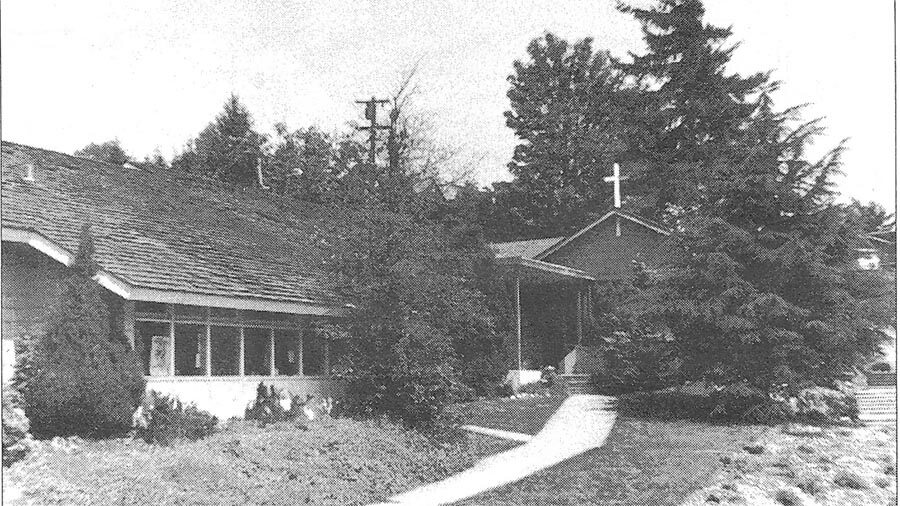
This describes the construction of the old church building by congregants of Church of the Redeemer in 1950-1952. This gave the congregation a place to hold services, a parish hall, office space, and classroom space. This building is still in use (Education Building and church office), although the parish hall building has been removed. The text and pictures were taken from “A decade of beginnings” by Scott Daniel, found in Redeemer: The First Fifty Years.
This is one of several posts celebrating the 75th anniversary of Church of the Redeemer.
Building the old church building
At the Annual Meeting of February 19, 1950, Father Markgraf was already preparing future building plans. It was hoped that the church could erect an entirely new and original building to free up the former Lutheran hall for the church school and to accommodate parish expansion. On February 28, this plan was approved by the Bishop’s Committee, on the condition that the fee for the architect would not exceed $100. The plan was accepted in place of one which would merely have enlarged the hall already in use.
True to form, the mission once more lost its priest. Father Markgraf moved south to California on September 1, 1950, leaving the Church of the Redeemer and St. John’s, Kirkland, under the guidance of the newly-appointed Reverend Alfred L. Griffiths. It was unfortunate that Father Markgraf chose to leave before the new building, his brainchild, was completed in February of 1952.
The completion of the new building was a monumental achievement for the church. Designed by Seattle architect Robert Durham, the new building was capable of accommodating 100 people and was designed for easy expansion in case of a major growth in population. The building was constructed in three stages, beginning with the construction of the main worship area, continuing with the construction of classroom space (which now holds Redeemer’s nursery and parish office), and finishing with the construction of a breezeway addition. This breezeway connected the new building and the old Lutheran parish hall, which was pressed into service once again as a nursery, kitchen and fellowship hall.
Now the church had a home to call its own, a home which it built with its own hands, a home of which it could truly feel proud. This home was the culmination of seven years of hard work starting with the first few pioneers of the Lake Forest Park clubhouse, and ending with the men and women of the Church of the Redeemer. The church was just a mission at the time, but we were as strong in unity and action as any church could be. The people were truly blessed, not only by God, but by their own work and sacrifices for the good of the church.
Church of the Redeemer
Welcome to Church of the Redeemer: Worshiping God, living in community, and reaching out to the world. We are an Episcopal Church serving north King County and south Snohomish County, Washington. As you travel your road, go with friends walking the way of Jesus at Redeemer.
Church of the Redeemer is at 6220 Northeast 181st Street in Kenmore, Washington. We are a short distance north of Bothell Way, near the Burke-Gilman Trail. The entrance looks like a gravel driveway. The campus is larger on the inside than it is on the outside. And we managed to hide a large building on the side of a hill that is not easily seen from the street.
This describes the land purchase by congregants of Church of the Redeemer in 1949 where the church campus is today. The purchase allowed moving from Sunday-only use at the clubhouse of the Lake Forest Park Civic Club to a facility dedicated for church use. The text and picture were taken from “A decade of beginnings” by Scott Daniel, found in Redeemer: The First Fifty Years.
This is one of several posts celebrating the 75th anniversary of Church of the Redeemer.
Land purchase for Redeemer
The church began to mature a little in 1949. By the Annual Meeting of January 9, 1949, the church had selected the property on which it was to build its facilities. All that was left to do was to approve and perform the official purchase. There was a large problem with this: acquiring the land and building on would entail a large amount of fundraising, which still needed to be done. Though the church had overcome the major hurdle of property selection, it was by no means out of the woods.
To address this problem, the church established a Building Fund Campaign. Members were asked to pledge gifts of money towards the purchase of the church land from the Squires Investment Company. People were to be contacted during the services and, for those absent on the given days, by canvassers over the phones. The Bishop’s Committee set a goal of $800 for this project.
By February 20 another major obstacle had been cleared. First Lutheran Church, located nearby, had recently finished using its church hall, and Redeemer seized this opportunity to buy the building. The plan was to purchase and move the hall in one piece onto the land they were about to acquire. This deal was agreeable to both the Lutheran church and the Church of the Redeemer. The purchase of the hall was finalized in March of 1949 and announced in the joint newsletter of Church of the Redeemer and St. John’s, Kirkland. These missions had been joined by the Bishop due to their small size, so they shared many things, including priests and newsletters. Seemingly, the only thing separate about them was locale. However, once each gained enough of a following, it was assured chat they both would be granted their autonomy.
Later that year, the property for the church was purchased from the Squires Investment Company. The property consisted of five lots and was the perfect place on which to erect the purchased hall. The only major job that remained was to move the recently purchased Lutheran church hall to the even-more-recently-purchased property. In late 1949, the Lutheran parish hall was trucked through the streets of Kenmore and unloaded on the present property. Although this endeavor provided the church with a place of its own, it was not the solution the mission was looking for.
Church of the Redeemer
Welcome to Church of the Redeemer: Worshiping God, living in community, and reaching out to the world. We are an Episcopal Church serving north King County and south Snohomish County, Washington. As you travel your road, go with friends walking the way of Jesus at Redeemer.
Church of the Redeemer is at 6220 Northeast 181st Street in Kenmore, Washington. We are a short distance north of Bothell Way, near the Burke-Gilman Trail. The entrance looks like a gravel driveway. The campus is larger on the inside than it is on the outside. And we managed to hide a large building on the side of a hill that is not easily seen from the street.
This describes the first service of Church of the Redeemer on Quinquagesima Sunday, February 16, 1947, at the former clubhouse of the Lake Forest Park Civic Club. It is taken from the chapter “Redeemer before Redeemer,” written by Margaret Banks in about 1960. She was the historiographer and one of the founders of the congregation. This is from Redeemer: The First Fifty Years.
This is one of several posts celebrating the 75th anniversary of Church of the Redeemer.
The first service
Few services will ever be more joyous for those persons present than the first service of Church of the Redeemer,
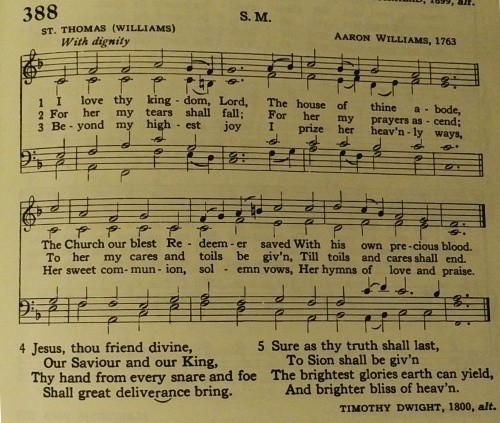
First they surprised and delighted the Bishop by having a cross, movable altar rails, and kneeling benches ready for use. Mrs. Banks had made the rails and had a cabinetmaker friend make a wooden cross, mounted on a three-step base, which Mr. Banks gilded. The kneeling benches had been given to them by the disbanded group which formerly had met in the clubhouse. An oak table belonging to the club was pushed against the natural stone fireplace. The gray stone formed a background for the cross and improvised altar. Mrs. Stanley was on hand to help prepare the vessels and linens brought by Bishop Huston and candles were used in brass candlesticks loaned by Mrs. Mohr. Flowers, altar rails, kneeling benches and chair were in place when the Bishop arrived. Mr. Mohr had typed service sheets and in planning the service according to Prayer Book rubrics, one hymn was:
I love Thy Kingdom, Lord, The house of thine abode, The Church our blest Redeemer saved With His own precious blood.
Then when they knelt at the altar for the Holy Eucharist they were deeply moved and grateful, and felt they were especially under Our Blessed Lord’s care. After the service Bishop Huston asked those interested in forming a mission to remain. Almost everyone present did so, and he talked to them of the need for the spread of Christ’s Kingdom on Earth and said each one should consider himself a missionary. “But do not approach those who already have a church home, ” he said. “There are enough unchurched persons to fill this church and more. I have no patience with sheep stealers. ” Then he asked that all those seriously interested sign a formal petition. Fifteen happy but humble persons petitioned “Reverend Father in God….We put ourselves in your charge and will reverently obey your authority…”
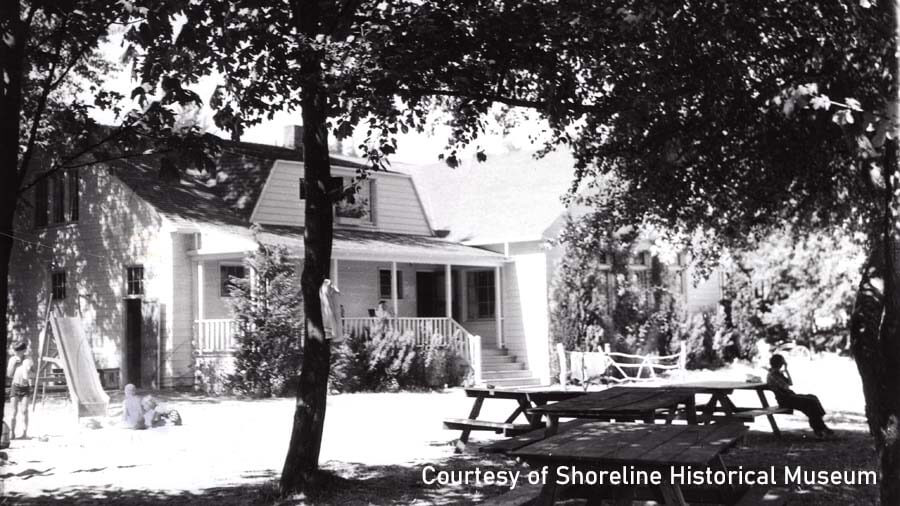
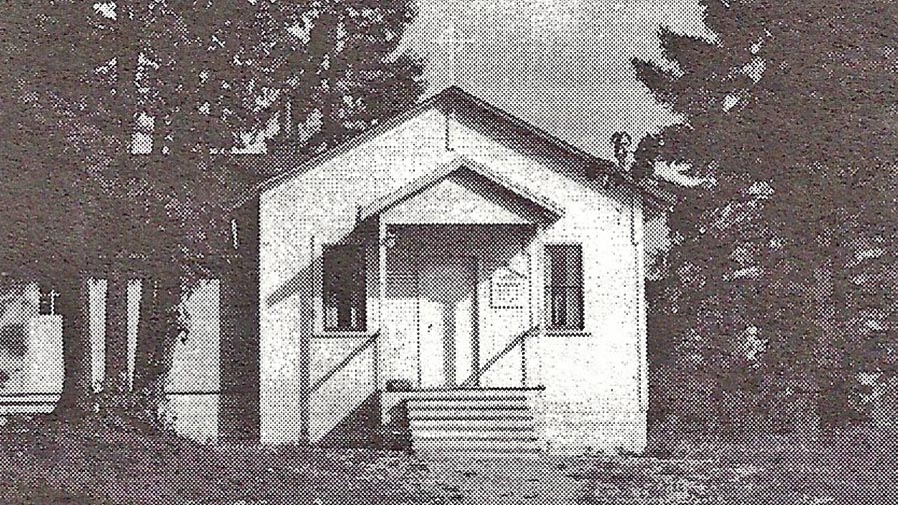
The picture of the club house is how it looked in 1947. It is courtesy of the Shoreline Historical Museum. Earlier pictures show it a dark color in black and white photos, possibly brown. This original club house building burned down the same time the dedication service for the current Redeemer church building was happening.
Church of the Redeemer
Welcome to Church of the Redeemer: Worshiping God, living in community, and reaching out to the world. We are an Episcopal Church serving north King County and south Snohomish County, Washington. As you travel your road, go with friends walking the way of Jesus at Redeemer.
Church of the Redeemer is at 6220 Northeast 181st Street in Kenmore, Washington. We are a short distance north of Bothell Way, near the Burke-Gilman Trail. The entrance looks like a gravel driveway. The campus is larger on the inside than it is on the outside. And we managed to hide a large building on the side of a hill that is not easily seen from the street.
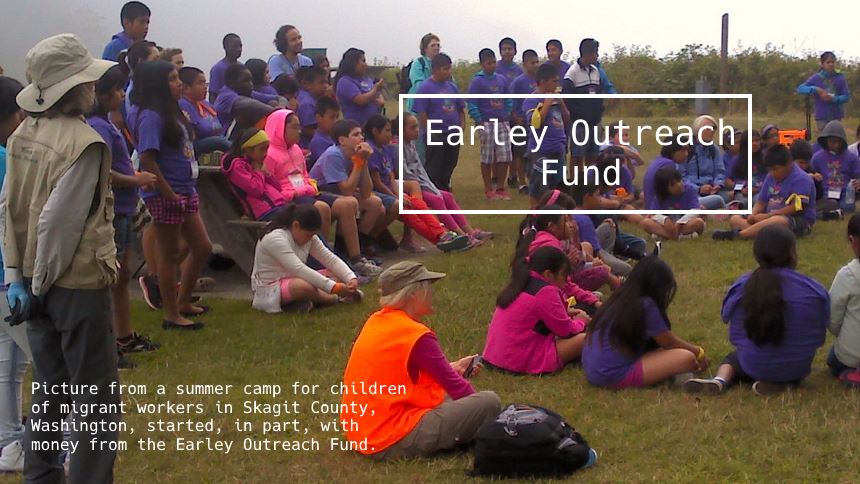
The Earley Outreach Fund at Church of the Redeemer supported a wide variety of outreach projects. The money to establish this fund came from the sale of the Butterfly Shop, a thrift shop operated by Redeemer in Bothell, Washington.
These are some of the programs supported by the Earley Outreach Fund at some point since 2009:
bE.kON Collective
Friends of Third Place Commons Farmers “Market Bucks”
Kairos Torch Prison Ministry
Northshore Adult Day Health
Page Ahead
Capitol Hill Community Resource Center
United Way Community Resource Exchange: Homeless Foot washing Project
Internship at Mosoj Yan in Bolivia
Northshore YMCA ESL Summer Program
Mission to Seafarers in Seattle
Rebuild the Churches Fund
Episcopal Jail Ministry at the King County Jail
Foundation for Academic Endeavors
Origin of the Earley Outreach Fund
The Earley Outreach Fund started from the sale of the former Butterfly Thrift Store building. The crowded-but-tidy shop sold used and consigned household goods and clothing in downtown Bothell, Washington. Volunteers from Church of the Redeemer staffed and operated the shop.
During more than two decades of operation, the Butterfly Shop distributed over $275,000 in small grants to local people with urgent needs for things like the following:
Paying the utility bill for families in danger of losing power.
Getting the last few dollars of someone’s rent together.
Paying for medical bills, gas, or bus vouchers.
The “Butterfly Ladies” helped over 2,500 people over rough spots.
An aging volunteer staff and an unsolicited offer to purchase the property in late 2007 led to the decision to close the Butterfly Shop and sell the property. Church of the Redeemer did not treat the $300,000 purchase price as a windfall. Instead, Redeemer’s parishioners placed the entire sum into a fund to continue to serve those in need.
This fund became known as the the Earley Outreach Fund. The name recognizes Gretchen and John Earley, leading lights of the Butterfly Shop for its entire existence.
Church of the Redeemer
Church of the Redeemer: Worshiping God, living in community, and reaching out to the world. We are an Episcopal Church serving north King County and south Snohomish County, Washington. As you travel your road, go with friends walking the way of Jesus at Redeemer.
Church of the Redeemer is at 6220 Northeast 181st Street in Kenmore, Washington. We are a short distance north of Bothell Way, near the Burke-Gilman Trail. The entrance looks like a gravel driveway. The campus is larger on the inside than it is on the outside. And we managed to hide a large building on the side of a hill that is not easily seen from the street.
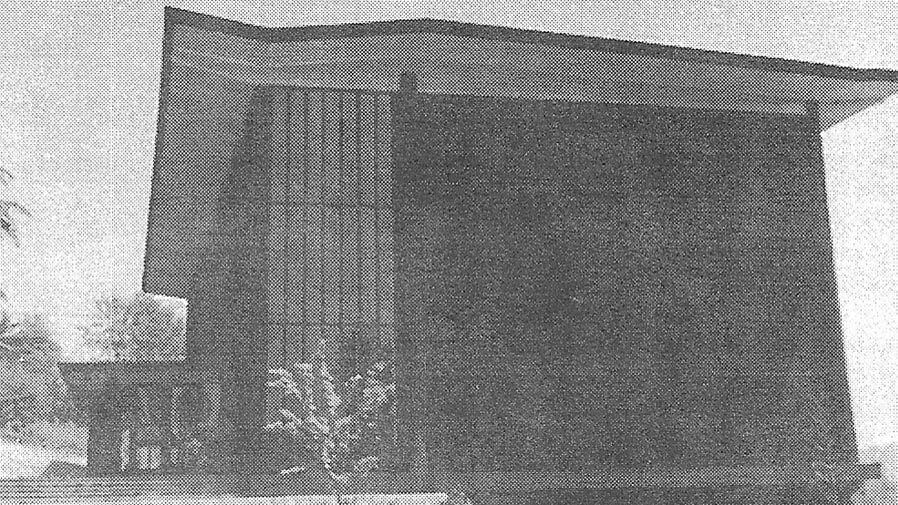
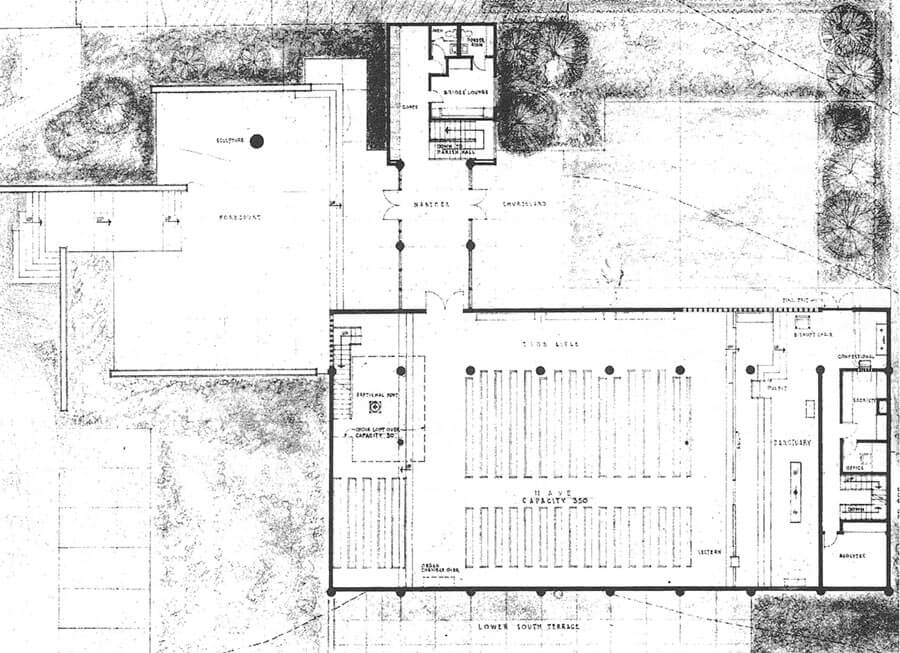
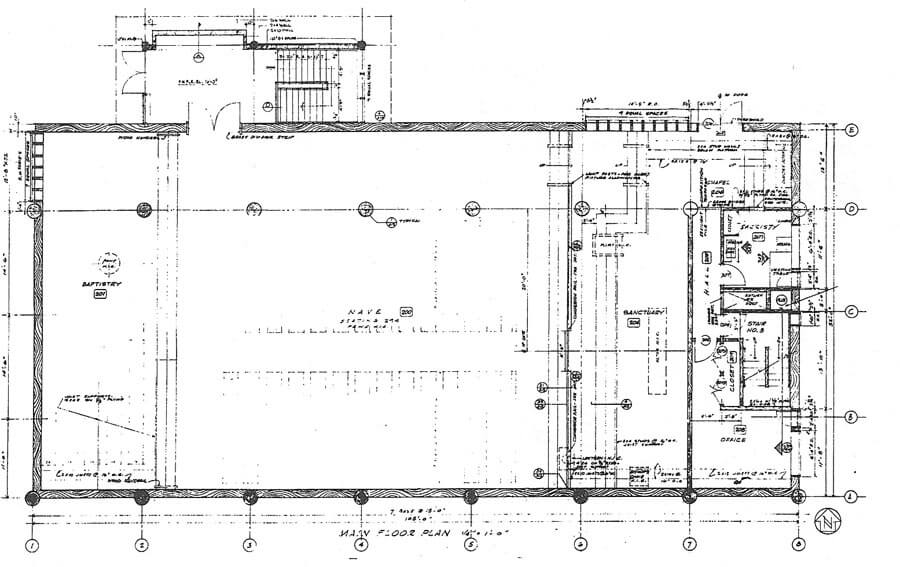
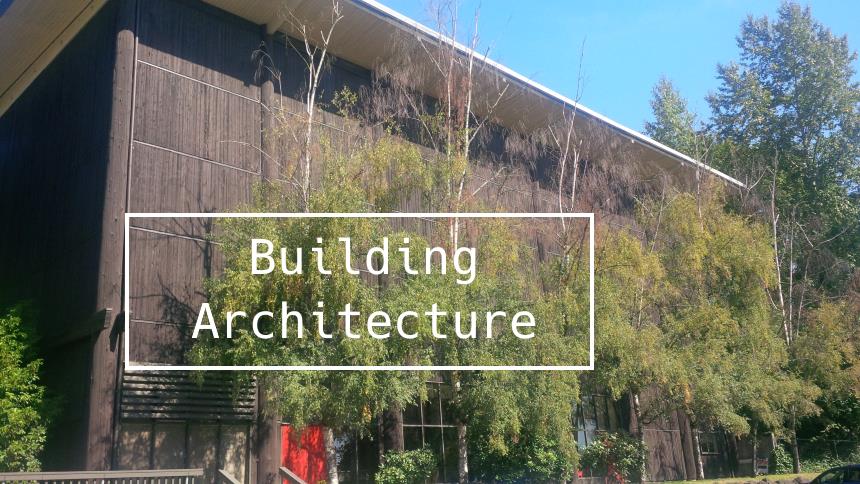
The Church of the Redeemer main building was designed by noted Northwest Modern architect Roland Terry.
According to a brochure produced by Docomomo WEWA, this building architecture has the following features:
Terry produced an original an unconventional design, one that combined elements derived from the agriculture vernacular and Asian precedents to achieve economy and rustic elegance….
The church demonstrated a spiritually-uplifting verticality, with proportions of the columns, siding and shoji-like windows being very tall and narrow. A key element of Terry’s solution was his use of pole framing, a structural system employed in vernacular farm structures requiring long spans and low costs (and Japanese Zen temples)….
Others have noted that the building bears some resemblance to a longhouse found in Coast Salish culture.
The building was dedicated on December 20, 1964.
Read a brochure from Docomomo WEWA (10.4 KB, PDF) about the building architecture at Church of the Redeemer. The brochure opens in a new window.
Church of the Redeemer
Church of the Redeemer: Worshiping God, living in community, and reaching out to the world around us. We are an Episcopal Church serving north King County and south Snohomish County. We welcome you be with us as we walk the way of Jesus.
Church of the Redeemer is at 6220 Northeast 181st Street in Kenmore, Washington. We are a short distance north of Bothell Way, near the Burke-Gilman Trail. The entrance looks like a gravel driveway. The campus is larger on the inside than it is on the outside. And we managed to hide a large building on the side of a hill that is not easily seen from the street.
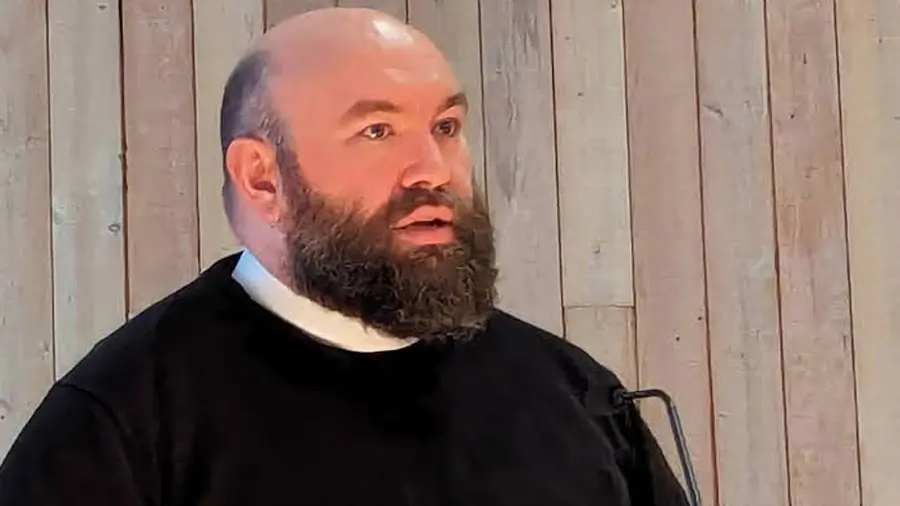
Jed, along with his family, enjoy being outdoors, reading, and travel. He has also tried his hand at woodworking, various musical instruments, and triathlon.
After Church of the Redeemer, Fr. Jed became the rector of St. Mark’s Episcopal Church in Grand Rapids, Michigan.
Please accept YouTube cookies to play this video. By accepting you will be accessing content from YouTube, a service provided by an external third party.
If you accept this notice, your choice will be saved and the page will refresh.
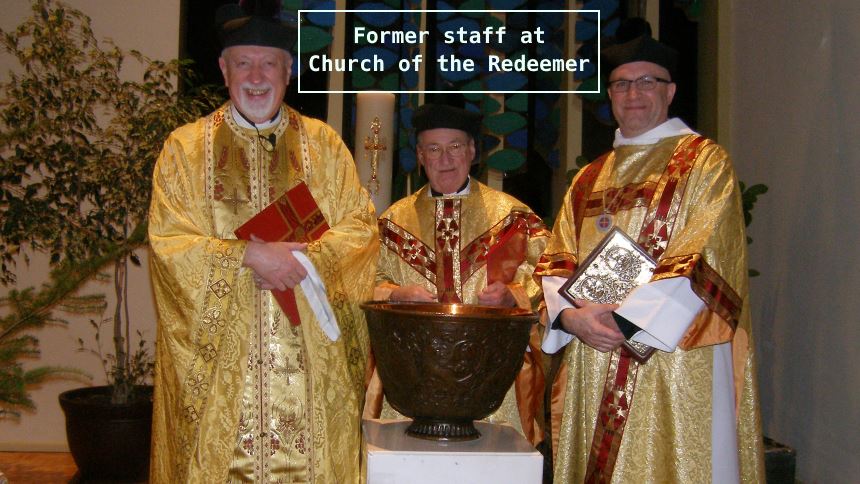
The Rev. John P. (Jack) Zimmerman
Father Jack Zimmerman
The Rev. John P. (Jack) Zimmerman was an unpaid associate priest at Church of the Redeemer who had retired from full-time parish ministry.
Fr. Jack Zimmerman was born in Rochester, New York, in 1946. Upon completion of his bachelor’s degree in philosophy, he entered St. Bernard’s Roman Catholic Seminary. There he received a Master of Divinity and Master of Theology degrees. In 1972, he was ordained a priest in the Roman Catholic Church.
In 1990, Fr. Zimmerman was received as priest in the Episcopal Church for the Diocese of Rochester, New York. He was active in his home parish and did supply work throughout the Diocese. During this time, he worked full time for the American Red Cross as Coordinator of Services for Seneca County.
In 1994, Fr. Zimmerman became the Rector of St. Boniface Episcopal Parish in the Diocese of Albany, New York. He served there until his retirement in 2008.
In December 2010, Fr. Zimmerman and his wife, Kitty, moved to Kenmore, Washington, to be closer to children and grandchildren. Jack and Kitty found Redeemer to be a great place to grow spiritually. However, in January 2020, they moved to a retirement residence Portland, Oregon, near other relatives.
The Rev. Stephen Garratt
The Rev. Dr. Stephen Garratt’s last service was Christmas Eve, 2014.
The Rev. Dr. Stephen Garratt
The Rev. Dr. Stephen Garratt was Interim Priest at Church of the Redeemer after Canon John Fergueson retired.
Fr. Stephen Garratt has lived in the Lake City area of Seattle area since the early 1960s after his family moved here from the Midwest. He is a graduate from the University of Washington.
In 1977, he entered Seabury-Western Theological Seminary in Evanston, Illinois and graduated in 1980. Seabury-Western is now part of Bexley-Seabury in Bexley, Ohio. In 2005, Fr. Garratt graduated from Seabury-Western with a Doctor of Ministry degree.
His ordination to the diaconate was in 1980. Then, his ordination as a priest was in 1981 while serving as the curate at St. Barnabas Parish on Bainbridge Island. Later, Fr. Garratt was the Assistant to the Rector at St. Stephen’s Parish in Seattle and part-time assistant at Christ Church in the University District and the Canterbury Chaplain to the University of Washington. In 1995, he became the rector of Christ Church and worked in that capacity his 2012 retirement. Since retirement, he served as the interim at Trinity Parish in downtown Seattle while they completed their search process before coming to Redeemer.
Fr. Garratt’s employment outside the church includes four years as a probation counselor for the Municipal Courts of Seattle. Then, after earning a degree in counseling from Seattle University in the 1980s. he worked at Mental Health North, a community mental health center near Northgate, as an intern and later as a therapist on their out-patient team.
He married his wife Margaret in 1987. They have three adult sons, Niles, Andrew, and Daniel. His interests include spending time with his family, traveling, reading, exercising, opera, and attending University of Washington home football games.
The late Rev. Canon John Fergueson
Fr. John Fergueson
The Rev. Canon John Fergueson retired as rector on June 1, 2014.
The Rev. Canon John Fergueson was born in Jackson, Michigan, in 1944. He graduated from Albion College in 1966 with a Bachelor’s degree in biology. Later that year he entered the United States Marine Corps.
From 1967 to 1968, Fr. John served with the 15th Marine Counterintelligence Team in northern Quang Tri province in Vietnam. While in Vietnam, he received his call to become a priest.
Upon returning home, Fr. John entered Seabury-Western Theological Seminary in Evanston, Illinois. He graduated in 1972 with a Master’s of Divinity degree in theology.
After ordination as a priest, Fr. John served at a mission church in the Ada-Cascade region of Grand Rapids, Michigan. Later, Fr. John was Dean of the Cathedral Church of Christ the King. Following four years at Emmanuel Parish in Hastings, Michigan, Fr. John came to Church of the Redeemer in 1983. He retired in 2014.
His vision of Redeemer was to be a safe place to explore what George Herbert once called “the deep down depths of things.” His personal spiritual journey is shaped by the following:
His own experiences of the dark side of life
The Paschal mystery
A deep, profound belief in the power of liturgy and living into the church year to transform people’s lives
For the last 15 years of his ministry at Church of the Redeemer, Fr. John’s non-parochial energies had been devoted to the subject of spirituality and post-traumatic stress disorder (PTSD). He had participated in national psychiatric workshops on the topic. Fr. John works with veterans and others who are experiencing trauma issues on an ongoing basis. With Landy F. Sparr, he wrote the chapter “Moral and Spiritual Issues Following Traumatization” for the book Psychiatry and Religion: The Convergence of Mind and Spirit.
Fr. John and his wife Ginny lived in Bothell, Washington. They have two adult children, Susan and Dan.
Fr. John had a passion for adult education. He enjoyed jogging and lifting weights, and reads theology, history, and murder mysteries. His 30-year relationship with his spiritual father, a Trappist monk at Our Lady of the Assumption Abbey in Ava, Missouri, was a continual source of inspiration and strength to him.
Fr. John Fergueson passed peacefully on Saturday, January 24, 2026. He was surrounded by his family and friends. Three priests gave Fr. John last rites, the Rev. Theresa Newell of Redeemer, Fr. John Forman from St. Elizabeth’s in Burien, and Fr. Michael Ryan from St. John’s in Kirkland.
The Rev. John Forman was ordained to the diaconate on December 21, 2013, and as a priest on July 22, 2014. When a seminarian at the School of Theology and Ministry at Seattle University, John was the graduate assistant to the Ecumenical Liturgical Director. He graduated in July 2014 with a Master of Divinity degree.
For the past 13 years, he has run a small consulting business, Integral Development Associates. This company works with organizations of all kinds, primarily in the areas of organization and leadership development. This company bases its work on a body of evidence-based developmental schemas under the umbrella philosophy of Ken Wilber’s Integral Theory and methodology.
With Laurel A Ross, John released his first book, Integral Leadership: The Next Half-Step, in May 2013 through SUNY Press. As a founding member of Wilber’s Integral Institute and Integral Spiritual Center, he has had the opportunity to meet and befriend a number of intellectual and spiritual heroes, many of whom provided guidance and insights for the book.
John is a regular contributor to Nectar of NonDual Truth, an Adviatic-based magazine interested in universal teachings from multiple traditions. A student of Zen for many years, John has worked with Genpo Roshi, Diane Musho Hamilton, and his spiritual director, Vidyuddeva.
He is a Benedictine oblate at Mt. Angel Abbey in St. Benedict, Oregon. John has served on the board of advisors for St. Placid Priory, Transfiguration Monastery, and several other boards and organizational governing bodies.
John was the Episcopal student liaison for the Ecumenical Outreach Teams of the School of Theology. He has completed a ten-month chaplaincy internship at Swedish-Edmonds, as part of being a postulant for Holy Orders (priesthood) in the Diocese of Olympia.
John has been married to his wife Jennifer for over 25 years. They are the parents of two daughters, Emily and Elizabeth.
The late Reverend Geoffrey Ethelston, Associate Director for Outreach
Fr. Geoffrey Ethelston
Fr. Geoff Ethelston was a retired, unpaid assistant at Church of the Redeemer.
Fr. Geoffrey Ethelston died on December 14, 2015. He immigrated from the United Kingdom to the United States in 1967 with his wife, Jean, and four children. He worked in the manufacturing industry as engineer and plant manager for twenty years.
A lifelong Anglican, Geoff was ordained a priest in 1980. He has worked at several Eastside churches. In 1991, Fr. Geoff formed a new mission congregation in Duvall, Grace Church. He retired in 1996, when he and Jean joined Redeemer.
As Associate Rector for Outreach, Geoff worked with human service providers and educators to build a stronger community identity for those who live in the cities of Shoreline, Lake Forest Park, Kenmore, Bothell, and Woodinville. He saw this as a way that the church can do outreach beyond the hands-on work already going on at Redeemer.
Geoff enjoyed the arts, especially painting, cross-country skiing in season, and singing in the choir.
Church of the Redeemer: Worshiping God, living in community, and reaching out to the world. We are an Episcopal Church serving north King County and south Snohomish County, Washington. As you travel your road, go with friends walking the way of Jesus at Redeemer.
Church of the Redeemer is at 6220 Northeast 181st Street in Kenmore, Washington. We are a short distance north of Bothell Way, near the Burke-Gilman Trail. The entrance looks like a gravel driveway. The campus is larger on the inside than it is on the outside. And we managed to hide a large building on the side of a hill that is not easily seen from the street.