Today’s episode features a conversation with Fr. Chris McNabb, the Program Manager of EMM’s new Neighbor to Neighbor program initiative. He discusses the beginnings of this program, and also how it brings communities together in a ministry of welcome. This invites faith communities to join together in community sponsorship to welcome our newest neighbors: Neighbor to Neighbor.
Our Neighbor to Neighbor program is now an official Sponsor Circle Umbrella under the Sponsor Circle Program for Afghans! We are in urgent need of sponsor circles to support the move of Afghan newcomers off of bases and into welcoming communities in the coming weeks. You can play a critical role. To learn how you can be a community sponsor, visitNeighbor to Neighbor Interest Form.
Be sure to follow us on Facebook, Twitter, and Instagram where we are @emmrefugees. To stay up to date on all new episodes, make sure to follow us wherever you get your podcasts on Spotify, iTunes, stitcher, Google play, or SoundCloud.
To continue to support the ministry of welcome, you can make a gift to Episcopal Migration Ministries. With your help, we will continue to welcome and resettle refugees in communities across the country, offer support to asylum seekers, and create beloved community for all of our immigrant siblings. Visit Give Today or text HOMETOWN to 91999.
Find the episode online or wherever you listen to podcasts.
Hometown: a podcast from Episcopal Migration Ministries
The Hometown podcast features interviews with people resettled to the U.S. as refugees, history and background on refugee-producing countries, interviews with authors, and spiritual reflections from lay and clergy across the Church. In addition, in-between season episodes include advocacy and policy updates, webinar recordings, and opportunities to get involved in the ministry of welcome.
Episcopal Migration Ministries welcomes refugees, educates communities, and mobilizes congregations to advocate for the protection and rights of all migrants.
Every newcomer who reaches our shores brings tremendous gifts and capabilities to achieve success in the United States. Our mission is to provide every person we serve with the foundation required to live out those gifts to the fullest.
Episcopal Migration Ministries is a ministry of The Episcopal Church and is one of nine national agencies responsible for resettling refugees in the United States in partnership with the government. Episcopal Migration Ministries currently has 11 affiliate offices in 9 states. In addition to its long-standing work in refugee resettlement ministry, Episcopal Migration Ministries is The Episcopal Church’s convening place for collaboration, education, and information-sharing on migration.
In 2021, EMM helped 830 refugees and 489 SIV’s from 24 countries build new lives in peace and security in 12 communities across the United States.
Welcome to Church of the Redeemer: Worshiping God, living in community, and reaching out to the world. We are an Episcopal Church serving north King County and south Snohomish County, Washington. As you travel your road, go with friends walking the way of Jesus at Redeemer.
Church of the Redeemer is at 6220 Northeast 181st Street in Kenmore, Washington. We are a short distance north of Bothell Way, near the Burke-Gilman Trail. The entrance looks like a gravel driveway. The campus is larger on the inside than it is on the outside. And we managed to hide a large building on the side of a hill that is not easily seen from the street.
[Episcopal News Service] Episcopal Migration Ministries is nearing a milestone in the church’s 40-year history of participation in the U.S. refugee resettlement program: Sometime this month, the church will have helped more than 100,000 people establish new homes in the United States after fleeing war, violence and persecution in their home countries.
In the 1980s and 1990s, many of those refugees came from East Africa, South Asia and Eastern Europe. In recent years, the new arrivals most commonly have been displaced by turmoil in Burma, Syria and the Democratic Republic of Congo, according to State Department data. And in the past four months, Episcopal Migration Ministries, or EMM, and its affiliated local organizations have scrambled to welcome thousands of Afghan evacuees who were allowed into the United States after the Taliban took control of Afghanistan in August.
While each new neighbor has a personal story to share, all 100,000 have benefited from the support of local Episcopalians and a range of federally funded services provided by EMM’s affiliates, including English language and cultural orientation classes, employment services, school enrollment, and initial assistance with housing and transportation.
“They all have one underlying common thread, and that is they are people who needed protection. They were seeking safety and security,” EMM Director of Operations Demetrio Alvero told Episcopal News Service. He estimated that the church would pass the milestone in the week leading up to Christmas. “The 100,000 represents 100,000 lives that have changed; they found security in this country, they found hope, opportunities.”
EMM’s work is historically rooted in the Presiding Bishop’s Fund for World Relief, which began assisting people from Europe fleeing the Nazis in the 1930s and 1940s. After World War II, The Episcopal Church partnered with 16 other Protestant denominations to create Church World Service to provide overseas aid and resettlement assistance for displaced people. After the Vietnam War ended in 1975, thousands of Southeast Asian refugees were resettled in U.S. communities with The Episcopal Church’s help.
The current federal refugee resettlement program was created in 1980, and The Episcopal Church participated from the start, through the Presiding Bishop’s Fund. EMM was established in 1988 as a separate agency to coordinate The Episcopal Church’s resettlement work.
Ali Al Sudani is one of the nearly 100,000 people who have received assistance from The Episcopal Church to resettle in the United States. He was 36 when he arrived in Houston, Texas, as a refugee in 2009. Al Sudani told ENS he had fled his native Iraq over threats to his safety because of his work as a translator for the U.S.-led coalition of troops stationed in his country.
Al Sudani now serves as chief programs officer for Interfaith Ministries for Greater Houston, the EMM affiliate that helped welcome him to Houston 12 years ago. He praised the Episcopal agency’s continued commitment to serving refugees as the church approaches its resettlement milestone.
“As a beneficiary of The Episcopal Church’s support, I think this is beautiful,” Al Sudani said when asked about the significance of 100,000 people resettled. EMM and Interfaith Ministries not only eased his transition into the Houston community, he said. They also helped him find a sense of purpose through his work helping other refugees start new lives there. “I will always be grateful for this opportunity.”
The Episcopal Church’s General Convention regularly expresses its support for refugee resettlement, most recently in 2018, when it called on governments “to expand refugee resettlement as a humanitarian response that offers individuals safety and opportunity.” Its support for immigrants dates back at least as far as 1883, when it created a Committee for the Spiritual Care of Immigrants. Subsequent chaplaincies were based in New York and ports on the West Coast to minister to immigrants coming from Europe and Asia.
Most of the 100,000 people resettled by the church in the past 40 years have come to the United States as refugees. EMM also assists recipients of special immigrant visas, which the government typically offers to people who have worked with the U.S. military overseas.
This year, EMM was asked to assist about 3,200 Afghan evacuees as they arrive in cities like Houston. Some may be able to apply for special immigrant visas, while others will apply for asylum. They are among the 50,000 Afghans who were welcomed into the country under a humanitarian parole program tied to the end of the United States’ 20-year war in Afghanistan.
Though not classified as refugees, they will receive services similar to those provided to refugees by EMM and the other eight agencies with federal contracts to carry out the resettlement program. The other agencies are Church World Service, Ethiopian Community Development Council, Hebrew Immigrant Aid Society, the International Rescue Committee, U.S. Committee for Refugees and Immigrants, Lutheran Immigration and Refugee Services, the United States Conference of Catholic Bishops and World Relief Corporation.
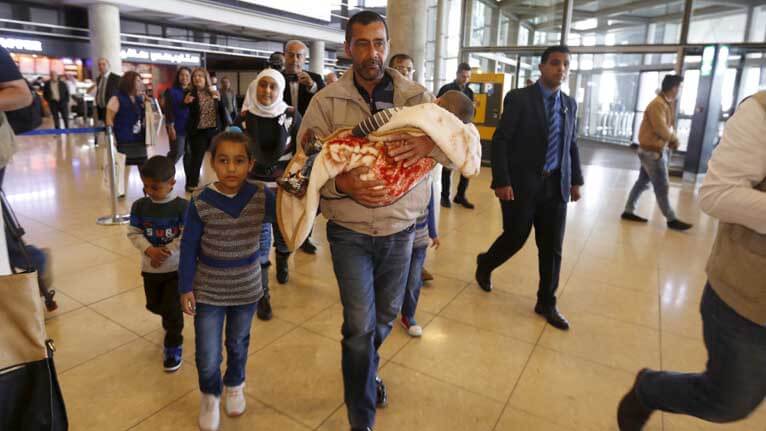
Syrian refugee Ahmad al Aboud and his family members, on their way to be resettled in the United States as part of a refugee admissions program, walk to board their plane in Amman, Jordan, in 2016. Photo: Reuters
Helping refugees “is a tangible way of living out our commitment to be a church that looks and acts like Jesus, sharing his way of love with all, especially the most vulnerable among us,” the Rev. Charles Robertson, canon to the presiding bishop for ministry beyond The Episcopal Church, said in a written statement to ENS. “While EMM is one of the smaller of the nine official resettlement agencies for the United States, it has been acknowledged as a model of excellence in this vital work.”
Alvero, EMM’s director of operations, said the agency typically resettles about 5% of the total refugees brought to the country through the federal program. Historically, EMM has served about 2,000 to 3,000 refugees a year, with a peak of 6,600 resettled in 2016, the last year of the Obama administration. At that time, EMM oversaw the work of 31 resettlement affiliates in 26 dioceses.
Refugee resettlement plummeted during the Trump administration, as President Donald Trump pursued policies to restrict both legal and illegal immigration. Trump slashed the maximum number of refugees allowed into the United States to a historic low of 15,000 a year, down from a norm of between 70,000 and 90,000 during the previous two decades.
The diminished resettlement activity forced the nine resettlement agencies to end their work with about 100 local affiliates, Alvero said, and EMM’s number of affiliates has since decreased to 11.
Global resettlement needs, meanwhile, have only increased in recent years. The United Nations High Commissioner for Refugees estimates there are 26 million such refugees worldwide, and tens of millions more have been displaced within their home countries.
With President Joe Biden taking office in January, his administration pledged to work with EMM and other resettlement agencies to restore a spirit of welcome to refugees fleeing war and persecution in their home countries. Biden increased the resettlement cap to 125,000 for the fiscal year that began Oct. 1, though it remains uncertain how soon EMM and the other resettlement agencies will be able to ramp up their operations to accommodate additional refugees awaiting resettlement.
“This country is big enough and rich enough really to assist 125,000,” Alvero said, but the government needs to restore its overseas processing operations to full capacity while the resettlement agencies rebuild networks that were decimated under Trump. EMM has not yet added new affiliates, though it is researching options in Kansas, West Virginia and Wyoming, a state that has no prior history of refugee resettlement.
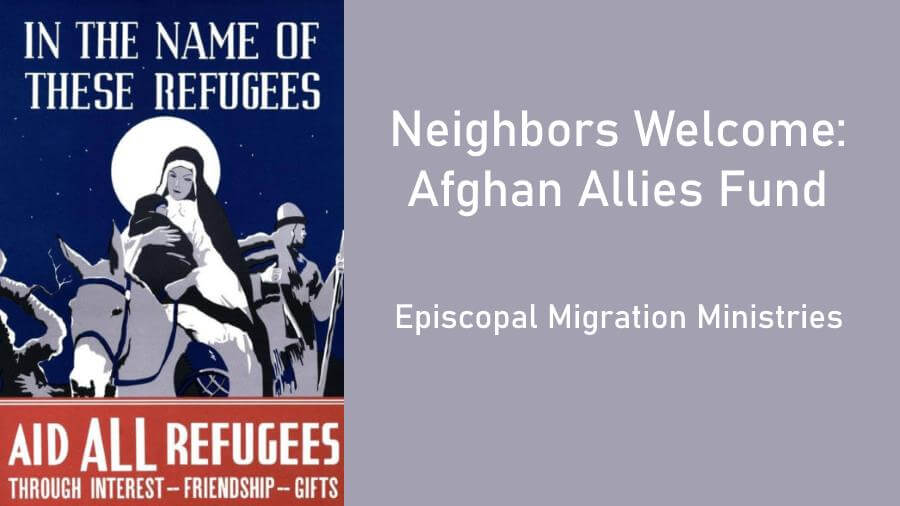
For the Afghans who arrived in the United States under the humanitarian parole program, EMM has invited Episcopalians and their congregations and dioceses to support the resettlement work by making donations online to the Neighbors Welcome: Afghan Allies Fund and by volunteering in other ways, which they can do after filling out an online form.
Donations to the Afghan Allies Fund have topped $500,000 so far, Alvero said.
Afghan refugee girls watch a soccer match near where they are staying at the Fort McCoy U.S. Army base in Wisconsin on September 30, 2021. Photo: Reuters.
The Afghans initially were housed at U.S. military bases. Many of them now are making their way to Houston, where Interfaith Ministries is in the middle of welcoming an estimated 1,300 individuals, Al Sudani said. About 730 already have moved to the city. Most of the remaining are expected by mid-February.
The number of arrivals is unprecedented in such a short period of time, he said, but the community and The Episcopal Church are stepping up. “We have seen an outpouring of support during this crisis in a manner that we haven’t experienced it before,” he said.
He recalled a similar experience when he first arrived in Houston in 2009, not knowing what to expect. “My perception about Houston was about oil and, you know, the Wild West, cowboys. But I was surprised how welcoming and generous and supportive the people of Houston are. It’s a great city to be in.”
Now, with Interfaith Ministries and other EMM affiliates about to begin welcoming the church’s next 100,000 refugees, Al Sudani, who became a U.S. citizen in 2014, said the underlying mission endures. “We are creating new Americans,” he said. “We are helping these people to become new Americans and support them as they contribute to their communities.”
– David Paulsen is an editor and reporter for Episcopal News Service. He can be reached at dpaulsen@episcopalchurch.org.
Seattle-area refugee efforts
Founded in 1978, Diocese of Olympia’s Refugee Resettlement Office (RRO), an affiliate of Episcopal Migration Ministries and the Episcopal Diocese of Olympia, serves refugees and asylees in the Seattle area. Our clients come to us from anywhere in the world seeking guidance and assistance in building a new life in America and achieving economic self-sufficiency. Our mission is accomplished through resettlement, job placement activities, and business development programs that promote self-employment.
The Episcopal Church has served immigrants new to the United States since the late 1800s, when the Church opened port chaplaincies to minister to sojourners on both coasts. In the 1930s, local parishes collected donations to provide steamship passage for those fleeing Nazi Europe. Out of this effort, the Presiding Bishop’s Fund for World Relief was born, the forerunner organization to Episcopal Relief & Development and Episcopal Migration Ministries.
Through the mid- and late 20th century, Episcopal Migration Ministries (EMM) partnered with other faith organizations to resettle those oppressed by the Iron Curtain and the genocides of Southeast Asia. In the 1980s, EMM was formally established. In partnership with a network of affiliate agencies, dioceses, churches, and volunteers, EMM is today one of only nine national agencies through which all refugees enter the United States.
Church of the Redeemer
Welcome to Church of the Redeemer: Worshiping God, living in community, and reaching out to the world. We are an Episcopal Church serving north King County and south Snohomish County, Washington. As you travel your road, go with friends walking the way of Jesus at Redeemer.
Church of the Redeemer is at 6220 Northeast 181st Street in Kenmore, Washington. We are a short distance north of Bothell Way, near the Burke-Gilman Trail. The entrance looks like a gravel driveway. The campus is larger on the inside than it is on the outside. And we managed to hide a large building on the side of a hill that is not easily seen from the street.
As Episcopalians, as followers of Jesus, as people of faith, we mourn the recent loss of life in Afghanistan, the ongoing chaos and instability, and the risk that many Afghans face, in particular women and girls.
The situation in Afghanistan is changing quickly with many lives lost and thousands more at risk. The current crisis leaves over 5 million displaced Afghans in the country, in bordering nations and many more around the world who have been evacuated, who are trying to find long-term safe solutions.
As Afghans arrive to the U.S. with the hope of safety, The Episcopal Church, through the work of Episcopal Migration Ministries, is assisting our new neighbors through the Afghan Parolee Support Program.
This new U.S. program, dependent on private resources and community-led welcome and support, will provide security and foundation necessary for arriving Afghans to begin life in the U.S.
The ministry of offering welcome to those fleeing violence is nothing less than God’s work—one that calls us to walk the way of love as Jesus of Nazareth taught us, through compassion, through practical care, showing to our newest neighbors that we are neighbors.
Episcopal Migration Ministries has launched a special appeal—Neighbors Welcome: Afghan Allies Fund—to meet the financial and in-kind needs necessary to provide adequate housing, basic services, and long-term support.
The needs are great and will require our communities and congregations to come together to contribute financially, offering housing, volunteer, and pray.
You can also stay involved in the work of advocacy in ensuring that the government of the United States honors its commitments to our Afghan allies.
Included with this video, there are links and information sources that can assist you in participating in any way that you can.
As Episcopalians in the late 1930s rose up to respond to allies, primarily Jewish allies fleeing tyranny in Europe, at the advent of the Second World War, as Episcopalians have continued to rise up wherever and whenever there has been human need, joining hands with other peoples of faith and people of goodwill, so now I invite you to rise up again for our Afghan friends, to stand with them in their time of need.
Thank you for all that you do. Thank you for this work. Thank you for anything that you can do.
God love you. God bless you. And may God bless the people of Afghanistan wherever they may be. Amen.
How you can help
Find out how to stay involved in the work of advocacy in ensuring the U.S. government honors its commitments to our Afghan allies at Office of Government Relations
To contribute financially to provide for housing, medical and financial support, and expanded community sponsorship to serve our Afghan allies, do one of the following:
Visit Support Our Afghan Allies to make a secure donation online on the website of Episcopal Migration Ministries.
The Episcopal Church has served immigrants new to the United States since the late 1800s, when the Church opened port chaplaincies to minister to sojourners on both coasts. In the 1930s, local parishes collected donations to provide steamship passage for those fleeing Nazi Europe. Out of this effort, the Presiding Bishop’s Fund for World Relief was born, the forerunner organization to Episcopal Relief & Development and Episcopal Migration Ministries.
Through the mid- and late 20th century, Episcopal Migration Ministries (EMM) partnered with other faith organizations to resettle those oppressed by the Iron Curtain and the genocides of Southeast Asia. In the 1980s, EMM was formally established. In partnership with a network of affiliate agencies, dioceses, churches, and volunteers, EMM is today one of only nine national agencies through which all refugees enter the United States.
Church of the Redeemer
Welcome to Church of the Redeemer: Worshiping God, living in community, and reaching out to the world. We are an Episcopal Church serving north King County and south Snohomish County, Washington. As you travel your road, go with friends walking the way of Jesus at Redeemer.
Church of the Redeemer is at 6220 Northeast 181st Street in Kenmore, Washington. We are a short distance north of Bothell Way, near the Burke-Gilman Trail. The entrance looks like a gravel driveway. The campus is larger on the inside than it is on the outside. And we managed to hide a large building on the side of a hill that is not easily seen from the street.
Funeral for the Rev. Canon John Fergueson, Saturday, March 2, 2026, at 10:00 am in Church of the Redeemer. Additional parking available at The Vine Church across 181st Street from Redeemer.
The 6th Sunday of Easter (Year A), May 10, 2026. Services at 8:00 am (no music) and 10:30 (music). Xristos Kuxwoo-digoot! Xegaa-kux Kuxwoo-digoot!