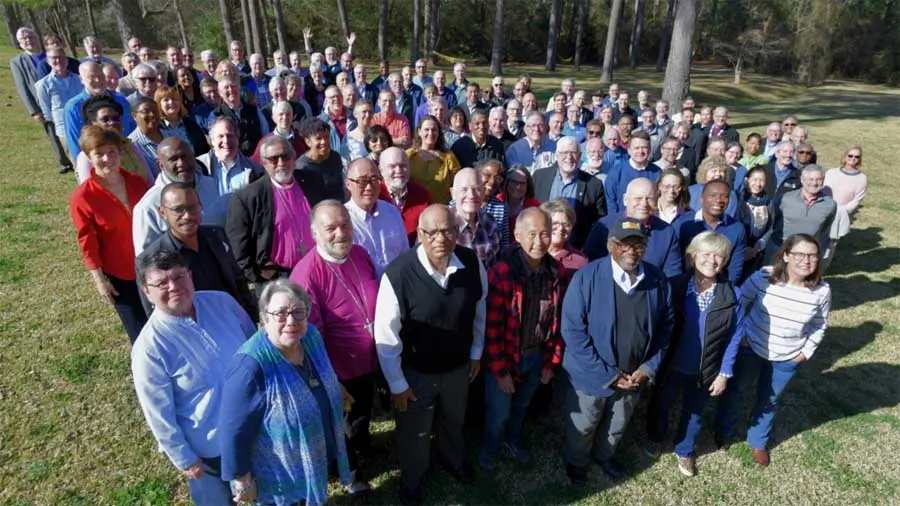
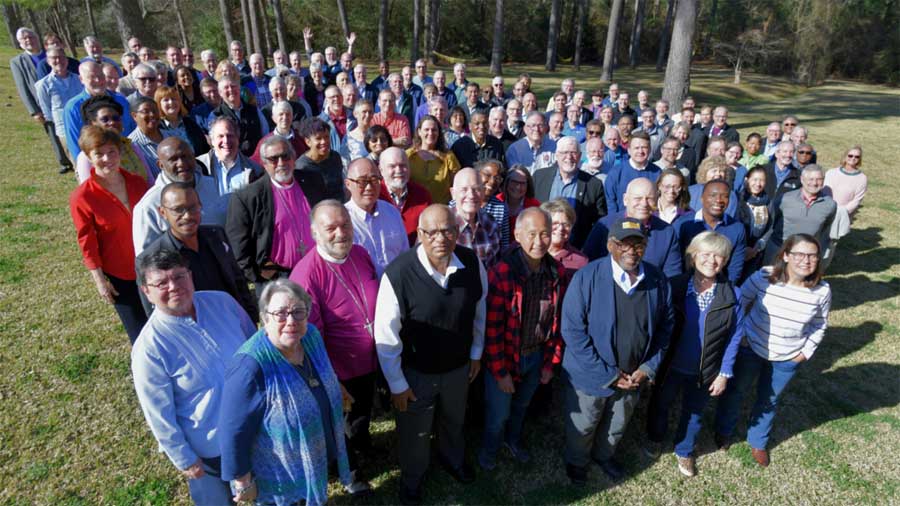
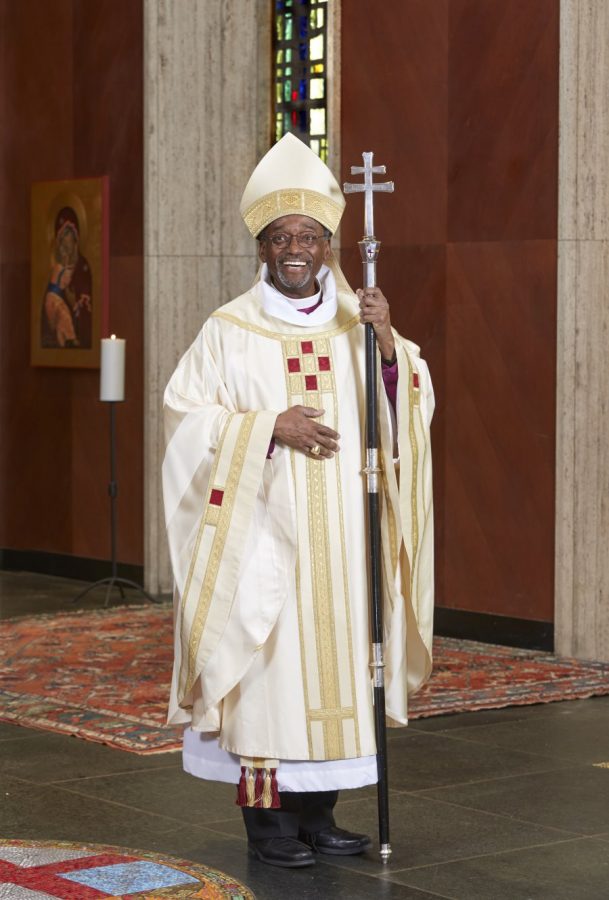
The House of Bishops is second house of the General Convention of the Episcopal Church. The House is composed of all bishops, active and retired, of the church. It meets concurrently with the House of Deputies during General Convention. It also holds meetings between conventions.
The original definition of pastoral letter, from the Latin littera pastoral, was an official letter addressed by a bishop to all members of the diocese. Pastoral letters may be issued in the Episcopal Church by the Presiding Bishop, the House of Bishops, or any diocesan bishop. The canons require that pastoral letters of the House of Bishops and diocesan bishops be read or otherwise distributed to the people. While the canons do not define a pastoral letter, one issued by a diocesan bishop is to address “points of Christian doctrine, worship, or manners.”
The Pastoral Letter
Dear people of God:
Grace and peace to you in Jesus Christ our Lord.
Introduction
The bishops of The Episcopal Church gathered from March 17-24 [, 2026] at Camp Allen Conference Center in Navasota, Texas. Our gathering included 122 bishops and bishops-elect, representing 89 dioceses and special ministries across 17 countries and territories. As we conclude our meeting, we give thanks for the mutual affection and fruitful collaboration we experience during our time together, and we renew our commitment to bear witness with clarity and unity to the transforming power of the Gospel.
Reflections from our meeting
Our gathering was focused primarily on the challenges and opportunities before us as a church. We welcomed 12 representatives from Episcopal seminaries and local formation programs to engage in thoughtful dialogue about the state of theological education and our need to better integrate traditional and innovative modes of discernment, recruitment, and training for future clergy and lay leaders. We explored possibilities for expanding the work of church planting and the redevelopment of existing congregations. We reflected on our relationships within the Anglican Communion, including discussion of The Nairobi-Cairo Proposals and expressed our concerns regarding the urgency to change the definitions and structures of the communion. We rejoiced in the election of the Rt. Rev. Alba Sally Sue Hernandez Garcia as primate of the Anglican Church of Mexico. Finally, we issued a courtesy resolution celebrating the installation of the Most Rev. and Rt. Hon. Dame Sarah Mullally as the 106th archbishop of Canterbury.
While engaged in this important work for the church, we gathered each day to pray for the church and the world. We prayed for a swift conclusion to the armed conflict with Iran; the wars in Ukraine, Sudan, and Myanmar; and all hostilities across the globe. We prayed for peace in the Holy Land, for Archbishop Hosam Naoum, the Episcopal Church in Jerusalem and the Middle East, and for all those living in the reality of violence in that region. We prayed for healing and reconciliation among the nations of the world, that there may be justice and peace on the Earth. We prayed for those who are victims of injustice and discrimination, terror and war, and the pervasive degradation of human dignity. We prayed for strength and courage to continue the robust and tangible response in our respective dioceses to the myriad and varied challenges before us. And yet, in the face of these challenges, we are not without hope.
A word of hope
We find our hope in God’s promises as made known to us in the words and actions of Jesus Christ. Christian hope is the sure and present confidence, grounded in the resurrection of Jesus, that suffering is not the end. Hope is the stubborn trust that God is not finished. Even in the shadow of the cross, God is already at work, bringing life out of death.
This promise of hope is central to the story of the raising of Lazarus (John 11:1-45). Jesus stands before the tomb of his friend, surrounded by grief and despair, and a community aching for his intervention. It is precisely in the moment when all hope seems lost that Jesus speaks the Word of life. There is hope because “even in death, Lazarus has access to the voice of life.” Jesus, the Word of God, commands Lazarus to “come forth,” and that same divine Word immediately calls the gathered community to “unbind him and let him go.”
In our present moment, in a world ravaged by war and the degradation of human dignity, Jesus is still speaking the Word of life. There is hope in this moment, because even in the face of grief, death, and despair, we have access to the voice of life—the voice of the One who calls us to participate in the Gospel mission of unbinding those who are held captive by the bonds of injustice and ensnared by the cords of corruption and oppression. We do not raise the dead; God alone does that. But we are summoned into the tender, deliberate work of unbinding, of participating in resurrection by loosening the grave clothes that still cling.
It is in this hope, as those who have received life and heard the voice of life, that we go forth in faith to bear witness to the resurrection, to unbind what is still bound, and to trust in Christ’s promise to make all things new.
As we prepare to celebrate the Paschal feast, with the hope of the resurrection ever before us, may the God of hope fill us with all joy and peace in believing through the power of the Holy Spirit.
Church of the Redeemer
Church of the Redeemer: Worshiping God, living in community, and reaching out to the world around us. We are an Episcopal Church serving north King County and south Snohomish County. We welcome you be with us as we walk the way of Jesus.
Church of the Redeemer is at 6220 Northeast 181st Street in Kenmore, Washington. We are a short distance north of Bothell Way, near the Burke-Gilman Trail. The entrance looks like a gravel driveway. The campus is larger on the inside than it is on the outside. And we managed to hide a large building on the side of a hill that is not easily seen from the street.
Move follows calls by fellow bishops for renewed scrutiny
[Episcopal News Service] The Episcopal Church, on Presiding Bishop Michael Curry’s direction, updated its website to launch a series of informational resources February 22, 2024, intended to increase the transparency of pending disciplinary cases involving bishops while also making it easier for the public to file complaints and navigate the church’s inquiry process.
The new webpage on episcopalchurch.org includes chronologies for six active cases involving bishops under the church’s Title IV disciplinary canons — including two newly revealed cases against retired Florida Bishop John Howard. The webpage also shares statistical information on all complaints against bishops received in the past six months, data that will be updated at least once a year. And a blue “report misconduct” button was added to the top-right corner of all pages on the church’s website linking to the new Title IV page.
Until now, details about Title IV cases have mostly remained confidential unless they are referred to a hearing panel, the equivalent of a trial. Church canons require the release of information in hearing panel cases, though most cases are resolved without a hearing. Curry, as presiding bishop, has broad discretion under the canons to make some information public if he deems it “pastorally appropriate” to do so. Curry and, in some cases, bishops he has designated to act on his behalf are now exercising that discretion to release timelines and status updates in select cases when the “matter becomes public.” Church leaders are continuing to protect the identities of complainants and withhold other details about the allegations.
“Experience over the past several years with Title IV matters involving bishops has given rise to calls for more transparency in the process,” Curry said in a letter introducing the new online resources.
“Given the current atmosphere, I have chosen to exercise my canonical discretion to adopt a general protocol for transparency in Title IV matters involving bishops … while also appropriately protecting privacy,” he added.
The Title IV canons apply to all clergy ordained in The Episcopal Church. Their application to bishops has drawn renewed scrutiny, especially since House of Deputies President Julia Ayala Harris revealed publicly in August 2023 that she had been the complainant in a harassment case that ended in no punishment for the bishop.
Several other cases involving bishops made public last year prompted some church leaders, including fellow bishops, to call for an examination of the church’s disciplinary canons to ensure bishops are held to the same standards as other clergy and to consider possible canonical reforms. Curry and Ayala Harris both urged the Standing Commission on Structure, Governance, Constitution and Canons to study the issue and possibly propose resolutions for consideration this June when the 81st General Convention convenes in Louisville, Kentucky.
The newly released chronologies for six specific Title IV cases involving bishops include some information that already had been released by the church’s Office of Public Affairs, and much of the rest of the information was already publicly known through other sources, as reported by Episcopal News Service.
The release, however, confirms publicly for the first time that Howard is the focus of two Title IV investigations, one alleging discrimination and the other for financial matters. The new information also identifies a second case pending against former Rochester Bishop Prince Singh, in addition to the previously known domestic abuse complaint filed by his family.
In the past, the bishop in charge of the Office of Pastoral Development had been assigned by the presiding bishop to serve as intake officer for complaints involving bishops. Last year, Curry chose to reassign that function to a newly created position on his staff. On August 1, the Rev. Barbara Kempf took over as “the primary contact for receiving allegations of misconduct by bishops,” according to a news release announcing her hire.
Since then, Kempf has received information on 34 potential Title IV matters, according to the newly released statistical information, which does not specify how many individual bishops were named. Of those matters, Kempf concluded that seven did not rise to the level of a canonical offense or were not of “clear or weighty importance” to pursue further.
Of the remaining 27 matters, 18 are in the initial inquiry stage, and Kempf has referred the other nine to the Reference Panel, the body that decides next steps on allegations of canonical offenses. Of those nine, the Reference Panel resolved one with a pastoral action, five were sent to an investigation and three are awaiting referral.
Ousley, though no longer serving as intake officer, told the House of Bishops in a September 2023 session that he previously fielded about 40-50 complaints a year, with individual bishops sometimes being the focus of multiple complaints. After initial review, about 95% of those complaints did not rise to the level of Title IV matters, he said. That might mean that the complainant was not alleging any canonical violation, or the matter amounted to something like a communication breakdown between the complainant and the bishop that could be resolved with a pastoral conversation.
In the newly launched Title IV resources, five of the six active cases listed have advanced to formal investigations. The Reference Panel typically requests those investigations and relies on their findings to choose from a range of follow-up options, from closing a case with no discipline to referring it to a hearing panel.
The cases included on the church’s newly launched Title IV webpage are displayed in one of three categories: current cases, hearing panel cases and past cases. Under “current cases,” the bishops facing Title IV complaints are Curry, Ousley, Singh, Howard and Wyoming Bishop Paul-Gordon Chandler.
Two cases involving Bishop Prince Singh
When Singh’s family members went public with their allegations in June 2023, Singh was serving as bishop provisional of the dioceses of Eastern Michigan and Western Michigan. Curry recused himself from the case, designating his Title IV role to the Rt. Rev. Clifton Daniel III, a former bishop of East Carolina and former dean of the Cathedral of St. John the Divine in New York.
The newly released chronologies, which don’t include the names of those involved, indicate that the Reference Panel referred the Singh matter for a possible accord on October 18. Two weeks later, the Reference Panel referred it for an investigation instead. Since then, the family has called for an independent investigation into the handling of their case.
Much less is known about the second case involving Singh. The chronology says only that it involves alleged “improper behavior” in the Diocese of Rochester, in New York.
Singh was consecrated in 2008 as bishop of the Diocese of Rochester. Documents obtained by Episcopal News Service from his tenure in Rochester indicate that he was beloved by many in that diocese but that he also fueled tensions with others who objected to his management style. In July 2021, Singh informed the Rochester Standing Committee that he intended to resign.
The online chronology indicates the second case was initiated soon after the one involving his family. The last listed activity was October 10, when it too was referred for an investigation.
Two cases involving Bishop John Howard
In the Diocese of Florida, some clergy and lay leaders have accused Howard of a pattern and practice of discriminating against LGBTQ+ clergy and those who opposed his stated views against same-sex marriage. Howard reached the mandatory clergy retirement age of 72 on September 8, 2023, and resigned at the end of October.
The chronology of the first Title IV case against him indicates Kempf first officially received information about those allegations in July 2023 as she was preparing to take on the role of intake officer for bishops. On October 19, she forwarded an intake report to the Reference Panel, which referred the case to an investigation on November 9.
The second case against Howard is described only as “of a financial nature.” It was initiated on August 11 and referred for an investigation on the same day as the discrimination case.
“The standing committee is aware of the complaints against Bishop Howard,” the Diocese of Florida said February 22, 2024, in a written statement to ENS after the church launched the new webpage. “The diocese will fully cooperate with the Title IV process. We have been assured it will be fair and pastoral to both the complainants and to Bishop Howard. We ask everyone to keep the complainants and Bishop Howard in your prayers.”
Bishop Paul-Gordon Chandler on administrative leave
The case against Chandler was revealed in October when the church’s Office of Public Affairs issued a news release saying he had been placed on administrative leave. The release provided no information about the nature of the allegations against Chandler – identified in the new chronology only as “allegations of misconduct” – though a letter to the diocese from the chair of its standing committee cited “an alleged indiscretion with a member of our diocesan team.”
The restriction on Chandler’s ministry was enacted by Bishop Mary Gray-Reeves, vice president of the House of Bishops, on behalf of Curry, who was recovering from surgery. The online chronology also says that the Reference Panel referred the case for an investigation on October 19. No other updates were given.
Case involving Curry and Ousley
The chronology of the Singh family’s complaint against Curry and Ousley begins on December 28, when the family addressed a letter to bishops outlining their allegations, recounting their interactions with the presiding bishop and Ousley and saying they have no faith that a bishop or other clergy member could impartially investigate their complaint.
Curry recused himself from the case. Gray-Reeves initially served as Curry’s designate, but in a January 10, 2024, letter to bishops, she announced she too was recusing herself. Since then, the Rt. Rev. Herman Hollerith IV, retired Southern Virginia bishop, has taken her place in the matter.
Kempf also recused herself as intake officer for this case, and that role has been designated to the Rev. Mary Sulerud, interim rector of St. John’s Episcopal Church in Ellicott City, Maryland, according to the church’s Office of Public Affairs.
Information on the Title IV allegations was provided to Sulerud on January 18, according to the online chronology. There are no further updates since then.
Case against Bishop William Love rounds out new online chronologies
On the new Title IV webpage, the “hearing panel” category is empty, indicating no active cases facing a hearing.
There is one case listed under “past cases,” the one involving former Episcopal Bishop William Love. He led the Diocese of Albany until a hearing panel in October 2020 found he had violated church law by prohibiting clergy from using the same-sex marriage rite approved for churchwide use by General Convention in 2018. Love has since left The Episcopal Church.
The website does not include a chronology of Ayala Harris’ Title IV complaint. In July 2022, she alleged retired Oklahoma Bishop Ed Konieczny “physically overpowered her” in an incident at the 80th General Convention. Konieczny denied any misconduct, and Ayala Harris’ case was closed in July 2023 with a “pastoral response” and no further action.
– David Paulsen is a senior reporter and editor for Episcopal News Service. He can be reached at dpaulsen@episcopalchurch.org.
Episcopal News Service
Episcopal News Service (ENS) offers in-depth reporting of local, regional, national and international news for Episcopalians and others interested in the church’s mission and ministry. Episcopal News Service is the official news source of the Episcopal Church.
Church of the Redeemer
Church of the Redeemer: Worshiping God, living in community, and reaching out to the world around us. We are an Episcopal Church serving north King County and south Snohomish County, Washington. As you travel your road, go with friends walking the way of Jesus at Redeemer.
Church of the Redeemer is at 6220 Northeast 181st Street in Kenmore, Washington. The campus is a short distance north of Bothell Way, near the Burke-Gilman Trail. The entrance looks like a gravel driveway. The campus is larger on the inside than it is on the outside. And we managed to hide a large building on the side of a hill that is not easily seen from the street.
At The Episcopal Church’s House of Bishops spring gathering, 122 bishops gathered March 8-13, 2023, at Camp McDowell in Nauvoo, Alabama, for a time of retreat.
Presiding Bishop’s opening sermon
In his opening sermon, Presiding Bishop Michael Curry challenged the group by asking how they live into the fact that they are bishops of a church that is both “Good Friday and Easter,” where there is death and new life all at the same time.
“Not one of us has ever been a bishop in this moment of the church’s life before; there are no experts; there’s nobody who knows how to do it,” Curry said, “but last time I checked my Bible, Jesus said, ‘Wherever two or three gather in my name, I’m going to show up.’”
He added: “You and I have been called to be bishops, as Mordecai said to Esther, ‘for such a time as this,’ when Good Friday and Easter are indistinguishable. And this Jesus has the truth of eternal life.”
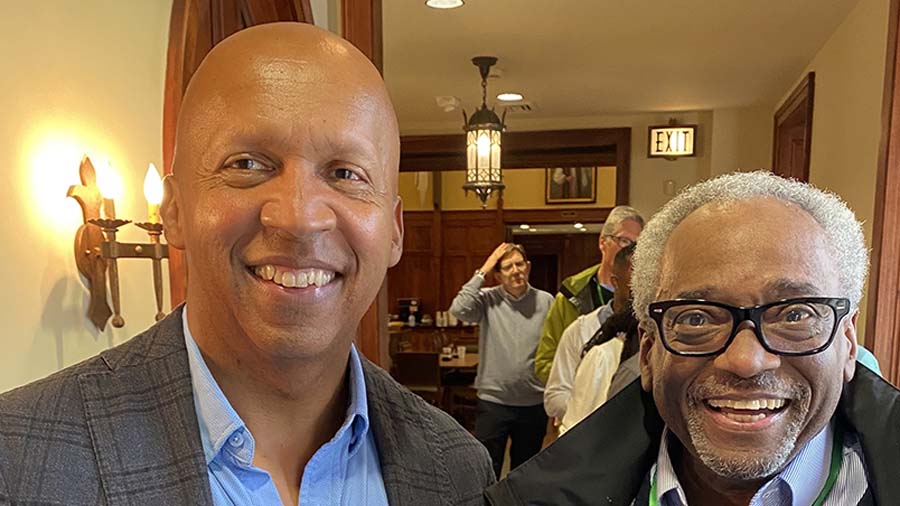
Scheduled events included a day pilgrimage to Montgomery, Alabama, with visits to the Legacy Museum, the National Memorial for Peace and Justice, and conversation with Bryan Stevenson of the Equal Justice Initiative at St. John’s Episcopal Church.
“We went to Montgomery not as tourists to consume, but as pilgrims to pray,” Curry said, reflecting on the visit. “We went on pilgrimage to holy places to remember those enslaved and abused in the institution of chattel slavery—and the martyrs and witnesses who labored for a society in which there is ‘liberty and justice for all.’ … We went as pilgrims following Jesus and his way of love.”
The Very Rev. Miguelina Howell, chaplain to the House of Bishops and dean of Christ Church Cathedral in Connecticut, delivered a homily for Sunday Eucharist. She invited those present to reconsider traditional interpretations of the story in the Gospel of John of the Samaritan woman at the well.
“Change begins from within at the personal and institutional levels,” Howell said. “The Samaritan woman was courageous, and her bravery did not translate into arrogance. She allowed herself to be vulnerable. She felt seen by Jesus. Jesus spoke to her soul. Jesus spoke to her story. She made the most of the encounter at the well.”
Bishop Suffragan for the Armed Forces and Federal Ministries
In its March 12 business meeting, the House of Bishops elected the Rev. Ann Ritonia, former Marine Corps major, to the position of bishop suffragan for the Armed Forces and Federal Ministries. While the initial election was declared null and void due to a single ineligibly cast vote, Ritonia was then elected on the first ballot of the second election.
Most recently, Ritonia served as rector of St. John’s Episcopal Church and Parish Day School in the Episcopal Diocese of Maryland. She is the recipient of the Navy Commendation Medal, the Navy Achievement Medal, the National Defense Service Medal, Meritorious Unit Commendations, and the Recruit Honor Graduate Award. Ritonia also served as a member of the Chaplain Selection Committee for Armed Forces and Federal Ministries for seven years.
“I so look forward to working with the Rev. Ritonia,” said Curry. “We are very fortunate to have her coming on board, and I wish her every blessing in this crucial ministry.”
Ritonia’s consecration date, pending consents, is set for September 30, 2023, at St. John’s Church, Lafayette Square.
The bishop suffragan for Armed Forces and Federal Ministries is a Department of Defense-appointed Ecclesiastical Endorser with responsibility for Episcopal chaplains and congregations in the departments of Defense and Veterans Affairs, and the Federal Bureau of Prisons. The Office of Armed Forces and Federal Ministries supports federal chaplains who provide spiritual and day-to-day support for those in the military, Veterans Affairs hospitals, and prisons.
Bishop Provisional of the Navajoland area mission
Also in the business meeting, the House of Bishops confirmed the recommendation of the people of the Navajoland area mission to appoint the Rt. Rev. Barry Beisner as their bishop provisional. Beisner served previously as bishop of the Episcopal Diocese of Northern California, and, since 2019, has served as assisting bishop in Navajoland with a focus on the formation of new clergy—in collaboration with his wife, the Rev. Ann Hallisey.
The Rt. Rev. Todd Ousley, bishop for pastoral development, referenced Resolution D080 from the 80th General Convention, which calls for the empowerment of The Episcopal Church in Navajoland to call its own leadership, including any necessary amendments to church canons at the 81st General Convention.
Transgender support
Recalling its March 2022 statement of love and continued support for transgender people and their families, the House of Bishops reaffirmed its commitment in a resolution responding to current legislative actions in 41 states targeting trans people. “We urge all in our church, in all the countries in which The Episcopal Church is found, to create safe spaces and shield all people from harassment based on gender identity, and to join in advocacy to protect them from discriminatory laws,” the resolution states.
Honoring life and ministry of the Most Rev. Frank Griswold
The bishops also passed a resolution honoring the life and ministry of the Most Rev. Frank T. Griswold III, the 25th presiding bishop of The Episcopal Church, who died on March 5. The resolution remembers Griswold for being a leader “who, rooted in the fullness of the human experience, encouraged us, in tracking down the Holy Ghost and in gathering up the fragments, to pray all our days, that we might grow more deeply into the love of and longing for God, and so might become prayer itself.”
Church of the Redeemer: Worshiping God, living in community, and reaching out to the world around us. We are an Episcopal Church serving north King County and south Snohomish County, Washington. As you travel your road, go with friends walking the way of Jesus at Redeemer.
Church of the Redeemer is at 6220 Northeast 181st Street in Kenmore, Washington. The campus is a short distance north of Bothell Way, near the Burke-Gilman Trail. The entrance looks like a gravel driveway. The campus is larger on the inside than it is on the outside. And we managed to hide a large building on the side of a hill that is not easily seen from the street.
In the spirit of our understanding of Jerusalem as the Holy City of Peace, we call on all Episcopalians to hear the words of our Presiding Bishop, “As we pray for the peace of Jerusalem, as the Bible teaches us, we must find ways to work for the peace of Jerusalem, which will be found where there is true equity for all, true justice for all, and true freedom for everyone. Here it is clear that this is not simply an idealistic dream. It is the only hope, and we must not rest until it is realized.”
The peace of Jerusalem is a promise not yet attained, but it is proclaimed by the prophets of all three Abrahamic faiths. Their words embody principles of love, humility, forgiveness, putting others first, and a preference for the marginalized.
We can have little doubt that Jesus commands us to lift up those who are oppressed, hold accountable any who misuse their power, abhor the use of violence, exhibit penitence and offer accountability for sins that governments have done on our behalf, and act always in the spirit of peace with justice.
In this quest for peace and justice full respect must be accorded to the civil rights and religious interests of all persons and all holy places in the city must be equally protected and accessible to faithful Jews, Christians, and Muslims, and to all people of goodwill.
We remind ourselves that Christians have an obligation to devote ourselves to renewed ecumenical and interfaith discernment and collaboration in the spirit of our shared values. Jerusalem should be honored as a community for all Jews, Christians, and Muslims, and serve as a symbol and a focal point for such work as the Holy City continues to exert its theological and spiritual authority as a sacred space of ultimate reconciliation and unity. Now is the time to work toward a unity of perspective on Middle East peace and justice with our Roman Catholic, Orthodox, and Protestant siblings, as well as with the Jewish and Muslim communities who share our hope for peace. Our journey as the children of the Abrahamic traditions is a journey to a future built on shared values and commitments for the common good of all who call Jerusalem and the Holy Land their home.
Deeper communion with those in the region who already work for peace is also vital. Scores of organizations work at the grass roots on behalf of freedom, dignity, and economic opportunity for all, promoting mutual understanding across barriers of cultural and religious difference. Their efforts deserve the Church’s understanding and support.
In all this work, our permanent partners are the Christian communities in the Holy Land, especially the Episcopal Diocese of Jerusalem. As the numbers of Palestinian Christians continue to decline, the region loses more potential bridge-builders and conciliators, as well as an integral part of the diverse landscape. We pray that our Church will encourage them to persevere, learn more about the region’s historical complexities, deepen our ties with its people and peace-building institutions, and promote ecumenical and interfaith peace with justice.
We offer this letter for the sake of God’s people, especially those in Israel and Palestine, whose faces are lit by neighborly light from the holy city of God itself. Why Jews, Christians, and Muslims have been called to live together in Jerusalem and the Holy Land is a mystery known only to God. But it is our responsibility as those who are part of the family of the children of Abraham to do all in our power to further and to deepen the commitment to peace with justice, and to its realisation. We ask all to join with us and with the Psalmist: “Pray for the peace of Jerusalem; may they prosper who love you. Peace be within your walls and quietness within your towers. For my brethren and companions’ sake, I pray for your prosperity; because of the house of the Lord our God, I will seek to do you good.”
An Addendum to Pastoral Letter
At the 79th General Convention of the Episcopal Church in Austin, Texas, The Episcopal Church, as it had over the past four decades, continued to address the complexity and contentious difficulties in the Middle East by resolutions. Among the adopted resolutions was B003, affirming the Church’s belief that Israel and Palestine should share Jerusalem as their capital and encouraging the whole Church “to engage earnestly in education, advocacy, and prayer for the renewal of a diplomatic and political process for peace in the region, and for the peace of Jerusalem.” The resolution called on the House of Bishops to offer a pastoral letter “supporting Jerusalem’s prophetic identity as the Holy City of Peace.”
House of Bishops
The House of Bishops is the second house of the General Convention of the Episcopal Church. It is composed of all bishops, active and retired, of the church. It meets concurrently with the House of Deputies, the first house, during General Convention, and also holds yearly meetings between conventions.
Welcome to Church of the Redeemer: Worshiping God, living in community, and reaching out to the world. We are an Episcopal Church serving north King County and south Snohomish County, Washington. As you travel your road, go with friends walking the way of Jesus at Redeemer.
Church of the Redeemer is at 6220 Northeast 181st Street in Kenmore, Washington. We are a short distance north of Bothell Way, near the Burke-Gilman Trail. The entrance looks like a gravel driveway. The campus is larger on the inside than it is on the outside. And we managed to hide a large building on the side of a hill that is not easily seen from the street.
In its first in-person assembly since September of 2019, The Episcopal Church House of Bishops gathered March 15-21, 2022, at Camp Allen in Navasota, Texas, for its traditional spring retreat. In addition to their primary activities of fellowship, study, prayer, and Sabbath, the 133 bishops and bishops-elect present held a business meeting the morning of March 19 that included the passage of pastoral statements/resolutions on the war in Ukraine and anti-trans legislation in various states.
Statement by the bishops on the war against Ukraine
The Rt. Rev. Marc Andrus, bishop of the Episcopal Diocese of California, introduced the statement on Ukraine on behalf of the Rt. Rev. Mark Edington, bishop in charge of the Convocation of Episcopal Churches in Europe, whose arrival at the gathering was delayed due to supporting churches in the region serving an influx of Ukrainian refugees.
The statement follows an Executive Council resolution from January 2022 expressing grave concern about escalating tensions between Ukraine and Russia and speaks to the current moment, identifying “a direct link between our baptismal covenant to respect the dignity of all people in Christ and the demand to respect the will of nations to determine their own destiny—the rule of jus cogens, in international law—when expressed freely in the ballot box.”
The bishops denounced Russian attacks on civilians, including “civilian residences, medical facilities, even agreed corridors for the humanitarian withdrawal of civilians in areas of combat,” and described these actions as a flagrant breach of international norms.
Anti-transgender response of the bishops
Turning to other recent events, the bishops acknowledged, in a pastoral statement/resolution, the context of meeting in Texas three weeks after Texas Gov. Greg Abbott called upon citizens to report parents pursuing gender-affirming medical care for their transgender children. The Rt. Rev. Kai Ryan, bishop suffragan of the Episcopal Diocese of Texas, introduced the statement, and the bishops debated at some length whether to name specific states proposing anti-trans legislation or to cast broadly in anticipation of likely future bills.
The Rt. Rev. Andrew Doyle, bishop of the Episcopal Diocese of Texas, urged the group to consider the importance of naming specific instances of bigotry and mentioned the support he personally felt in recent weeks knowing The Episcopal Church stands up for the protection and inclusion of transgender people.
The bishops unanimously affirmed this perspective in their resolution, which further states:
[We] voice love and continued support for all persons who identify as transgender or non-binary and their families. We decry legislative initiatives and governmental actions targeting trans children and their families. We urge all in our church to create safe spaces and shield all people from harassment based on gender identity.
Several bishops spoke as parents and grandparents of trans and non-binary children in affirming their support for the statement.
80th General Convention of the Episcopal Church
Heading into The Episcopal Church’s 80th General Convention in July 2022, the House of Bishops will include 39 new voting members since the 79th General Convention in 2018, and the bishops were introduced to a legislation-tracking spreadsheet tool to assist in their committee processes.
The Rt. Rev. John Taylor, bishop of Los Angeles, introduced a pastoral letter in response to B003—a 2018 resolution on Jerusalem—that focuses on the hope of the holy city as well as possible new coalitions and partnerships in the region with whom the church may continue to work for peace and reconciliation.
Other actions by the bishops
The House of Bishops Committee on Resignations also presented and passed a proposal to re-admit the Rt. Rev. Whayne Hougland, former bishop of the dioceses of Eastern and Western Michigan, as a non-voting member of the house. The Rt. Rev. Todd Ousley, bishop for pastoral development, praised this moment of reconciliation as an example of “living into the highest ideals of our Title IV process.”
On Sunday, March 20, the House of Bishops changed gears from originally planned programming when guest speaker Pádraig Ó Tuama was unable to attend due to a personal emergency. Five bishops from the dioceses of Olympia, Maryland, Northwestern Pennsylvania and Western New York, Colombia, and South Carolina offered a variety of stories from their dioceses of the difficult, painful—but essential—work of truth and reconciliation.
Lambeth Conference, a once-a-decade gathering of bishops from across the Anglican Communion, will be held July 26 to August 8, 2022, in Canterbury, England. The Episcopal bishops discussed their anticipated involvement Monday, March 21, with particular attention to logistics and some discussion of objectives.
House of Bishops
The second house, along with the House of Deputies, of the General Convention of the Episcopal Church. The House of Bishops is composed of all bishops, active and retired, of the church. It meets concurrently with the House of Deputies during General Convention. The House of Bishops also holds yearly meetings between conventions.
Welcome to Church of the Redeemer: Worshiping God, living in community, and reaching out to the world. We are an Episcopal Church serving north King County and south Snohomish County, Washington. As you travel your road, go with friends walking the way of Jesus at Redeemer.
Church of the Redeemer is at 6220 Northeast 181st Street in Kenmore, Washington. We are a short distance north of Bothell Way, near the Burke-Gilman Trail. The entrance looks like a gravel driveway. The campus is larger on the inside than it is on the outside. And we managed to hide a large building on the side of a hill that is not easily seen from the street.
“Give me Jesus!” is Presiding Bishop Michael Curry’s sermon for the House of Bishops on March 15, 2022.
The following is a transcript of the sermon of Presiding Bishop Michael Curry at the House of Bishops of The Episcopal Church, meeting in retreat at Camp Allen, Navasota, Texas, through March 21, 2022. These remarks have been lightly edited for clarity. A transcript in Spanish is available at the same link.
In the name of our loving, liberating and life-giving God, Father, Son, and Holy Spirit.
Some of y’all remember the TV show “Welcome Back, Kotter”? Welcome back, Kotter. Welcome, bishops. Welcome back, in person. It feels like a modified exile. And in one sense, I suppose it has been. COVID, racial reckoning, an attempted overthrow of the government of the United States. And now a world that hasn’t been this close to self-destruction since the Cuban missile crisis. But welcome back anyway.
So when I saw the lessons that had been appointed—because I love lectionaries. You can love in a dialectical sort of way. When I saw the lessons that were appointed for today, I said, “Those are good lessons.” But I think I heard the Spirit, maybe. I won’t blame it on the Spirit. Something said, “I got another text for you.” And this is a welcome back text. Words of Jesus found in the 11th chapter of Matthew:
“Come unto me all ye who are weary and heavy laden and I will give you rest. Take my yoke upon you and learn from me, for my yoke is easy.” It’ll fit, because my burden is light.
Come unto me, all ye who were bishops before this pandemic, and all ye, [inaudible] bishops who were consecrated during the pandemic. Come unto me, all ye who have been consecrated since then and all who soon will be. Come unto me, Episcopal Church. Come unto me, people who follow in my way and claim the name Christian. Come unto me whosoever will, who are weary, tired, beaten down, worn out, COVID crazy, right? Come unto me, all ye who are weary and heavy laden, and I will give you rest.
Take my yoke. Instead of the yoke that’s imposed on you from this world, take my yoke and learn from me. For my yoke is easy, and my burden is not slavery. It’s freedom.
An old spiritual said it this way, “In the morning when I rise, in the morning when I rise, in the morning when I rise, give me Jesus. When it’s time for me to die, when it’s time for me to die, when it’s time for me to die, just give me Jesus. Give me Jesus. Give me Jesus. You can have all this world. Just give me Jesus” (paraphrased). Come unto me, he said. Or as he would’ve said in south of Judah, y’all come. Come.
That spiritual, you can have all the world, give me Jesus, I’ve known it all my life. It’s kind of like the Lord’s prayer. I don’t remember when I didn’t know it. And I think I know it because it tended to get sung at family funerals, at least at the Baptist side of my family. Not at the Episcopal side. Those funerals were so short, they’re not memorable, but anyway, oops.
But in the Baptist side of my family, the Pentecostal Holiness side of my family, that was always sung. You can have all this world, give me Jesus. I suspect that’s where I heard it, but I remember at one particular funeral—this would’ve been the summer of 1969, I believe. The funeral had been at 16th Street Baptist Church in Birmingham, where my Aunt Callie taught Sunday school. And she had gone on the glory, and so the whole family trucked to Birmingham for a funeral. And then we buried her out in the country and came back to Birmingham for the family repast after the funeral.
I don’t know if y’all’s families are like this. I don’t know if this is an ethnic thing or not. I have no idea. But usually the repast is the time folk tell stories, and that’s what people do at funerals anyway. They tell stories and lies, and usually critique the preacher. Because sometimes the preachers will preach folk into heaven and say, “Oh, so and so, oh, he was a saint. He was a…” And we say, “You know, we loved uncle so and so, but we knew him. He wasn’t no saint now.”
But anyway, folk would come back. And then in my family, on my father’s side, folk, they would debate politics, and sports, and the Bible. On this one occasion, this was 1968, the summer of ‘68, Dr. King had been assassinated. Bobby Kennedy had been assassinated. Medgar Evers. Viola Liuzzo. John Kennedy, a president. And one of my cousins got in a debate, a polite debate, because in those day you didn’t talk back to the elders. A polite debate with one of my uncles who was a preacher, Baptist preacher. And he said, “You know, I’m tired of hearing folks sing that song, ‘You can have all this world, just give me Jesus.’” And he said, “That’s exactly what our folk got. We’ve been singing that song. You can have all this world, and somebody else got the world and all we got was Jesus.”
And I don’t remember how the debate ended, but needless to say, my uncle was not pleased. But it was like what Desmond Tutu said about Southern Africa, he said, “When the missionaries came, they had the Bible and we had the land. Next thing we knew, we had the Bible, and they had the land.” Something was wrong with that deal. We love the Bible, but how about Bible and land?
My cousin had a point, that religion sometimes can be an opiate of the people. It can be twisted and distorted and misused to a narcotic, to keep people from rising up and claiming their God-given rights and human dignity. Although it has been used before, but I believe that old song has a deeper wisdom. “You can have all this world, just give me Jesus.” See, don’t underestimate the power of that which is authentically spiritual. Because if it is authentically of the spirit, it is of God. Don’t underestimate that. It may take its time. As the old preachers say, “It may not be on your time.” It may not happen on my time, but when God’s will is done on earth, as it is in heaven, it is always on time.
Don’t underestimate the power of hope. Dante warned us, “Abandon hope, all ye who enter here,” over the gates of hell. Don’t underestimate the power of faith. Don’t underestimate the power of love. Don’t underestimate the spiritual. People who believe. People got God. They will make it against all the odds. If you don’t believe me, ask the folk of Ukraine. Help me, somebody. Mary Glasspool gave this to me right before the Eucharist. It is a candle, adorned. She got it from a Ukrainian shop in New York. Don’t, Putin, oh, I’m going to get in trouble. I know I’m going to get in trouble with what I’m about to say. Putin may overrun the country, but he will not defeat the people of Ukraine. He will not. Spirit will always win over flesh. It may not be in the forecast time, but it’s real.
In 1853, Theodore Parker, an abolitionist, when it looked like slavery would never end in this country, said, and I quote, “I do not pretend to understand the moral universe. The arc seems to be a long one, but from what I can see it bends toward justice.” Dr. King shortened it and said, “The moral arc of the universe is long, but it is bent toward justice.” Not because of some metaphysical magic, but because there is a God. And if there is a God, then there is hope. If there is a God, then there can be faith. And if there is a God, as my Bible says, who is love, then in the end, no matter what we have to go through now, in the end, love is going to win. If there’s a God, love is going to win.
Pray for Ukraine. Don’t give up on them. Do other things, send money to the refugees—Episcopal Relief & Development is working with other Christian groups in Hungary and in Eastern Europe. So get folk to send money. This is a commercial. Am I on TV somewhere here? Get the money to Episcopal Relief & Development. And there may be other things we can do, but do not abandon them without prayer. Pray. Pray for Ukraine. Pray for Russia. Pray for Putin, that unlike Pharaoh his hardened heart may be turned.
And if it doesn’t turn, pray for the leaders of the nations, that they will have moral courage, spiritual wisdom to do what is right, to do justice, love mercy, and walk humbly with our God. Don’t abandon prayer now. Pray for the children of Ukraine. I love, I got to tell this, I have fallen in love with the people of Ukraine. First of all, they cuss better than anybody else I have … I mean, they have invented some cussing that wasn’t there. They are incredible. I can’t say some of the words that they … There was a group of little old ladies who looked like a prayer group on CNN, and they asked them, “What do you think of Putin?” And I think it was “glossolalia,” some unknown tongue, because they got to cussing and saying all sorts of stuff.
But these are remarkable people. Their spirit, they just want to free. They just want to be free. And the truth of the matter is, Thomas Jefferson, he had his issues like the lesson that we just had from Matthew 23, where Jesus said, “Do what the scribes and pharisees say, don’t do what they do.” When it comes to Thomas Jefferson, don’t do what he did, but he was right: “We hold these truths to be self-evident that all men”—all people—”are created equal.” Thomas Jefferson said the God who gave us life, gave us liberty at the same time. And that is true for everybody. The people of Ukraine just want to be free.
I’m not going to talk long this morning, but I ain’t seen y’all in person in a long time. You don’t know. You have no idea how glad I am to see you all. You have no idea. Oh, dear Lord. I remember this would’ve been, well, probably 1960, and I went to the movie with my daddy. And we went to see “Exodus.” It was based on Leon Uris’ book, “Exodus.” And now we understand that’s a complex story, more complex than we understood in 1960. I understand all of that, so don’t go political on me right now. But it is the story of people seeking freedom.
At the end of the movie, we went out and daddy just blurted out—it was really fascinating now that I think about it—he just said, “The Lord didn’t make anybody to be under anybody’s boot. He made us all to be free.” All of us. He was right. He made the people of Ukraine to be free. Not free for licentiousness, but free to be all that God intends for us to be. But freedom, stay with me, freedom is a spiritual reality. You see where I’m going now? Don’t underestimate the power for freedom, said St. Paul. “Christ has set us free. Stand fast and do not accept the yoke of slavery again.” That’s St. Paul. That’s in the Bible. And it ain’t just talking about personal sin. It’s talking about that, but it’s talking about for freedom, Christ has set us free.
Those slaves used to sing a spiritual. It said, “Oh, freedom. Oh, freedom. Oh, freedom over me. And before I’ll be a slave, I’ll be buried in my grave and go home to my Lord and be free.”
Did you catch that? Somebody who is legally chattel property, somebody who by every political socioeconomic reality of this world—stay with me—is a slave, declaring, “I’m not a slave. Before I’ll be a slave, I’ll be buried in my grave and go home to my Lord and be free.” Oh, this spiritual thing, this business we are, this is powerful stuff. It can set the captive free, even when the world would enslave. Jesus says, “Come unto me. Come unto me, all ye who are weary and heavy laden.”
I don’t know if it’s just because I’m 69, but I’m not lying. I’m tired. But I’m feeling good this morning because I see you all. Yeah, we’re all kind of tired. And folk in church, I call it COVID crazy. Everybody’s a little bit on edge and folk acting out in ways that… Have you noticed a pattern? Yeah, I don’t know if it’s just Christian COVID crazy or if it’s human COVID crazy. And I got to go to the meeting with the primates of the Anglican communion right after this meeting . . . I don’t know what to expect in that, but I’m looking forward to a great, getting-up morning. But nonetheless, I mean the truth is everybody, there is a weariness, and you have been frontline folk even on Zoom. And our clergy have been frontline folk. And they’re tired. And the world is giving us no rest.
Jesus says, come unto me all who are weary, heaven laden and beaten down by the realities of this world. Take my yoke. Take my way of life and love. Take what I’m trying to teach you. Take my yoke upon you. Learn from me. Don’t you know? Oh, Cynthia Bourgeault is coming. You all got to know Jesus is Sophia’s child. “Learn from me for my yoke is easy.” That Greek, where it doesn’t mean it’s easy. What was that? “Ease on down, ease on down the road” (singing). This is not that. No. Easy means it fits. It was made for you. My yoke is easy. It was made to make human life human as God dreamed and intended. It fits. My yoke is easy, and my burden is light. And you will find rest. Did you catch this? Rest. God’s eternal Sabbath rest for your soul.
I read [Walter] Brueggemann’s book, “Sabbath as Resistance,” or at least most of the part I could understand. Rob Wright turned me on to Brueggemann. He understands it. Lot of times I just go, that’s deep. I don’t know what he was talking about, but it’s deep. But at one point, the one part I did understand was when Brueggemann said, “When God rested on the Sabbath, the seventh day, it is rest in one sense. But, it also means that everything,” stay with me, I’m coming at something, “is in its right relationship and proportion. It is as God intended it to be.” That’s when everything is at rest and God saw after the Sabbath was made, everything that God had made, including Sabbath rest. And God said, “Oh, that is showing off good.” Or as George Jefferson used to say, you all remember “The Jeffersons”? When George did something right, he used to pat himself on the back and say, “Good one, George.”
God kind of said, “This is a good one.” When the world is the way I intended it to be. When all things are consistent with the created order. When love is the law of the creation. When the creation is cared for. When there’s room for all of God’s children. And God rested and said, “It is good.” Oh, you can have all this world. You all see this? Is this making some sense? Just give me Jesus. Well, I’m really going to bring this home. I really am now.
As many of you know, this past January, Dr. Charles Willie, who served at one time as the vice president of the House of Deputies in the 1970s, and who was, oh yeah, you know him well, yeah. I mean, Jennifer (Baskerville-Burrows) would know him from Syracuse, from Grace Church. But Dr. Charles Willie, who was a lifelong Episcopalian from Dallas, Texas, he died and entered life eternal in January. And that has been the case with many who have gone on to glory during the COVID pandemic; funerals are delayed. And so I got a note, an email from Byron Rushing, our current vice president of the House of Deputies, just Sunday, saying that the family’s having a memorial service for him this coming Saturday, in light of the fact that the omicron spread was happening in January.
When I got that note from Byron, I thought about Dr. Willie, and remembered that he was an African American child born and reared here in Texas a long time ago. His mama was a teacher, but not allowed to teach in the public schools because of Jim Crow. Daddy was a Pullman car porter. My granddaddy was a Pullman porter. Went with A. Philip Randolph to the march on Washington in the ‘40s. I wish I had asked him when I was a little kid, what was all that like? Dr. Willie was, Arthur Williams would know Dr. Willie, was a great person, committed Episcopalian, lifelong. He was somebody who devised these segregation plans that were used in a number of cities in this country that actually worked. He was a sociologist who challenged the prevailing notions about the inadequacies of the Black family. And he statistically verified that frankly, that the survival of the Black family was a miracle. A miracle. He was a remarkable guy, not only in his career as an academician, but in his churchmanship and his commitment to Jesus Christ and his church.
He became the vice president of the House of Deputies. And Byron Rushing, in an article, said this, “Black Episcopalians were both proud of Chuck being elected first African American to the Executive Council and vice president of the House of Deputies.” They were so proud because you cannot imagine and cannot overemphasize how racially segregated The Episcopal Church was before the 1970s. It was a stunning reality. Dr. Willie believed that God made all people equal. He believed that the “imago Dei,” the image of God that is conferred upon every human being, is a conferral of infinite value and worth of every human child of God. And that imago Dei is equally distributed upon everybody. Nobody’s got a little bit more of imago Dei than anybody else. Nobody got no more superiority of that imago Dei than anybody else. This is God’s image. This is God’s likeness. This is the God who is love, conferring his dignity and words on every human child of God. And Dr. Willie came to believe that if this was true for his African American community, this must be true for everybody.
And in 1974, he preached at the ordination of the Philadelphia 11. And when the House of Bishops spoke against him, I know I’m getting in trouble, but I’m 69 now. When the House spoke—and we respect people’s opinions, don’t misunderstand me, please—the voices and the chorus against him, and the tide turned against him. And he found himself receiving criticism from Blacks and whites alike. Black folk were upset because he could have been the first Black president of the House of Deputies. And others had their reasons.
But he believed in it, in the God who is love and who is an equal opportunity lover. And so he resigned as vice president of the House of Deputies. And this is what he said to explain this decision, and I quote, “An officer is a servant of the people who attend to the collective life and the rules and regulations developed by that community or association for its life. Either I had to enforce sexist laws, or I had to get the church to change them, or I had to resign as vice president of the House of Deputies. It was the only path of integrity.” And then listen to this: “I could not act like Pilate and do what I knew was wrong. I could not segregate, alienate, and discriminate against women simply because it was legal to do this and yet somehow claim to be acting in love. When that which is legal and that which is loving are in contention, legality must give way to love. I decided not to be Pontius Pilate.”
That, my friends, is a profile in courage. That, my friends, is someone who chose Jesus and not the way of the world. And don’t misunderstand me. Courage comes in conservative stripes as well as liberal ones. Courage comes in all colors. Courage comes in all kinds. Courage comes in all shapes.
For all who have been baptized into Christ and put on Christ, and there is no more slave or free. There is no more male or female. There is no more Jew or Greek, for all are one in Christ. And those who are in Christ, they shall wait upon the Lord. They shall mount up on wings like eagles. They shall run and not be weary. They shall walk and they will not faint. Come unto me, all ye who are weary and heavy laden, and I will give you rest.
(singing)
You can have all this world, Give me Jesus!
In the morning when I rise, In the morning when I rise, In the morning when I rise,
Give me Jesus! Give me Jesus! Give me Jesus! You can have all this world, Give me Jesus!
Welcome back.
Amen.
Presiding Bishop Michael Curry
Being a Christian is not essentially about joining a church or being a nice person, but about following in the footsteps of Jesus, taking his teachings seriously, letting his Spirit take the lead in our lives, and in so doing helping to change the world from our nightmare into God’s dream.
―Michael Curry, Crazy Christians: A Call to Follow Jesus
The Most Rev. Michael Bruce Curry is Presiding Bishop and Primate of The Episcopal Church. He is the Chief Pastor and serves as President and Chief Executive Officer, and as Chair of the Executive Council of the Episcopal Church.
Presiding Bishop Curry was installed as the 27th Presiding Bishop and Primate of The Episcopal Church on November 1, 2015. He was elected to a nine-year term and confirmed at the 78th General Convention of The Episcopal Church in Salt Lake City, Utah, on June 27, 2015.
This second house, along with the House of Deputies, of the General Convention of the Episcopal Church. This house is composed of all bishops, active and retired, of the church. It meets concurrently with the House of Deputies during General Convention. The House of Bishops also holds yearly meetings between conventions.
Church of the Redeemer: Worshiping God, living in community, and reaching out to the world around us. We are an Episcopal Church serving north King County and south Snohomish County, Washington. As you travel your road, go with friends walking the way of Jesus at Redeemer.
Church of the Redeemer is at 6220 Northeast 181st Street in Kenmore, Washington. The campus is a short distance north of Bothell Way, near the Burke-Gilman Trail. The entrance looks like a gravel driveway. The campus is larger on the inside than it is on the outside. And we managed to hide a large building on the side of a hill that is not easily seen from the street.
[Episcopal News Service] Presiding Bishop Michael Curry, in his September 21, 2021, sermon during the opening day of the fall House of Bishops meeting, recalled a recent conversation with a fellow bishop about planning for The Episcopal Church’s future. Such conversations typically look to the coming years, Curry said, “but in pandemic time, we can barely think a month ahead of time.”
This House of Bishops meeting is a prime example. The bishops’ twice-a-year meetings have been held online since the start of the pandemic in March 2020, but with vaccines against COVID-19 now widely available, the bishops had planned to gather Sept. 21-23 in St. Louis, Missouri, for their first in-person meeting in two years. Instead, the delta variant and the national surge in COVID-19 cases since July forced the bishops to cancel their face-to-face meeting and return to Zoom.
“So now we are here, not in St. Louis,” Curry told the bishops. “The miracle of vaccination has arrived, even with some boosters, and yet some refuse and the pandemic goes on.”
Curry wondered if diocesan conventions would be held in person this fall, and whether the delta variant could force further changes next year to the church’s General Convention and the Anglican Communion’s Lambeth Conference. “I don’t have any answers yet,” Curry said.
Curry spent much of his 25-minute sermon invoking the term “narthex,” the area of a church that people pass through to enter and exit, using it as a metaphor for this period of uncertainty and transition. “We are living in a narthex moment, between the world we knew and whatever is being born,” he said.
That moment was to be the focus of the bishops’ discussions with each other in the “table time” portion of the meeting’s first day. The opening worship service was livestreamed on YouTube, but the rest of the meeting was closed to the public.
Before the bishops broke into smaller groups, Utah Bishop Scott Hayashi posed three questions for them to discuss: What five words describe your experience with the pandemic? Where has God been present in this time? Have your goals as a bishop changed because of this time of pandemic, racial unrest and political division?
“I’ve had to take it into my heart to consider what has been lost and what has been gained,” said Hayashi, as he lamented that the bishops still could not have such conversations in person.
During his sermon, Curry described watching the 1953 movie “The Robe,” set in biblical times, and hearing echoes of today’s call for the church to reject the trappings of empire. He presented a vision of reformation in the church, away from the establishment and closer to Christianity’s origins in small gatherings.
This, he said, is a “church before collusion with the empire, the church that looks something like Jesus, the church that lived into ‘narthex,’ to let go of the ways things were, to behold the way things could be.”
Curry continued that such a church would be “not formed in the way of the world but formed in the way of Jesus and his love.”
“A community of small gatherings and congregations of all stripes and types, a human tapestry, God’s wondrous variety, the Kingdom, the reign of God, the beloved community, no longer centered on empire or establishment, no longer fixated on the preservation of institution, no longer propping up white supremacy or in collusion with anything that hurts or harms any child of God or God’s creation – by God’s grace, a church that looks and acts and lives like Jesus.
“Welcome to narthex, and welcome to behold a new heaven, a new Earth, a new you, a new me, a new we.”
—David Paulsen is an editor and reporter for Episcopal News Service.
He can be reached at dpaulsen@episcopalchurch.org.
To embrace Presiding Bishop Curry’s invitation to become a church that looks and sounds like Jesus, and to download related resources, visit A Church That Looks and Acts Like Jesus.
Presiding Bishop Michael Curry
“Being a Christian is not essentially about joining a church or being a nice person, but about following in the footsteps of Jesus, taking his teachings seriously, letting his Spirit take the lead in our lives, and in so doing helping to change the world from our nightmare into God’s dream.” ―Michael Curry, Crazy Christians: A Call to Follow Jesus
The Most Rev. Michael Bruce Curry is Presiding Bishop and Primate of The Episcopal Church. He is the Chief Pastor and serves as President and Chief Executive Officer, and as Chair of the Executive Council of the Episcopal Church.
Presiding Bishop Curry was installed as the 27th Presiding Bishop and Primate of The Episcopal Church on November 1, 2015. He was elected to a nine-year term and confirmed at the 78th General Convention of The Episcopal Church in Salt Lake City, Utah, on June 27, 2015.
This second house, along with the House of Deputies, of the General Convention of the Episcopal Church. This house is composed of all bishops, active and retired, of the church. It meets concurrently with the House of Deputies during General Convention. The House of Bishops also holds yearly meetings between conventions.
Welcome to Church of the Redeemer: Worshiping God, living in community, and reaching out to the world. We are an Episcopal Church serving north King County and south Snohomish County, Washington. As you travel your road, go with friends walking the way of Jesus at Redeemer.
Church of the Redeemer is at 6220 Northeast 181st Street in Kenmore, Washington. The campus is a short distance north of Bothell Way, near the Burke-Gilman Trail. The entrance looks like a gravel driveway. The campus is larger on the inside than it is on the outside. And we managed to hide a large building on the side of a hill that is not easily seen from the street.