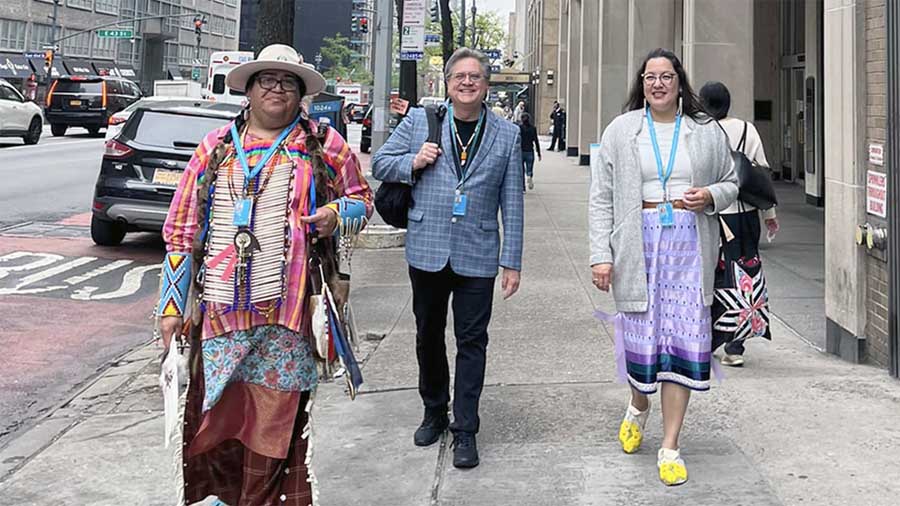
The Roman Catholic Church was the last major Christian denomination to repudiate the doctrine, making the pope’s statement “a significant advancement,” said the Rev. Brad Hauff, the Episcopal Church’s missioner for Indigenous ministries and a member of the Oglala Lakota tribe.
Previously, addressing the doctrine’s negative impacts was harder when “over 50% of the world’s Christians were not on board with it,” he said.
The Episcopal Church led the way as the first Christian body to repudiate the Doctrine of Discovery through an act of General Convention in 2009.
Monarchs and nation-states used the doctrine, which dates to 15th-century papal statements, called “bulls,” as justification for the subjugation of Indigenous peoples in Africa, Asia, New Zealand, and the Americas. In the United States, this included forced removal of tribes from their ancestral homelands to reservations, massacres and removing children from their families to attend residential boarding schools designed to erase their culture.
During each of the annual U.N. forum meetings Hauff has attended, there has been a commonality of issues, no matter where delegates lived, that resulted from colonization that was justified by the Doctrine of Discovery, he said.
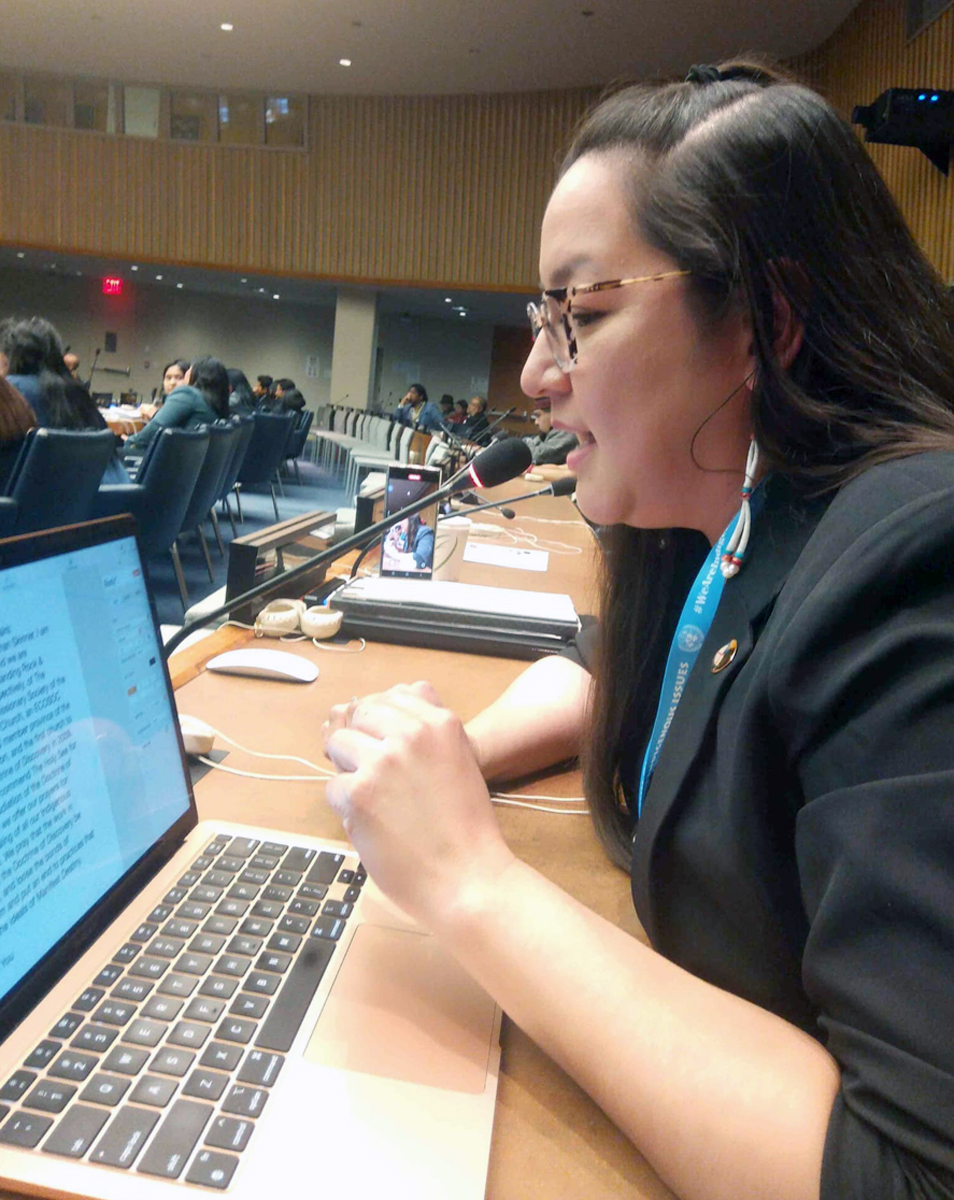
Hauff was joined by two other two delegates – Melissa Chapman Skinner, Standing Rock Sioux from the Diocese of South Dakota and Ronald Braman, Eastern Shoshone from the Diocese of Idaho – who had the chance to provide statements, called interventions in U.N. language, addressing the doctrine.
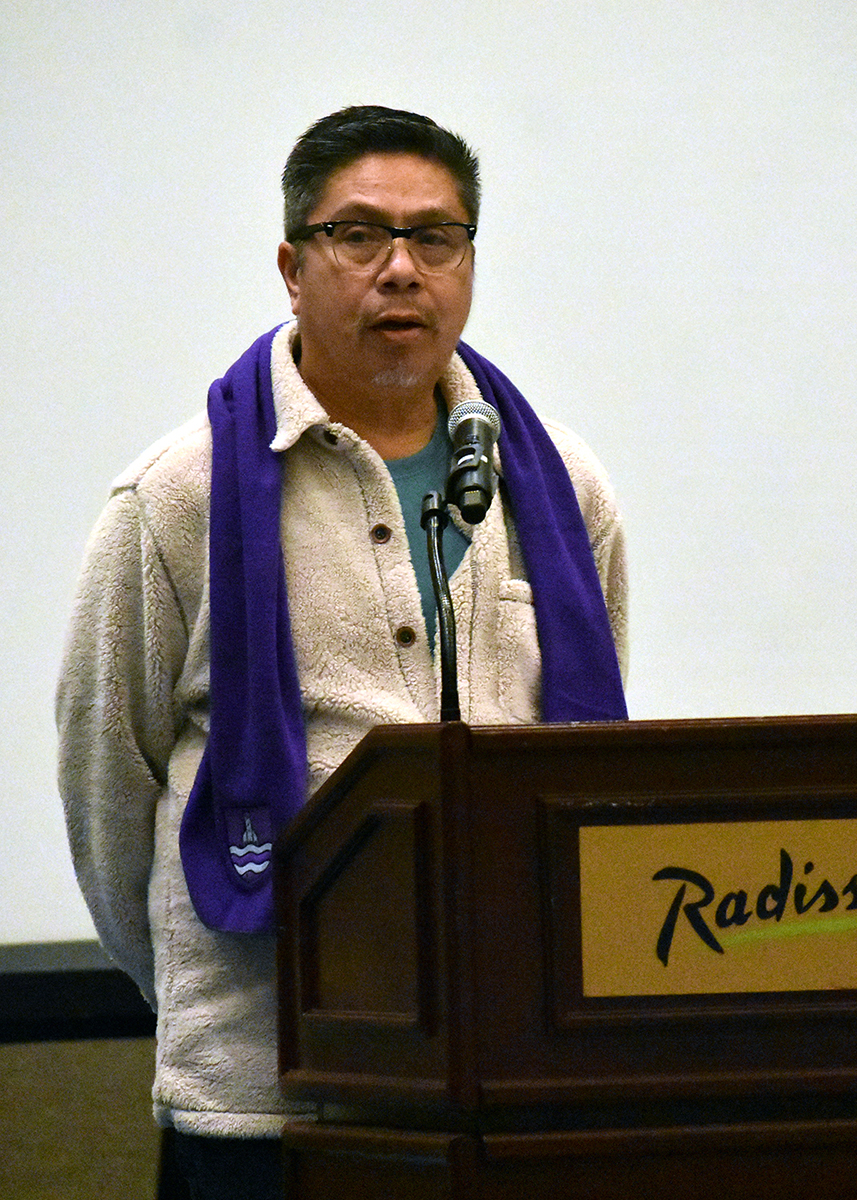
Episcopal delegate Melissa Chapman Skinner offered a statement about the Doctrine of Discovery on April 24. Photo: Lynnaia Main
Skinner made brief remarks on April 24, and Braman, reflecting on the forum’s theme this year – Indigenous peoples, human health, planetary and territorial health and climate change: a rights-based approach – made a statement on April 28 describing how the legacy of boarding schools continues to harm Indigenous people in Canada and the United States. The trauma tribal elders experienced in those schools is being passed on to their descendants today, resulting in poverty, violence and substance abuse, he said.
The Permanent Forum on Indigenous Issues was formed by U.N. resolution in 2000 to focus on issues related to economic and social development, culture, the environment, education, health and human rights. Its first meeting took place in 2002. It has continued to offer opportunities each year for Indigenous peoples to provide expert advice to global leaders through the U.N.’s Economic and Social Council, or ECOSOC, and to inform U.N. agencies working on a variety of international issues, from human rights to the environment. The Episcopal Church is an ECOSOC-accredited nongovernmental organization, which means delegates are permitted to offer statements.
Skinner and Braman, who were serving as delegates for the fifth time, told ENS in a joint interview they were aware they brought to the event both their Christian and their Indigenous identities. “I have to walk carefully between them,” Braman said, but he noted that holding that tension allows him to serve as a bridge-builder between faith communities and those harmed by churches. He joked that as people got to know him and Skinner over the course of the meeting, they’d be greeted warmly as “the church people.”
In addition to general sessions, member states and nongovernmental organizations offered side events, where smaller groups could engage on a variety of topics. Hauff called these events “the meat and potatoes” of the forum. The Episcopal Church offered one such side event on April 21. Forum participants were invited to a multi-faith worship service at the Chapel of Christ the Lord at the Episcopal Church Center, followed by lunch and a panel discussion, which also was livestreamed, entitled “The Church and Indigenous Boarding Schools: A Time of Reckoning and Looking to the Future.”
Skinner and Braman both said they were thankful The Episcopal Church provided support so they could participate during both weeks of the event (Hauff was present for the first week). For the forum’s opening session, many people wore traditional dress, which Braman called “an important representation of Indigenous identities.” Speakers included U.N. Secretary-General António Guterres and U.S. Secretary of the Interior Deb Haaland, a member of the Pueblo of Laguna and the first Native American to serve as a cabinet secretary. Skinner said that seeing Haaland was a highlight of the event for her.
Having served four times as an Episcopal Church delegate to the U.N. Commission on the Status of Women, Skinner said she knows the importance of sharing what she learned with people back home, and she and Braman both said they plan to host community events to share their experience. Not enough people across The Episcopal Church know about the Doctrine of Discovery, and Braman wants to help change that. “There is much work to be done,” he said.
—Melodie Woerman is a freelance writer and former director of communications for the Diocese of Kansas.
Church of the Redeemer
Church of the Redeemer: Worshiping God, living in community, and reaching out to the world around us. We are an Episcopal Church serving north King County and south Snohomish County. We welcome you be with us as we walk the way of Jesus.
Church of the Redeemer is at 6220 Northeast 181st Street in Kenmore, Washington. We are a short distance north of Bothell Way, near the Burke-Gilman Trail. The entrance looks like a gravel driveway. The campus is larger on the inside than it is on the outside. And we managed to hide a large building on the side of a hill that is not easily seen from the street.
[Episcopal News Service – Green Bay, Wisconsin] The Oneida have called the Green Bay area home for 200 years since the tribe was forced to relocate from its ancestral homeland in central New York under pressure from expansionist European-American settlers and business interests. Many of the Oneida who first arrived here in the 1800s brought not only their families, traditions and culture but also the Episcopal faith.
While putting down new roots here, the Oneida established the first permanent Episcopal worshipping community in what today is the state of Wisconsin. The historic Church of the Holy Apostles located on the Oneida Reservation is often referred to as “the grandmother church” of the state’s three Episcopal dioceses.
“Holy Apostles has always been a center of our lives,” Jenny Webster, a tribal council member, said on January 21, 2023, as she and other Oneida Episcopalians hosted a small, weekend gathering of Indigenous ministry leaders at the Radisson Hotel & Conference Center, an Oneida-run facility adjacent to the Oneida Casino.
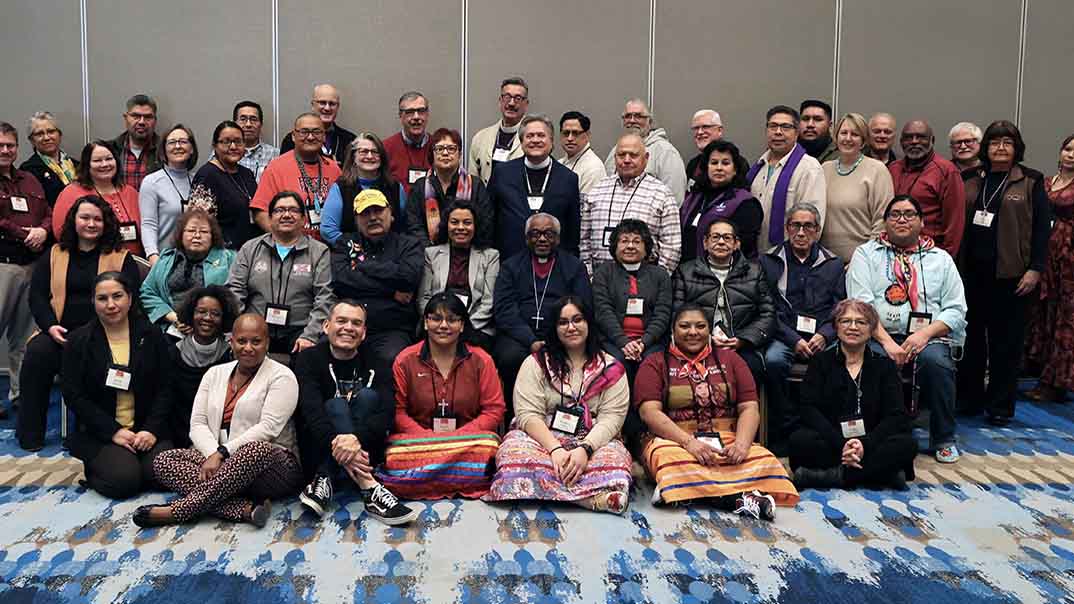
The annual Winter Talk conference is organized by The Episcopal Church’s Office of Indigenous Ministries, and this year, in addition to drawing several bishops from dioceses with large Indigenous communities, the 50 or so attendees included Presiding Bishop Michael Curry and House of Deputies President Julia Ayala Harris.
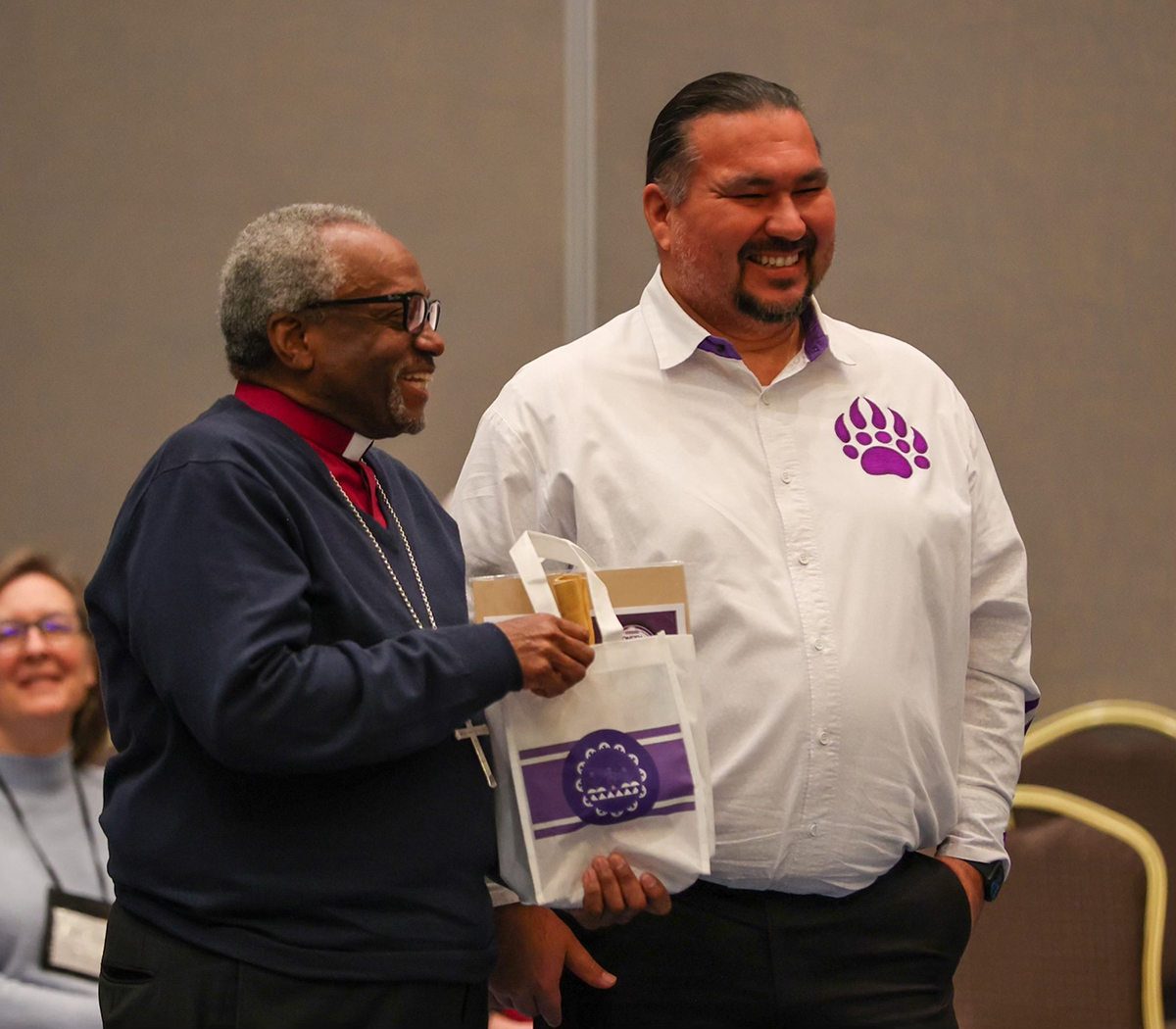
Presiding Bishop Michael Curry receives a gift bag from Oneida Chairman Tehassi Hill during Winter Talk on Jan. 21 at the Oneida Nation’s Radisson Hotel & Conference Center in Green Bay. Photo: Jeremy Tackett
There to listen
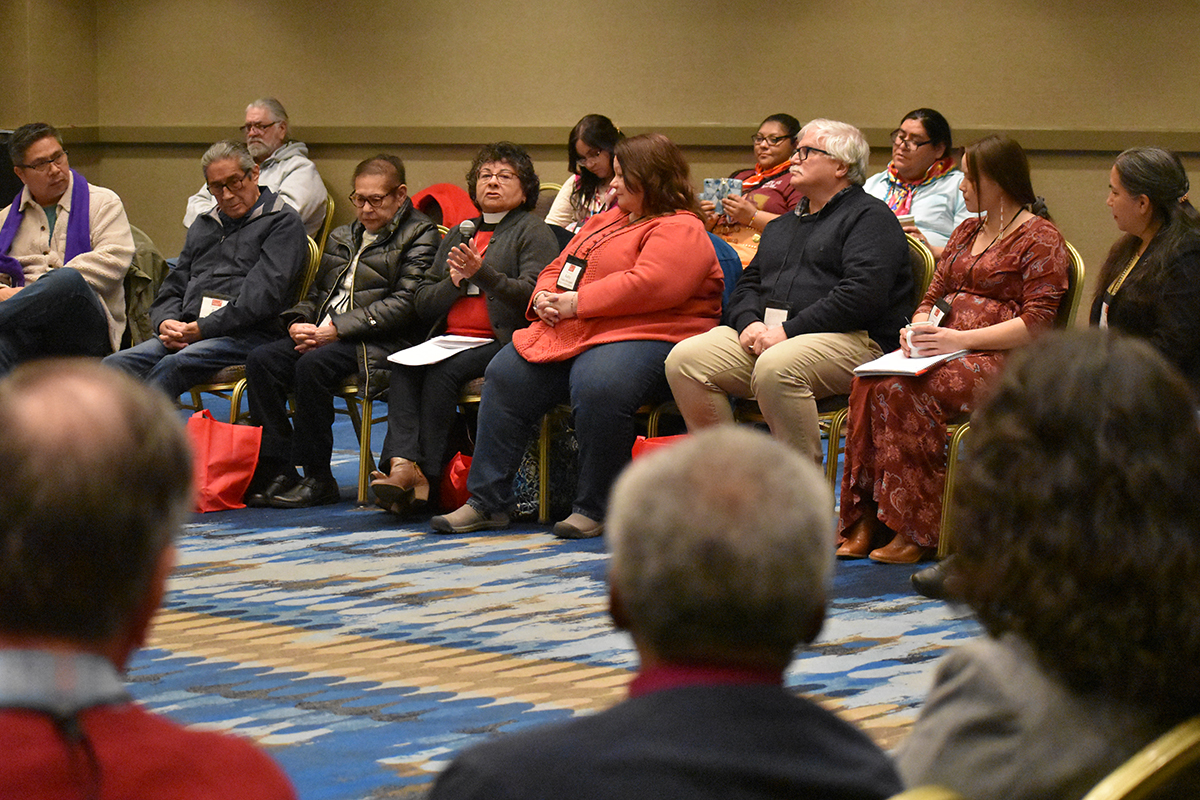
Curry and Ayala Harris underscored that they came to listen. The stories shared by Indigenous participants at Winter Talk spanned a wide range of emotions, from the joy they feel at practicing their Episcopal faith to a mix of sadness and anger at the legacy of the attempted extermination of their ancestors and their culture. Some tearfully invoked the generational trauma that lingers long after the harm done by the federal boarding school system of the 19th and 20th centuries, which sought to take Native American children from their families and assimilate them into the dominant white culture.
“Anger is going to come out when the truth is spoken,” said Warren Hawk, a lay leader in the Diocese of South Dakota and a Standing Rock Sioux tribal council member. “I think the biggest thing of all, speaking to the anger of our people, is that we need to heal. And how can we heal, from all the generations of being downtrodden?”
Boarding schools legacy
The legacy of boarding schools made international headlines in 2021 with the discovery of a mass grave containing the remains of 215 children at a former Indigenous boarding school in Canada. Following the discovery, the U.S. Department of Interior announced it was launching a comprehensive review of American boarding school policies dating to 1819.
The National Native American Boarding School Healing Coalition, a nonprofit based in Minneapolis, Minnesota, has identified at least 367 schools that were part of that system, many of them run by Christian denominations. At least nine were thought to have Episcopal Church connections, though the dearth of churchwide records has made it difficult to fully account for the church’s role in the schools.
The Rev. Debbie Heckel, center with microphone, a deacon with the Oneida congregation of Church of the Holy Apostles, speaks about her service with the church Jan. 21 during Winter Talk. Photo: David Paulsen/Episcopal News Service
For the past 18 months, Episcopal leaders have considered how best to address the church’s complicity in the boarding school system. They have organized listening sessions and invited survivors and their families to share personal stories, most notably last July at the 80th General Convention in Baltimore, Maryland.
After an extended period of “holy listening” on the floor of the House of Deputies, General Convention approved a resolution calling for the creation of a fact-finding commission to conduct intensive research into church, diocesan and federal archives to document and share the untold history of Episcopal-run boarding schools. That measure also incorporated a parallel resolution calling for creation of community-based spiritual healing centers.
Challenges and hardships
“When I looked at these resolutions, I see the faces my parents, as I’m sure many of us do,” the Rev. Bradley Hauff, the church’s missioner for Indigenous Ministries, told attendees at Winter Talks while seated in a circle around a small ballroom at the conference center. Hauff is Lakota, and both his parents attended Indigenous boarding schools in South Dakota.
“We who are their descendants, we carry the scars, we carry the pain,” Hauff said. “Their boarding school experience lives on in us as part of our story, as part of our collective narrative.”
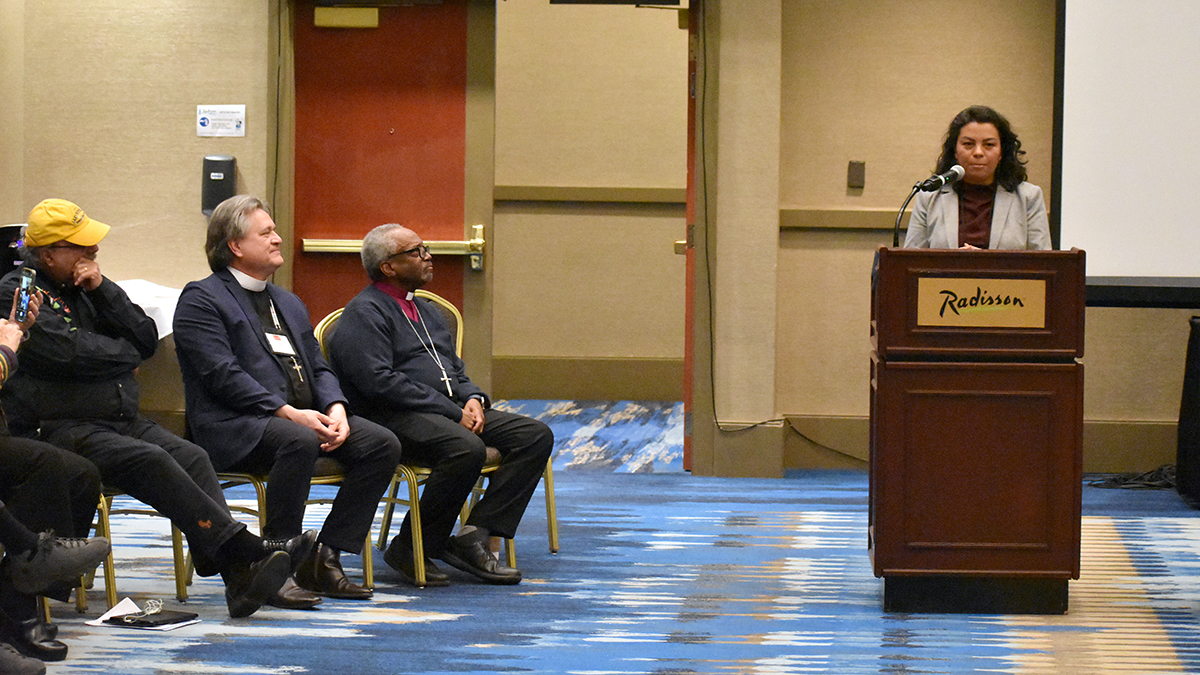
House of Deputies President Julia Ayala Harris addresses attendees at Winter Talk on Jan. 21 as Presiding Bishop Michael Curry listens. Sitting next to Curry is the Rev. Bradley Hauff, the church’s missioner for Indigenous ministries. Photo: David Paulsen/Episcopal News Service
Boarding school students endured a wide spectrum of challenges and hardships. Some were forced to attend, while other families voluntarily sent their children to receive what often was the only formal education available. In some cases, students endured a nightmare of mistreatment, abuse and even death far from home. Other survivors of the boarding schools recall no physical abuse but still speak of the trauma of family separation and deprivation of their culture and identity.
Doctrine of Discovery
The afternoon session of Winter Talk on Jan. 21 featured guest speaker Sarah Augustine, co-founder and executive director of the Coalition to Dismantle the Doctrine of Discovery. The coalition’s name refers to a centuries-old doctrine rooted in the Roman Catholic Church’s endorsement of the post-Columbian European conquest of North America in the name of spreading Christianity, and it continued to underpin the United States’ westward expansion under the banner of Manifest Destiny.
Sarah Augustine, executive director of the Coalition to Dismantle the Doctrine of Discovery, discusses American policies of Indigenous child removal on Jan. 21 during Winter Talk. Photo: David Paulsen/Episcopal News Service
Augustine made the case that the removal of Indigenous children from their families is not only a historical injustice but continues to be a problem today through a foster care system that casually violates provisions in the Indian Child Welfare Act of 1978. That law, now facing a legal challenge before the U.S. Supreme Court, gives tribes jurisdiction over placing Native American foster children and adoptees with families, with preference given to families in their own tribes.
Augustine, who lives in central Washington State, is Tewa and originally from New Mexico. Her father was taken from his mother as a baby and raised at a boarding school, an experience that later fueled his struggles with substance abuse, violence and incarceration.
“His story defined my story,” Augustine said, and such generational trauma is all too common in Indigenous communities. “In all the places I’ve gone, I’ve met people who’ve said, ‘I have a story like yours.’”
These experiences were not by accident, she said, but rather part of a systemic approach to reducing the numbers and collective power of the continent’s Indigenous peoples. “I am a product of the most powerful nation on earth removing me from my land, my people, my home, my language,” she said.
Fact-finding commission
Curry and Ayala Harris, who are in the process of forming the Episcopal fact-finding commission mandated by General Convention, said they first wanted to attend Winter Talk and receive additional input face-to-face before proceeding. The meeting January 21-23, 2023, was the first in-person Winter Talk since the start of the COVID-19 pandemic three years ago.
“We are blessed to be able to be here,” Curry said. “In your story, in our stories, with the pain and the possibility, may well be our hope as a human family.”
Ayala Harris alluded to the emotional testimony that deputies shared last year at General Convention. “People told their stories and some people told their stories for the very first time, and I want to continue to honor that,” she said. “We want this to last and be meaningful. We want this to meet where the spirit is calling us to go.”
Repatriating remains
Among those who shared stories at Winter Talk was Kirby Metoxen, an Oneida tribal councilman and member of Church of the Holy Apostles. A year ago, during a previous online meeting of Winter Talk, Metoxen told of helping to repatriate the remains of three Oneida girls who died more than a century ago while attending the Carlisle Indian School in Pennsylvania. They now are buried on the reservation, one at Holy Apostles and the other two in tribal burial grounds.
Kirby Metoxen, an Oneida councilman, speaks Jan. 21 at Winter Talk. Photo: David Paulsen/Episcopal News Service
As Metoxen spoke at this year’s Winter Talk, he tried to convey the mix of conflicting emotions he feels during conversations about the boarding school system. Indigenous peoples’ anger often is directed at the Christian churches that participated in that system, he said, which sometimes causes him to question whether to feel proud of his own Christian faith.
At the same time, he tends to focus his own thoughts forward, on how to alleviate such pain. “I’m thinking about it a lot,” he said. “And I think it’s just acknowledging that it happened. It can’t be corrected. … Nothing you give me is going to make it go away.”
What the church means
Metoxen and other Oneida Episcopalians also happily shared what their church has meant to them, particularly Holy Apostles’ beloved Oneida Hymn Singers. Metoxen said he never learned how to speak his tribe’s language, but from listening to the hymns in church, he knows enough to sing along. He concluded his remarks by singing the doxology in Oneida.
The Oneida choral tradition dates to the tribe’s earliest experiences with the Episcopal faith more than 200 years ago, Edna Cornelius-Grosskopf said. “When we came from New York, we brought those songs with us,” she said. They have been treasured by the Oneida for generations.
Cornelius-Grosskopf’s childhood memories include listening to her father singing hymns at night, in the dark with his eyes close, tears running down his face. “I have this Oneida singing in my blood,” she said. “The songs have sustained us.”
—David Paulsen is an editor and reporter for Episcopal News Service. He can be reached at dpaulsen@episcopalchurch.org.
Indigenous Ministries
The Office of Indigenous Ministries celebrates the longstanding presence and influence of Native Americans throughout the history of The Episcopal Church in the U.S., from its earliest days in the New World.
Exercising a deep spirituality grounded in respect for and care of creation and others, Indigenous Episcopalians enrich the church through myriad roles in lay and ordained ministry, modeling wisdom, resilience, and forbearance.
Indigenous Ministries works for the full inclusion of Indigenous people in the life and leadership of the church.
Church of the Redeemer: Worshiping God, living in community, and reaching out to the world around us.
We are an Episcopal Church serving north King County and south Snohomish County, Washington. As you travel your road, go with friends walking the way of Jesus at Redeemer.
Church of the Redeemer is at 6220 Northeast 181st Street in Kenmore, Washington. The campus is a short distance north of Bothell Way, near the Burke-Gilman Trail. The entrance looks like a gravel driveway. The campus is larger on the inside than it is on the outside. And we managed to hide a large building on the side of a hill that is not easily seen from the street.
As The Episcopal Church reckons more deeply with its past involvement in Indigenous boarding schools, the Office of Indigenous Ministries invites all Episcopalians to register to watch Winter Talk 2023, an annual conference that highlights Indigenous and Native American traditions and contributions within the church.
The Jan. 21-23 event will be hosted by the Oneida Nation of Wisconsin, which recently marked its 200th anniversary in that state. In-person and interactive Zoom attendance is by invitation only. Those wishing to view the livestream can register online here.
Presiding Bishop Michael Curry and House of Deputies President Julia Ayala-Harris will join activities on Jan. 21, which include conversations with the Oneida people, video viewing of and discussion about “Native Voices: Speaking to the Church and the World,” a welcoming ceremony, and Evening Prayer.
Other conference activities include the annual “State of the State Address” by the Rev. Brad Hauff, Indigenous missioner for The Episcopal Church; presentations and reports; a local excursion; and “building the altar,” an anticipated highlight of Winter Talk conferences. Participants are invited to place items of significance to their culture, tradition, and ministry on the altar and to share briefly about the pieces, some of which are later given away in accordance with various cultures.
January’s Winter Talk—which is themed “A Chain Linking Two Traditions”—comes six months after The Episcopal Church’s General Convention approved a resolution calling for the creation of a fact-finding commission to research and fully investigate the church’s role in Indigenous boarding schools, as well as create educational resources about the schools. The resolution also calls for a grant program to support Episcopal dioceses in conducting local research and preserving the stories of boarding school survivors and their families; and to establish spiritual healing centers in Indigenous communities across the church.
“Winter Talk 2023 as a hybrid event allows us to be present on the Oneida Reservation with the people as they mark their 200th anniversary in Wisconsin. This is something we were not able to do last year when the gathering was changed to an all-virtual format,” said Hauff, the church’s Indigenous missioner. “It will also give us an opportunity to participate in the traditions of the gathering, such as building the altar, hearing witnesses from elders, and joining in an enculturated eucharistic liturgy.”
The Episcopal Church’s first Winter Talk was held in Oklahoma in the 1980s. Inspired by the traditional Native American practice of “winter counts”—hides inscribed annually with a pictograph representing the year—the conferences are typically held in January.
The Office of Indigenous Ministries celebrates the longstanding presence and influence of Native Americans throughout the history of The Episcopal Church in the U.S., from its earliest days in the New World.
Exercising a deep spirituality grounded in respect for and care of creation and others, Indigenous Episcopalians enrich the church through myriad roles in lay and ordained ministry, modeling wisdom, resilience, and forbearance.
Indigenous Ministries works for the full inclusion of Indigenous people in the life and leadership of the church.
Church of the Redeemer: Worshiping God, living in community, and reaching out to the world around us.
We are an Episcopal Church serving north King County and south Snohomish County, Washington. As you travel your road, go with friends walking the way of Jesus at Redeemer.
Church of the Redeemer is at 6220 Northeast 181st Street in Kenmore, Washington. The campus is a short distance north of Bothell Way, near the Burke-Gilman Trail. The entrance looks like a gravel driveway. The campus is larger on the inside than it is on the outside. And we managed to hide a large building on the side of a hill that is not easily seen from the street.
[Episcopal News Service] Indigenous children who died at boarding school finally make it home as tribes repatriate remains.
Repatriation of Oneida boarding school student remains
Kirby Metoxen had long heard the stories of Pennsylvania’s Carlisle Indian Industrial School from his parents, grandparents and other elders on the Oneida Reservation in Wisconsin, just west of Green Bay. He knew attending boarding schools like Carlisle had devastated earlier generations of Native Americans who were separated from their families, sometimes against their will. The U.S. government-backed education system’s intent was to force them to assimilate into white culture, at the expense of their own cultural identities.
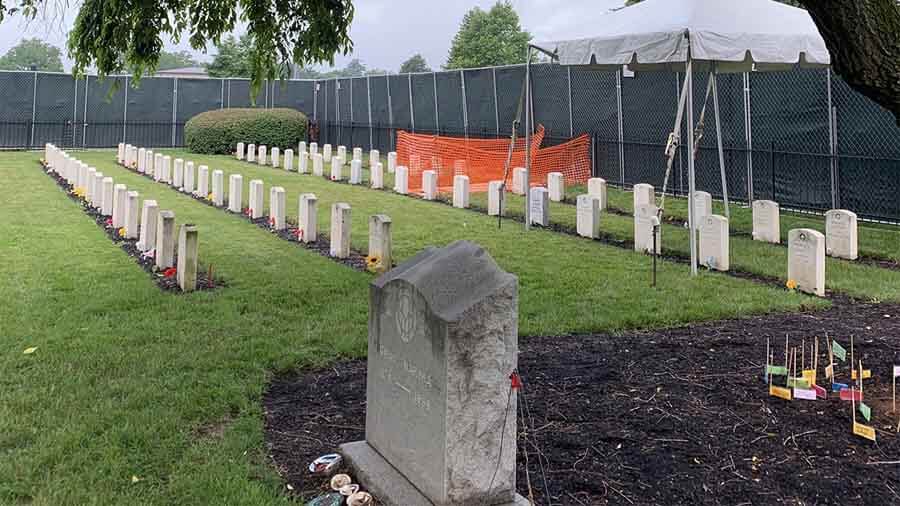
But it wasn’t until a few years ago, thanks to a detour on a road trip, that Metoxen confronted the tragic depths of that history. In the four decades the school was open, from 1879 to 1918, nearly 200 students died and were buried at Carlisle, far from home.
Metoxen, an Oneida tribal councilman and member of Church of the Holy Apostles on the reservation, first visited the former site of the government-run boarding school in 2017, while he and a group of friends were driving through Pennsylvania. They walked through the cemetery that still exists on the grounds, an experience Metoxen described Jan. 15 during The Episcopal Church’s annual Winter Talk gathering of Native American church leaders.
Some of the cemetery’s headstones indicated the deceased were Oneida. “I came across the name Jemima Metoxen, and that’s my last name,” he said in his Winter Talk presentation. “It kind of took me aback a little bit.” The name on another headstone was Sophia Coulon, a common Oneida last name. Further along was the grave of Ophelia Powless. “My grandmother is a Powless,” Metoxen said.
Overcome with emotion, Metoxen struggled to continue his presentation. “I think it affected me, walking through that cemetery, that this is our own,” he said. “These children didn’t ask to be here. How come nobody came to get these kids? It’s forever changed me.”
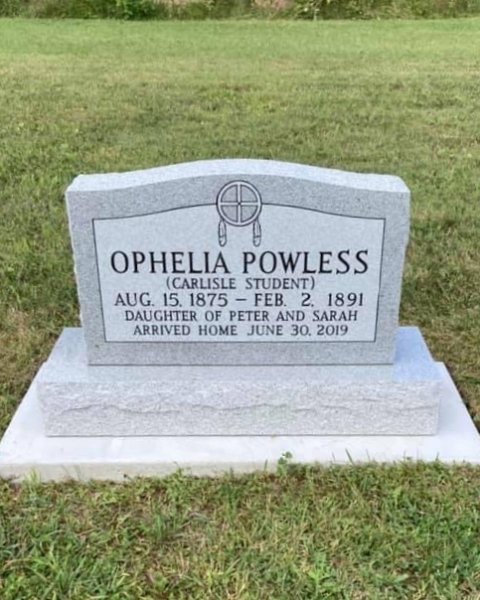
Ophelia Powless died in 1891 of pneumonia, and Jemima Metoxen died in 1904 of meningitis, according to school records. Both were 16. Sophia Coulon, 18, died in 1893 of tuberculosis. In 2019, all three finally were returned home. Their remains were disinterred from Pennsylvania and brought to the Oneida Reservation as part of an ongoing federal repatriation effort.
A funeral service for the three girls was held in June 2019 at Holy Apostles. Powless is now buried at the church’s cemetery, while Oneida tribal burial grounds hold the graves of the other two girls.
“It was done right for our children, here at Oneida,” Metoxen said.
Discussions during Winter Talk
Discussions of the Oneida repatriation and a parallel repatriation effort on the Rosebud Sioux Reservation in South Dakota formed the emotional core of the weekend’s Winter Talk. Holy Apostles Episcopal Church hosted the two-day conference, which had been planned as an in-person meeting but was moved online because of the latest surge in COVID-19 cases.
The wide-ranging sessions on January 15 and 16, 2022, included Native American music, a church-produced documentary about the colonial-era Doctrine of Discovery and a presentation on Indigenous theological education. The Rev. Bradley Hauff, The Episcopal Church’s missioner for Indigenous ministries, shared highlights from the past year, and Indigenous deputies reviewed some of the issues they hope to raise in July at the church’s 80th General Convention in Baltimore, Maryland.
Presiding Bishop Michael Curry and the Rev. Gay Clark Jennings, president of the House of Deputies, have pledged to “make right relationships with our Indigenous siblings an important focus” of General Convention’s upcoming work. In their joint statement last year, they acknowledged church’s past complicity in the federal boarding school system. Many schools were run by Christian denominations, and at least nine were thought to have Episcopal Church connections. The dearth of churchwide records has made it difficult to fully account for the church’s role.
Curry and Jennings joined other attendees at the online Winter Talk conference and thanked the presenters in brief remarks toward the end of the day January 15. “President Jennings and I are here not to speak, but to hear and to learn and to humbly be present with you,” Curry said.
Boarding schools today
Some Indigenous boarding schools remain open today, though they no longer operate under former federal policies of forced assimilation. The U.S. Department of Interior announced in June 2021 it was launching a comprehensive review of American boarding school policies dating to 1819, and some lawmakers are pushing for creation of a truth and healing commission to investigate further.
The former Carlisle school site is now part of the Army War College campus. Kirby Metoxen and other tribal and church leaders worked with the U.S. Army to arrange for the repatriation of the Oneida girls’ remains from the Carlisle cemetery, and other tribes with children buried there have pursued similar efforts, with costs covered by the Army. The Rev. Rodger Patience, vicar at Holy Apostles, traveled to Carlisle in 2019 with Metoxen and some of the girls’ relatives to consult with the forensics experts who oversaw the disinterment and examination of the remains.
Ophelia Powless, who died in 1891 at age 16 while in a boarding school in Carlisle, Pennsylvania, is now buried in the cemetery at Church of the Holy Apostles on the Oneida Reservation in Wisconsin. Photo: Rodger Patience
Though not directly related to the girls, Metoxon said he was overwhelmed by emotion at seeing the bones belonging to the girls. “It was like my own child,” he said. “And the thought they were all by themselves, I couldn’t get over thinking of a young child getting ready to go to the next world, alone, with no family.”
Patience, the Holy Apostles vicar, said it is likely but not certain that Ophelia and her family were members of the church. In 2021, the congregation unveiled a new headstone for Ophelia’s grave in the church cemetery. It identifies her as the daughter of Peter and Sarah and says she “arrived home June 30, 2019.”
Jennings said she was deeply moved by Metoxen’s story, adding that it evoked memories of her own grief over the death of her daughter 11 years ago.
“In the deepest times of grief, early on, I would just say ‘come back!” Jennings recalled. “In my grief, ‘Come back to me!’ And so, I imagine Peter and Sarah Powless [saying], ‘Please come back! Come back, Ophelia!’ And you brought her back – her parents’ deepest desire, to have her back.”
Repatriation of Rosebud Sioux boarding school student remains
The Rev. Lauren Stanley, canon to the ordinary in the Diocese of South Dakota, presented information at Winter Talk about the efforts to repatriate students’ remains to the Rosebud Sioux Reservation.
The Rosebud effort began when teenagers from the tribe’s Sicangu Youth Council visited Carlilse during a 2015 trip to attend a Washington, D.C., summit for Indigenous youth – a trip that the Rosebud Episcopal Mission had donated funds for. When they saw the graves on the grounds of the former school, “they recognized [the names of] a bunch of their relatives – of children who died there,” Stanley told Episcopal News Service in a previous interview.
“They said, ‘We need to bring these children home.’ They were very upset, very distraught to see these gravesites, including a bunch that are marked ‘unknown,’ which is just a ridiculous travesty.”
The teens asked the Rosebud Sioux Tribal Council to help bring the remains back to Lakota land. In May 2016, the tribe hosted a meeting with lawyers from the Army, during which Stanley and others testified in support of repatriation and the Army agreed to fund the exhumation of the remains.
After years of delays, the Army transferred the remains of nine children to the tribe in a ceremony at Carlisle in July 2021. Tribal members drove the remains over 1,400 miles to the Rosebud reservation in a caravan that grew to about 400 vehicles, with people lining roadsides to salute them.
Six of the children were buried in the Rosebud Sioux Tribe Veterans Cemetery on July 17. Three received private family burials, including one — Ernest Knocks Off (White Thunder) – who was buried in the Old St. James Episcopal Cemetery. The family, who are Episcopalians, invited Stanley to offer prayers at the burial.
Jennings said such stories underscore the need for the church to face the truth of its own historic complicity in the boarding school system.
“I know some of the history, but hearing it in the way that all of you presented it today hits in a deeper level, and to come to grips with our own church’s participation in that will take perseverance and tenacity on our part,” Jennings said. “And I think I can speak for the presiding bishop that both of us are deeply, deeply committed to doing what needs to be done.”
—David Paulsen and Egan Millard of Episcopal News Service
David Paulsen is an editor and reporter for Episcopal News Service. He can be reached at dpaulsen@episcopalchurch.org.
Egan Millard is an assistant editor and reporter for Episcopal News Service. He can be reached at emillard@episcopalchurch.org.
The Office of Indigenous Ministries celebrates the longstanding presence and influence of Native Americans throughout the history of The Episcopal Church in the U.S., from its earliest days in the New World.
Exercising a deep spirituality grounded in respect for and care of creation and others, Indigenous Episcopalians enrich the church through myriad roles in lay and ordained ministry, modeling wisdom, resilience, and forbearance.
Indigenous Ministries works for the full inclusion of Indigenous people in the life and leadership of the church.
Welcome to Church of the Redeemer: Worshiping God, living in community, and reaching out to the world. We are an Episcopal Church serving north King County and south Snohomish County, Washington. As you travel your road, go with friends walking the way of Jesus at Redeemer.
Church of the Redeemer is at 6220 Northeast 181st Street in Kenmore, Washington. We are a short distance north of Bothell Way, near the Burke-Gilman Trail. The entrance looks like a gravel driveway. The campus is larger on the inside than it is on the outside. And we managed to hide a large building on the side of a hill that is not easily seen from the street.