

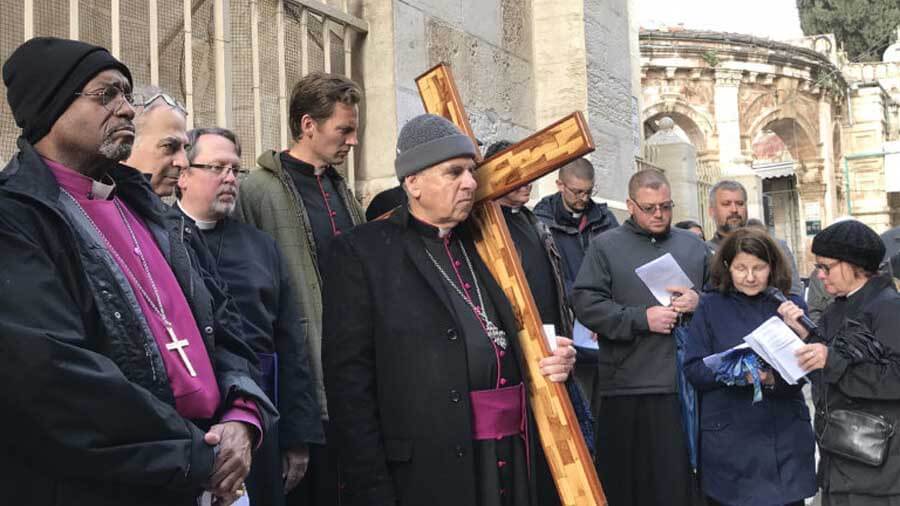
We offer our prayers and support during this time of violence in Israel and Palestine. In Luke 19:41, we are reminded ‘That when Jesus drew near and saw the city, he wept over it.’ Many still weep.
We pray for those who have been killed, injured, are searching for loved ones, and are struggling with grief and fear. The Episcopal Diocese of Jerusalem has consistently advocated for peace and justice, teaching us all what it means to walk in the way of love, to which Jesus points.
We are praying for Israelis and Palestinians.
We give thanks for the dedicated staff at al-Ahli Arab Hospital in Gaza, part of the Episcopal Diocese of Jerusalem, and for all who are offering medical care in the region. We pray for their strength and safety.
Please join us in praying that there is a de-escalation and that the root causes of violence and oppression may be confronted and challenged so that a new understanding of peace prevails.
The Rev. C.K. Robertson, PhD, Canon to the Presiding Bishop for Ministry Beyond The Episcopal Church
This is taken from a statement from The Office of Government Relations.

Statement from the Churches for Middle East Peace
The Episcopal Church, a founding member of Churches for Middle East Peace, shares the following statement:
Churches for Middle East Peace (CMEP) is deeply grieved by the news coming out of Israel and
Gaza today. CMEP condemns all acts of violence against civilians that have occurred in the past
twenty-four hours, as fighting has escalated between Hamas and Israel. As of late Saturday (EDT),
reports indicated that hundreds have been killed and thousands wounded, both Israelis and
Palestinians. CMEP mourns with the victims of the violence and their families.The actions of Hamas and the Israeli response in Gaza in no way advance peace, but rather cause
loss of life and harm, grief, and devastation, not only to the individuals affected, but also to the
legitimate cause of the Palestinian people in seeking an end to the decades long occupation and the
blockade of the Gaza Strip.Throughout this year, CMEP and allies have urgently been calling attention to the evolving context,
characterized by escalating levels of violence between settlers, soldiers, and Palestinians. The
increased nationalism and radicalization within Israeli society have led to more frequent and
numerous incidents of hatred, racialized tensions, settler attacks, and incursions onto Muslim and
Christian holy sites such as Stella Maris Monastery in Haifa and the Temple Mount in Jerusalem.
These realities are not justifications but have long been ignored by the international community,
including the longstanding frustration and desperation of the Palestinian people who seek an end to
the oppression of the occupation and Israeli desires for lack of fear and for security. It is time for the
US and the international community to strengthen efforts to de-escalate the systemic violence that
has gone on for decades.CMEP reiterates its consistent call for a negotiated, just, and peaceful resolution to the conflict that
advances security and self-determination for Israelis and Palestinians. A just peace will only be
realized when all parties respect and protect the full human rights of all. In light of the current war, we
make the following desperate pleas:CMEP calls on all parties to end all acts of violence and aggression and to pursue peaceful and
diplomatic resolutions to accomplish their desired outcomes.CMEP is concerned that Israel’s response is disproportionate and urges it not to engage in military
actions that devastate Palestinian civilian populations. CMEP opposes Israel’s practice of collective
punishment of all people in Gaza, including the turning off of electricity and water.CMEP calls on Hamas to stop all acts of aggression, the targeting of Israeli civilians, and the taking of
civilian hostages.CMEP calls on the United States government, including the Biden Administration and Congress, not
to act rashly but to prioritize immediate diplomatic measures to bring an end to the violence, including
through the United Nations.CMEP urges the US government to refrain from providing further unrestricted material and political
support for further militarization of the conflict but rather focus on the protection of all civilians,
especially the most vulnerable. The US must not prioritize the support of one side of the conflict over
another but support the safety and dignity of all people in the Holy Land, including Israelis and
Palestinians. While the United States empathizes with Israeli suffering, so should it empathize with
Palestinian suffering. Furthermore, the U.S. should not exacerbate the problem by ignoring the
legitimate struggle of the Palestinian people for their rights.Churches for Middle East Peace (CMEP) calls upon all Christians and people of faith to pray for
October 7, 2023: Hamas and Israel War
peace – not an empty peace devoid of justice, equality, and hope for all people, but a deep, lasting,
and just peace that addresses core systemic issues of the conflict, from Palestinian needs for self determination and freedom to Israel’s needs for safety and security.
For more information
To learn more about the Anglican presence in the Holy Land, visit the Episcopal Diocese of Jerusalem
To learn more about the American Friends of the Episcopal Diocese in Jerusalem.
Office of Government Relations
The Office of Government Relations (OGR) represents the policy priorities of The Episcopal Church to the U.S. government in Washington, D.C. and helps to shape the discussion of political issues throughout the Church. OGR aims to influence policy and legislation on critical issues, highlighting the voices and experiences of Episcopalians and Anglicans globally. All policy positions are based on General Convention and Executive Council resolutions.
Church of the Redeemer
Church of the Redeemer: Worshiping God, living in community, and reaching out to the world around us. We are an Episcopal Church serving north King County and south Snohomish County, Washington. As you travel your road, go with friends walking the way of Jesus at Redeemer.
Church of the Redeemer is at 6220 Northeast 181st Street in Kenmore, Washington. The campus is a short distance north of Bothell Way, near the Burke-Gilman Trail. The entrance looks like a gravel driveway. The campus is larger on the inside than it is on the outside. And we managed to hide a large building on the side of a hill that is not easily seen from the street.
The Episcopal Church welcomes you.