The Rev. Dr. Leah D. Schade, associate professor of preaching and worship at Lexington Theological Seminary. An ordained Lutheran minister since 2000, Dr. Schade has written or edited seven books and is the EcoPreacher blogger for Patheos.com. Dr. Schade is the director of a Lilly Grant for the project, “Compelling Preaching for a Climate-Changed World,” in partnership with Lexington Theological Seminary, The BTS Center, and Climate Justice Ministries.
The Courageous Chris Clark, who makes his home on the unceded and ancestral lands of the Musqueam people (Vancouver, British Columbia) where he’s a final-year M.Div. student at Vancouver School of Theology. Chris is a fantasy nerd, a church geek, and a neuro-spicy creative who loves classical ethnocultural music, stand-up comedy, musicals, opera, board games, animals (all animals), and belly laughs.
The Rev. Dr. Tommie Lee Watkins, Jr., assistant professor at the University of Alabama Department of Social Work. Tommie also provides spiritual direction and is a licensed multi-engine rated commercial pilot. He has several research articles and publications on religiosity, spirituality, sexuality, and health, as well as a workbook, “God’s Gift: Sexuality and Spirituality,” available at his website.
Prophetic Voices is hosted by the Rev. Isaiah “Shaneequa” Brokenleg, The Episcopal Church’s interim officer for Indigenous Ministries. For more information on Becoming Beloved Community, visit iam.ec/becomingbelovedcommunity. To learn more about Creation Care, visit episcopalchurch.org/creation-care.
Prophetic Voices: Preaching and Teaching Beloved Community
Across our church and our society, we are having profound dialogues about race, truth, justice, and healing. Coming this Advent, Prophetic Voices: Preaching and Teaching Beloved Community explores where that dialogue intersects with our faith. Join us and our invited guests as we share prophetic voices and explore the readings through the lens of social justice.
You’ll hear ancient texts interpreted in new ways, find fodder for preaching and teaching, and make present day connections to the prophetic voices of the Bible. This podcast will help us rethink how we hear, see, and interact with the lectionary readings.
Church of the Redeemer
Welcome to Church of the Redeemer: Worshiping God, living in community, and reaching out to the world. We are an Episcopal Church serving north King County and south Snohomish County, Washington. As you travel your road, go with friends walking the way of Jesus at Redeemer.
Church of the Redeemer is at 6220 Northeast 181st Street in Kenmore, Washington. We are a short distance north of Bothell Way, near the Burke-Gilman Trail. The entrance looks like a gravel driveway. The campus is larger on the inside than it is on the outside. And we managed to hide a large building on the side of a hill that is not easily seen from the street.
To commemorate the 1700th anniversary of the Council of Nicaea, the Rt. Rev. Matthew Gunter, bishop of Wisconsin, has written a series of reflections on the Nicene Creed and its relevance for contemporary Episcopalians. This is the last of the series.
That doesn’t leave much room for doubt.
The issue is not about doubt or judging those who struggle with this or that aspect of the Creed. I have no problem with honest struggle with the Creed – historical or otherwise. I have my share, though as I’ve said elsewhere, there are implications of the Creed that I struggle with more than things like the virginal conception or bodily resurrection (the Sermon on the Mount for starters). Thankfully, it is not up to us to believe this or that bit of the Creed on our own. As we sometimes pray, “regard not our sins, but the faith of your Church” (1979 Book of Common Prayer, p. 395). Sometimes others believe for us. In spite of any personal doubts, the Creed is the standard of Church teaching. At the very least, it is what Christians aspire to believe and conform their lives to – however inadequately.
Doubts, whether about orthodoxy (right belief and worship) or orthopraxy (right behavior), arise when one way of understanding how the world works and how God engages the world comes into conflict with another. But that cuts both ways. Questioning the virginal conception and the bodily resurrection, for example, is unsettling to one way of understanding things. Believing that we live in a world where such things have happened is unsettling to others.
We might also wonder why we hold doubt in such high esteem. Are we prepared to doubt everything?
Conclusion
The Nicene Creed offers the foundation of a way of understanding the nature of reality and the God at the heart of it all. It presents a powerful, provocative, and evocative vision of God, humanity, and creation. The deepest truth about reality is personal and relational. The world in which we live is not an accident, but a creation delighted in by its Creator. In spite of human rebellion, sin, and brokenness; in spite of our failure to live lives of complete love and truth; that Creator, who is merciful, has entered into the mess we have made, bringing deliverance, forgiveness, healing, and transformation. It does not answer all questions and was not meant to. But those whose imaginations have been shaped by the Creed and have sought to inhabit the world it describes have found that it opens up thrilling vistas of life and hope. It is worth celebrating.
Weekly bulletin inserts
This weekly bulletin insert provides information about the history, music, liturgy, mission, and ministry of The Episcopal Church. For more information, please contact us at stw@episcopalchurch.org.
Sermons That Work
For more than 20 years, Sermons That Work, a ministry of The Episcopal Church’s Office of Communication, has provided free sermons, Bible studies, bulletin inserts, and other resources that speak to congregations across the Church. Our writers and readers come from numerous and varied backgrounds. Small house churches, sprawling cathedrals, and everything between use the resources that Sermons That Work provides.
Church of the Redeemer: Worshiping God, living in community, and reaching out to the world around us. We are an Episcopal Church serving north King County and south Snohomish County, Washington. As you travel your road, go with friends walking the way of Jesus at Redeemer.
Church of the Redeemer is at 6220 Northeast 181st Street in Kenmore, Washington. The campus is a short distance north of Bothell Way, near the Burke-Gilman Trail. The entrance looks like a gravel driveway. The campus is larger on the inside than it is on the outside. And we managed to hide a large building on the side of a hill that is not easily seen from the street.
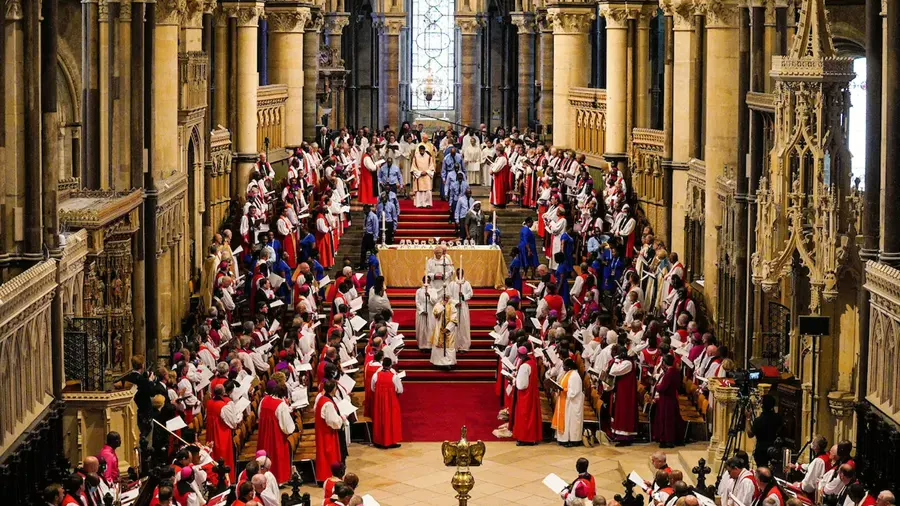
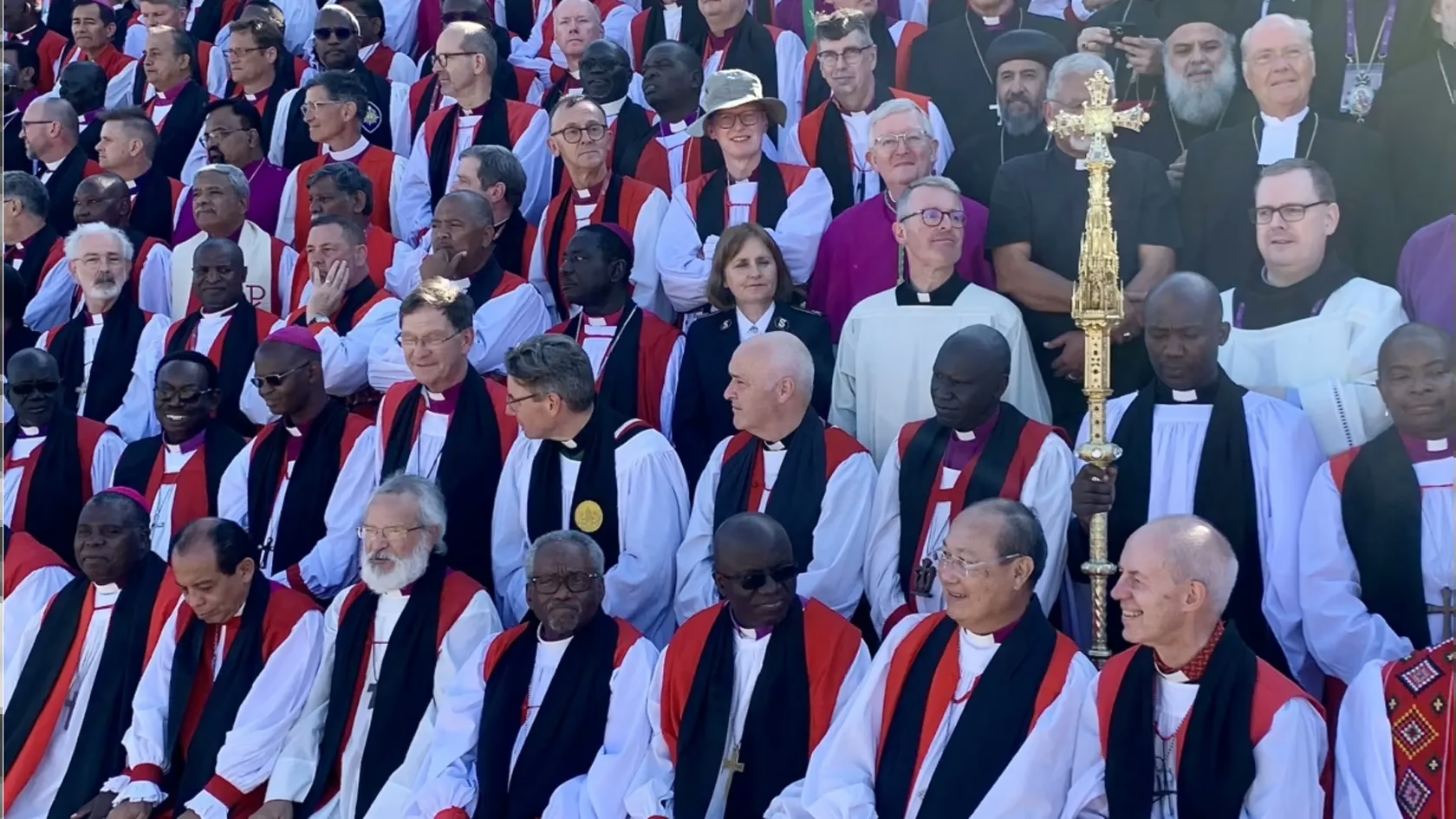
The conservative Christian network, a mix of leaders from recognized Anglican provinces and breakaway groups, had announced that its primates, as the heads of their respective churches, were effectively leaving the Anglican Communion. They would reject the authority of the archbishop of Canterbury and no longer participate in, contribute to or receive assistance from the structures that have long bound together the Anglican Communion’s 42 autonomous, interdependent provinces.
The statement, titled “The Future Has Arrived,” accused senior leaders of the Anglican Communion of “the abandonment of the Scriptures” and said GAFCON’s member primates had “resolved to reorder the Anglican Communion.”
Some conservative supporters of GAFCON rejoiced at the apparent split. Other Anglicans, particularly in provinces like The Episcopal Church that have been more welcoming to LGBTQ+ Christians, reacted variously with dismay, confusion, ambivalence and uncertainty.
A week later, one lingering question is how many – if any – Anglican primates and their provinces plan to follow through with GAFCON’s call to leave the Anglican Communion. The statement outlining that plan was signed by one person, Rwanda Archbishop Laurent Mbanda, who serves as chair of GAFCON’s primate council.
Response within GAFCON
Of the GAFCON council’s other 12 members, eight represent provinces that are recognized as members of the existing Anglican Communion.
Church of Nigeria
One, the Church of Nigeria, shared the text of the letter online without additional comment. Episcopal News Service could find no evidence of any statements from the other seven provinces supporting the new GAFCON plan for disengagement outlined by Mbanda.
Church of Congo
All efforts to reach leaders of those provinces were met with silence, except for one: The Province of the Anglican Church of Congo is still part of the Anglican Communion, one of its top bishops told ENS.
“The call to disengage from the Anglican Communion needs to be made collegially through debate,” Archbishop Zacharie Masimango Katanda, who served as Congo’s primate from 2016 to 2022, said by email in response to an ENS inquiry. “The Church of Congo will not follow that call and remains a full member of the Anglican Communion, and also a member of the Global South.”
Church of Rwanda
Mbanda’s Rwanda province is one of three Anglican provinces that have long boycotted Anglican Communion meetings over theological disagreements on human sexuality, same-sex marriage, and the ordination of gay and lesbian priests and bishops. Likewise, Nigeria and Uganda had already disengaged with much of the Anglican Communion’s structure, including the Lambeth Conference of Anglican bishops, the Primates’ Meeting and the Anglican Consultative Council. The exit of those three provinces, therefore, would signify little change in participation with what the Anglican Communion calls its Instruments of Communion.
Other provinces on the GAFCON primate’s council
The other six Anglican provinces that are represented on GAFCON’s primates’ council are Alexandria (Egypt), Chile, Congo, Kenya, Myanmar, and South Sudan. Until now, conservative primates in those provinces, though affiliated with GAFCON, have continued to engage with their peers across the Anglican Communion at its meetings.
In addition to seeking comment from those six provinces by email and WhatsApp, ENS also reviewed their websites and social media accounts for any references to the GAFCON statement in the week since its release, but found none.
GAFCON, on the other hand, has been regularly promoting Mbanda’s statement on its Facebook account, with daily posts since last week.
“We give thanks for the joyful announcement approved last week by the Gafcon Primates’ Council that the Anglican Communion has been reordered as a fellowship of autonomous provinces bound together by the Scriptures and the Reformation Formularies,” an October 22 Facebook update says. “We rejoice that we have not left the Communion… we are the Communion!” (The October 16, 2025 statement said GAFCON would name the new entity the “Global Anglican Communion.”)
ENS sought comment and clarification from GAFCON’s general secretary, the Rt. Rev. Paul Donison, who is a leader in the breakaway Anglican Church in North America. ACNA was founded in 2009, and many of its early members were former Episcopalians who objected to The Episcopal Church’s stances on women’s ordination, LGBTQ+ inclusion, or both.
Donison, based at an ACNA church in Plano, Texas, had not yet responded to an October 22 phone message by the time this ENS story was published. He has spoken about Mbanda’s statement in other venues. On October 17, he published an article on the Christian website the Gospel Coalition explaining the reasons for GAFCON’s split with the Anglican Communion.
“Over the last several decades, some of the most senior leaders in the communion – particularly in the Church of England and The Episcopal Church (USA) – have embraced revisionist teachings,” Donison wrote. “These include the rejection of biblical authority in matters of marriage, sexuality and the uniqueness of Christ. Evangelicals across traditions will recognize the dynamics here: when leaders abandon Scripture as the final authority, the gospel itself is at stake.”
GAFCON responses to events
Mbanda’s statement did not specify the reason for timing this decision now, though it was issued two weeks after the Church of England announced that London Bishop Sarah Mullally would become the first female archbishop of Canterbury. The position represents a “focus of unity” for the 165-country Anglican Communion in recognition of the 42 provinces’ roots in the Church of England. She is scheduled to take office in January.
On October 17, Mbanda alluded to Mullally’s selection as Archbishop of Canterbury in a discussion of his latest GAFCON statement with the Christian interview program, “The Pastor’s Heart.” He suggested GAFCON has been building to this moment since its founding in 2008 as the Global Fellowship of Confessing Anglican Leaders.
“As we knew that we were anticipating this announcement of the archbishop of Canterbury, and knowing that we had been on a journey since 2008 with GAFCON … I think it was time to start thinking, OK, so what do some of these founding fathers think?” Mbanda said. “It was also time to say, OK, we have talked a lot. Is it a time to walk the talk?”
Mbanda did not specify who was involved in those conversations or how they may have registered their assent to his statement.
Response from leaders within the Anglican Communion
Yet even some conservative leaders within the Anglican Communion have questioned the legitimacy and prudence of declaring a break with the communion to establish a rival network with a similar name.
The Rev. Matthew Olver
“To my dear Brothers and Sisters in Christ in GAFCON: You have broken my heart,” the Rev. Matthew Olver, an Episcopal priest who serves as executive director and publisher at the Living Church Foundation, wrote in an essay on the Living Church’s website.
“Your communiqué of October 16 sounds as though you are rejecting all of us who confess the apostolic faith and are committed to a traditional witness within the Episcopal Church and in provinces throughout the communion — my heart is crushed.”
The Most Rev. Sean Rowe
Others have affirmed their commitment to the Anglican Communion, emphasizing the importance of walking together as Anglicans despite persistent differences on individual theological questions. The Episcopal Church places “great value on our continuing relationships in the Anglican Communion and on the historic role of the archbishop of Canterbury as first among equals,” Presiding Bishop Sean Rowe said last week in a written statement to ENS.
The Rt. Rev. Helen Kennedy
Bishop Helen Kennedy of the Canadian Diocese of Qu’appelle, as liaison to The Episcopal Church’s Executive Council, called GAFCON’s statement “heartbreaking” in her remarks to Executive Council on October 22 at its recent meeting.
The Rt. Rev. Anthony Poggo, secretary general of the Anglican Communion and a bishop from South Sudan, said last week the Anglican Communion “is ordered by historic bonds, voluntary association” and that any changes “should be made through existing structures.” Some such reforms, known as the Nairobi-Cairo proposals, are scheduled to be discussed next year at a meeting of the Anglican Consultative Council in Belfast, Northern Ireland.
The Rt. Rev. Sarah Mullaly
Mullally has emphasized “working together in mission.” On October 3, in her first address as archbishop of Canterbury-designate, Mullally said she has witnessed local expressions of the faith in her travels around the Anglican Communion that “echoed with familiar grace” in their shared Anglican context.
“I saw something deeply distinctive, coupled with mutual understanding: a shared inheritance of history, of family of worship, sacrament and word – made real in global diversity,” Mullally said. “Anglican Churches and networks around the world working together in mission, joining their voices in advocacy for those in need.
“In an age that craves certainty and tribalism, Anglicanism offers something quieter but stronger: shared history, held in tension, shaped by prayer, and lit from within by the glory of Christ. That is what gives me hope. In our fractured and hurting world, that partnership in the Gospel could not be more vital.”
– David Paulsen is a senior reporter and editor for Episcopal News Service based in Wisconsin. He can be reached at dpaulsen@episcopalchurch.org.
About Episcopal News Service
Episcopal News Service (ENS) offers in-depth reporting of local, regional, national and international news for Episcopalians and others interested in the church’s mission and ministry. Episcopal News Service is the official news source of the Episcopal Church.
Church of the Redeemer
Church of the Redeemer: Worshiping God, living in community, and reaching out to the world around us. We are an Episcopal Church serving north King County and south Snohomish County, Washington. As you travel your road, go with friends walking the way of Jesus at Redeemer.
Church of the Redeemer is at 6220 Northeast 181st Street in Kenmore, Washington. The campus is a short distance north of Bothell Way, near the Burke-Gilman Trail. The entrance looks like a gravel driveway. The campus is larger on the inside than it is on the outside. And we managed to hide a large building on the side of a hill that is not easily seen from the street.
To commemorate the 1700th anniversary of the Council of Nicaea, the Rt. Rev. Matthew Gunter, bishop of Wisconsin, has written a series of reflections on the Nicene Creed and its relevance for contemporary Episcopalians. Over the coming weeks, we’ll share his teachings, written mostly in a question-and-answer format.
I read or heard somewhere that the root meaning of credo is to “give the heart,” so intellectual assent is not the point.
I am not sure that is accurate. In any event, to say that the root meaning of credo is to “give the heart” and reduce its meaning to only that is like saying that every time the atheist, Richard Dawkins, says, “Good bye,” he really means, “God be with ye.” However helpful it might be in adding color to our understanding, the meaning of words and phrases are not reducible to their roots. The meanings of words evolve. What did credo mean to those who used it in the 4th century? One need only look at the historical context and development of the Creed to know that it was meant to delineate right belief from wrong belief as well as to shape the direction of the heart (and imagination).
Both are necessary. You cannot give your heart to something without some knowledge or belief about that to which you are giving your heart. And you cannot truly come to know something without giving your heart to it. Loving and knowing go together. Can I claim to love my wife but then believe whatever I want to believe about the kind of person she is, trying to fit her into some fantasy of my own making? Getting to know her as she is is what it means to love her. And it is by attending to her in love that I get to know her.
We are not supposed to be able to say the Creed with integrity if we find it incredible (a related word). The very reason for trying to shift the meaning of credo from intellectual assent is self-contradictory in as much as it is based on the conclusion that some aspects of the Creed are no longer intellectually credible.
Continuing to say the words of the Creed without intellectual assent and meaning them in their common sense warps language. Either we mean it or we don’t. Or we stretch the meaning of words beyond all logic. What if we used the same approach to language with the marriage vows? Can I have an affair and then tell my wife she needs to get over her unsophisticated, literalistic interpretation of “forsaking all others?”
Reducing the Creed to “matters of the heart” to minimize its intellectual claims tailors it to the heritage of a naïve romanticism prioritizing feeling over reason. It is an odd thing to do for those who (as Episcopalians sometimes love to do) pride themselves on being in the “thinking person’s church.”
Weekly bulletin inserts
This weekly bulletin insert provides information about the history, music, liturgy, mission, and ministry of The Episcopal Church. For more information, please contact us at stw@episcopalchurch.org.
Sermons That Work
For more than 20 years, Sermons That Work, a ministry of The Episcopal Church’s Office of Communication, has provided free sermons, Bible studies, bulletin inserts, and other resources that speak to congregations across the Church. Our writers and readers come from numerous and varied backgrounds. Small house churches, sprawling cathedrals, and everything between use the resources that Sermons That Work provides.
Church of the Redeemer: Worshiping God, living in community, and reaching out to the world around us. We are an Episcopal Church serving north King County and south Snohomish County, Washington. As you travel your road, go with friends walking the way of Jesus at Redeemer.
Church of the Redeemer is at 6220 Northeast 181st Street in Kenmore, Washington. The campus is a short distance north of Bothell Way, near the Burke-Gilman Trail. The entrance looks like a gravel driveway. The campus is larger on the inside than it is on the outside. And we managed to hide a large building on the side of a hill that is not easily seen from the street.
[Episcopal News Service] The conservative Anglican network GAFCON, a mix of leaders from Anglican provinces and breakaway groups, released a statement October 16, 2025, saying it would disengage from the Anglican Communion’s existing deliberative bodies and create a rival to the Anglican Communion with an unspecified number of provinces.
The Future Has Arrived
Only Archbishop Laurent Mbanda of Rwanda, as chair of the network’s primates council, signed the message posted to GAFCON’s website, titled “The Future Has Arrived.” Mbanda said he was issuing the statement after a meeting with other GAFCON primates about their path forward.
In it, Mbanda said the GAFCON primates have rejected the authority of the archbishop of Canterbury, the Anglican Consultative Council, the Lambeth Conference of Anglican bishops and the Primates’ Meeting, the four so-called “Instruments of Communion” by which the 42 autonomous provinces of the Anglican Communion maintain their interdependence. It also says the breakaway provinces “shall not make any monetary contribution to the ACC, nor receive any monetary contribution from the ACC or its networks.”
Mbanda and his Anglican Church of Rwanda have boycotted Instruments of Communion meetings for years, as have leaders of the Anglican provinces in Nigeria and Uganda. Until now, conservative primates in other provinces, though affiliated with GAFCON, have continued to engage with their peers across the Anglican Communion at those meetings.
Unclear how many GAFCON provinces will leave
It was not clear from Mbanda’s statement how many of his fellow primates now planned to join him in forming what he said would be called the “Global Anglican Communion.” Of the members of GAFCON’s primates’ council listed on its website, nine lead provinces recognized as part of the Anglican Communion: Alexandria (Egypt), Chile, Congo, Kenya, Myanmar, Nigeria, Rwanda, South Sudan and Uganda. The statement did not specify which of those members attended the meeting before releasing the statement.
Mbanda also did not specify the reason for timing this decision now, though he issued the statement two weeks after the Church of England announced that London Bishop Sarah Mullally would become the first female archbishop of Canterbury, a position that represents a “focus of unity” for the 85-million-member Anglican Communion in recognition of the 42 provinces’ roots in the Church of England.
Some of the communion’s more conservative provinces do not allow women to become bishops. Several of those provinces’ leaders released statements this month grieving the choice of Mullally, scheduled to take office as archbishop of Canterbury in January.
GAFCON’s also issued the latest statement, which rejects continued participation in the Anglican Consultative Council, a day after the ACC Standing Committee held its annual meeting October 13-15, 2025, in Jordan. The ACC structure welcomes representatives from all 42 provinces, a mix of bishops, other clergy and lay leaders.
Nairobi-Cairo Proposals
A scheduled discussion of possible changes by the full ACC of the Anglican Communion’s leadership structure, including the role of the archbishop of Canterbury, is on for June and July 2026 in Belfast, Northern Ireland. It is not clear what affect the GAFCON statement will have of what are known as the Nairobi-Cairo Proposals.
In an October 17 written statement to Episcopal News Service, the Rt. Rev. Anthony Poggo, secretary general of the Anglican Communion and a bishop from South Sudan, said the Anglican Communion “is ordered by historic bonds, voluntary association” and that any changes “should be made through existing structures.” That is why, he said, the work of the Nairobi-Cairo Proposalsis important.
GAFCON was formed in 2008 in opposition to the increasingly welcoming policies toward LGBTQ+ Christians that were embraced by some Anglican provinces, including The Episcopal Church. Mbanda’s statement this week alludes to those disagreements over human sexuality, accusing more progressive Anglicans of “the abandonment of the Scriptures” and saying global Anglican leadership had “failed to uphold the doctrine and discipline of the Anglican Communion.”
Episcopal Church reaction
Episcopal Church Presiding Bishop Sean Rowe released a statement to Episcopal News Service for this story, affirming that The Episcopal Church places “great value on our continuing relationships in the Anglican Communion and on the historic role of the archbishop of Canterbury as first among equals.”
“We celebrate Bishop Sarah Mullally’s elevation to that seat and rejoice that, as the first woman to hold that role, she will bring our communion closer to the fullness of the image of God and bear witness to the breadth of God’s gifts in the service of God’s mission to the world,” Rowe said. “It is always a cause of sorrow when siblings in Christ choose to walk apart, and we grieve that some GAFCON primates have chosen to remove themselves from the Anglican Communion. We pray for their participation in God’s mission in their contexts.”
The Anglican Communion is diverse
The Inter-Anglican Standing Commission on Unity, Faith and Order developed the Nairobi-Cairo Proposals by upon request of the ACC at its meeting in February 2023. Leaders attended that meeting from all 42 Anglican provinces except Nigeria, Uganda and Rwanda. The release of the draft proposals was in December 2024. Poggo emphasized that all Anglican Communion primates, members of the ACC and others from Global South Fellowship of Anglicans and GAFCON have been invited to engage with the proposals in advance of next year’s ACC meeting.
“The Anglican Communion Office recognizes that in a diverse, global communion, there is a wide range of theological and doctrinal perspectives. There are also deeply held differences, disagreements, and divisions, which strain and wound the Communion,” said Poggo, who also shared a pastoral letter on October 17 with Anglican provinces. “The Nairobi-Cairo Proposals face these divisions directly, not to resolve them, but to encourage all Anglicans to ‘make room for one another.’
“Jesus prayed that ‘they may all be one’ (John 17.11). To persist in – imperfect, impaired – communion is to commit to work at this task together, and not apart.”
David Paulsen is a senior reporter and editor for Episcopal News Service based in Wisconsin. You can reach him at dpaulsen@episcopalchurch.org.
About Episcopal News Service
Episcopal News Service (ENS) offers in-depth reporting of local, regional, national and international news for Episcopalians and others interested in the church’s mission and ministry. Episcopal News Service is the official news source of the Episcopal Church.
Church of the Redeemer
Church of the Redeemer: Worshiping God, living in community, and reaching out to the world around us. We are an Episcopal Church serving north King County and south Snohomish County, Washington. As you travel your road, go with friends walking the way of Jesus at Redeemer.
Church of the Redeemer is at 6220 Northeast 181st Street in Kenmore, Washington. The campus is a short distance north of Bothell Way, near the Burke-Gilman Trail. The entrance looks like a gravel driveway. The campus is larger on the inside than it is on the outside. And we managed to hide a large building on the side of a hill that is not easily seen from the street.
To commemorate the 1700th anniversary of the Council of Nicaea, the Rt. Rev. Matthew Gunter, bishop of Wisconsin, has written a series of reflections on the Nicene Creed and its relevance for contemporary Episcopalians. Over the coming weeks, we’ll share his teachings, written mostly in a question-and-answer format.
But isn’t the language of the Creed poetic, rich in metaphors?
Theologically and philosophically, “metaphor” is a tricky concept, but we’ll use it for the moment. We should never forget that even our best language cannot fully comprehend God, who is always beyond our comprehension. In fact, you’d have a hard time finding a theologian of the early Church who did not say the same. They were not so naïve as moderns often suppose. Over and over again, the early theologians remind us that all our language for God is stammering. All images must be held lightly. Gregory Nazianzus, one of the more important defenders of the Creed, affirmed, “It is difficult to conceive of God, but to define him in words is an impossibility” (Fourth Theological Oration).
And yet those same theologians also affirm that we must speak of God because God has spoken a Word to us in history, especially in Jesus Christ. Thus, while we must speak cautiously and humbly in the face of the mystery that is God, we can yet dare to say something about God because God has said something to us in Jesus, the Word made flesh. “The impossibility has become a possibility by the boundless excellence of the grace of God,” is how Origen put it in his treatise On Prayer.
Because it is about God, some of the Creed is indeed metaphorical. Certainly, referring to God as “Father,” while it reflects the language of Jesus and signifies something true about God, does not mean God is male. Gregory of Nyssa, another foundational theologian who defended the Nicene Creed, is clear on this in his commentary on the Song of Songs. Similarly, affirming that Jesus Christ is “seated at the right hand of God the Father” metaphorically signifies something about the relationship between Jesus and God the Father, but it is not a spatial relationship. There is no literal physical chair on which Jesus sits.
But, because the Creed is about the God revealed in the life, death, and resurrection of Jesus much of it is not metaphorical, but historical, e.g., he became incarnate from the Virgin Mary and was made man, for our sake he was crucified under Pontius Pilate, he suffered death and was buried, on the third day he rose again, etc. That has always been the scandal of Christianity to the philosophers and Gnostics (ancient and contemporary) who want to keep God safely on the side of the metaphorical beyond the messiness of material reality in space and time (protecting God? themselves?). But Christians confess a historical virgin birth to a historical Mary of an historical enfleshment of God who died an historical death under an historical Pontius Pilate but lives again through an historical resurrection, leaving behind an historical empty tomb – all “for us and for our salvation.”
The Creed is part poetry, part prose. Indeed, one might say that in the incarnation, God (ultimately hidden in Mystery and Metaphor) has become prose – prosaic – in order to turn all to poetry. Trying to keep them strictly separate or make it all one or the other always gets us into trouble.
To say that our language about God’s essence is metaphorical is a theological truism. To conclude that, therefore, all metaphors for God are only human creations or that all metaphors are more or less equal is an assumption and a theological falsehood. To say that all language about God acting in history, e.g., the virginal conception, the incarnation, and the bodily resurrection as historical, physical events, is metaphorical and only true in some spiritual sense is to try to be more spiritual than the God we know through Jesus has chosen to be. This was the fundamental error of the Arians. Arius found it inconceivable and offensive to imagine the One beyond all things taking on human flesh and material reality. The God we know through Jesus and the Creed is a God who is prepared to get down and dirty in the material world to address and transform the very literal, tragic, and historical mess we have made of ourselves, others, and the world. And all so that we might be “become partakers of the divine nature” (2 Peter 1:4). As some of the bishops who were at the Council of Nicaea would say, the Son of God “became what we are that we might become what he is” (for example, Athanasius, ‘On the Incarnation’).
Weekly bulletin inserts
This weekly bulletin insert provides information about the history, music, liturgy, mission, and ministry of The Episcopal Church. For more information, please contact us at stw@episcopalchurch.org.
Sermons That Work
For more than 20 years, Sermons That Work, a ministry of The Episcopal Church’s Office of Communication, has provided free sermons, Bible studies, bulletin inserts, and other resources that speak to congregations across the Church. Our writers and readers come from numerous and varied backgrounds. Small house churches, sprawling cathedrals, and everything between use the resources that Sermons That Work provides.
Church of the Redeemer: Worshiping God, living in community, and reaching out to the world around us. We are an Episcopal Church serving north King County and south Snohomish County, Washington. As you travel your road, go with friends walking the way of Jesus at Redeemer.
Church of the Redeemer is at 6220 Northeast 181st Street in Kenmore, Washington. The campus is a short distance north of Bothell Way, near the Burke-Gilman Trail. The entrance looks like a gravel driveway. The campus is larger on the inside than it is on the outside. And we managed to hide a large building on the side of a hill that is not easily seen from the street.
To commemorate the 1700th anniversary of the Council of Nicaea, the Rt. Rev. Matthew Gunter, bishop of Wisconsin, has written a series of reflections on the Nicene Creed and its relevance for contemporary Episcopalians. Over the coming weeks, we’ll share his teachings, written mostly in a question-and-answer format.
Can’t we just worship God without getting hung up with the Creed?
Again, that presumes some knowledge (creed) about God and what it means to worship that God rightly. In fact, part of what guided the developing understanding expressed in the Nicene Creed was the language of the church’s worship.
In any event, within the Episcopal/Anglican tradition, eliminating or ignoring the Creed would not resolve things for those who don’t like it. The rest of the liturgy is saturated with the same story and the same imagery.
Further, the Creed and worship are integrally related:
…Nicene Christianity has also understood orthodoxy in a richer and deeper sense: as right praise. To be orthodox is to strive to stand rightly with others before the mystery of the true God. To be orthodox is to join with a community of faith in adoration of God’s doxa (glory), which already casts light on the day when God will finally make everything right. Belief is never correct when it becomes nothing more than a political mechanism to ensure the unity of an institution. Belief is right only when it points us in the right direction: to glorification of the true God, who promises not to give us a secret wisdom, but to be graciously present to us, even and especially where our vision and knowledge are weak.
John Burgess, ‘Going Creedless,’ The Christian Century, June 1, 2004, pp. 24-28
Weekly bulletin inserts
This weekly bulletin insert provides information about the history, music, liturgy, mission, and ministry of The Episcopal Church. For more information, please contact us at stw@episcopalchurch.org.
Sermons That Work
For more than 20 years, Sermons That Work, a ministry of The Episcopal Church’s Office of Communication, has provided free sermons, Bible studies, bulletin inserts, and other resources that speak to congregations across the Church. Our writers and readers come from numerous and varied backgrounds. Small house churches, sprawling cathedrals, and everything between use the resources that Sermons That Work provides.
Church of the Redeemer: Worshiping God, living in community, and reaching out to the world around us. We are an Episcopal Church serving north King County and south Snohomish County, Washington. As you travel your road, go with friends walking the way of Jesus at Redeemer.
Church of the Redeemer is at 6220 Northeast 181st Street in Kenmore, Washington. The campus is a short distance north of Bothell Way, near the Burke-Gilman Trail. The entrance looks like a gravel driveway. The campus is larger on the inside than it is on the outside. And we managed to hide a large building on the side of a hill that is not easily seen from the street.
[Episcopal News Service] Episcopalians in the Diocese of Chicago are calling for the immediate release of a church member who was detained last month by federal immigration officials and is being held in a facility in Michigan.
The detainee, Willian Alberto Giménez González, has been active at St. Paul and the Redeemer Episcopal Church on Chicago’s South Side since Fall 2023. The church is hosting a prayer vigil October 7, 2025, for González – and for all “our immigrant neighbors” – as U.S. Immigration and Customs Enforcement agents conduct raids and detain residents across the Chicago area.
“We believe that Willian’s detention is unjust, and that his immediate release would benefit not just Willian and his family but also our community and our country,” St. Paul and the Redeemer said in a written statement, González is an asylum-seeker who had recently received a work permit. “Yet ICE arrested him anyway and quickly moved him across state lines.”
How González was detained
González was taken into custody September 12, 2025, during an ICE traffic stop. His attorney told an American Prospect reporter that González, at the time of the incident, was taking his wife to get a haircut in a largely Latino neighborhood southwest of downtown Chicago. After being held briefly at an ICE facility in suburban Chicago, he was taken to a different ICE facility in Baldwin, Michigan, about 70 miles north of Grand Rapids.
“ICE is circumventing laws and processes to create terror in communities of people seeking a better life, and we are joining with Christians and others who feel spiritually compelled to call for justice and mercy,” St. Paul and the Redeemer said in its statement.
Immigration enforcement by ICE
ICE has taken an increasingly aggressive approach toward immigration enforcement in Chicago, the United States’ third largest city. It is part of the Trump administration’s efforts to ramp up arrests and deportations. It also fulfill a campaign promise of sharply reducing both legal and illegal immigration.
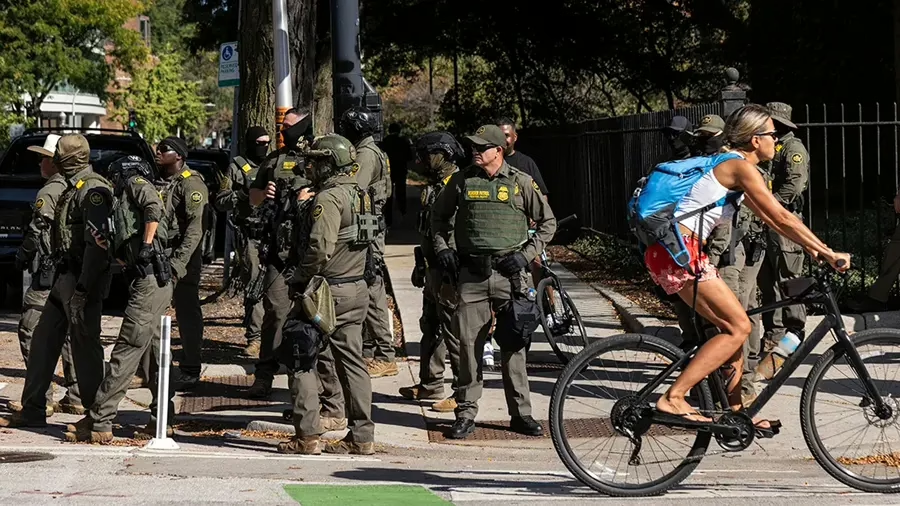
Early last month, the Department of Homeland Security announced it was launching a major immigrant enforcement action in Chicago that it dubbed “Operation Midway Blitz.” Since then, local officials, Democratic state legislators, immigrant advocates and residents have accused the Trump administration of heavy-handed tactics that have sometimes involved detentions of people with no criminal records or immigration violations.
More than 1,000 immigrants have been arrested in Chicago in the past month. It includes 37 on September 30 in an early-morning ICE raid that targeted one apartment building on Chicago’s South Side. Residents reported fearing they were under siege by a military-style operation. Agents reportedly landed on the building from helicopters, then went door to door making arrests.
President Donald Trump has vowed to further escalate the crackdown. He sent troops, including the Texas National Guard, into Chicago and other Democrat-led cities. He said reinforcements are needed to protect federal property and employees. After federal agents shot and injured a woman in Chicago on October 4, Homeland Security Secretary Kristi Noem called Chicago a “war zone.”
Illinois Gov. JB Pritzker, a Democrat, has accused the Trump administration of manufacturing a crisis and then making it worse. The ICE agents in Chicago were indiscriminately “picking up people who are brown and Black and then checking their credentials,” Pritzker said in an Oct. 5 interview with CNN. “They are the ones that are making it a war zone.”
Support from the Diocese of Chicago
The Diocese of Chicago has been active in helping immigrant communities and their supporters across northern Illinois respond to the presence of ICE and threats of arrest. A statement released September 10 by a group of diocesan ministry leaders affirmed that Episcopalians in Chicago were “standing in solidarity with immigrants and asylum-seekers.”
“We urge all diocesan churches, clergy, and laity to get involved as we redouble our efforts to welcome the stranger, protect the vulnerable and respect the dignity of every human being,” they said. They referenced an earlier pastoral letter from Chicago Bishop Paula Clark calling on Episcopalians to support “our immigrant siblings.”
“Anxiety and apprehension are rampant in our communities, especially those of people of color, who are affected by these threats. People are afraid to go to church, the grocery store, or even to work,” Clark said in her August 1 letter. “This is not merely about immigration – it is about justice, dignity, and the soul of our diocese.”
Support for González
The diocese has invited all members to join the prayer vigil at St. Paul and the Redeemer. It starts at 7 pm on October 7, in support of immigrants like González, the parishioner being held by ICE in Michigan.
González “is a faithful participant in our worship and gives financially to the church every week. He has helped cultivate the earth in our food garden and shared dinners in our homes. We pray and sing together,” the congregation said in its written statement protesting his detention. “Every Sunday we receive the sacrament of Holy Communion together recognizing that we are God’s beloved children created in God’s image, and all have a place at God’s Table.”
The National Day Laborer Organizing Network has raised $5,800 to support González through a GoFundMe campaign. The Diocese of Chicago also worked with the Diocese of the Great Lakes in Michigan to arrange for González to receive a pastoral visit with a priest at the facility.
His next immigration court date is October 8.
“I find myself surprised by all you have done to support me,” González said in a written statement released by the diocese. “It fills me up with hope and I ask God to help me get out of this place. I’m grateful to the church, from the bottom of my heart.”
– David Paulsen is a senior reporter and editor for Episcopal News Service based in Wisconsin. He can be reached at dpaulsen@episcopalchurch.org.
About Episcopal News Service
Episcopal News Service (ENS) offers in-depth reporting of local, regional, national and international news for Episcopalians and others interested in the church’s mission and ministry. Episcopal News Service is the official news source of the Episcopal Church.
Church of the Redeemer
Church of the Redeemer: Worshiping God, living in community, and reaching out to the world around us. We are an Episcopal Church serving north King County and south Snohomish County, Washington. As you travel your road, go with friends walking the way of Jesus at Redeemer.
Church of the Redeemer is at 6220 Northeast 181st Street in Kenmore, Washington. The campus is a short distance north of Bothell Way, near the Burke-Gilman Trail. The entrance looks like a gravel driveway. The campus is larger on the inside than it is on the outside. And we managed to hide a large building on the side of a hill that is not easily seen from the street.
🕊️ Church Asks for Release of Member Taken by ICE. Willian Alberto Giménez González goes to church at St. Paul and the Redeemer in Chicago. He was taken by immigration officers (ICE) on September 12 while driving his wife. He had a work permit and was asking to stay in the U.S. safely. ICE moved him to a jail in Michigan. 🙏 Church Response. His church says this is unfair and wants him released. They held a prayer event on October 7 to support him and other immigrants. Church leaders say Willian helps the church and is part of their family. 🚨 ICE Actions in Chicago. ICE has been arresting many immigrants in Chicago. Over 1,000 people were taken in one month. Some raids were very scary, with helicopters and soldiers. The president says this is to protect people, but others say it’s hurting families. ❤️ Support for Willian. The church raised money to help him. He got a visit from a priest while in jail. His next court date was October 8. Willian said he feels hopeful and thankful for the church’s love.
To commemorate the 1700th anniversary of the Council of Nicaea, the Rt. Rev. Matthew Gunter, bishop of Wisconsin, has written a series of reflections on the Nicene Creed and its relevance for contemporary Episcopalians. Over the coming weeks, we’ll share his teachings, written mostly in a question-and-answer format.
Isn’t one’s faith about one’s relationship with the living God and with God’s children? Can’t we say, “Love God and love your neighbor,” and leave it at that?
That is indeed Jesus’ summary of the law, and that is no small thing. However, in his context (the time’s tradition and teachings), Jesus had received a great deal about the nature and purposes of God as a son of Israel. While there was no written creed as such, Jesus was part of a people who held certain ideas, i.e., doctrines, about God and humanity. As a faithful Jew, he would have recited the Sh’ma found in Deuteronomy 6:4-5: “Hear, O Israel: The Lord is our God, the Lord alone. You shall love the Lord your God with all your heart, and with all your soul, and with all your might.”
The Nicene Creed gives the word ‘God’ meaning
There is no sufficient knowledge of God without some sort of creed. ‘God’ is a meaningless word until it is given meaning. To say, “Just love God with your whole heart, mind, and soul” only begs the questions, “Who, or what, is this ‘God’ I am to love, and what does it mean to love this ‘God’?” As for loving neighbors, who counts as my neighbor? Do strangers count? What about enemies? And why should I love them? And in what way, to what extent, and at what cost? Why is it so hard to do? Does it matter ultimately? Is there any divine reckoning for our failure and refusal to love? What does it mean to be human? And what kind of world do we live in?
Any answers to these questions are not obvious. That they seem obvious to many of us is because our imaginations have already been formed in a society shaped by the vision of Christianity reflected in the Nicene Creed, even if we have mostly forgotten the source of that shaping. And any answer to these questions takes us into the realm of belief and doctrine. The Creed is the basic Christian foundation for answering them. One might prefer other answers or make up one’s own, but one cannot talk about “god,” “love,” “creation,” or “human beings” without some sort of belief system, i.e., a creed.
Inadequate simplistic pietism
It is inadequate to appeal to a simplistic pietism, whether in its more conservative or more liberal versions, that says, “Don’t bother me with doctrine, just give me Jesus.” We have no direct access to Jesus other than through the Gospels, which are heavily influenced by the interpretation (doctrine) of who Jesus is and why He matters. The Creed is the Christian guide to understanding the God of Abraham, Isaac, and Jacob in light of Jesus. It affirms that, while God will always remain beyond our understanding, when we look at Jesus, we see God. And that God has so loved humanity as to enter into our physical reality with our rebellion, our sin, our brokenness, our unlove, and untruth to deliver us.
Weekly bulletin inserts
This weekly bulletin insert provides information about the history, music, liturgy, mission, and ministry of The Episcopal Church. For more information, please contact us at stw@episcopalchurch.org.
Sermons That Work
For more than 20 years, Sermons That Work, a ministry of The Episcopal Church’s Office of Communication, has provided free sermons, Bible studies, bulletin inserts, and other resources that speak to congregations across the Church. Our writers and readers come from numerous and varied backgrounds. Small house churches, sprawling cathedrals, and everything between use the resources that Sermons That Work provides.
Church of the Redeemer: Worshiping God, living in community, and reaching out to the world around us. We are an Episcopal Church serving north King County and south Snohomish County, Washington. As you travel your road, go with friends walking the way of Jesus at Redeemer.
Church of the Redeemer is at 6220 Northeast 181st Street in Kenmore, Washington. The campus is a short distance north of Bothell Way, near the Burke-Gilman Trail. The entrance looks like a gravel driveway. The campus is larger on the inside than it is on the outside. And we managed to hide a large building on the side of a hill that is not easily seen from the street.
To commemorate the 1700th anniversary of the Council of Nicaea, the Rt. Rev. Matthew Gunter, bishop of Wisconsin, has written a series of reflections on the Nicene Creed and its relevance for contemporary Episcopalians. Over the coming weeks, we’ll share his teachings, written mostly in a question-and-answer format.
Wasn’t the message of Jesus about what to do and how to be rather than what to believe. Why does the Creed focus on the latter?
The life and teachings weren’t in dispute
The short answer to this question is that the life and teachings of Jesus were not in dispute. The early church already took the teaching and example of Jesus seriously. They were contained in the scriptures, which were already read in worship every week.
The church put love and compassion at the heart of its life and teaching. It organized social services for the poor, hungry, and needy. It founded hospitals. Its teaching reflected the example of Jesus in critiquing wealth and violence. It advocated for hospitality to the stranger and foreigner. The dignity of traditionally marginalized groups like women, children, and the poor was honored in a way unprecedented in the ancient world (though, admittedly, the church did not embrace total equality of women and men).
The church surely did not practice all of this perfectly, always, and everywhere. But none of the above was particularly controversial. It was the emphatic teaching of the theologians most often identified with the defense of the Nicene faith, e.g., Athanasius of Alexandria, Macrina the Younger, Basil of Caesarea, Gregory of Nazianzus, Gregory of Nyssa, John Chrysostom, Ambrose of Milan, and others. And these teachers understood that the practice of the church is grounded in its belief.
Not everything decided by the Council of Nicaea is in the Nicene Creed
Not everything that was decided by the Council of Nicaea is in the Creed.
The Council also addressed issues of church organization and discipline, including penalties for clergy guilty of sensual sin (Canon 2) or greed and usury (Canon 17).
Canon 12, reflecting the church’s commitment to peace, established penance for those who “having cast aside their military girdles, but afterwards returned, like dogs, to their own vomit.”
Canon 17 did address a disputed question: to what extent were mercy and forgiveness possible for those who had denied their faith during a recent persecution? Imitating Jesus, the canon declared such people should be “dealt with mercifully.”
But those canons did not address the controversy that had led to the calling of the Council of Nicaea.
Who Jesus was was in dispute
The debate roiling the church was not about Jesus’ moral teachings, but rather who Jesus was and how he was related to God, whom he called Father. And, with that, questions about the basic understanding of God.
The answer to that question had implications for the salvation of humanity and the restoration of creation. The answer to that question also has implications for why the teaching and example of Jesus should matter more than any other human teacher.
Weekly bulletin inserts
This weekly bulletin insert provides information about the history, music, liturgy, mission, and ministry of The Episcopal Church. For more information, please contact us at stw@episcopalchurch.org.
Sermons That Work
For more than 20 years, Sermons That Work, a ministry of The Episcopal Church’s Office of Communication, has provided free sermons, Bible studies, bulletin inserts, and other resources that speak to congregations across the Church. Our writers and readers come from numerous and varied backgrounds. Small house churches, sprawling cathedrals, and everything between use the resources that Sermons That Work provides.
Church of the Redeemer: Worshiping God, living in community, and reaching out to the world around us. We are an Episcopal Church serving north King County and south Snohomish County, Washington. As you travel your road, go with friends walking the way of Jesus at Redeemer.
Church of the Redeemer is at 6220 Northeast 181st Street in Kenmore, Washington. The campus is a short distance north of Bothell Way, near the Burke-Gilman Trail. The entrance looks like a gravel driveway. The campus is larger on the inside than it is on the outside. And we managed to hide a large building on the side of a hill that is not easily seen from the street.