Category: The Episcopal Church

  • ‘My Name Is Pauli Murray’ brings trailblazing Episcopal saint’s story to a wider audience

    ‘My Name Is Pauli Murray’ brings trailblazing Episcopal saint’s story to a wider audience

    [Episcopal News Service] In the new documentary “My Name Is Pauli Murray,” filmmakers Betsy West and Julie Cohen paint a picture of an unsung trailblazer who remains relatively unknown despite her lasting influence on American society. Episcopalians know her as the first African American woman to be ordained a priest and as a pioneer in the struggles for racial and gender equality. But many may not know about other important aspects of her life, such as her struggle to come to terms with her gender identity in an era long before transgender people were accepted in mainstream society.

    When West and Cohen came across Murray’s story while working on their previous film (“RBG,” the Ruth Bader Ginsburg biopic), they wondered why such a pivotal figure wasn’t a household name.

    “‘Why didn’t we know this person?’ was the first question everybody asked,” West told Episcopal News Service, “and could we do something about it?”

    Murray is celebrated on July 1 in The Episcopal Church’s “Holy Women, Holy Men” calendar of saints, and an increasing number Episcopal leaders – especially Black and LGBTQ+ people – cite her as an influence. Trinity Church Wall Street and the Diocese of North Carolina are supporting partners of the Pauli Murray Center for History and Social Justice at Murray’s childhood home in Durham, North Carolina.

    The result, “My Name Is Pauli Murray,” premiered online in January 2021 at the Sundance Film Festival and is now playing in select theaters. Washington National Cathedral will screen the documentary for an in-person audience on September 30. It will stream on Amazon Prime beginning October 1. It will also be shown online the same day through the Church of the Heavenly Rest in New York, followed by a discussion with West and Presiding Bishop Michael Curry. The film, which incorporates excerpts from Murray’s diaries and memoirs, shows how she laid the groundwork for future achievements for racial and gender equality.

    Murray was undaunted by the fact that she was often the first and/or only Black woman in the positions she held. Fifteen years before Rosa Parks was arrested for refusing to move out of a whites-only section on a bus, Murray and a friend did the same in Virginia, though their case did not gain momentum the way Parks’ did. In her legal career, she was among the first to argue the unconstitutionality of “separate but equal” laws, an argument cited 10 years later in Brown v. Board of Education by Supreme Court Justice Thurgood Marshall, who called her book on segregation laws “the bible of the civil rights movement.” Ginsburg used Murray’s arguments in a brief she wrote – listing her as a co-author – while arguing Reed v. Reed, the 1971 Supreme Court case that banned gender discrimination based on the 14th Amendment’s equal protection clause.

    Part of what makes Murray significant today was her commitment to intersectionality: the idea that social justice movements for different groups should support each other rather than work alone. As a Black woman experiencing discrimination based on both her race and her gender – a situation she described as “Jane Crow” – Murray supported the civil rights and feminist movements. But intersectionality was not as common then as it is today, and Murray’s penchant for crossing boundaries is one reason she didn’t achieve wider renown, West said.

    “The civil rights movement was not as open to acknowledging the contributions of women as it should have been, and the women’s movement was pretty dense at times about recognizing the needs and the contributions of African American women,” West told ENS. “The concept of Jane Crow really is intersectionalism. It’s a brilliant way to express the double bind that African American women find themselves in, and it was certainly true for Pauli.”

    Another factor was Murray’s sexuality and gender identity. In her diaries, Murray described having relationships with women but feeling that she was not a lesbian but a man living in a female body. This experience would today be classified as gender dysphoria and might have led Murray to live as a transgender man or a nonbinary person, the film suggests. The film also considers what pronouns should be used to describe Murray, who used she/her pronouns to describe herself, though some today speculate that Murray would have preferred they/them or he/him. In any case, Murray did not have those options in the mid-20th century.

    “The difficulty of living a somewhat secret life – the problem of feeling so strongly of having a male identity in what everybody says is a female body and not being able to express that – plus having what would be considered lesbian relationships at a time when that was not accepted as well – may have caused Pauli to be a little bit less up front in taking leadership roles,” West speculates. “It didn’t stop Pauli, certainly, from speaking out, having contact with lots of very powerful, important people, but Pauli didn’t stick around to take the credit for a lot of the ideas.”

    The Episcopal Church is one place, West said, where Murray received due recognition.

    “A lot of people say, ‘Why didn’t I know about Pauli Murray?’ There are a lot of Episcopalians who know about Pauli Murray,” West told ENS. “The church has been one place that has lifted up Pauli’s name.”

    —Egan Millard is an assistant editor and reporter for Episcopal News Service.
    He can be reached at emillard@episcopalchurch.org.

    Source of this article.

    The poster for “My Name Is Pauli Murray.”

    Church of the Redeemer

    Welcome to Church of the Redeemer: Worshiping God, living in community, and reaching out to the world. We are an Episcopal Church serving north King County and south Snohomish County, Washington. As you travel your road, go with friends walking the way of Jesus at Redeemer.

    Church of the Redeemer is at 6220 Northeast 181st Street in Kenmore, Washington. We are a short distance north of Bothell Way, near the Burke-Gilman Trail. The entrance looks like a gravel driveway. The campus is larger on the inside than it is on the outside. And we managed to hide a large building on the side of a hill that is not easily seen from the street.

    The Episcopal Church welcomes you.


  • Churches Beyond Borders calls for education, solidarity around Doctrine of Discovery on Orange Shirt Day

    Churches Beyond Borders calls for education, solidarity around Doctrine of Discovery on Orange Shirt Day

    Please accept YouTube cookies to play this video. By accepting you will be accessing content from YouTube, a service provided by an external third party.

    YouTube’s privacy policy

    If you accept this notice, your choice will be saved and the page will refresh.

    Churches Beyond Borders—comprising The Episcopal Church, Anglican Church of Canada, Evangelical Lutheran Church in America, and the Evangelical Lutheran Church of Canada—is calling for a day of commemoration, truth, and healing on September 30, 2021, otherwise known as Orange Shirt Day, in solidarity with Indigenous people and other marginalized communities.

    The coalition released a statement on September 23, 2021, titled “Telling and Teaching the Truth: The Church’s Obligation to Education about the Ongoing Legacy of the Doctrine of Discovery,” signed by the leaders of the four churches, including Episcopal Church Presiding Bishop Michael Curry. A Spanish translation, “Diciendo y enseñando la verdad: La obligación de la Iglesia con la educación en relación con la herencia persistente de la doctrina del descubrimiento,” is also available.

    All church members are invited to wear orange on Thursday, September 30, as well as to worship services on Sunday, September 26, “as a sign of remembering, solidarity, and commitment to seeking healing.” September 30 is Orange Shirt Day, a legacy of the St. Joseph Mission Residential School Commemoration Project and Reunion events that took place in British Columbia, Canada, in 2013, that were designed to honor the healing journey of residential school survivors and their families.

    Every Child Matters: Orange Shirt Day

    Orange Shirt Day

    Orange Shirt Day is a legacy of the St. Joseph Mission (SJM) Residential School (1891-1981) Commemoration Project and Reunion events that took place in Williams Lake, BC, Canada, in May 2013. This project was the vision of Esketemc (Alkali Lake) Chief Fred Robbins, who is a former student himself.  It brought together former students and their families from the Secwepemc, Tsilhqot’in, Southern Dakelh and St’at’imc  Nations along with the Cariboo Regional District, the Mayors and municipalities, School Districts and civic organizations in the Cariboo Region.

    Read the reason for calling the annual remembrance Orange Shirt Day.

    Doctrine of Discovery

    What is the Doctrine of Discovery? Read General Convention renounces Doctrine of Discovery to find out more.

    The Episcopal Church repudiated the Doctrine of Discovery in Resolution D035 at the General Convention of the Episcopal Church in 2009.

    Church of the Redeemer

    Welcome to Church of the Redeemer: Worshiping God, living in community, and reaching out to the world. We are an Episcopal Church serving north King County and south Snohomish County, Washington. As you travel your road, go with friends walking the way of Jesus at Redeemer.

    Church of the Redeemer is at 6220 Northeast 181st Street in Kenmore, Washington. The campus is a short distance north of Bothell Way, near the Burke-Gilman Trail. The entrance looks like a gravel driveway. The campus is larger on the inside than it is on the outside. And we managed to hide a large building on the side of a hill that is not easily seen from the street.

    The Episcopal Church welcomes you.

  • Weekly bulletin insert for Pentecost 18B

    Weekly bulletin insert for Pentecost 18B

    This is the weekly bulletin insert from the Episcopal Church for Pentecost 17B.

    The Episcopal Church’s Annual Appeal

    Dear Reader,

    Use your words.

    In The Episcopal Church, we have long been taught to let our actions speak for our faith. As the Presiding Bishop’s canon for Evangelism, Reconciliation, and Creation Care, it has been my joy to invite and equip Episcopalians to witness boldly and to match words with our loving deeds. Words matter now more than ever, and thanks to the work of a creative and committed team, we have invited thousands of individuals and congregations to claim the ministry for themselves.

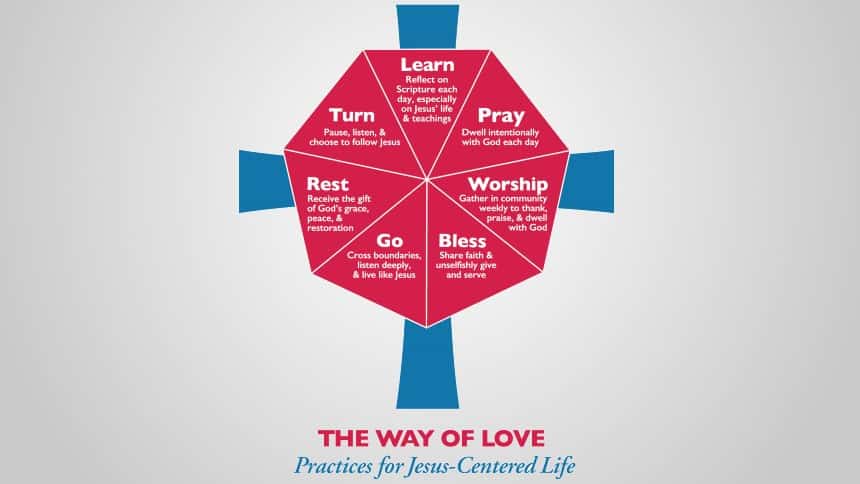
    Presiding Bishop Michael Curry is, of course, our C.E.O. – that is, the Chief Evangelism Officer. He is out front inspiring people to grow in love for God and one another. As his team, we partner with leaders across the church to spread that Jesus Movement and to help people gain confidence as they share and welcome stories of God’s lively, risen presence with humility, curiosity, and hope. Through the Way of Love and many related resources, podcasts and video series, we help Episcopalians to take up a rule of life that leads us to practice Jesus’ way in the world. Through the Episcopal Revivals, dozens of dioceses and communities have shared in prayer, renewal and public proclamation of God’s love. Through the Embracing Evangelism video course, we see people gaining confidence as they share and welcome stories of God’s presence and invite people to deeper relationship with God. Amid the COVID-19 pandemic, we have partnered with friends in Creation Care to introduce the Good News Gardens, and partnered with the Reconciliation and Justice Team to launch “From Many, One”: Conversations Across Difference, an effort that brings people together for one-to-one conversations about the things that matter most. This Pentecost, we gathered a team from six dioceses to host a churchwide revival that sent Episcopalians everywhere to live their faith out loud – in song, in testimony, and in deeds.

    The Episcopal Church, Bless: 2021 Annual Appeal

    These transformative ministries that include numerous programs, webinars, podcasts, resources, concerts, and conversations are possible because people like you supported The Episcopal Church and Bless Annual Appeal.

    Please support this vital work and the work of our siblings across the church –from Creation Care to Young Adult Service Corps. Please make your gift today. You can give by calling (800) 334-7626, ext 6002, or online at iam.ec/blessgiving.

    Your gift helps us to bring the work of seeking, naming, and celebrating our risen Lord to the world. I invite you to join us on this journey — episcopalchurch.org.

    God bless you on the journey we share,

    The Rev. Canon Stephanie Spellers
    Canon to the Presiding Bishop for
    Evangelism, Reconciliation and Creation Care

    Taken from Bulletin Insert: Pentecost 18 (B) – The Episcopal Church’s Annual Appeal – September 26, 2021.

    Church of the Redeemer

    Welcome to Church of the Redeemer: Worshiping God, living in community, and reaching out to the world. We are an Episcopal Church serving north King County and south Snohomish County, Washington. As you travel your road, go with friends walking the way of Jesus at Redeemer.

    Church of the Redeemer is at 6220 Northeast 181st Street in Kenmore, Washington. The campus is a short distance north of Bothell Way, near the Burke-Gilman Trail. The entrance looks like a gravel driveway. The campus is larger on the inside than it is on the outside. And we managed to hide a large building on the side of a hill that is not easily seen from the street.

    The Episcopal Church welcomes you.

  • Presiding Bishop calls for church reformation ‘in the way of Jesus’ at House of Bishops meeting

    Presiding Bishop calls for church reformation ‘in the way of Jesus’ at House of Bishops meeting

    [Episcopal News Service] Presiding Bishop Michael Curry, in his September 21, 2021, sermon during the opening day of the fall House of Bishops meeting, recalled a recent conversation with a fellow bishop about planning for The Episcopal Church’s future. Such conversations typically look to the coming years, Curry said, “but in pandemic time, we can barely think a month ahead of time.”

    This House of Bishops meeting is a prime example. The bishops’ twice-a-year meetings have been held online since the start of the pandemic in March 2020, but with vaccines against COVID-19 now widely available, the bishops had planned to gather Sept. 21-23 in St. Louis, Missouri, for their first in-person meeting in two years. Instead, the delta variant and the national surge in COVID-19 cases since July forced the bishops to cancel their face-to-face meeting and return to Zoom.

    “So now we are here, not in St. Louis,” Curry told the bishops. “The miracle of vaccination has arrived, even with some boosters, and yet some refuse and the pandemic goes on.”

    Curry wondered if diocesan conventions would be held in person this fall, and whether the delta variant could force further changes next year to the church’s General Convention and the Anglican Communion’s Lambeth Conference. “I don’t have any answers yet,” Curry said.

    Curry spent much of his 25-minute sermon invoking the term “narthex,” the area of a church that people pass through to enter and exit, using it as a metaphor for this period of uncertainty and transition. “We are living in a narthex moment, between the world we knew and whatever is being born,” he said.

    That moment was to be the focus of the bishops’ discussions with each other in the “table time” portion of the meeting’s first day. The opening worship service was livestreamed on YouTube, but the rest of the meeting was closed to the public.

    Before the bishops broke into smaller groups, Utah Bishop Scott Hayashi posed three questions for them to discuss: What five words describe your experience with the pandemic? Where has God been present in this time? Have your goals as a bishop changed because of this time of pandemic, racial unrest and political division?

    “I’ve had to take it into my heart to consider what has been lost and what has been gained,” said Hayashi, as he lamented that the bishops still could not have such conversations in person.

    During his sermon, Curry described watching the 1953 movie “The Robe,” set in biblical times, and hearing echoes of today’s call for the church to reject the trappings of empire. He presented a vision of reformation in the church, away from the establishment and closer to Christianity’s origins in small gatherings.

    This, he said, is a “church before collusion with the empire, the church that looks something like Jesus, the church that lived into ‘narthex,’ to let go of the ways things were, to behold the way things could be.”

    Curry continued that such a church would be “not formed in the way of the world but formed in the way of Jesus and his love.”

    “A community of small gatherings and congregations of all stripes and types, a human tapestry, God’s wondrous variety, the Kingdom, the reign of God, the beloved community, no longer centered on empire or establishment, no longer fixated on the preservation of institution, no longer propping up white supremacy or in collusion with anything that hurts or harms any child of God or God’s creation – by God’s grace, a church that looks and acts and lives like Jesus.

    “Welcome to narthex, and welcome to behold a new heaven, a new Earth, a new you, a new me, a new we.”

    —David Paulsen is an editor and reporter for Episcopal News Service.
    He can be reached at dpaulsen@episcopalchurch.org.

    Public Affairs Office of The Episcopal Church

    For more information

    Read the complete text of “A Narthex Moment” at Episcopal Church House of Bishops: Homily from the Presiding Bishop.

    To embrace Presiding Bishop Curry’s invitation to become a church that looks and sounds like Jesus, and to download related resources, visit A Church That Looks and Acts Like Jesus.

    Crest of the Presiding Bishop of the Episcopal Church

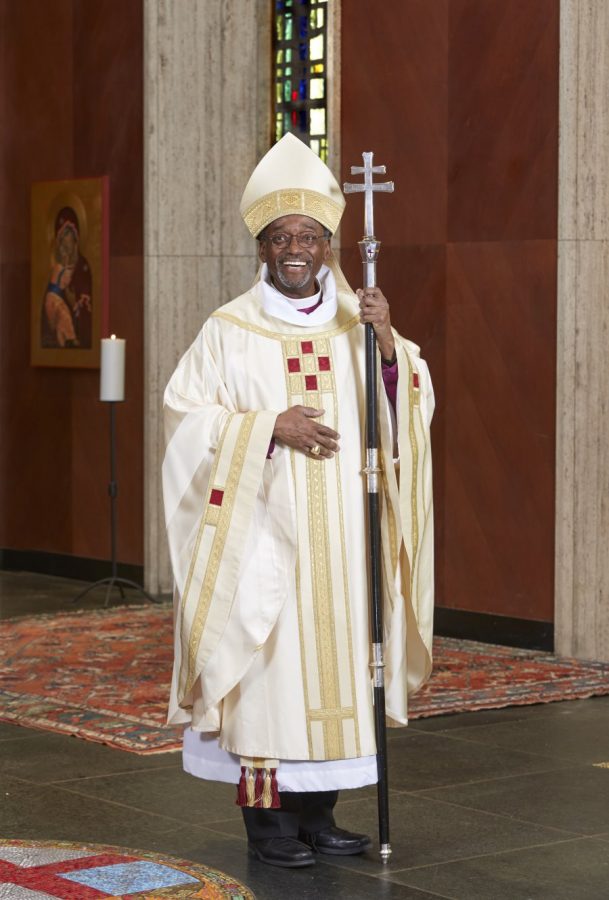
    Presiding Bishop Michael Curry

    “Being a Christian is not essentially about joining a church or being a nice person, but about following in the footsteps of Jesus, taking his teachings seriously, letting his Spirit take the lead in our lives, and in so doing helping to change the world from our nightmare into God’s dream.” ―Michael Curry, Crazy Christians: A Call to Follow Jesus

    The Most Rev. Michael Bruce Curry is Presiding Bishop and Primate of The Episcopal Church. He is the Chief Pastor and serves as President and Chief Executive Officer, and as Chair of the Executive Council of the Episcopal Church.

    Presiding Bishop Curry was installed as the 27th Presiding Bishop and Primate of The Episcopal Church on November 1, 2015. He was elected to a nine-year term and confirmed at the 78th General Convention of The Episcopal Church in Salt Lake City, Utah, on June 27, 2015.

    Read Presiding Bishop Curry’s biography and find out about the Jesus Movement.

    Presiding Bishop Michael Curry in Eucharistic Vestments

    House of Bishops

    This second house, along with the House of Deputies, of the General Convention of the Episcopal Church. This house is composed of all bishops, active and retired, of the church. It meets concurrently with the House of Deputies during General Convention. The House of Bishops also holds yearly meetings between conventions.

    From House of Bishops.

    Church of the Redeemer

    Welcome to Church of the Redeemer: Worshiping God, living in community, and reaching out to the world. We are an Episcopal Church serving north King County and south Snohomish County, Washington. As you travel your road, go with friends walking the way of Jesus at Redeemer.

    Church of the Redeemer is at 6220 Northeast 181st Street in Kenmore, Washington. The campus is a short distance north of Bothell Way, near the Burke-Gilman Trail. The entrance looks like a gravel driveway. The campus is larger on the inside than it is on the outside. And we managed to hide a large building on the side of a hill that is not easily seen from the street.

    The Episcopal Church welcomes you.

  • Weekly bulletin insert for Pentecost 17B

    Weekly bulletin insert for Pentecost 17B

    This is the weekly bulletin insert from the Episcopal Church for Pentecost 17B.

    Explore the Way of Love: Go

    As we discover the Way of Love and the practices through which we can follow Jesus more closely, we realize that Jesus did not stay in one place very often.

    The pursuit of Jesus can often mean moving out of our circles of comfort and going to other places – geographically, culturally, economically, spiritually. Because if there is one thing Jesus did, it is that he went – out of his home, out of his town, out of his community – to engage with other cultures and people, to listen and dignify their stories, no matter their culture or station in life.

    Jesus was a listener and witness to outcasts and sinners, drinkers and tax collectors, strangers and foreigners, the rich and the poor. He uplifted women who were considered unequal to men. He dignified people of other faiths or no faith at all, and showed them the values of the Kingdom of God, through his teaching, through his healing, through his listening, and through his meeting them where they were and putting love into action.

    The Scriptures teach us that it is also our mission to go out into the world. As the writer of John’s Gospel quotes Jesus, “As the Father has sent me, so I send you.” And as the first letter of John tells us, “Little children, let us love, not in word or speech, but in truth and action.”

    The Way of Love--Adult Education topics

    Are you ready to make the commitment to go beyond your boundaries? To listen and talk, to love and serve, to use your gifts in the struggle for dignity and justice for your neighbor and for people who are outside your comfort zone?

    Are you ready to challenge yourself to forge new friendships, open yourself up to new perspectives, and build bridges where once there were walls?

    The Way of Love challenges us to Go.

    As the writer of Hebrews tells us: “Do not neglect to do good and to share what you have, for such sacrifices are pleasing to God.” We are called to give freely of our resources, our stories and experiences, our time and our attention. And we are called to invite others into this Way of Love. We bless ourselves in the process.

    Learn more about the Way of Love at episcopalchurch.org/wayoflove. You can find suggestions on getting started and going deeper with Going at iam.ec/explore.

    Taken from Bulletin Insert: Pentecost 17 (B) – Explore the Way of Love: Go – September 19, 2021.

    Church of the Redeemer

    Welcome to Church of the Redeemer: Worshiping God, living in community, and reaching out to the world. We are an Episcopal Church serving north King County and south Snohomish County, Washington. As you travel your road, go with friends walking the way of Jesus at Redeemer.

    Church of the Redeemer is at 6220 Northeast 181st Street in Kenmore, Washington. The campus is a short distance north of Bothell Way, near the Burke-Gilman Trail. The entrance looks like a gravel driveway. The campus is larger on the inside than it is on the outside. And we managed to hide a large building on the side of a hill that is not easily seen from the street.

    The Episcopal Church welcomes you.

  • Continued support after Hurricane Ida

    Continued support after Hurricane Ida

    Episcopal Relief & Development continues to support regional partners in response to Hurricane Ida. Much of Louisiana and parts of Mississippi continue to face power outages, lack of water, and extensive property damage to homes and businesses.

    Hurricane Ida left more than a million people in the Gulf Coast region without power. While utility teams are working to restore power, water, and sewer, it may be several weeks before fully restoring utilities. Many residents have evacuated their homes, even if the home was not damaged, as it is not safe to remain without power or water.

    Thousands of homes were damaged or destroyed. Experts estimate the total damage could exceed $50 billion, according to AP News. This makes Ida one of the costliest hurricanes in US history.

    The remnants of Ida caused flooding and damage September 1, 2021, in the District of Columbia, Maryland, Virginia, Pennsylvania, New York, New Jersey, Connecticut, and Rhode Island as it moved north.

    The Episcopal Church in Western Louisiana delievered basic goods to evacuees at the Alexandria Megashelter at the request of the shelter

    Continued contact and support

    Episcopal Relief & Development’s US Disaster Program team is continuing daily coordination calls with the Episcopal dioceses of Louisiana, Mississippi, Texas, and Western Louisiana in response to Hurricane Ida. Also, the team is in contact with other partners as they assess the damage from the storm.

    “Right now, our focus is on identifying and meeting immediate needs,” said Katie Mears, Senior Director, US Disaster Program, Episcopal Relief & Development. “We are grateful for the response from the community of people wanting to help and we ask that you not donate in-kind items because our partners don’t have the capacity to sort and store them.”

    Learn more about how to help after a disaster. Please continue to pray for the people who have evacuated, those who are still in their homes, first responders, and everyone who has been impacted by Hurricane Ida from Louisiana to Rhode Island. Please consider a donation to Episcopal Relief & Development’s Hurricane Relief Fund to support their continued response to Hurricane Ida and other storms.

    Episcopal Relief & Development: Working together for lasting change

    Episcopal Relief & Development

    For over 80 years, Episcopal Relief & Development has been working together with supporters and partners for lasting change around the world. Each year the organization facilitates healthier, more fulfilling lives for more than 3 million people struggling with hunger, poverty, disaster, and disease. Inspired by Jesus’ words in Matthew 25, Episcopal Relief & Development leverages the expertise and resources of Anglican and other partners to deliver measurable and sustainable change in three signature program areas: Women, Children, and Climate.

    Church of the Redeemer

    Welcome to Church of the Redeemer: Worshiping God, living in community, and reaching out to the world. We are an Episcopal Church serving north King County and south Snohomish County, Washington. As you travel your road, go with friends walking the way of Jesus at Redeemer.

    Church of the Redeemer is at 6220 Northeast 181st Street in Kenmore, Washington. We are a short distance north of Bothell Way, near the Burke-Gilman Trail. The entrance looks like a gravel driveway. The campus is larger on the inside than it is on the outside. And we managed to hide a large building on the side of a hill that is not easily seen from the street.

    The Episcopal Church welcomes you.

  • Neighbors Welcome: Afghan Allies Fund

    Neighbors Welcome: Afghan Allies Fund

    The Most Rev. Michael Curry, Presiding Bishop of the Episcopal Church, highlights ways to help Afghan refugees through Episcopal Migration Ministries. Source for this information, también incluye el mensaje en español.

    Message from the Presiding Bishop

    As Episcopalians, as followers of Jesus, as people of faith, we mourn the recent loss of life in Afghanistan, the ongoing chaos and instability, and the risk that many Afghans face, in particular women and girls.

    The situation in Afghanistan is changing quickly with many lives lost and thousands more at risk. The current crisis leaves over 5 million displaced Afghans in the country, in bordering nations and many more around the world who have been evacuated, who are trying to find long-term safe solutions.

    As Afghans arrive to the U.S. with the hope of safety, The Episcopal Church, through the work of Episcopal Migration Ministries, is assisting our new neighbors through the Afghan Parolee Support Program.

    This new U.S. program, dependent on private resources and community-led welcome and support, will provide security and foundation necessary for arriving Afghans to begin life in the U.S.

    The ministry of offering welcome to those fleeing violence is nothing less than God’s work—one that calls us to walk the way of love as Jesus of Nazareth taught us, through compassion, through practical care, showing to our newest neighbors that we are neighbors.

    Episcopal Migration Ministries has launched a special appeal—Neighbors Welcome: Afghan Allies Fund—to meet the financial and in-kind needs necessary to provide adequate housing, basic services, and long-term support.

    The needs are great and will require our communities and congregations to come together to contribute financially, offering housing, volunteer, and pray.

    You can also stay involved in the work of advocacy in ensuring that the government of the United States honors its commitments to our Afghan allies.

    Included with this video, there are links and information sources that can assist you in participating in any way that you can.

    As Episcopalians in the late 1930s rose up to respond to allies, primarily Jewish allies fleeing tyranny in Europe, at the advent of the Second World War, as Episcopalians have continued to rise up wherever and whenever there has been human need, joining hands with other peoples of faith and people of goodwill, so now I invite you to rise up again for our Afghan friends, to stand with them in their time of need.

    Thank you for all that you do.
    Thank you for this work.
    Thank you for anything that you can do.

    God love you.
    God bless you.
    And may God bless the people of Afghanistan wherever they may be. Amen.

    How you can help

    Find out how to stay involved in the work of advocacy in ensuring the U.S. government honors its commitments to our Afghan allies at Office of Government Relations

    To contribute financially to provide for housing, medical and financial support, and expanded community sponsorship to serve our Afghan allies, do one of the following:

    • Visit Support Our Afghan Allies to make a secure donation online on the website of Episcopal Migration Ministries.
    • Text “EMMALLIES” to 41444.

    For opportunities to volunteer, provide housing, or sponsor, visit Volunteer & Community Sponsorship Interest Form on the Episcopal Migration Ministries website.

    Also, watch Resettling Afghan Refugees: A Webinar from the Diocese of Olympia for information about Seattle-area efforts.

    Episcopal Migration Ministries

    Episcopal Migration Ministries

    The Episcopal Church has served immigrants new to the United States since the late 1800s, when the Church opened port chaplaincies to minister to sojourners on both coasts. In the 1930s, local parishes collected donations to provide steamship passage for those fleeing Nazi Europe. Out of this effort, the Presiding Bishop’s Fund for World Relief was born, the forerunner organization to Episcopal Relief & Development and Episcopal Migration Ministries.

    Through the mid- and late 20th century, Episcopal Migration Ministries (EMM) partnered with other faith organizations to resettle those oppressed by the Iron Curtain and the genocides of Southeast Asia. In the 1980s, EMM was formally established. In partnership with a network of affiliate agencies, dioceses, churches, and volunteers, EMM is today one of only nine national agencies through which all refugees enter the United States.

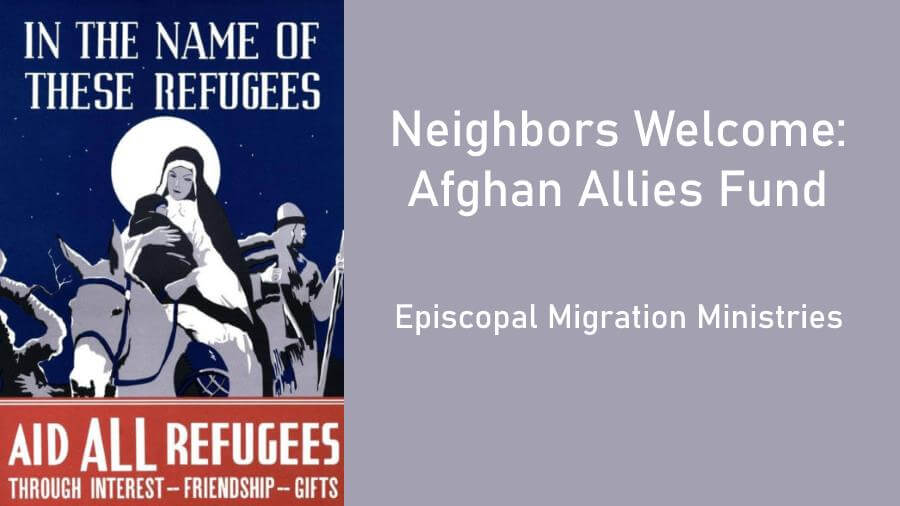
    In the name of these refugees, aid all refugees. This is a World War II-era poster used to raise money for relief efforts in the Episcopal Church.

    Church of the Redeemer

    Welcome to Church of the Redeemer: Worshiping God, living in community, and reaching out to the world. We are an Episcopal Church serving north King County and south Snohomish County, Washington. As you travel your road, go with friends walking the way of Jesus at Redeemer.

    Church of the Redeemer is at 6220 Northeast 181st Street in Kenmore, Washington. We are a short distance north of Bothell Way, near the Burke-Gilman Trail. The entrance looks like a gravel driveway. The campus is larger on the inside than it is on the outside. And we managed to hide a large building on the side of a hill that is not easily seen from the street.

    The Episcopal Church welcomes you.

  • Episcopal Relief & Development responds in Haiti

    Episcopal Relief & Development responds in Haiti

    Episcopal Relief & Development is supporting the Episcopal Diocese of Haiti and other partners in response to the devastating earthquake that struck on Saturday, August 14, 2021. The organization’s first grant is through the diocese and will support 400 vulnerable households in 21 isolated communities.

    Haitian earthquake damage, August 2021, from Diocese of Haiti

    The overall need

    A 7.2 magnitude earthquake hit Haiti’s southern peninsula and, as of Wednesday, August 18, it had caused nearly 2,000 deaths and injured more than 9,000 people, according to the United Nations. The UN also said the quake impacted more than 1.2 million people. The quake destroyed buildings and infrastructure, including nearly 61,000 homes, and damaged more than 76,000 more.

    Thousands of families are in need of humanitarian assistance. The Haitian Civil Protection General Directorate says 137,000 families have been affected in the Sud, Grand’Anse and Nippes departments. About 500,000 people – 40 percent of the total population in the affected departments – are in need of emergency humanitarian assistance. Rescue efforts have been hampered by heavy rains and winds from Tropical Storm Grace and the full extent of the damage has yet to be determined.

    Immediate response by Episcopal Relief & Development

    The Diocese of Haiti, in collaboration with its congregations on the southern peninsula, quickly assessed the most urgent needs of vulnerable groups such as pregnant women, mothers with young children, the elderly, and people whose homes were damaged or destroyed. The diocese selected 400 families in hard-to-reach areas that have been affected by the earthquake and Tropical Storm Grace. With Episcopal Relief & Development’s support, these families will receive direct assistance so that they can meet basic needs such as food, medicine, and housing.

    “For marginalized groups, the combined impact of COVID-19, the earthquake, and Tropical Storm Grace has the potential to be devastating,” said Ernest Cajuste, Senior Program Officer, Episcopal Relief & Development. “Episcopal Relief & Development is working with partners such as the Diocese of Haiti to support these individuals and families as they maintain their livelihoods, assets and dignity.”

    Episcopal Relief & Development remains in close contact with the diocese and other partner organizations on the ground in Haiti as leaders assess needs in their communities. Please continue to pray for those who have been affected by the earthquake, tropical storm and COVID-19. Donations to the Haiti Fund will help the organization to continue to respond to this disaster.

    [The above information is from a press release from Episcopal Relief & Development on August 18, 2021.]

    Select to donate to Haitian relief through Episcopal Relief and Development

    Presiding Bishop Michael Curry in choir dress

    Pray for Haiti

    This prayer comes from the Presiding Bishop and Primate of the Episcopal Church, the Most Rev. Michael Curry. It is translated into Haitian Creole.

    Prayer for Haiti from Presiding Bishop Michael Curry—English

    Eternal God, send forth your Sprit to encourage and strengthen the people of Haiti in these difficult times. We pray especially for those impacted by the recent earthquake. Encourage and strengthen those who help and support others. In your mercy, receive the souls of those who have died; comfort their families and loved ones. Surround with your presence the sick and suffering. Aid the work of those who still search and rescue. Empower the medical and aid workers and all who labor to heal.

    Likewise, inspire and empower the resolve of the nations and peoples of the world to be your instruments of help and healing. Stir up the might of your love and compassion among the nations to rally resources and stay the course until the humanitarian job is accomplished.

    Lastly, enfold and uphold the people of Haiti—from the youngest newly born to the oldest among us—in the arms of your love and the strength of your might. This we pray in the name of Jesus Christ our Lord. Amen.

    Priyè pou Ayiti de Evèk prezidan Michael Curry—Kreyòl Asyiyen

    Bondye Letènèl, voye Lespri ou pou ankouraje epi ranfòse pèp Dayiti nan moman difisil sa yo. Nou priye espesyalman pou sila yo moun tranbleman detè resan an te enpakte. Ankouraje epi ranfòse moun ki ede epi sipòte zòt yo. Nan mizerikòd ou, resevwa nanm moun ki mouri yo; konfòte fanmi yo ak moun pwòch yo. Antoure ak prezans ou moun ki malad epi k ap soufri. Ede travay moun sou teren an k ap fouye epi fè sovtaj. Bay travayè medikal ak asistans yo fòs, ansanm ak tout moun k ap eseye refè.

    Epitou, enspire epi ranfòse detèminasyon nasyon ak pèp nan lemond pou yo ka tounen enstriman pou w bay èd ak delivrans. Deklanche pisans lanmou ak konpasyon ou pami nasyon yo pou rasanble resous epi rete sou menm chimen an jiskaske djòb asistans imanitè a fini.

    Pou fini, anvlope epi pwoteje pèp ayisyen—depi pi piti tibebe a ki fenk fèt jiska granmoun ki gen plis laj pami nou—nan bra lanmou ou ak nan fòs pisans ou. Se sa nou priye onon Jezi Krist Senyè nou, amèn.

    Episcopal Relief & Development

    For over 80 years, Episcopal Relief & Development has been working together with supporters and partners for lasting change around the world. Each year the organization facilitates healthier, more fulfilling lives for more than 3 million people struggling with hunger, poverty, disaster, and disease. Inspired by Jesus’ words in Matthew 25, Episcopal Relief & Development leverages the expertise and resources of Anglican and other partners to deliver measurable and sustainable change in three signature program areas: Women, Children, and Climate.

    Church of the Redeemer

    Church of the Redeemer: Worshiping God, living in community, and reaching out to the world. We are an Episcopal Church serving north King County and south Snohomish County, Washington. As you travel your road, go with friends walking the way of Jesus at Redeemer.

    Church of the Redeemer is at 6220 Northeast 181st Street in Kenmore, Washington. We are a short distance north of Bothell Way, near the Burke-Gilman Trail. The entrance looks like a gravel driveway. The campus is larger on the inside than it is on the outside. And we managed to hide a large building on the side of a hill that is not easily seen from the street.

    The Episcopal Church welcomes you.

  • Statement on Indigenous boarding schools

    Statement on Indigenous boarding schools

    This is a statement from the Episcopal Church on Indigenous boarding schools by Presiding Bishop Michael Curry and President of the House of Deputies Gay Clark Jennings.


    In Genesis, God conferred dignity on all people by creating them in God’s own image–a belief that is shared by all Abrahamic faiths. We are grieved by recent discoveries of mass graves of Indigenous children on the grounds of former boarding schools, where Indigenous children experienced forced removal from their homes, assimilation and abuse. These acts of cultural genocide sought to erase these children’s identities as God’s beloved children.

    We condemn these practices and we mourn the intergenerational trauma that cascades from them. We have heard with sorrow stories of how this history has harmed the families of many Indigenous Episcopalians.

    While complete records are unavailable, we know that The Episcopal Church was associated with Indigenous schools during the 19th and 20th centuries. We must come to a full understanding of the legacies of these schools.

    As chair and vice-chair of Executive Council, and in consultation with our church’s Indigenous leaders, we pledge to make right relationships with our Indigenous siblings an important focus of the work of Executive Council and the 80th General Convention.

    To that end, we commit to the work of truth and reconciliation with Indigenous communities in our church. We pledge to spend time with our Indigenous siblings, listening to their stories and history, and seeking their wisdom about how we can together come to terms with this part of our history. We call upon Executive Council to deliver a comprehensive proposal for addressing the legacy of Indigenous schools at the 80th General Convention, including earmarking resources for independent research in the archives of The Episcopal Church, options for developing culturally appropriate liturgical materials and plans for educating Episcopalians across the church about this history, among other initiatives.

    We also commend Department of the Interior Secretary Deb Haaland on her establishment of the Federal Indian Boarding School Initiative and the effort to “shed light on the traumas of the past.” The Episcopal Church is also working to support legislation that will establish a truth and healing commission on Indian boarding school policy, which would complement the Department of the Interior’s new initiative.

    As followers of Jesus, we must pursue truth and reconciliation in every corner of our lives, embracing God’s call to recognition of wrongdoing, genuine lamentation, authentic apology, true repentance, amendment of life and the nurture of right relationships. This is the Gospel path to becoming beloved community.

    (Statement from the Episcopal Church website. The cover photo comes from this Episcopal News Service article.)

    The Most Rev. Michael Curry

    The Most Rev. Michael Bruce Curry is Presiding Bishop and Primate of The Episcopal Church.  He is the Chief Pastor and serves as President and Chief Executive Officer, and as Chair of the Executive Council of The Episcopal Church.

    Presiding Bishop Curry was installed as the 27th Presiding Bishop and Primate of The Episcopal Church on November 1, 2015.  He was elected to a nine-year term and confirmed at the 78th General Convention of The Episcopal Church in Salt Lake City, UT, on June 27, 2015.

    Read more about the Presiding Bishop.

    The Rev. Gay Clark Jennings

    The Rev. Gay Clark Jennings was elected president of the House of Deputies by her peers at the 77th General Convention of the Episcopal Church in 2012, and at the 78th General Convention in 2015, she was reelected by acclamation. She is the first ordained woman to hold the position.

    As president, Gay is committed to fostering a new generation of leaders in the Episcopal Church and encouraging the church’s work for justice through the actions of General Convention and the work of Episcopalians throughout the church. She works closely with the elected and appointed leaders who serve the church between conventions, with more than 850 members of the House of Deputies, and with the presiding bishop and other church leaders.

    Read more about the President of the House of Deputies.

    Church of the Redeemer

    Welcome to Church of the Redeemer: Worshiping God, living in community, and reaching out to the world. We are an Episcopal Church serving north King County and south Snohomish County, Washington. As you travel your road, go with friends walking the way of Jesus at Redeemer.

    Church of the Redeemer is at 6220 Northeast 181st Street in Kenmore, Washington. We are a short distance north of Bothell Way, near the Burke-Gilman Trail. The entrance looks like a gravel driveway. The campus is larger on the inside than it is on the outside. And we managed to hide a large building on the side of a hill that is not easily seen from the street.

    Click for COVID-19 updates.

    The Episcopal Church welcomes you.

  • Presiding Bishop Michael Curry’s opening remarks for Executive Council, June 25, 2021

    Presiding Bishop Michael Curry’s opening remarks for Executive Council, June 25, 2021

    The following is a transcript of the opening remarks of Presiding Bishop Michael Curry at the Executive Council of The Episcopal Church, which met virtually June 25 through June 28, 2021. These remarks have been lightly edited for clarity. They were provided by Office of Public Affairs of the Episcopal Church.

    Toward Truth and Reconciliation

    Let me start with a scripture that you know well; it comes from Galatians, Paul, who wrote and I quote:

    As many of you as were baptized into Christ have clothed yourselves with Christ. There is no longer Jew or Greek, there is no longer slave or free, there is no longer male and female; for all of you are one in Christ Jesus. (Galatians 3:27-28)

    At our last meeting I shared with you some preliminary thoughts about expanding and deepening our ongoing work of racial justice and reconciliation, now through a churchwide effort of truth and reconciliation.

    Many dioceses, congregations, schools, seminaries and other institutions of our church have engaged this work under a variety of names. Many throughout our church for years have participated in anti-racism training, Becoming Beloved Community, and many other important efforts and ways of engaging racism. This is not to replace any of that work, but rather to build on it.

    I am convinced that we have an opportunity to encourage the work of truth and reconciliation throughout our church, and to do at the same time what, to my knowledge, we have never done as a churchwide community before — that is to engage in a process of truth and reconciliation for us, not only as dioceses – many dioceses have already done this – not only as congregations – many congregations and schools and seminaries have done this. Not all, but many have. But now to do this work of truth and reconciliation on the level of the churchwide community and organization of us as The Episcopal Church, in all the countries where we are located. To my knowledge this has not been done before on the churchwide level.

    This is an invitation and an opportunity to do the hard and holy work of love. This is an opportunity to do and to model, I think, for our societies, the societies in which we live, what we must do to save our souls from the evils of racism, the evils of supremacy of anybody over anybody else, and the evils of the ways we hurt and harm each other in spite of the fact that we are all children of God, created equally in God’s image, and therefore brothers, sisters, siblings, the human family of God.

    Allow me to locate this work of truth and reconciliation intentionally in a biblical and theological context. When I was a freshman in college, almost 50 years ago now, the late William Stringfellow came to lecture on campus. Stringfellow, as some of you know, was an Episcopalian and a lawyer who gave up opportunities for a successful and lucrative legal practice, and instead, seeking to follow Jesus, gave much of his life providing legal services for the poor. In time he became an advocate in the biblical sense of that word, and I believe he was one of our greatest theologians. I don’t remember the actual occasion of his coming to campus, or what his subject was. But I do remember his response to one of the questions from the floor.

    Someone asked him, “What is the deepest and most significant way that we can engage all of the manifestations of racism and bigotry? Personal, social, institutional. What is the best way to engage it?” And he answered, “Baptism.”

    Now I have to admit … What was I? 17 or 18. At the time, I remember thinking, “Baptism?” I grew up in St. Phillips, Buffalo. I had seen plenty of babies baptized, but it never occurred to me that those babies being baptized was an answer to racism. I remember in my grandma’s Baptist church that folk got immersed in the waters of the baptismal pool all the time. And while that was a bit more dramatic than baptism was in our Episcopal church, it never occurred to me there either that baptism was the answer to deep engagement with racism. But Stringfellow was right. The key to all of this for us as followers of Jesus Christ is baptism.

    Jesus commanded us, in Matthew 28, “Go therefore make disciples of all nations.” How do you do that? Baptize them, in the name of the Father, Son and Holy Spirit, in the reality of the triune God. And then Jesus says, “Teach them everything I’ve taught you to do.”

    The sacrament of baptism is a lifelong commitment immersed in the reality of the triune God and daring to live the teachings and the ways of Jesus of Nazareth. It is a commitment to renounce, reject, and actively oppose in our lives and in our world anything that rebels against the God who the Bible says is love. It is a commitment to renounce anything that attempts to separate us from the love of God and from each other. It is a commitment to renounce anything that hurts or harms any human child of God or this creation.

    You don’t have to believe Michael Curry, but this is what the prayer book says. These are the first three promises of baptism in the Book of Common Prayer:

    • Do you renounce Satan and all the spiritual forces of wickedness that rebel against God?
    • Do you renounce all sinful desires that draw you from the love of God?
    • Do you renounce [Listen to this one.] … Do you renounce the evil powers of this world, which corrupt and destroy the creatures of God, that hurt or harm any child of God, or God’s grand and glorious creation?

    If these renunciations were check-off boxes, which they’re not, but if they were, and we had to check off items that engage racism, Satan and spiritual forces of wickedness that rebel against God, is that about racism? Check off. Simple desires that draw you from the love of God? Smell like racism? Check it off. Evil powers which corrupt and destroy the creatures of God? Oh, I think that’s a triple check-off.

    Stringfellow was right. Baptism’s the answer.

    Baptism is not only about renunciation and standing against. It’s also about standing for someone and something. It’s about a committed life of ongoing repentance and revival in the best sense of those words. You know that the word repent means metanoia. It means to turn. To repent, to live a life, a constantly repenting life, is to turn away from that which is unloving. To turn away from that which brings darkness into the world instead of light. To turn away from that which hurts or harms, and to turn to Jesus Christ, and his way of love as our way of life.

    Again, hear the prayer book:

    • Do you turn to Jesus Christ and accept him as your savior?
    • Do you put your whole trust in his grace and love?
    • Do you promise to follow and obey him as your Lord?

    This work of being a baptized follower and disciple of Jesus Christ, this is the holy and hard work of love. The holy and hard work of baptism. And when and where that holy and hard work is done by a community, the beloved community becomes a possibility. In some sense, God’s kingdom really does come on earth as it is in heaven.

    And that realization … I know I’m not supposed to be preaching here. These are opening remarks, but that’s OK. In some sense, that realization, I can actually see Paul getting excited, and the Pauline tradition getting excited. It’s like Paul realized this and said, “Oh, my God, a baptism. This is not just about joining the church. This is about a transformed humanity and creation.” And in his excitement, in Ephesians, one of his followers writes, “In Christ Jesus, you who were once far off, are now brought near. This Jesus has broken down the dividing wall of the hostility that separated us, that he might make out of all of our divisions and differences, a new humanity.” I can see Paul. He goes wild in 2 Corinthians: “So if anyone is in Christ, there is a new creation. The old has passed away. Behold the new has come. All this is from God who in Christ was reconciling the world to himself, and who has now given to us ministry of reconciliation.”

    And last but not least, as many of you as have been baptized, you have put on Christ. Whether you were immersed under the water or whether a little dab would do you. If it was in the name of the triune God, you have put on Christ. For those who have put on Christ, there is no more male or female, no more slave or free, no more Jew or Gentile, no more Republican or Democrat, no more black, white, brown. No more divisions, no more segregation, no more separations, for all are one in Christ.

    Oh, my brothers and sisters, that’s what baptism is about. Following in the way of Jesus of Nazareth, his way of love, and that is a new way of life. Our work of truth and reconciliation is about that.

    Like baptism, it is about facing truths of our past. Maybe even especially painful truths. But not to impose or wallow in guilt. Not for anybody to point fingers at anybody, but for us all together … I want to say that again. For us all together, and I say that as a descendant of African slaves. I’m sitting right here in Raleigh, North Carolina, less than  100 miles from the plantations where my momma’s ancestors worked for nothing. But this is an opportunity for all of us, no matter who we are, no matter who we descend from, to face the pain of the past, to confess it, and above all, to learn from it. To tell the truth in love, as the Bible says, so that we can learn love’s more excellent way.

    And having learned to turn, to repent, to turn in a new direction, in a new way, and to do that by righting old wrongs as best we can. To do that by repairing any breaches, as we are able, to help and to heal and to join hands together to make God’s beloved community real.

    So what are the next steps to help to make this reality? House of Deputies President Gay Clark Jennings and I have been working on this and in conversation about ways and how to do this. Secretary Michael Barlowe has joined us in helping to figure out a way forward that can really invite and enable us as a church to this work, together as The Episcopal Church, across all of our differences.

    Toward that end, as the presiding officers of the General Convention, President Jennings and I are in the process of forming a presiding officers working group on truth and reconciliation for the churchwide organization and community of The Episcopal Church.

    We plan to appoint a working group composed of bishops and deputies. There will be some bishops and deputies who currently serve on the Episcopal committee on anti-racism, some bishops and deputies from the existing presiding officers advisory council on beloved community implementation, as well as bishops’ and deputies’ representatives from the Executive Council.

    The working group of bishops and deputies is charged to develop proposals for the 80th General Convention that will foster and facilitate the convention’s adoption of a plan and pathway for a process of truth and reconciliation in The Episcopal Church.

    The proposals will include ways to:

    1. Tell the truth about our collective racial and ethnic history and present realities.
    2. Reckon with our church’s historic and current complicity with racial injustice.
    3. Make commitments to right old wrongs and repair breaches.
    4. Discern a vision for healing and reconciliation that fosters God’s dream of the Beloved Community and advances the reign of God’s love, “on earth as it is in heaven.”

    To carry out this charge, the presiding officers working group will:

    1. Review the history and current state of truth and reconciliation processes, or their equivalents, in The Episcopal Church, the provinces of the Anglican Communion, and in the countries of The Episcopal Church and Anglican Communion to learn from work that’s already been done already. What can we learn from South Africa? What can we learn from Rwanda? What can we learn from New Zealand?
    2. Propose to General Convention a process for congregations, dioceses, schools, church-affiliated organizations, agencies and boards, and the DFMS (Domestic and Foreign Missionary Society) itself to participate at both grassroots and grass-tops levels, in a churchwide truth and reconciliation process.
    3. Propose to General Convention a plan and process for the curation, organization and dissemination of practical resources, support, assistance, training, and networks for Episcopal entities, whether congregations, dioceses, schools, seminaries, that are seeking to participate in the work of truth and reconciliation.
    4. Propose to General Convention a budget for this work.

    The working group will convene in September 2021 and submit its work in the form of General Convention resolutions, and if it elects, a memorial, to General Convention by March the first 2022.

    We genuinely have an opportunity not just for the church, but for the sake of the world, that God so loved that he gave his only son. We have an opportunity to be a witness in a society, here in the United States, but also in a world profoundly divided and dangerously polarized. We have an opportunity to witness how we can overcome our divisions and heal our hurts and find a balm in Gilead.

    Maybe James Weldon Johnson captured his hope and dream and this commitment in the refrain of his hymn Lift Every Voice and Sing, where he wrote:

    Sing a song full of the faith that the dark past has taught us.
    Sing a song full of the hope that present has brought us.
    Facing the rising sun, of a new day begun
    Let us march on, till victory is won.

    Amen.

    Source for this text.

    Read the opening remarks of the President of the House of Deputies Gay Clark Jennings for the same meeting.

    Crest of the Presiding Bishop of the Episcopal Church

    Presiding Bishop Michael Curry

    “Being a Christian is not essentially about joining a church or being a nice person, but about following in the footsteps of Jesus, taking his teachings seriously, letting his Spirit take the lead in our lives, and in so doing helping to change the world from our nightmare into God’s dream.” ―Michael Curry, Crazy Christians: A Call to Follow Jesus

    The Most Rev. Michael Bruce Curry is Presiding Bishop and Primate of The Episcopal Church. He is the Chief Pastor and serves as President and Chief Executive Officer, and as Chair of the Executive Council of the Episcopal Church.

    Presiding Bishop Curry was installed as the 27th Presiding Bishop and Primate of The Episcopal Church on November 1, 2015. He was elected to a nine-year term and confirmed at the 78th General Convention of The Episcopal Church in Salt Lake City, Utah, on June 27, 2015.

    Read Presiding Bishop Curry’s biography and find out about the Jesus Movement.

    Church of the Redeemer

    Church of the Redeemer: Worshiping God, living in community, and reaching out to the world around us. We are an Episcopal Church serving north King County and south Snohomish County, Washington. As you travel your road, go with friends walking the way of Jesus at Redeemer.

    Church of the Redeemer is at 6220 Northeast 181st Street in Kenmore, Washington. The campus is a short distance north of Bothell Way, near the Burke-Gilman Trail. The entrance looks like a gravel driveway. The campus is larger on the inside than it is on the outside. And we managed to hide a large building on the side of a hill that is not easily seen from the street.

    Click for COVID-19 updates.

    The Episcopal Church welcomes you.

The 7th Sunday after Pentecost, July 12, 2026. Services at 8:00 am (no music) and 10:30 (music).

Episcopal Church of the Redeemer
Privacy Overview

Cookie information is stored in your browser and performs functions such as recognizing you when you return to our website and helping our team to understand which pages of the website are visited. We aren't using cookies to determine your web browsing habits, but others can.