In this first episode of season 6 of Prophetic Voices: Preaching and Teaching Beloved Community, we speak with Episcopalians committed to the Beloved Community about the texts for Ash Wednesday. The texts covered in this episode are Isaiah 58:1-12 and Matthew 6:1-6, 16-21.
Our guests this week are the following:
The Rev. Jerry Maynard, also known as the People’s Priest, a spiritual renegade and social revolutionary in Houston, Texas. As a Two-Spirit Xochihua person, Jerry seeks to bring healing medicine through pastoral care and public witness at the intersection of church and society.
The Rev. Michelle Dayton, rector of St. Katharine’s Episcopal Church in Martin, S.D., and the superintending presbyter of Pine Ridge Episcopal Mission. As an emergency physician for 20 years in southeastern Ohio, she noticed how trauma in all its forms separates us from God, one another, and our true selves.
The Rev. Jazzy Bostock, a kanaka maoli woman serving St. John the Baptist and Maluhia Lutheran Church in Waianae, Hawaii. She and her wife have a small homestead, consisting of raised garden beds, a flock of hens, a hive of bees, a dog, and a cat. They are foster parents, currently awaiting their next placement.
Prophetic Voices is hosted by the Rev. Isaiah “Shaneequa” Brokenleg, The Episcopal Church’s staff officer for Racial Reconciliation. For more information on Becoming Beloved Community, visit iam.ec/becomingbelovedcommunity.
Prophetic Voices: Preaching and Teaching Beloved Community
Across our church and our society, we are having profound dialogues about race, truth, justice, and healing. Coming this Advent, Prophetic Voices: Preaching and Teaching Beloved Community explores where that dialogue intersects with our faith. Join us and our invited guests as we share prophetic voices and explore the readings for each week of Advent and Christmas Day through the lens of social justice.
You’ll hear ancient texts interpreted in new ways, find fodder for preaching and teaching, and make present day connections to the prophetic voices of the Bible. This podcast will help us rethink how we hear, see, and interact with the lectionary readings.
Welcome to Church of the Redeemer: Worshiping God, living in community, and reaching out to the world. We are an Episcopal Church serving north King County and south Snohomish County, Washington. As you travel your road, go with friends walking the way of Jesus at Redeemer.
Church of the Redeemer is at 6220 Northeast 181st Street in Kenmore, Washington. We are a short distance north of Bothell Way, near the Burke-Gilman Trail. The entrance looks like a gravel driveway. The campus is larger on the inside than it is on the outside. And we managed to hide a large building on the side of a hill that is not easily seen from the street.
In this final episode of season 5 of Prophetic Voices: Preaching and Teaching Beloved Community, we speak with Episcopalians committed to the Beloved Community about the texts for Christmas Day. The texts covered in this episode are Luke 2:1-20, John 1:1-14, and Isaiah 9:2-7.
Our guests this week are the following:
The Rev. Clay Riley, rector of All Angels Episcopal Church in Spearfish, S.D. He enjoys recording music, gardening, reading history, and biographies. Clay is husband to wife Maggie and dad to his sons, Liam and Finn.
Canon Myra Garnes, officer for youth ministries on the Presiding Bishop’s staff in the Department of Faith Formation. Canon Myra leads a ministry with young people grounded in principles of social justice and rooted in the Gospel. She loves traveling with family and friends and cheering on the Ohio State Buckeyes.
The Rev. Shug Goodlow, assistant rector at St. Martin’s Episcopal Church in Ellisville in the Diocese of Missouri. She serves as the missioner for racial reconciliation and justice for the diocese. Shug is married to wife Doris and they have two daughters, Monica and Simone, as well as a granddaughter, Khloe.
Prophetic Voices is hosted by the Rev. Isaiah “Shaneequa” Brokenleg, The Episcopal Church’s staff officer for Racial Reconciliation. For more information on Becoming Beloved Community, visit iam.ec/becomingbelovedcommunity.
Prophetic Voices: Preaching and Teaching Beloved Community
Across our church and our society, we are having profound dialogues about race, truth, justice, and healing. Coming this Advent, Prophetic Voices: Preaching and Teaching Beloved Community explores where that dialogue intersects with our faith. Join us and our invited guests as we share prophetic voices and explore the readings for each week of Advent and Christmas Day through the lens of social justice.
You’ll hear ancient texts interpreted in new ways, find fodder for preaching and teaching, and make present day connections to the prophetic voices of the Bible. This podcast will help us rethink how we hear, see, and interact with the lectionary readings, refocusing from the rush of the Christmas season to the voice crying out in the wilderness.
Welcome to Church of the Redeemer: Worshiping God, living in community, and reaching out to the world. We are an Episcopal Church serving north King County and south Snohomish County, Washington. As you travel your road, go with friends walking the way of Jesus at Redeemer.
Church of the Redeemer is at 6220 Northeast 181st Street in Kenmore, Washington. We are a short distance north of Bothell Way, near the Burke-Gilman Trail. The entrance looks like a gravel driveway. The campus is larger on the inside than it is on the outside. And we managed to hide a large building on the side of a hill that is not easily seen from the street.
In this third episode of season 5 of Prophetic Voices: Preaching and Teaching Beloved Community, we speak with Episcopalians committed to the Beloved Community about the texts for Advent 3. The texts covered in this episode are Isaiah 35:1-10, Canticle 15, and Matthew 11:2-11.
The Rev. Christopher McNabb, SMMS, program officer for recruitment and engagement for the Neighbor-to-Neighbor program of Episcopal Migration Ministries. He lives in Seattle, Washington, with his rescue pup, Lucky.
The Rev. Canon Dr. Lauren Stanley, canon to the ordinary in the Episcopal Diocese of South Dakota. She has been ordained for 25 years and has served in Virginia, Pennsylvania, Sudan, Haiti, and on the Rosebud Indian Reservation in South Dakota.
Prophetic Voices is hosted by the Rev. Isaiah “Shaneequa” Brokenleg, The Episcopal Church’s staff officer for Racial Reconciliation. For more information on Becoming Beloved Community, visit iam.ec/becomingbelovedcommunity.
Prophetic Voices: Preaching and Teaching Beloved Community
Across our church and our society, we are having profound dialogues about race, truth, justice, and healing. Coming this Advent, Prophetic Voices: Preaching and Teaching Beloved Community explores where that dialogue intersects with our faith. Join us and our invited guests as we share prophetic voices and explore the readings for each week of Advent and Christmas Day through the lens of social justice.
You’ll hear ancient texts interpreted in new ways, find fodder for preaching and teaching, and make present day connections to the prophetic voices of the Bible. This podcast will help us rethink how we hear, see, and interact with the lectionary readings, refocusing from the rush of the Christmas season to the voice crying out in the wilderness.
Welcome to Church of the Redeemer: Worshiping God, living in community, and reaching out to the world. We are an Episcopal Church serving north King County and south Snohomish County, Washington. As you travel your road, go with friends walking the way of Jesus at Redeemer.
Church of the Redeemer is at 6220 Northeast 181st Street in Kenmore, Washington. We are a short distance north of Bothell Way, near the Burke-Gilman Trail. The entrance looks like a gravel driveway. The campus is larger on the inside than it is on the outside. And we managed to hide a large building on the side of a hill that is not easily seen from the street.
In this second episode of season 5 of Prophetic Voices: Preaching and Teaching Beloved Community, we speak with Episcopalians committed to the Beloved Community about the texts for Advent 2. The texts covered in this episode are Isaiah 11:1-10, Psalm 72:1-7, 18-19, and Matthew 3:1-12.
Our guests this week are the following:
The Rev. Jazzy Bostock, a kanaka maoli woman serving St. John the Baptist and Maluhia Lutheran Church in Waianae, Hawaii. She and her wife have a small homestead, consisting of raised garden beds, a flock of hens, a hive of bees, a dog, and a cat. They are foster parents, currently awaiting their next placement.
The Rev. Phil Hooper, SMMS, curate at Trinity Episcopal Church, Fort Wayne, in the Diocese of Northern Indiana. Phil has interests in writing and exploring contemplative spirituality.
Prophetic Voices is hosted by the Rev. Isaiah “Shaneequa” Brokenleg, The Episcopal Church’s staff officer for Racial Reconciliation. For more information on Becoming Beloved Community, visit iam.ec/becomingbelovedcommunity.
Prophetic Voices: Preaching and Teaching Beloved Community
Across our church and our society, we are having profound dialogues about race, truth, justice, and healing. Coming this Advent, Prophetic Voices: Preaching and Teaching Beloved Community explores where that dialogue intersects with our faith. Join us and our invited guests as we share prophetic voices and explore the readings for each week of Advent and Christmas Day through the lens of social justice.
You’ll hear ancient texts interpreted in new ways, find fodder for preaching and teaching, and make present day connections to the prophetic voices of the Bible. This podcast will help us rethink how we hear, see, and interact with the lectionary readings, refocusing from the rush of the Christmas season to the voice crying out in the wilderness.
Welcome to Church of the Redeemer: Worshiping God, living in community, and reaching out to the world. We are an Episcopal Church serving north King County and south Snohomish County, Washington. As you travel your road, go with friends walking the way of Jesus at Redeemer.
Church of the Redeemer is at 6220 Northeast 181st Street in Kenmore, Washington. We are a short distance north of Bothell Way, near the Burke-Gilman Trail. The entrance looks like a gravel driveway. The campus is larger on the inside than it is on the outside. And we managed to hide a large building on the side of a hill that is not easily seen from the street.
In this first episode of season 5 of Prophetic Voices: Preaching and Teaching Beloved Community, we speak with Episcopalians committed to the Beloved Community about the texts for Advent 1. The texts covered in this episode are Isaiah 2:1-5, Romans 12:11-14, and Matthew 24:36-44.
Our guests this week are the following:
The Rev. LaClaire Atkins, an alumnus of Church Divinity School of the Pacific who works in the hospitality sector and is currently momma to an amazing son.
Fr. Halim Shukair, who hails from Beirut, Lebanon, and is the priest-in-charge at Mother of the Savior Church, an Arabic-speaking congregation, and assistant priest at Christ Episcopal Church, Dearborn, Mich. Fr. Halim has interests in interfaith dialogue and contemplative life.
The Rev. Rachel Taber-Hamilton, who is of Indigenous, Shackan First Nation and European heritage. She is rector of Trinity Episcopal Church in Everett, Wash., serves as the vice-president of the House of Deputies, and cofounded the Circles of Color advocacy network in the Diocese of Olympia.
Prophetic Voices is hosted by the Rev. Isaiah “Shaneequa” Brokenleg, The Episcopal Church’s staff officer for Racial Reconciliation. For more information on Becoming Beloved Community, visit iam.ec/becomingbelovedcommunity.
Prophetic Voices: Preaching and Teaching Beloved Community
Across our church and our society, we are having profound dialogues about race, truth, justice, and healing. Coming this Advent, Prophetic Voices: Preaching and Teaching Beloved Community explores where that dialogue intersects with our faith. Join us and our invited guests as we share prophetic voices and explore the readings for each week of Advent and Christmas Day through the lens of social justice.
You’ll hear ancient texts interpreted in new ways, find fodder for preaching and teaching, and make present day connections to the prophetic voices of the Bible. This podcast will help us rethink how we hear, see, and interact with the lectionary readings, refocusing from the rush of the Christmas season to the voice crying out in the wilderness.
Welcome to Church of the Redeemer: Worshiping God, living in community, and reaching out to the world. We are an Episcopal Church serving north King County and south Snohomish County, Washington. As you travel your road, go with friends walking the way of Jesus at Redeemer.
Church of the Redeemer is at 6220 Northeast 181st Street in Kenmore, Washington. We are a short distance north of Bothell Way, near the Burke-Gilman Trail. The entrance looks like a gravel driveway. The campus is larger on the inside than it is on the outside. And we managed to hide a large building on the side of a hill that is not easily seen from the street.
There are concerns about the election of the Rev. Charlie Holt as bishop coadjutor of the Diocese of Florida. These concerns range from procedural matters to fitness for office. Following is an article from the Episcopal News Service and a resolution adopted by the Vestry of the Church of the Redeemer at its May 24, 2022, meeting.
Florida bishop coadjutor election challenged with formal objection, effort to deny consent
[Episcopal News Service] The Diocese of Florida announced May 25 that a formal objection to the May 14, 2022, election of the Rev. Charlie Holt as bishop coadjutor has been filed with the diocese.
The objection, signed by 37 clergy and lay deputies to the diocese’s special election convention, claims that last-minute changes to the voting process violated diocesan canons and that technical problems disrupted the vote, rendering the election invalid.
In an email to members of the diocese acknowledging receipt of the objection, its Standing Committee and chancellor responded to the points of contention and denied any procedural errors or misconduct. No objections were raised during the election itself, they said, and the election was observed and confirmed by independent auditors.
“We want to assure you – with the highest degree of confidence – that we believe in the election’s validity from every perspective,” the committee members and chancellor wrote. “We value the input and consciences of our few friends who have objected, and we will do everything we can to follow the proper channels so that their questions and concerns may be answered.”
The Standing Committee and chancellor did not include the text of the objection itself along with their response, and diocesan staff would not provide a copy to Episcopal News Service, citing a desire to follow the canonical process and inform the presiding bishop’s office first. ENS obtained a copy of the six-page objection letter and verified with one of the signers that it is the document that was filed with the diocese.
The May 14 election was held to choose a successor to the diocese’s current bishop, the Rt. Rev. Samuel Johnson Howard, who intends to retire in late 2023. Upon Howard’s retirement, the bishop coadjutor would become the ninth diocesan bishop. Holt, currently associate rector of teaching and formation at The Church of St. John the Divine in Houston, Texas, was one of five candidates.
Disputed election practices
In their objection letter, dated May 23, 2024, the 37 delegates claimed that the required clergy quorum for the election was not met, the agenda was not followed and there were “procedural and technical flaws” that interfered with remote voting.
According to the objection, the diocese in April invited delegates to register for an in-person election at St. John’s Cathedral in Jacksonville, writing: “…the integrity of the election at this Special Convention will require that we pay very close attention to who is present. Therefore, if you do not register by the deadline, you will not be allowed to attend. There will be no exceptions.” However, the objection says, only 89 clergy delegates had registered by the May 9 deadline, below the two-thirds quorum of canonically resident clergy required by diocesan canons. The objection says the required clergy quorum was 116, “as stated by the election officials,” being two-thirds of 174 canonically resident clergy in the diocese.
On May 12 (two days before the election), the diocese said there were not enough clergy registrants for a quorum and announced that clergy who had not yet registered could register to participate by Zoom, but that lay delegates could still only vote in person. Standing Committee President the Rev. Joe Gibbes told ENS that this change “permitted clergy impeded by factors such as COVID-19 risk, travel and emergencies to attend and vote digitally. This option was not offered to laity because unlike clergy delegates, lay delegates have alternates who can attend and act in their stead – where we had strong participation and there was never a question of reaching a quorum [among the laity].”
The objection says that the diocese’s governing documents do not allow for remote voting. Gibbes told ENS that the Diocesan Council and chancellor “ensured that our bylaws permit online attendance and voting, according to Florida law.” He added that an “independent, non-Episcopal audit team” – the Forde Firm of Jacksonville (CPAs) – “was present on the Zoom [election] to ensure voting procedure was in accordance with all relevant laws.”
The objection then says that on the morning of the election, the Diocesan Council changed the rules of order, which the delegates approved during the election. The objecting delegates’ letter says this violated The Episcopal Church’s Canon III.11.1(a), which requires the “adoption of rules and procedure for [such an] election … at a regular or special Diocesan Convention with sufficient time preceding the election … .”
At the beginning of the livestreamed election, the credentials chairman said that 89 clergy delegates were present in person and 29 were attending remotely for a total of 118, “which is more than the two-thirds requirement for a quorum,” but he did not specify the exact number necessary to satisfy the quorum requirement.
There were 138 lay delegates present out of 145, he said.
After the third ballot, Howard announced that Holt received 64 votes from clergy and 80 from the laity. Howard then asked the auditors to confirm the results; one rose to the podium and said the election “had no irregularities in any of the votes or counts.”
The number of voters in the final ballot was 125 clergy and 141 lay, according to the numbers provided by the diocese to ENS. The total number of voters in the final ballot cited in the objection is off by one; it counts one additional lay voter.
According to the objecting delegates, the Zoom voting process did not go smoothly.
“For clergy who were attempting to be present on remote voting, there was no orientation of how to vote, no testing of communications systems, no ‘trial vote’ to test whether all could vote, and in fact, at least two clergy could not see or hear the proceedings,” the objection letter reads. “When voting was taken, in at least one instance, the votes were not registered. Also, in-person delegates could not see nor could they hear the Zoom clergy.”
Objection process
The objection invokes a canonical process that has only been used twice before: in the 2018 bishop coadjutor election in the Diocese of Haiti and in the 2021 diocesan bishop election in the Diocese of Ecuador Central. Under Title III.11.8 in the Canons of The Episcopal Church, an objection may be filed within 10 days of a bishop election by a group of at least 10% of the voting delegates. The objection must be filed with the secretary of the diocesan convention, “setting forth in detail all alleged irregularities.” The canons do not specify what constitutes an “irregularity.”
The objection is then forwarded to the presiding bishop, “who shall request the Court of Review of the Province in which the Diocese is located to investigate the complaint,” according to the current canons. However, General Convention amended the canons in 2018 to replace provincial courts of review (which had primarily handled appeals in clergy disciplinary cases) with a single churchwide Court of Review. That 2018 resolution changed all canonical references to courts of review in Title IV, but not in Title III. The Rt. Rev. Todd Ousley, bishop for the churchwide Office of Pastoral Development, told ENS that the remaining reference to a provincial court of review was an oversight and that objections would be referred to the churchwide Court of Review. A resolution to correct the error has been proposed for this summer’s General Convention. The Court of Review has 30 days to investigate and release a report of its findings.
In an interview with ENS on May 25, Ousley said he had not received the letter of objection from the Diocese of Florida. The diocese’s secretary of convention must submit the letter to Presiding Bishop Michael Curry’s office within 10 days of receiving it.
“When the presiding bishop receives notification of an objection to an episcopal election, it is a top priority of his and his staff to review and make arrangements to transmit to the Court of Review,” Ousley said.
The Court of Review’s mandate is not necessarily to issue rulings on the canonical validity of election procedures, Ousley explained, but to write a report that is then sent to all diocesan standing committees and bishops with jurisdiction. A majority of each group must consent before a bishop-elect can be consecrated.
In almost all cases, the consent process is a formality, but besides the objection filed by the 37 convention delegates, Holt’s election is facing additional challenges. Some Episcopalians have voiced objections to Holt’s election on social media, citing Holt’s views on same-sex marriage and statements that they view as intolerant or insulting to LGBTQ+ people and Black people. Some have said they are writing to their bishops and standing committees to encourage them not to consent to the election.
In interviews and Q&A sessions with bishop candidates before the election, Holt has said he holds the view of marriage expressed in the 1979 Book of Common Prayer – that marriage is between a man and a woman. Since 2018, as a result of General Convention Resolution B012, same-sex marriage liturgies must be made available to all Episcopalians in countries where same-sex marriage is legal. The compromise resolution also allows bishops who disagree with same-sex marriage to delegate any required oversight of such marriages to another bishop. In a letter to the diocese after the election, Holt said B012 “will be followed and upheld to pastorally support both our progressive and conservative parishes.”
“I will seek a harmonious relationship with the diocese, granting authority for marriages to parish rectors in keeping with the letter and spirit of Resolution B012-2018 and the canons of General Convention,” Holt told ENS in a May 24 email. Holt declined to comment on the alleged voting irregularities, adding, “I do not have anything to offer to that part of the story as I was a candidate and not responsible for the election.”
In the days after the election, Episcopalians from the Diocese of Florida and beyond took to Twitter and posted statements Holt made during the Q&A sessions. An anonymous YouTube account uploaded edited clips of two of Holt’s answers during those sessions, as well as a compilation of his other answers. The description of the account, “Episcopal Bishop Election Info,” reads: “Information for Standing Committees and Bishops to review as they consider whether to give consent to Episcopal elections throughout the church.”
In an answer to one of multiple questions about how he would lead a diocese with diverse views on sexuality, Holt noted a heightened focus on LGBTQ+ issues in America and in The Episcopal church, “and by singularly focusing on one thing, we actually are a little off. And so it’s not to say that those are not important, or those people that are represented by the letters are not important. They are super important. They are children of God who need to be welcomed into the life of our church. We have something to give to them and they have things and gifts to give to us. Don’t hear me wrong. But if that is the only thing that we ever talk about all the time – which, sometimes it feels like it is – then we’re a little sick. Because you can’t talk about sex all the time. That’s not healthy. It’s not healthy for the LGBTQIA people for us to focus on them all the time.”
Holt then appeared to indirectly draw a comparison with his own life and suggested that LGBTQ+ people might “give up” something to follow Jesus, as he did.
“It’s not a commitment that says, ‘I can come in the doors and you have to receive me and accept me just the way I am. And I’m never going to change,’” he said. “I had to give up a lot of things when I became a Christian. I was a frat boy at the University of Florida. And I was not living a godly lifestyle. … Over time, God dealt with the various things in my life that needed to be changed.”
In response to a question about diversity, Holt told a story about when he had previously served in the diocese and was the only white minister at a rally in Sanford, Florida, protesting the 2012 killing of Trayvon Martin. He said he was initially reluctant to speak and that he did not want to be seen in front of signs saying “Trayvon Martin: A modern-day lynching.” After encouragement from a Black pastor, Holt recalled, he did speak, even though the signs “didn’t quite represent my perspective.”
Campaign to withhold consent
Episcopalians including author Diana Butler Bass objected to Holt’s Q&A responses on Twitter and suggested that they were grounds for withholding consent to his election.
One Connecticut priest – the Rev. Melissa Rohrbach – has created an online petition for other clergy in her diocese to urge their standing committee to withhold consent. A clergy Facebook group is keeping a running tally of standing committees they have contacted in a Google Doc.
In his letter to the diocese responding to the concerns over his comments on race and sexuality, Holt said his “commitment is to be a faithful pastor to all. I am committed to embracing the diversity that the people of the Diocese of Florida represent.”
Reiterating his commitment to uphold Resolution B012, Holt wrote, “I highly respect those who hold a different view than my own. I have always learned the most from dialogue with those who disagree with me. This is why my first mission as bishop-elect will be to listen, from one end of the Diocese of Florida, geographically and theologically, to the other. I am respectful of the lives, experiences, and opinions of all others, and I hope for the same from others.”
Referring to Trayvon Martin’s killing, Holt wrote, “God used that moment to work change in my life which has served my ministry of reconciliation to this day,” adding that he and a Black pastor started an interracial group called Sanford Pastors Connecting dedicated to racial reconciliation after Trayvon Martin’s killing. One of their ministries was to be “pastoral observers” at the trial of George Zimmerman, who killed Trayvon Martin.
“It will be my priority as Bishop to lead our diocese in the work of racial reconciliation. This begins with honoring our historic Black congregations,” Holt wrote. “I will encourage all of our congregations to build strong Christian ties with their nearest Black congregation neighbors in other Christian denominations. This is at the heart of what it means to be the Beloved Community.”
On May 25, the leadership of the LGBTQ+ Caucus in the House of Deputies sent a memo to its members and the General Convention Office expressing “grave concern” about Holt’s election. Linking to the YouTube videos of Holt’s Q&A responses – including one in which he described learning about racial injustice in a conversation with a Black pastor that included both Trayvon Martin’s killing and the unsolved killings of other Black men – the caucus leaders wrote, “We decry Fr. Holt’s comments regarding race and racism, which were deeply offensive and objectionable.”
The deputies also wrote that Holt’s promise to uphold B012 “does nothing to ensure even a base level of acceptable treatment for most LGBTQ+ Episcopalians and our allies. Would a Bishop Holt stymie the clergy of his diocese who were in favor of officiating same-sex weddings? Would he prohibit congregations from hiring an LGBTQ+ clergy or layperson?”
“We urge every bishop with jurisdiction and every Standing Committee to sincerely consider these concerns and if necessary request further clarification from Fr. Holt and the Diocese of Florida before discerning whether to offer consent to his election,” the memo concluded.
Once the presiding bishop receives the objection to Holt’s election, it will alter the timeline of the consent process, according to Ousley. It is up to the presiding bishop to determine when to refer the objection to the Court of Review, starting their 30-day investigative period. The normal 120-day period for bishops and standing committees to decide whether they will consent to the election does not start until the objection process has been completed and the Court of Review has submitted its report.
According to the diocese, Holt is scheduled to be consecrated bishop coadjutor in October.
“I welcome the opportunity to speak with any bishop and members of any standing committee if they have questions about my views,” Holt told ENS. “My goal is to bring unity and love to this wonderful Diocese and its people.”
– Egan Millard is an assistant editor and reporter for Episcopal News Service. He can be reached at emillard@episcopalchurch.org.
Response by the bishop-elect
The Rev. Charlie Holt, whose election as bishop coadjutor in the Diocese of Florida has been challenged on procedural and ideological grounds, responded to concerns raised by some Episcopalians about his positions on race, sexuality and church polity in a June 16 video message to members of the diocese and The Episcopal Church. Holt apologized for what he described as poor word choices and defended his record on engaging across cultures as a priest in the video, which comes after General Convention deputies filed a proposed resolution expressing concern about his election. Read the response by the Rev. Charlie Holt.
The resolution approved by the Vestry at Church of the Redeemer
At its meeting on May 24, 2022, the Vestry of the Church of the Redeemer passed this resolution:
Resolved, that the Vestry of the Church of the Redeemer wishes to convey to the Standing Committee of the Diocese of Olympia our grave reservation about the fitness of the Rev. Charles Holt, the bishop-elect of the Diocese of Florida, to carry out the ministry to which he has been elected based on his stances in regards both race and LGBTQIA+ equality and equity in the church, in contravention to the doctrine, discipline, and worship of the Episcopal Church, and of the teachings of Jesus Christ.
In this minute clip, Fr. Holt says that he wouldn’t invite an unknown Black pastor to speak in his church. He had been given this privilege when visiting in primarily Black churches. “Who knows what he would say, right?”
In this 40 second clip, Fr. Holt says that LBGTQIA+ persons should expect to change as he changed from being a college frat boy. This was in answering a question about leading a diocese of diverse opinions in regard to ordination and marriage of people in the LBGTQIA+ community.
Welcome to Church of the Redeemer: Worshiping God, living in community, and reaching out to the world. We are an Episcopal Church serving north King County and south Snohomish County, Washington. As you travel your road, go with friends walking the way of Jesus at Redeemer.
Church of the Redeemer is at 6220 Northeast 181st Street in Kenmore, Washington. We are a short distance north of Bothell Way, near the Burke-Gilman Trail. The entrance looks like a gravel driveway. The campus is larger on the inside than it is on the outside. And we managed to hide a large building on the side of a hill that is not easily seen from the street.
[Episcopal News Service] General Convention’s committees on Racial Justice and Reconciliation received testimony about resolutions to further and extend Beloved Community and the healing of intergenerational trauma resulting from the destructive effects of racism and white supremacy during a May 11, 2022, online hearing. The committees also engaged in discussion about appropriate inclusive language to refer to People of Color.
For the first time, two-dozen bishops’ and deputies’ committees are holding hearings together online in advance of the upcoming 80th General Convention. The triennial convention is the church’s governing body, where final resolutions are considered and voted on by both the House of Bishops and the House of Deputies. Select for a schedule of online hearings.
Julia Ayala Harris, chair of The Episcopal Church’s Standing Committee on Mission and a candidate for the president of the House of Deputies, told committee members that the “time is right to make a reality” Resolution A125, which would establish a voluntary Episcopal Coalition for Racial Equity and Justice among dioceses and congregations.
The proposed coalition was first unveiled in March in a report produced by the Presiding Officers’ Working Group on Truth-Telling, Reckoning and Healing. Presiding Bishop Michael Curry and the Rev. Gay Clark Jennings, president of the House of Deputies, created the working group last year to sharpen the church’s focus on confronting its past complicity with racist systems and the lingering legacy of white supremacy embedded in institutions like the church. The coalition also is seen as a remedy to the church’s uneven track record of prioritizing racial reconciliation, at the churchwide level and across its more than 100 dioceses. The proposal also calls on the church to set aside $2 million annually to carry out the work.
The Rev Cornelia Eaton.
Boarding school terror
The Rev. Cornelia Eaton described her mother’s terror at being sent to a New Mexico boarding school during the May 11 hearing.
The Rev. Cornelia Eaton, canon to the ordinary in the Navajoland Area Mission and part of its General Convention deputation and a member of Executive Council, described her mother’s terror at being sent to a New Mexico boarding school when supporting Resolutions A127 and A128. The resolutions call for “a comprehensive investigation of the church’s ownership and operation of Episcopal-run Indigenous boarding schools” and would also facilitate healing from their effects, respectively.
Eaton said A127, which also calls for the hiring of one or more research fellows to work with The Archives of The Episcopal Church to assist the investigation, would help Native people “move toward healing and reconciliation which, for many, will take time. This is another beginning for the church to respond to reparations and restore healing justice in God’s kingdom.”
Eaton’s mother was told she could not speak the Navajo language at the school. “She said, ‘I did not understand a word of English. I did not know how to respond to the teachers. Because I did not know how to speak English, I would just start crying.’”
If they did speak in Navajo, they were whipped. Her mother often cried herself to sleep at night, Eaton said. “I remember asking my mother how she continued to carry on the Navajo language and culture. At the boarding school, when she cried underneath the covers, she would speak to God in our Navajo language. She said that’s how she kept the Navajo language in her heart. To this day, she still speaks to us in the Navajo language. And I am grateful to her that she spoke to us in this language in a way that I am continuing today to speak it fluently.”
In July 2021, Curry and Jennings issued a statement lamenting the church’s involvement in operating Indigenous boarding schools and called Executive Council to deliver a comprehensive proposal for addressing the legacy of Indigenous schools at the 80th General Convention. The presiding officers called for earmarking resources for independent research in the archives of The Episcopal Church, options for developing culturally appropriate liturgical materials and plans for educating Episcopalians across the church about this history, among other initiatives.
Resolution A127 would allocate $125,000 and Resolution A128, would allocate $300,000 to invest in community-based spiritual healing centers to address intergenerational trauma through mental health and substance abuse counseling, traditional forms of healing and other services desired by the local community.
Eaton, program director for the Hozho Wellness Center, a ministry of the Navajoland Area Mission, noted that native people are at greater risk of dying by suicide than other Americans. Both resolutions, proposed by the Presiding Officers’ Working Group on Truth Telling, Reckoning and Healing, speak to the need for healing from intergenerational trauma. “I understand that healing won’t be easy,” she said. “However, we need to go through it in order for us to come back into harmony with one another.”
When testifying in support of Resolution C036 which proposes $2 million to extend the work of the Beloved Community, Miriam Casey, said the funding has assisted the Diocese of Northern California in three important efforts over the past three years: the creation of racial reconciliation workshops; funding basic instructional needs of an underfunded elementary school serving primarily Latino, immigrant and undocumented children; and hiring an Indigenous-led consulting firm to lead congregations through the process of developing land acknowledgments that build on meaningful relationships with the local Native communities.
“This process will be a model for other churches in our diocese,” said Casey, representing the diocesan Commission for Intercultural Ministries. “These projects were about telling the truth about racial inequities in our communities, imagining what it would be like if those inequities were not present, growing in our capacity to love and taking action to address inequities created by racism,” said Casey, noting that the efforts would not have been possible without funding from the Becoming Beloved Community grants.
South Dakota Deputy Claire Hussey.
Use of the term “people of color”
Discussion of Resolution A131, proposed by the Presiding Officers’ Working Group on Truth Telling, Reckoning and Healing would establish the phrase “people of color” when referring to communities in the church, that do not exclusively identify as white.
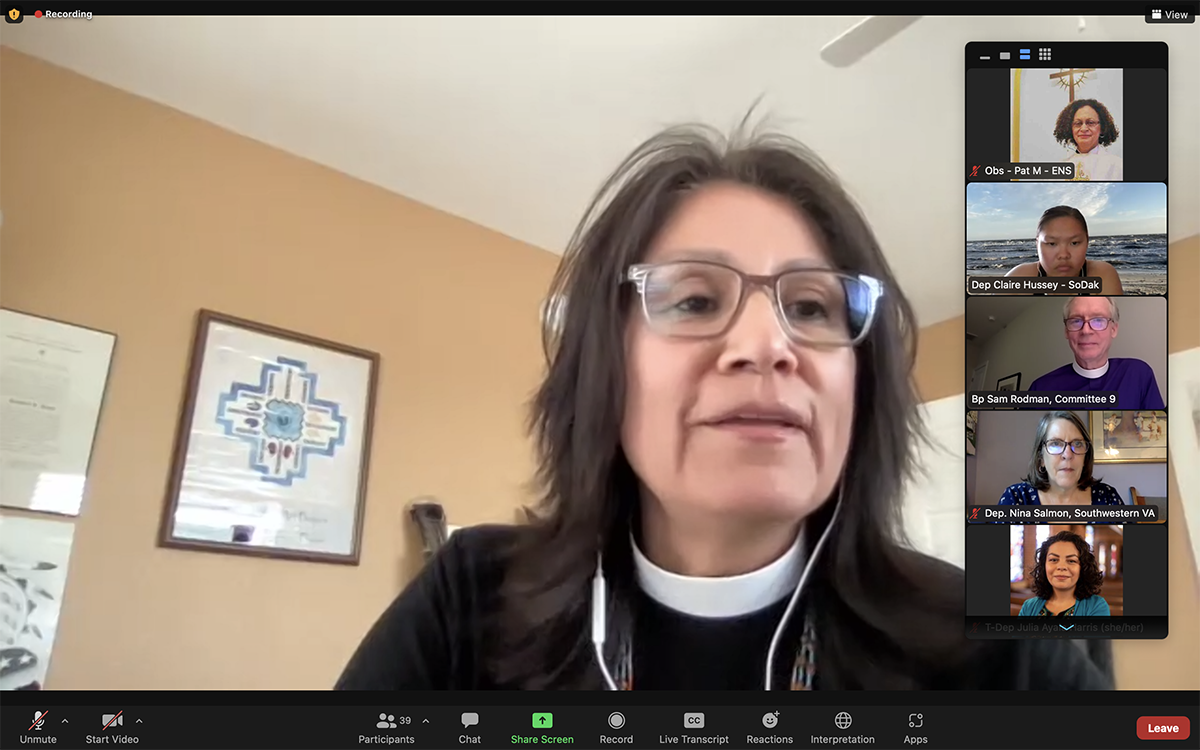
The Rev. Nina Salmon, Southwest Virginia deputy and committee secretary, sparked lively discussion when she asked if the term “BIPOC” or Black, Indigenous and people of color was a preferable term.
The Rev. Leon Sampson, a deputy from Navajoland Area Mission, and others told the meeting that BIPOC leaves out references to Latino and Asian Americans and is considered offensive. “I feel like it takes away from the uniqueness of our history. It takes away from the historical racial ideology that has happened.”
New York Deputy Diane Pollard, a member of Executive Council, said she found the acronym offensive and exclusionary. “So many of us, who do this work have been working so long to be inclusive. Reducing everyone to five letters for the convenience of society to me, there is something very wrong about that.”
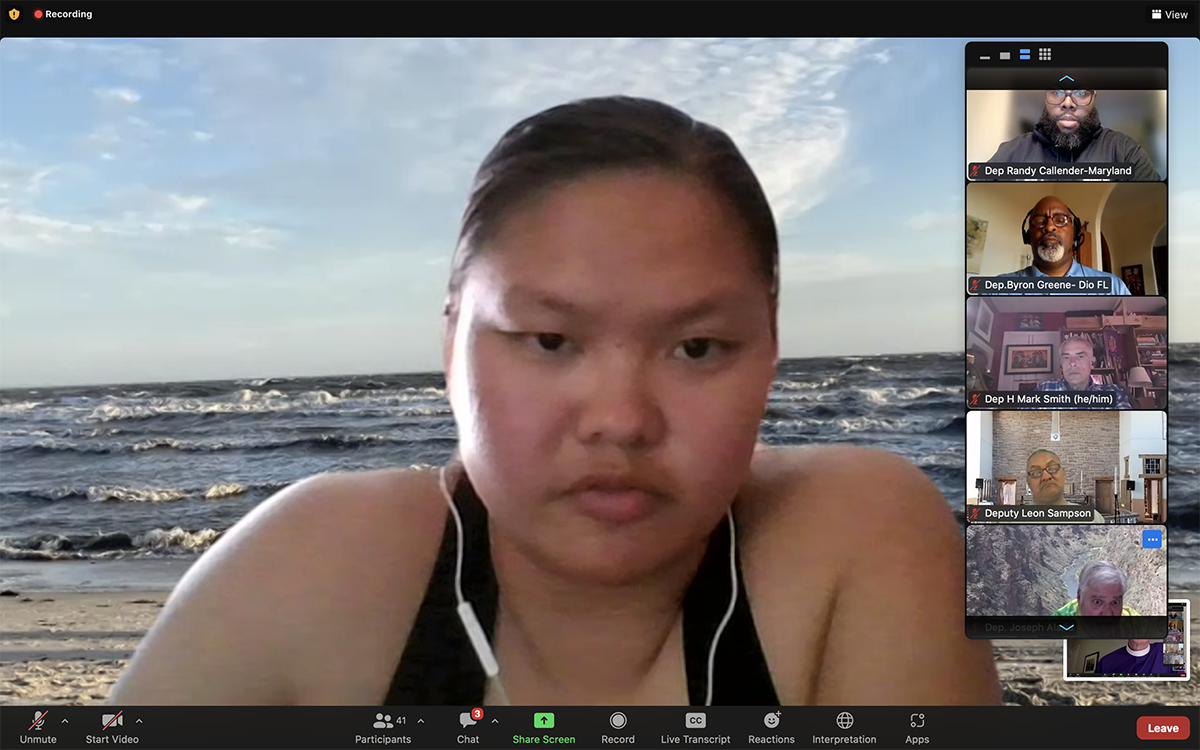
South Dakota Deputy Claire Hussey testified to her dislike of the acronym BIPOC.
South Dakota Deputy Claire Hussey, the assistant committee secretary, said: “As a young adult, an Asian American, I don’t really appreciate the term BIPOC. That makes it seem like if you are Black, or if you are Indigenous, you are somehow separate from people of color. Then you’re lumping in people like Latina, Latinx, Asian American, anyone else that is not identifying themselves as white into the separate category that’s not as important to recognize as Black or Indigenous. If we switch over to ‘people of color’ … that makes it sound like we’re all people that are not in that racial majority. And I think that inclusivity is important because it puts all of those ethnicities and a sort of united understanding that no, none of us, are truly in that racial majority.”
–The Rev. Pat McCaughan is a correspondent for Episcopal News Service, based in Los Angeles.
Church of the Redeemer
Welcome to Church of the Redeemer: Worshiping God, living in community, and reaching out to the world. We are an Episcopal Church serving north King County and south Snohomish County, Washington. As you travel your road, go with friends walking the way of Jesus at Redeemer.
Church of the Redeemer is at 6220 Northeast 181st Street in Kenmore, Washington. We are a short distance north of Bothell Way, near the Burke-Gilman Trail. The entrance looks like a gravel driveway. The campus is larger on the inside than it is on the outside. And we managed to hide a large building on the side of a hill that is not easily seen from the street.
Three years after launching Sacred Ground, a dialogue series on race, racism, and whiteness with more than 20,000 participants thus far, The Episcopal Church’s Racial Reconciliation and Justice Team is releasing a comprehensive evaluation report, updated curriculum and resources, and expanded licensing that invites people in other denominations/faiths to start their own Sacred Ground circles.
“Everywhere I travel, people are bursting to tell me about the transformational impact Sacred Ground has had in their lives,” said Episcopal Church Presiding Bishop Michael Curry. “The Lord is building Beloved Community through this movement, and in its updated and expanded form, Sacred Ground will help many thousands more take the next steps in the lifelong work of racial healing.”
Take action on racial justice, not just preach about it
In partnership with the Union of Black Episcopalians, Sacred Ground worked with Christina Pacheco of Indígena Consulting Inc. in 2021 to conduct surveys and focus groups with more than 2,900 participants, facilitators, and organizers of the film- and readings-based series that includes circle groups throughout the U.S. (84 dioceses were represented among survey respondents).
The resulting 63-page report is designed to help Sacred Ground facilitators, organizers, and churchwide staff discover what they can do to create the best outcomes for circles. It includes a detailed breakdown of questions and results, charts, graphs, and numerous quotes from respondents.
Among other findings, the survey showed overwhelmingly that Sacred Ground has had a powerful impact on participants’ knowledge, attitudes, and emotional capacity. It has prompted action such as initiating “racial reckoning” conversations in one’s family, supporting Black businesses, holding listening sessions with Indigenous people, and joining county-level policing accountability projects. The survey also reflected a desire for more guidance in this area.
“It has helped us take action on racial justice, not just preach about it,” a Sacred Ground organizer is quoted as saying in the evaluation report.
While the program was especially designed to help White people talk with each other about race, the survey showed that participants of color also found the experience valuable for their own learning and transformation.
Updates to Sacred Ground
These and other survey results—as well as a curriculum review by volunteers, consultants, and advisors—informed changes, updates, and additions to the Sacred Ground program that include the following:
A list of best practices for organizing and facilitating Sacred Ground circles, including a recommendation for more interracial circles.
“We Bless You,” a 22-minute invitational video produced collaboratively with the Union of Black Episcopalians that speaks to those discerning whether to participate in a circle, and whether to form a White or interracial circle.
A revised session 10 and new session 11 to help address the desire for help in moving from reflection to action.
Curriculum additions, such as some related to the history of Indigenous boarding schools.
Higher visibility of theological reflections in the program.
Deeper Dive, a list of supplementary videos and readings for those who want to go further in their learning and exploration.
In addition to the updated curriculum, Sacred Ground’s three-year licenses for videos and readings have been renewed, with an expansion for other local-level faith groups that would like to offer the program without direct Episcopal Church involvement.
One Sacred Ground facilitator is quoted in the report as saying: “Thank you. However painful it is to see what our country has done wrong, I am glad to have become informed of the truth. I hope everyone can have access to this program.”
Sacred Ground is a film- and readings-based dialogue series on race, grounded in faith. Small groups are invited to walk through chapters of America’s history of race and racism, while weaving in threads of family story, economic class, and political and regional identity.
The 11-part series is built around a powerful online curriculum of documentary films and readings that focus on Indigenous, Black, Latino, and Asian/Pacific American histories as they intersect with European American histories.
Sacred Ground is part of Becoming Beloved Community, The Episcopal Church’s long-term commitment to racial healing, reconciliation, and justice in our personal lives, our ministries, and our society. This series is open to all, and especially designed to help white people talk with other white people. Participants are invited to peel away the layers that have contributed to the challenges and divides of the present day – all while grounded in our call to faith, hope and love.
Public Affairs Office of the Episcopal Church
The Public Affairs Office provides statistics, biographies, photos, background information, and other resources to media representatives reporting on the mission and ministries of The Episcopal Church.
Welcome to Church of the Redeemer: Worshiping God, living in community, and reaching out to the world. We are an Episcopal Church serving north King County and south Snohomish County, Washington. As you travel your road, go with friends walking the way of Jesus at Redeemer.
Church of the Redeemer is at 6220 Northeast 181st Street in Kenmore, Washington. We are a short distance north of Bothell Way, near the Burke-Gilman Trail. The entrance looks like a gravel driveway. The campus is larger on the inside than it is on the outside. And we managed to hide a large building on the side of a hill that is not easily seen from the street.
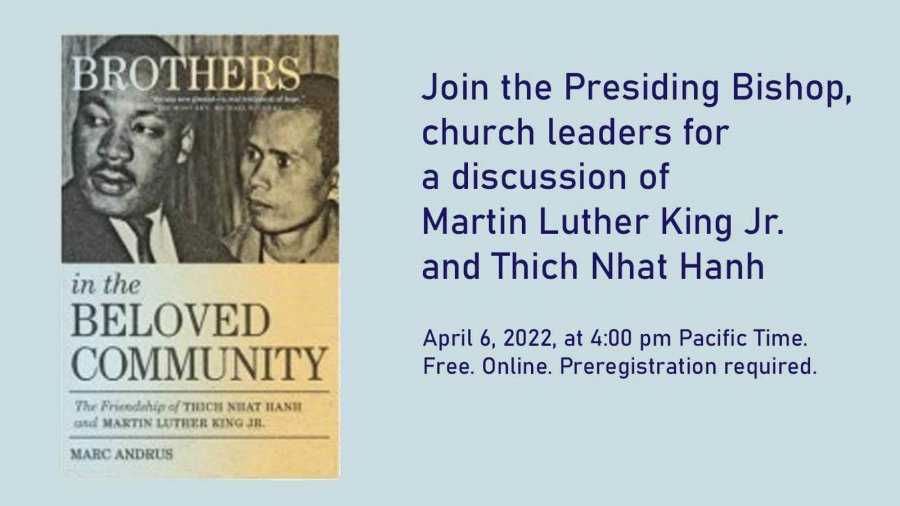
Episcopal Church Presiding Bishop Michael Curry joins other church leaders April 6, 2022, for an online discussion of the friendship between the Rev. Martin Luther King Jr. and Vietnamese monk Thich Nhat Hanh. Registration is free for Brothers in the Beloved Community, with an option to donate.
Hosted by Washington National Cathedral, Brothers in the Beloved Community starts at 4 pm Pacific Time on Zoom. The basis of this discussion is on a book of the same name by Bishop Marc Andrus of the Episcopal Diocese of California. The discussion explores the relationship between the two men and their efforts to resist harmful forces still at work today.
In addition to Curry and Andrus, speakers at Brothers in the Beloved Community include the following:
Bishop Mariann Budde of the Episcopal Diocese of Washington, D.C.
The Rev. Paul Smith, a civil rights veteran, minister, educator, and author.
Cathedral Dean Randy Hollerith moderates the discussion.
Several years before King’s death in 1968, Hanh wrote King an open letter. It was part of an effort to raise awareness and bring peace in Vietnam. As a result, the men met and—despite coming from different religions and cultures, as well as warring countries—developed a deep friendship as they worked together for peace.
In 1967 King nominated Hanh for the Nobel Peace Prize. He wrote, “Thich Nhat Hanh is a holy man, for he is humble and devout. He is a scholar of immense intellectual capacity. His ideas for peace, if applied, would build a monument to ecumenism, to world brotherhood, to humanity.”
Registrants will be sent information with a Zoom link on April 6.
Presiding Bishop Michael Curry
Being a Christian is not essentially about joining a church or being a nice person, but about following in the footsteps of Jesus, taking his teachings seriously, letting his Spirit take the lead in our lives, and in so doing helping to change the world from our nightmare into God’s dream.
―Michael Curry, Crazy Christians: A Call to Follow Jesus
The Most Rev. Michael Bruce Curry is Presiding Bishop and Primate of The Episcopal Church. He is the Chief Pastor and serves as President and Chief Executive Officer, and as Chair of the Executive Council of the Episcopal Church.
Presiding Bishop Curry was installed as the 27th Presiding Bishop and Primate of The Episcopal Church on November 1, 2015. He was elected to a nine-year term and confirmed at the 78th General Convention of The Episcopal Church in Salt Lake City, Utah, on June 27, 2015.
Church of the Redeemer: Worshiping God, living in community, and reaching out to the world around us. We are an Episcopal Church serving north King County and south Snohomish County, Washington. As you travel your road, go with friends walking the way of Jesus at Redeemer.
Church of the Redeemer is at 6220 Northeast 181st Street in Kenmore, Washington. The campus is a short distance north of Bothell Way, near the Burke-Gilman Trail. The entrance looks like a gravel driveway. The campus is larger on the inside than it is on the outside. And we managed to hide a large building on the side of a hill that is not easily seen from the street.
In this fifth episode of season 4 of Prophetic Voices: Preaching and Teaching Beloved Community, we speak with Episcopalians committed to the Beloved Community about the texts for the Easter Vigil. The texts covered in this episode are Exodus 14:10-31, 15:20-21, and Luke 24:1-12. Our guests this week are:
The energetic Nick Gordon, the United Thank Offering‘s Julia Chester Emery intern working with the Reconciliation, Justice, and Creation Care team. He is a college student attending New York University and is a Vestry and altar guild member at St. John’s in the Village Church in New York City. He is also a current member of the Diocese of New York’s Committee to Elect a Bishop and Antiracism Committee.
The Rev. Lydia Simmons, from Lead, South Dakota, missioner for Camp and Young Adult Ministries for the Diocese of South Dakota and rector of Christ Church Episcopal in Lead. Her labradoodle puppy, Luna, loves to contribute to all aspects of her ministry, including in the background of most conversations!
Prophetic Voices is hosted by the Rev. Isaiah “Shaneequa” Brokenleg, The Episcopal Church’s staff officer for Racial Reconciliation. For more information visit Becoming Beloved Community.
Find the episode online or wherever you listen to podcasts.
Prophetic Voices: Preaching and Teaching Beloved Community
Across our church and our society, we are having profound dialogues about race, truth, justice, and healing. Coming this Advent, Prophetic Voices: Preaching and Teaching Beloved Community explores where that dialogue intersects with our faith. Join us and our invited guests as we share prophetic voices and explore the readings for each week of Advent and Christmas Day through the lens of social justice.
You’ll hear ancient texts interpreted in new ways, find fodder for preaching and teaching, and make present day connections to the prophetic voices of the Bible. This podcast will help us rethink how we hear, see, and interact with the lectionary readings, refocusing from the rush of the Christmas season to the voice crying out in the wilderness.
Welcome to Church of the Redeemer: Worshiping God, living in community, and reaching out to the world. We are an Episcopal Church serving north King County and south Snohomish County, Washington. As you travel your road, go with friends walking the way of Jesus at Redeemer.
Church of the Redeemer is at 6220 Northeast 181st Street in Kenmore, Washington. We are a short distance north of Bothell Way, near the Burke-Gilman Trail. The entrance looks like a gravel driveway. The campus is larger on the inside than it is on the outside. And we managed to hide a large building on the side of a hill that is not easily seen from the street.
Funeral for the Rev. Canon John Fergueson, Saturday, March 2, 2026, at 10:00 am in Church of the Redeemer. Additional parking available at The Vine Church across 181st Street from Redeemer.
The 6th Sunday of Easter (Year A), May 10, 2026. Services at 8:00 am (no music) and 10:30 (music). Xristos Kuxwoo-digoot! Xegaa-kux Kuxwoo-digoot!