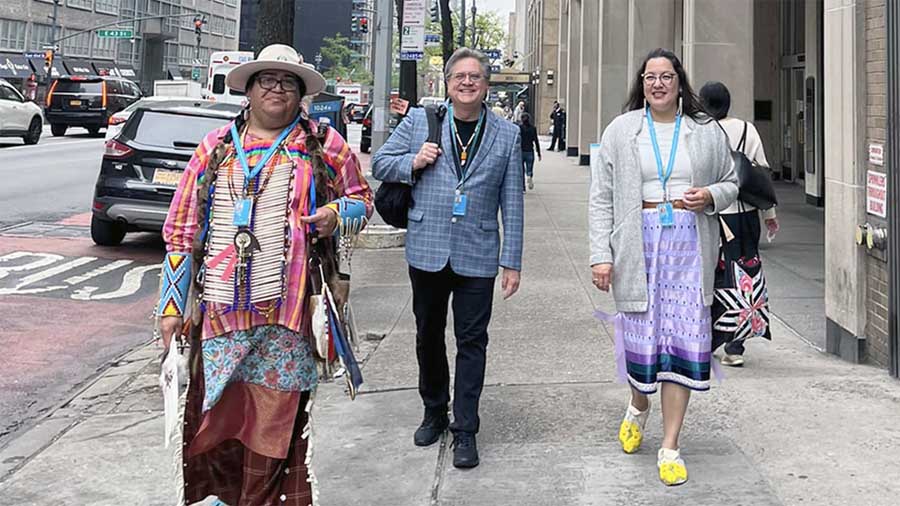
[Episcopal News Service] The March 30 statement by Pope Francis repudiating the “Doctrine of Discovery” had a major impact on the three people who represented The Episcopal Church at the 22nd session of the United Nations Permanent Forum on Indigenous Issues that met April 17-28, 2023, in New York City.
The Roman Catholic Church was the last major Christian denomination to repudiate the doctrine, making the pope’s statement “a significant advancement,” said the Rev. Brad Hauff, the Episcopal Church’s missioner for Indigenous ministries and a member of the Oglala Lakota tribe.
Previously, addressing the doctrine’s negative impacts was harder when “over 50% of the world’s Christians were not on board with it,” he said.
The Episcopal Church led the way as the first Christian body to repudiate the Doctrine of Discovery through an act of General Convention in 2009.
Monarchs and nation-states used the doctrine, which dates to 15th-century papal statements, called “bulls,” as justification for the subjugation of Indigenous peoples in Africa, Asia, New Zealand, and the Americas. In the United States, this included forced removal of tribes from their ancestral homelands to reservations, massacres and removing children from their families to attend residential boarding schools designed to erase their culture.
During each of the annual U.N. forum meetings Hauff has attended, there has been a commonality of issues, no matter where delegates lived, that resulted from colonization that was justified by the Doctrine of Discovery, he said.
Hauff was joined by two other two delegates – Melissa Chapman Skinner, Standing Rock Sioux from the Diocese of South Dakota and Ronald Braman, Eastern Shoshone from the Diocese of Idaho – who had the chance to provide statements, called interventions in U.N. language, addressing the doctrine.
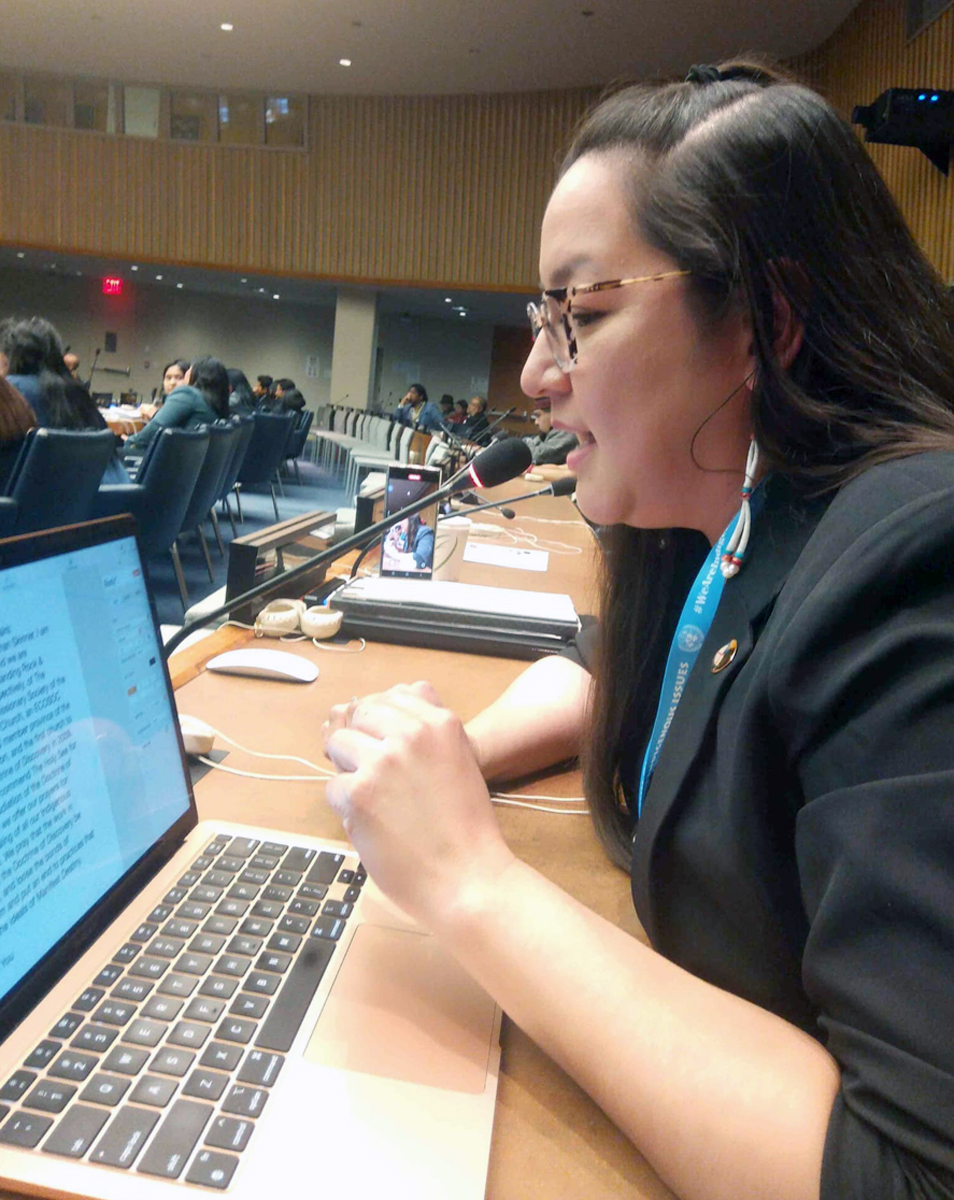
Skinner made brief remarks on April 24, and Braman, reflecting on the forum’s theme this year – Indigenous peoples, human health, planetary and territorial health and climate change: a rights-based approach – made a statement on April 28 describing how the legacy of boarding schools continues to harm Indigenous people in Canada and the United States. The trauma tribal elders experienced in those schools is being passed on to their descendants today, resulting in poverty, violence and substance abuse, he said.
The Permanent Forum on Indigenous Issues was formed by U.N. resolution in 2000 to focus on issues related to economic and social development, culture, the environment, education, health and human rights. Its first meeting took place in 2002. It has continued to offer opportunities each year for Indigenous peoples to provide expert advice to global leaders through the U.N.’s Economic and Social Council, or ECOSOC, and to inform U.N. agencies working on a variety of international issues, from human rights to the environment. The Episcopal Church is an ECOSOC-accredited nongovernmental organization, which means delegates are permitted to offer statements.
Skinner and Braman, who were serving as delegates for the fifth time, told ENS in a joint interview they were aware they brought to the event both their Christian and their Indigenous identities. “I have to walk carefully between them,” Braman said, but he noted that holding that tension allows him to serve as a bridge-builder between faith communities and those harmed by churches. He joked that as people got to know him and Skinner over the course of the meeting, they’d be greeted warmly as “the church people.”
In addition to general sessions, member states and nongovernmental organizations offered side events, where smaller groups could engage on a variety of topics. Hauff called these events “the meat and potatoes” of the forum. The Episcopal Church offered one such side event on April 21. Forum participants were invited to a multi-faith worship service at the Chapel of Christ the Lord at the Episcopal Church Center, followed by lunch and a panel discussion, which also was livestreamed, entitled “The Church and Indigenous Boarding Schools: A Time of Reckoning and Looking to the Future.”
Skinner and Braman both said they were thankful The Episcopal Church provided support so they could participate during both weeks of the event (Hauff was present for the first week). For the forum’s opening session, many people wore traditional dress, which Braman called “an important representation of Indigenous identities.” Speakers included U.N. Secretary-General António Guterres and U.S. Secretary of the Interior Deb Haaland, a member of the Pueblo of Laguna and the first Native American to serve as a cabinet secretary. Skinner said that seeing Haaland was a highlight of the event for her.
Having served four times as an Episcopal Church delegate to the U.N. Commission on the Status of Women, Skinner said she knows the importance of sharing what she learned with people back home, and she and Braman both said they plan to host community events to share their experience. Not enough people across The Episcopal Church know about the Doctrine of Discovery, and Braman wants to help change that. “There is much work to be done,” he said.
—Melodie Woerman is a freelance writer and former director of communications for the Diocese of Kansas.

Church of the Redeemer
Church of the Redeemer: Worshiping God, living in community, and reaching out to the world around us. We are an Episcopal Church serving north King County and south Snohomish County. We welcome you be with us as we walk the way of Jesus.
Church of the Redeemer is at 6220 Northeast 181st Street in Kenmore, Washington. We are a short distance north of Bothell Way, near the Burke-Gilman Trail. The entrance looks like a gravel driveway. The campus is larger on the inside than it is on the outside. And we managed to hide a large building on the side of a hill that is not easily seen from the street.
The Episcopal Church welcomes you.