Tag: pastoral letter

  • Pastoral Letter for Trinity Sunday

    Pastoral Letter for Trinity Sunday

    Greetings to you in the name of the holy and undivided Trinity, one God.

    On this day we gather to reflect on that which makes us distinctly Christian in our theology and practice: the belief that God exists in community. That God is in relationship within God’s self. Additionally, we believe that the relationship within the Triune God existed before taking any action which brought about the cosmos. God chose to engage in creation so that God could breathe forth new relationships with the whole of creation—from the furthest galaxies of deep space to the microorganisms on the ocean floor. Even more, God formed humanity in God’s own image.

    I believe that image centers on our being connected too. As those who bear the imago dei— the image of God—we are called to be in relationship with God, one another, and the natural world. Relationships define both our humanity and the God whom we worship and serve. Jesus—the living Word made flesh—showed us this directly in how he lived among us, constantly deepening connections with others through his ministry, actions, and prayer.

    The predominant culture of western industrialized countries, and especially our own, focuses on the individual above the collective whole. It is easy to succumb to the siren call that our individual needs and desires always take precedence over the needs and desires of others. That as long as we and ours are taken care of, what happens to others is of little or no concern.

    This is antithetical to the way of Jesus. It is anti-Christ.

    This past weekend, our current political administration announced a new policy that all those seeking green cards must leave the U.S. and apply from their home countries to do so. As reported, this policy—and many others that have preceded it in relation to immigrants, asylum seekers, and resident aliens—will separate families: spouses from each other, parents from children. With no regard for relationships or familial bonds, this administration seeks to further contempt for the other—that is, those who are not a part of the dominant culture or who are minorities of any kind—which has become one of the defining aspects of this administration. 

    This new policy, like the others before it, will greatly impact people within our Diocese. Amongst our clergy and lay members are those who have come to the United States desiring a better life and those who fled atrocities in their home countries, who are in the process of receiving permanent residency and citizenship. If this policy is enacted as described—a significant departure from previous immigration policies—it will rip congregations, communities, and families apart. We are reminded by St. Paul in Scripture that we are all the Body of Christ and that we need each member in order to function. We are in relationship with one another in order to be Christ’s presence in the world. 

    I entreat you in the name of the holy and undivided Trinity to respond. First, through prayer and contemplation. It is only in stillness and time connected with the Almighty that we ourselves can be changed and strengthened and then, as a result, take responsible action. The practice of contemplative prayer grounds our faith in relationship with the God who created us, and, as we’ve seen again and again, it has the power to change both us and our world.

    Second, stay connected with others, especially those who are impacted by these decisions. Many of these are fearful, filled with uncertainty, and feeling alone. We must not fall prey to the belief that as long as we individually are fine, it really doesn’t matter. We are called to be our siblings’ keepers, to attend to their needs, and to stay in relationship with them. There are a myriad of ways to do this, and I encourage you to intentionally make space in your lives and worship communities to do so.

    Finally, we must always respect the dignity of every human being. Whether we agree with a person’s positions or not, we must never degrade others, because all of us bear the image of God. All of us have been created to be in relationship with each other. Jesus commanded his followers to love those they perceived to be their enemies and to pray for them. I would encourage us to be in relationship and conversation with all our neighbors, breaking down those walls that divide us. We will be known as Christ’s followers through our love and care for all people.

    Beloved, stay in relationship with God, each other, and this amazing world of ours; this is the reason God created us. No matter what happens in our nation or our world, as disciples of Jesus, our call is to faithfully remain connected through love and hope and peace.

    May the Holy eternal Majesty, the Holy incarnate Word, and the Holy abiding Spirit, bless you now and in the days ahead.

    The Rt. Rev. Phil LaBelle
    Bishop Diocesan
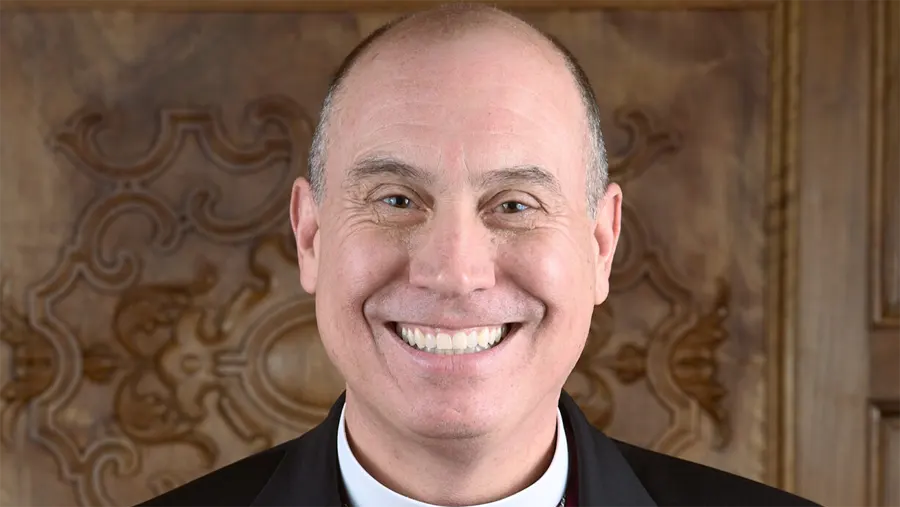
    The Right Reverend Phillip LaBelle

    Bishop Philip LaBelle

    The Rt. Rev. Philip N. LaBelle is the Ninth Bishop in the Episcopal Diocese of Olympia. The Diocese elected Bishop LaBelle on May 18, 2024. His Consecration and Ordination as bishop was on September 14, 2024.

    Bishop LaBelle previously served as rector of St. Mark’s Church in Southborough, Massachusetts. During his time in the Diocese of Massachusetts, Bishop LaBelle did the following:

    • Co-led the Mission Strategy Committee.
    • Served on Executive Committee and Diocesan Council
    • Directed the Fresh Start program.

    He co-founded Southborough Neighbors for Peace with Dr. Safdar Medina in their small town. The organization did the following:

    • Hosted peace vigils.
    • Began a community-wide Iftar dinner during Ramadan.
    • Established an interfaith Thanksgiving service.
    • Sponsored other bridge-building events.

    Additionally, Bishop LaBelle served on the core team of Central Mass. Connections in Faith, an organization centered on fostering relationships and learning about other religious faiths through quarterly gatherings.

    The Episcopal Church of the Redeemer: Worshiping God, living in community, reaching out to the world.

    Church of the Redeemer

    Church of the Redeemer: Worshiping God, living in community, and reaching out to the world around us. We are an Episcopal Church serving north King County and south Snohomish County, Washington. As you travel your road, go with friends walking the way of Jesus at Redeemer.

    Church of the Redeemer is at 6220 Northeast 181st Street in Kenmore, Washington. The campus is a short distance north of Bothell Way, near the Burke-Gilman Trail. The entrance looks like a gravel driveway. The campus is larger on the inside than it is on the outside. And we managed to hide a large building on the side of a hill that is not easily seen from the street.

    The Episcopal Church welcomes you.
  • A pastoral word to The Episcopal Church from the March 2026 gathering of the House of Bishops

    A pastoral word to The Episcopal Church from the March 2026 gathering of the House of Bishops

    House of Bishops

    The House of Bishops is second house of the General Convention of the Episcopal Church. The House is composed of all bishops, active and retired, of the church. It meets concurrently with the House of Deputies during General Convention. It also holds meetings between conventions.

    The original definition of pastoral letter, from the Latin littera pastoral, was an official letter addressed by a bishop to all members of the diocese. Pastoral letters may be issued in the Episcopal Church by the Presiding Bishop, the House of Bishops, or any diocesan bishop. The canons require that pastoral letters of the House of Bishops and diocesan bishops be read or otherwise distributed to the people. While the canons do not define a pastoral letter, one issued by a diocesan bishop is to address “points of Christian doctrine, worship, or manners.”

    The Pastoral Letter

    Dear people of God: 

    Grace and peace to you in Jesus Christ our Lord. 

    Introduction

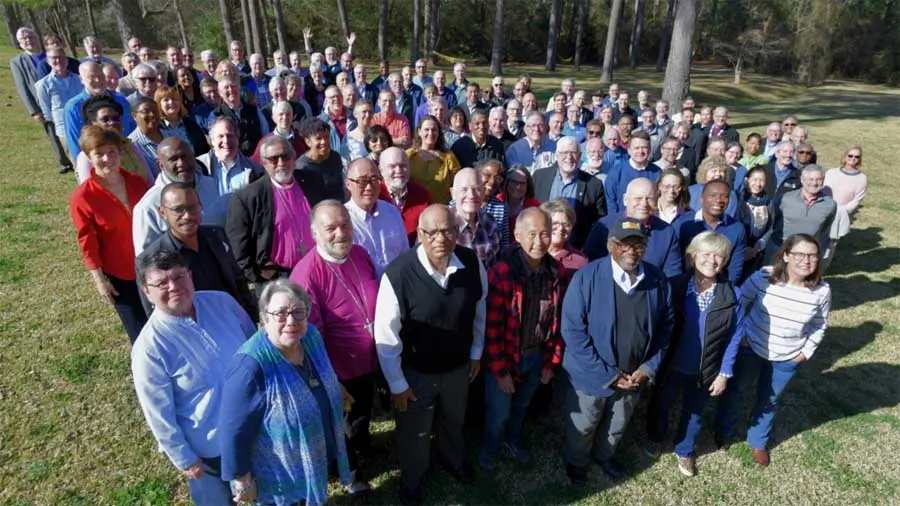
    The bishops of The Episcopal Church gathered from March 17-24 [, 2026] at Camp Allen Conference Center in Navasota, Texas. Our gathering included 122 bishops and bishops-elect, representing 89 dioceses and special ministries across 17 countries and territories. As we conclude our meeting, we give thanks for the mutual affection and fruitful collaboration we experience during our time together, and we renew our commitment to bear witness with clarity and unity to the transforming power of the Gospel.  

    Reflections from our meeting 

    Our gathering was focused primarily on the challenges and opportunities before us as a church. We welcomed 12 representatives from Episcopal seminaries and local formation programs to engage in thoughtful dialogue about the state of theological education and our need to better integrate traditional and innovative modes of discernment, recruitment, and training for future clergy and lay leaders. We explored possibilities for expanding the work of church planting and the redevelopment of existing congregations. We reflected on our relationships within the Anglican Communion, including discussion of The Nairobi-Cairo Proposals and expressed our concerns regarding the urgency to change the definitions and structures of the communion. We rejoiced in the election of the Rt. Rev. Alba Sally Sue Hernandez Garcia as primate of the Anglican Church of Mexico. Finally, we issued a courtesy resolution celebrating the installation of the Most Rev. and Rt. Hon. Dame Sarah Mullally as the 106th archbishop of Canterbury. 

    While engaged in this important work for the church, we gathered each day to pray for the church and the world. We prayed for a swift conclusion to the armed conflict with Iran; the wars in Ukraine, Sudan, and Myanmar; and all hostilities across the globe. We prayed for peace in the Holy Land, for Archbishop Hosam Naoum, the Episcopal Church in Jerusalem and the Middle East, and for all those living in the reality of violence in that region. We prayed for healing and reconciliation among the nations of the world, that there may be justice and peace on the Earth.  We prayed for those who are victims of injustice and discrimination, terror and war, and the pervasive degradation of human dignity. We prayed for strength and courage to continue the robust and tangible response in our respective dioceses to the myriad and varied challenges before us. And yet, in the face of these challenges, we are not without hope. 

    A word of hope

    We find our hope in God’s promises as made known to us in the words and actions of Jesus Christ. Christian hope is the sure and present confidence, grounded in the resurrection of Jesus, that suffering is not the end. Hope is the stubborn trust that God is not finished. Even in the shadow of the cross, God is already at work, bringing life out of death. 

    This promise of hope is central to the story of the raising of Lazarus (John 11:1-45). Jesus stands before the tomb of his friend, surrounded by grief and despair, and a community aching for his intervention. It is precisely in the moment when all hope seems lost that Jesus speaks the Word of life. There is hope because “even in death, Lazarus has access to the voice of life.” Jesus, the Word of God, commands Lazarus to “come forth,” and that same divine Word immediately calls the gathered community to “unbind him and let him go.” 

    In our present moment, in a world ravaged by war and the degradation of human dignity, Jesus is still speaking the Word of life. There is hope in this moment, because even in the face of grief, death, and despair, we have access to the voice of life—the voice of the One who calls us to participate in the Gospel mission of unbinding those who are held captive by the bonds of injustice and ensnared by the cords of corruption and oppression. We do not raise the dead; God alone does that. But we are summoned into the tender, deliberate work of unbinding, of participating in resurrection by loosening the grave clothes that still cling. 

    It is in this hope, as those who have received life and heard the voice of life, that we go forth in faith to bear witness to the resurrection, to unbind what is still bound, and to trust in Christ’s promise to make all things new.

    As we prepare to celebrate the Paschal feast, with the hope of the resurrection ever before us, may the God of hope fill us with all joy and peace in believing through the power of the Holy Spirit.

    The Episcopal Church of the Redeemer: Worshiping God, living in community, reaching out to the world.

    Church of the Redeemer

    Church of the Redeemer: Worshiping God, living in community, and reaching out to the world around us. We are an Episcopal Church serving north King County and south Snohomish County. We welcome you be with us as we walk the way of Jesus.

    Church of the Redeemer is at 6220 Northeast 181st Street in Kenmore, Washington. We are a short distance north of Bothell Way, near the Burke-Gilman Trail. The entrance looks like a gravel driveway. The campus is larger on the inside than it is on the outside. And we managed to hide a large building on the side of a hill that is not easily seen from the street.

    The Episcopal Church welcomes you.
The 2nd Sunday after Pentecost (Year A), June 7, 2026. Services at 8:00 am (no music) and 10:30 (music).