Episcopal Church of the Redeemer

Worshiping God, living in community, reaching out to the world.

Tag: sermon

  • Presiding bishop in sermon says Jesus puts the marginalized at center of his kingdom

    Presiding bishop in sermon says Jesus puts the marginalized at center of his kingdom

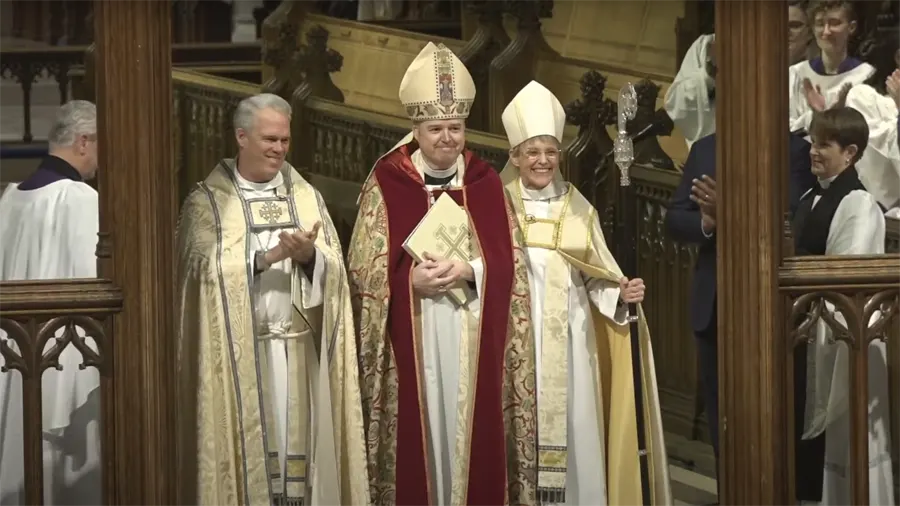
    Episcopal Church Presiding Bishop Sean Rowe preached the sermon during a February 2, 2025, Eucharist at Washington National Cathedral celebrating the Feast of the Presentation of the Lord. The service also included Bishop Rowe’s ceremonial seating, a liturgy in the Book of Occasional Services. A lightly edited transcript of the sermon—based on Luke 2:22-40—is below.

    The seating liturgy begins at around 19 minutes. The sermon starts at around 54 minutes.

    Please accept YouTube cookies to play this video. By accepting you will be accessing content from YouTube, a service provided by an external third party.

    YouTube’s privacy policy

    If you accept this notice, your choice will be saved and the page will refresh.

    The sermon by the Most Rev. Sean Rowe

    This child is destined for the falling and rising of many. Amen.

    So here we are on this feast day of the presentation. You might imagine this scene with me, a first-century temple which was chaotic, a marketplace with vendors and livestock and money changers—remember the money changers?—and all sorts and conditions of people hanging out in that place worshiping God.

    Enter Mary and Joseph, devout Jews from Nazareth. They’ve come for the purification rite and for the presentation of their child. The purification of Mary—that’s a whole other story. That’s another sermon for another day. One worthy of being preached. But in this case, we are reminded today that Jesus is born into the people of Israel, to whom Simeon’s prophecy is addressed this morning.

    It’s a noisy, unpredictable scene. They’re bringing a child into church like many who do and many of us who have experienced that. We know what that can be like. This child was coming to this place and at this time, and he was like a child like any other and like none other. Also, there were birds to be managed, and that can’t have made the situation easier, at least from my perspective.

    So into this scene, Simeon and Anna appear. We all know Simeon and Anna because Simeon and Anna are part of our lives, probably in the congregations that we attend or the places that are important to us. They’re always there. These are the people that have given their lives faithfully to the church or whatever it is. These are the people that have been around. They’re always around, they’re always there, and they’ve been old your whole life. On this day, they come to tell the stories because these are the people that tell the stories even when no one wants to hear them.

    But on this day, Simeon and Anna turned Mary and Joseph’s world upside down, and they give us a glimpse of a world very different from the one that we have been living in or the one that we are expecting. Simeon tells these two peasants from Galilee, these two faithful Jews who have come to their obligations of faith, that he can die now because he has seen the Messiah. He has seen the Savior. These words that he gives us, “Lord, you now have set your servant free to go in peace as you have promised. These eyes of mine have seen the Savior”—these are words we take and will carry us to our graves and to heaven.

    Simeon proclaims that this child is the savior of all peoples, a revelation to the world and that the division between Gentiles and Jews so powerful in the politics, in the economy of the day, have fallen away in an instant. Simeon gives them a vision of another way.

    The Scripture tells us that this mother and father were amazed at his words. Now I’m always perplexed by that. I mean, I’m sure it’s a big thing to be told your child is the savior of the world, but you think they would’ve been catching on by now, after the magi and Egypt.

    But then Simeon doesn’t stop there. He doubles down. You can’t really blame him. He’s just told God he’s ready to return to greater glory, so what does he have to lose? He says this child is destined for the falling and the rising of many in Israel—and to be a sign that will be opposed so that the inner thoughts of many will be revealed. I don’t know about you, the whole inner thoughts being revealed thing is not comforting. But this child is destined for the falling, and the rising—not the rising and the falling; the falling and the rising—of many.

    And then just in case we didn’t believe Simeon, Anna turns up, a foretaste of the women at the tomb who will be the first to proclaim that Christ has risen. She is the only woman in the New Testament to be named as a prophet, and everyone she can find in the temple that day, she’s telling that this child is the redemption of Israel.

    These two elders laid out the whole story. This child is destined for the falling and rising. Luke is writing this Gospel after the fall of the temple, this place about which is being spoken, which has been destroyed. They are under a tyranny, in conflict. Imperial rule has deepened the oppression and the inequality of the time. And even people in the new church that has been formed aren’t getting along with each other. Surprise.

    The Messiah has not returned, the liberation and justice, it might’ve seemed a long way off. Luke is writing to people who have already experienced the falling, and he tells them that this child, this one who has come and making the offering of the poor—two turtledoves—this one, this poor child born in a backwater to peasant parents, this one will be the redemption.

    Jesus reverses everything that the readers of the Gospel of Luke have known. From now on, the cross comes before resurrection. Dying comes before the rising. The last will be first. This tiny child presented in the temple causes the falling and the rising of many.

    Today, God is still calling us to live in this upside-down world order; and like the sometimes clueless disciples who we’ll get to travel with later in the Gospels, we struggle with how to make sense of what that all means because we are beset by the powers and principalities of the world that don’t see it the way that Jesus does.

    We’re told by the kings and the rulers of the day that the rich shall be first. That somehow compassion is weakness. That fealty to political parties—and here I mean either one, or all of them—is somehow paramount. That differences of race, class, gender identity, human sexuality are all divisions that must somehow separate us, and that we should regard migrants and strangers and those among us whom we don’t understand, with fear and contempt.

    But those divisions are not of God. Those are not the divisions of a kingdom about which Jesus speaks, of a kind of reversal, the one that Simeon and Anna foretell. In that kingdom of God, the meek shall inherit the earth. The last will be first. The merciful shall receive mercy, and the captives go free.

    In this world order, falling comes before rising. In God’s kingdom, immigrants and refugees, transgender people, the poor and the marginalized are not at the edges fearful and alone. They are at the center of the Gospel story. So the boundaries are not just extended, the story just isn’t extended to include all people. Those who have been considered at the margins are at the center. They are the bearers of the salvation of the world. Their struggles reveal to us the kingdom of God.

    This kingdom about which Jesus speaks is upside down. It’s reverse. It’s inverted. It’s countercultural. It’s another way of being and living in a world.

    In this new kingdom, the power of God is manifest in parents making a modest offering for their tiny child. In the woman at the well. In the leper who comes to be healed. In the women at the tomb. These are the very people Jesus points to as icons of the holy.

    Friends, we live in a world in which the enemy is bound and determined to sow division among us, to make us forget who we are and to what kingdom we belong. God did not come among us as a strongman. God came among us first as a child.

    We too easily turn on one another, succumbing to our need to regard people as other. We’re seduced by a world that tells us our worth and our value has to come at the expense of someone else. We forget that we were once strangers in a foreign land, and we fail to love our siblings who were created by God.

    But because of this tendency to forget, we need the place to which we gather to be remembered and to remember. We need our Christian community, week in and week out. To remember whose we are, we need to hear the story of the elders like Simeon and Anna. We need to greet with a sign of peace those who voted for the candidate we couldn’t stand. And to be in the communion line alongside people who don’t live like us or look like us or even love like us. We find the face of Christ in the most vulnerable in our communities.

    The point of this institution—this magnificent cathedral of ours; our modest country churches back home; the famous Episcopal Church A-frame with the blond furniture; our office in midtown Manhattan, which I call mid-century mediocre architecture—we need these places to remind us that we are first citizens of the kingdom of God. The point of the community, particularly in these fractious times, is to turn away from the evil we have done and the evil done on our behalf. And back toward the one Jesus brought from the margins to the center, back to one another, back to the risen Christ.

    This is the kingdom of God, which Jesus proclaims. This is the one that is reversed. This is the one where the people on the edge are at the center and where we find Christ in all people.

    There’s an old preaching parable about a monastery, a very famous place, very far, remote, a place that many people used to come to for miracles and signs and wonders and healing, and most of all, for the peace of God, which passes all understanding. But it fell on hard times. People began to argue with one another, as we are wont to do, and people stopped coming after a while. They stopped getting new vocations in that place. It was no longer the vibrant place.

    And the abbot of the monastery began to worry what would happen, began to despair about the way it would be. And he decided that he had no other choice but to leave that place for a time and to go find a rabbi who used to pray as a solitary, not far from the monastery. And he went out to see the rabbi, and he sat down, and he wept. And he said, “I don’t know what to do.”

    And the rabbi just held his hands and said, “We’ll pray.” And the rabbi prayed, and he said, “I’m sorry. I have no advice to give you, but I do have this word from God for you to take back to your people. Take back to your community.” He said, “Tell your people, one of you is the Messiah. Christ is among you.”

    The abbott gets up and walks away and thinks, “OK, surely not me. And it’s not Bob.” Part of the problem. He gets back to the monastery, gathers the monks together and says to them, “I have a word from you, from the rabbi.” He said, “I could share this with you once, and we’re then to go on about our business. One of us is the Messiah. Christ is among us.”

    And they began to look at each other differently. Their frame of reference changed. What if we saw Christ in each other? What if we understood what it meant for real? That Christ is among us, one of us, all of us together in this kingdom inverted, turned upside down and made for the healing and wholeness of the world.

    Amen.
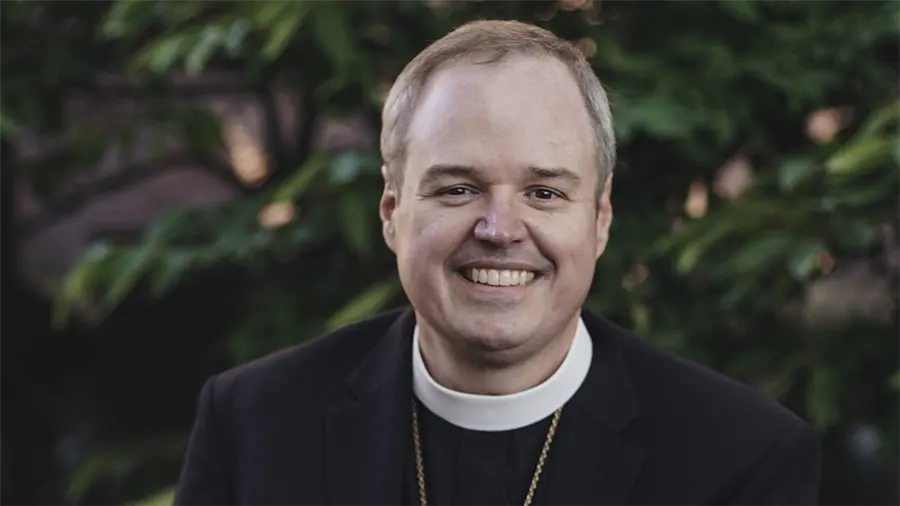
    The Most Rev. Sean Rowe, Presiding Bishop of the Episcopal Church

    Presiding Bishop Sean W. Rowe

    The Most Rev. Sean W. Rowe was elected presiding bishop and primate of The Episcopal Church in June 2024 and took office on Nov. 1 for a nine-year term. In this role, he serves as the church’s chief pastor and CEO. Known for his expertise in organizational learning and adaptive change, Rowe is committed to strengthening support for local ministry and mission.  

    He was ordained bishop of the Episcopal Diocese of Northwestern Pennsylvania in 2007 after serving as rector of St. John’s in Franklin, Pennsylvania, for seven years. From 2014 to 2018, he served as bishop provisional of the Episcopal Diocese of Bethlehem, and from 2019 to 2024, he led a partnership between the Episcopal Dioceses of Northwestern Pennsylvania and Western New York. 

    Rowe holds a bachelor’s degree in history from Grove City College, a Master of Divinity degree from Virginia Theological Seminary, and a doctorate in organizational learning and leadership from Gannon University. He has served as a leader of many civic and churchwide organizations and governance bodies, and as parliamentarian for the House of Bishops. 

    Read more about Presiding Bishop Sean Rowe.
    The Episcopal Church of the Redeemer: Worshiping God, living in community, reaching out to the world.

    Church of the Redeemer

    Church of the Redeemer: Worshiping God, living in community, and reaching out to the world around us. We are an Episcopal Church serving north King County and south Snohomish County. We welcome you be with us as we walk the way of Jesus.

    Church of the Redeemer is at 6220 Northeast 181st Street in Kenmore, Washington. We are a short distance north of Bothell Way, near the Burke-Gilman Trail. The entrance looks like a gravel driveway. The campus is larger on the inside than it is on the outside. And we managed to hide a large building on the side of a hill that is not easily seen from the street.

    The Episcopal Church welcomes you.
  • Listen to each General Convention 80 sermon

    Listen to each General Convention 80 sermon

    There were four sermons during the 80th General Convention of the Episcopal Church. Because of COVID-19 concerns, each sermon was prerecorded and played to each House separately during worship.

    Julia Ayala Harris, President-elect of the House of Deputies

    President-elect Julia Ayala Harris of the House of Deputies preached this sermon on Monday, July 11, 2022. When Convention ended, she became the President of the House of Deputies. This term ends in 2024, when she can run for reelection.


    The Rt. Rev. Eugene Sutton, Bishop of Maryland

    The Rt. Rev. Eugene Sutton, Bishop of Maryland preached this sermon on Sunday, July 10, 2022.


    The Rev. Gay Clark Jennings, President of the House of Deputies

    The Rev. Gay Clark Jennings, President of the House of Deputies, preached this sermon on Saturday, July 9, 2022. Her third and final term as President ended as Convention ended.


    The Most Rev. Michael Curry, Presiding Bishop and Primate of the Episcopal Church 

    The Most Rev. Michael Curry, Presiding Bishop and Primate of the Episcopal Church, preached this sermon on Friday, July 8, 2022, to open the Convention. His term ends at the end of the next General Convention in 2024.

     
    General Convention of the Episcopal Church

    What happens at General Convention?

    The legislative process of General Convention is an expression of The Episcopal Church’s belief that, under God, the Church is ordered and governed by its people: laity, deacons, priests, and bishops.

    The General Convention is the Church’s highest temporal authority. As such, it has the following power:

    • Amend the Constitution and Canons of the Episcopal Church
    • Amend the Book of Common Prayer and to authorize other liturgical texts
    • Adopt the budget for the Church
    • Create covenants and official relationships with other branches of the Church
    • Determine requirements for its clergy and other leaders
    • Elect its officers, members of the Executive Council, and certain other groups
    • Delegate responsibilities to the Interim Bodies of The Episcopal Church
    • Carry out various other responsibilities and authority
    The Episcopal Church of the Redeemer: Worshiping God, living in community, reaching out to the world.

    Church of the Redeemer

    Church of the Redeemer: Worshiping God, living in community, and reaching out to the world around us. We are an Episcopal Church serving north King County and south Snohomish County. We welcome you be with us as we walk the way of Jesus.

    Church of the Redeemer is at 6220 Northeast 181st Street in Kenmore, Washington. We are a short distance north of Bothell Way, near the Burke-Gilman Trail. The entrance looks like a gravel driveway. The campus is larger on the inside than it is on the outside. And we managed to hide a large building on the side of a hill that is not easily seen from the street.

    The Episcopal Church welcomes you.
  • Sermon on the Feast of the Baptism of Jesus (January 10, 2021)

    Sermon on the Feast of the Baptism of Jesus (January 10, 2021)

    This is a transcription of the sermon on the First Sunday after the Epiphany: the Baptism of Jesus, January 10, 2021, at Church of the Redeemer in Kenmore, Washington by the Reverend Jed Fox.

    The Rev. Jed Fox: In the name of the Father and the Son of the Holy Spirit. Amen.

    Watching events unfold on Wednesday on Twitter–because I’m a millennial–as well as on the radio and other news sources, I was struck by the fact that it was, in fact, the Feast of the Epiphany on Wednesday: the proclamation to the world that Jesus is King and God and Sacrifice made by the Wise Ones who were directed to him by Herod. Because it didn’t seem like Epiphany. Seemed more like the subsequent events that happen in Matthew’s Gospel after the Epiphany, the events that we remember on the 28th of December, which we euphemistically call the “Feast of the Holy Innocents,” when a mad tyrant, desperate to keep his throne, puts to death an entire town’s worth of toddlers. For fear.

    For many of us, it was the first time. The first time that we had ever experienced something like this. Now, I am of a generation that in my lifetime remembers the Oklahoma City bombing, 9/11, two subsequent wars, and now this. But this was different. This seemed different. And for many of us, it was seemed different because it was the first time.

    There’s the first time that we felt like we should be scared of our fellow Americans. The first time that everything, even all those neoclassical, marble buildings over there and the other Washington, everything felt unstable, felt chaotic. It felt, in fact, like the description that the Book of Genesis starts with, the deep. It felt, feels like we have been dumped into the deep end of some dark murky water that we cannot surface from.

    That’s what it felt like on Wednesday. And we’re desperately trying to cling on to anything that will let us come up to the surface and just breathe.

    It’s not a surprise generally that Hebrew scripture would describe chaos with the metaphor of deep water. The people who comprised the writers of the Hebrew scripture, who we know as the people of Israel, were desperately afraid of the ocean. They were not boat people. They didn’t like the ocean. They preferred the hill country.

    Now they’re mountain folk, hill folk, and to them, water was terrifying, but also transformational. Water changed things. You go to first century ruins in what is now considered the Holy land. You’ll see these big six foot deep stone pools. And you think, oh, that must’ve been, this must be a rich part of town. They had an in-ground pool.

    No, they were called mikvahs and they were filled with water for the use of the community for the ritual purification, by dunking yourself in water. So in the morning, if you needed to ritually purify yourself, which most observant Jews usually did, you, you went and dunked yourself in the mikvah. There were stairs down. You dunked your whole body in. You came back out and you went on with your day ritually pure, although probably very cold. You were transformed from uncleanness to cleanness through water.

    And Jesus at his baptism does something that is not terribly remarkable in going to John in the Jordan to be baptized. It is a more fundamental transformation, a more marked transformation than that what happens in a mikvah, but still within that realm of possibility. Still the same, still the acknowledgement that in this one, sacred act, this infinitesimal, sacred moment of time, all time has changed. All life is changed. All water has changed. Because that’s the thing. It is the holiness of that simple act that sanctifies everything.

    The holiness of a little sanctifying the whole.

    That’s especially true of water because water has been, yes, chaotic, yes, transformational, but always, always, always life giving. We cannot live without water. As became so famous a few years ago during the Dakota Access Pipeline protests, “Water is life.”

    I remember being at a workshop several years ago when an indigenous person stood up and said, “You all need to remember. Holy water is an oxymoron. All water is holy. Water is life.”

    And when we sanctified water, either in Jesus being baptized in the River Jordan and that cold wet kind-of murky river that now separates the kingdoms of Israel and Jordan, Jesus in that holy act sanctifies all water for all time, and all people for all time. You hear it in Paul saying, yes, John changed a little, but Jesus changes everything.

    The holiness of a little sanctifies the whole.

    It is tempting after the events of this week, after the events of Wednesday, to seek easy solutions, simple solutions to this one-time event. This has only happened one time. It was a one-time event. We’re right to be scared, but don’t worry. It was an isolated incident perpetrated by a few bad apples and et cetera, et cetera, et cetera.

    We’ve heard that all before. Doubtless, we will hear it again. And it is no more true now than it was before or will be afterwards. We must resist that temptation to pass it off, to try to paper over what’s really going on. We must resist the urge to numb ourselves to the simple fact that most of us are lucky enough to say that this is the first time that we have ever experienced this.

    It’s sure not true for most people.

    This is not the first United States insurrection in the United States. There’ve been plenty of them. We just don’t pay attention to them. There are several insurrections in the South at the end of Reconstruction, where mobs of angry white people change the government at their whim. Often with less people than there were at the US Capitol on Wednesday.

    The entire colonization of the, of what we know as, the United States is a slow motion insurrection by Western European people on land that was already lived on when we got here.

    The lake that we are two blocks from [at Redeemer] had a name before Lake Washington. It was just in the language we didn’t care to learn.

    This is it’s certainly not the first time that people have been afraid of their fellow citizens in this country. There are people, there are people in this country, many of them who have never felt safe with fellow citizens in this country with good reason.

    And you see that most clearly illustrated in the events of Wednesday because, when a whole mob of white insurrectionists mobbed the US Capitol, there were five deaths, five terrible deaths.

    In the protests this past summer, there were at least 10 times that many.

    You know what the difference was? The color of the people’s skin, plain and simple. We cannot let allow ourselves to become numb to this reality.

    You cannot allow ourselves to become numb to the fact that all of this is true for people all the time, that we are incredibly lucky to, to be experiencing this maybe for the first time, this level of fear, this level of uncertainty. There are brothers and sisters in faith, even in this moment, in this world, in places like Palestine who have no state to even rely on, much less one that is, that feels, unstable.

    Imagine trying to grow up country-less, without the benefits that we enjoy of driver’s license and passports and centralized government.

    We have brothers and sisters in Palestine who have none of those things. And we cannot simply try to slink back into numbness now that our eyes have been once again opened, because if we do, then we have forgotten our vows in baptism.

    Because when we sanctify a little, when we make holy a little of a thing, we make holy all of it.

    If we sanctify one person, we sanctify all of humanity. If one person is baptized, then all are worthy of it. And, if that is true, we have work to do to fulfill our baptismal covenant. And the very first thing we have to do, if we decide we are not going to go back into our numbness, slink back into our know-nothing muffled comfort, is to repent.

    Will you persevere in resisting evil? And when you fall into sin, repent and return to the Lord? Because many of us have some repenting to do, not necessarily for personal actions, although there are some that certainly do, certainly need to repent for our personal actions, but all of us have some duty to do some work in repentance for the systemic white supremacy that we allow to exist and we allow ourselves to benefit from. It cannot continue, if we are to remain honest to our baptismal covenant.

    And once we have done that, once we have repented and returned, begun to figure out how to do that work of dismantling systemic white supremacy, then we turn to seeking and serving all persons, in Christ, loving our neighbor as our self, seeking the least and the little. Those that this white supremacy system would rather see as not people, as less than, who have historically in our government been seen as property, been seen as roadblocks, been seen as inconveniences.

    And when we have figured out how to do that, we can also seek and serve the lost. Not just those lost by society, but those lost in a sea of misinformation possessed in their hearts by hate. The way to seek and serve them to love them as our neighbor is to tell them the truth, to exorcise their hearts, to assist them in exorcising their own hearts, if we can.

    Because we have been made holy in baptism, we can do no less than to remember that in our holiness all are made sacred. If we can be made sacred, then all are seen as sacred by God and must be treated so by us.

    On the Feast of the Baptism of Our Lord, it is time to do the actual work that we will recommit ourselves to in a moment, the renewal of our vows in baptism.

    Now, if you all were here, you’d all be getting wet. I want to make sure you felt, not only the joy of that baptism as you were sprinkled with holy water, but the responsibility of those vows that comes along with getting wet.

    They have not come up with baptismo-vision. Or aspurge-a-vision.

    And, so in the meantime, what you must do, please not go back to sleep, do not allow yourselves to slip into that sweet slumber of denial of numbness, pretending that everything is fine and that the problem is too big for you or me or us to do anything about.

    We can no longer abrogate our Covenant of Baptism. Instead, we must fulfill it. So that we too may hear the words that Jesus hears as he comes up out of the water this morning, “You are my child, the beloved, with you I am well pleased.”

    Amen.

    Being baptized

    For more information

    For other commentary on January 6, 2021, the Epiphany, and the Baptism of Jesus, see the following:

    Mist over the waters in the Memorial Garder

    Church of the Redeemer

    Welcome to Church of the Redeemer: Worshiping God, living in community, and reaching out to the world. We are an Episcopal Church serving north King County and south Snohomish County, Washington. As you travel your road, go with friends walking the way of Jesus at Redeemer.

    Church of the Redeemer is at 6220 Northeast 181st Street in Kenmore, Washington. The campus is a short distance north of Bothell Way, near the Burke-Gilman Trail. The entrance looks like a gravel driveway. The campus is larger on the inside than it is on the outside. And we managed to hide a large building on the side of a hill that is not easily seen from the street.

    The Episcopal Church welcomes you.
Third Sunday in Advent (Year A), December 14, 2025. Services at 8:00 am and 10:30 am. Christian education for children and adults at 9:15 am. Be patient, beloved, until the coming of the Lord.

Episcopal Church of the Redeemer
Privacy Overview

Cookie information is stored in your browser and performs functions such as recognizing you when you return to our website and helping our team to understand which pages of the website are visited. We aren't using cookies to determine your web browsing habits, but others can.