Category: Lambeth Conference

  • Indigenous Anglicans offer wisdom, heartache, challenge

    Indigenous Anglicans offer wisdom, heartache, challenge

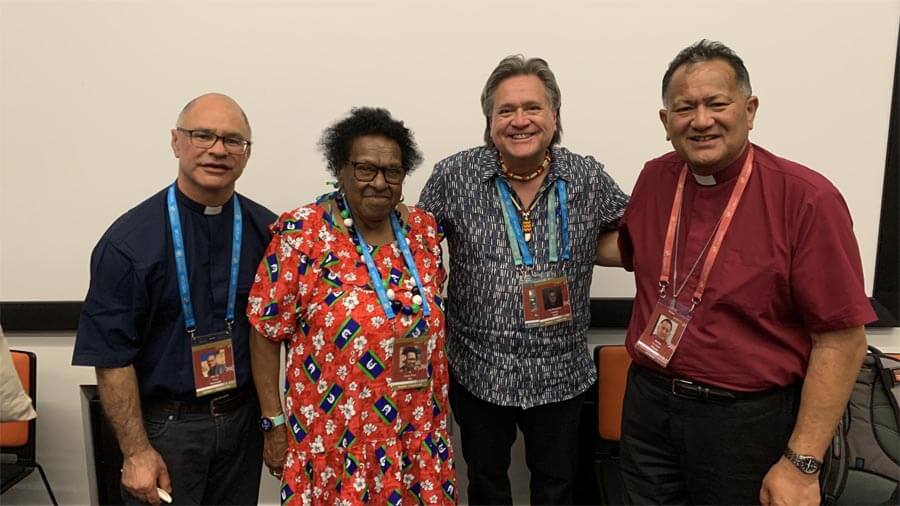
    [Episcopal News Service – Canterbury, England] Indigenous leaders from The Episcopal Church and across the Anglican Communion presented their perspectives at a Lambeth Conference seminar on August 1, 2022, describing the specific challenges they have faced in their regions but also the importance of embracing Indigenous wisdom and theology to solve problems that affect everyone.

    Members of the Anglican Indigenous Network also introduced an Indigenous encyclical they had compiled, putting the injustices they faced in a theological perspective, along with the church’s moral responsibility to address them.

    Indigenous residential schools

    The Rev. Bradley Hauff, The Episcopal Church’s missioner for Indigenous ministries, gave a presentation on residential schools in the United States and The Episcopal Church’s current efforts to learn the full extent of its involvement with them.

    Hauff showed part of a video made by his office, “Speaking to the Church and the World,” in which Indigenous Episcopalians talk about their resilience amid intergenerational trauma, especially from residential schools. Some participants had attended the schools, which separated thousands of Indigenous children in the U.S. and Canada from their families, in many cases damaging their cultural connections and subjecting them to abuse. Hauff also discussed the experience of his father in a residential school.

    The Episcopal Church, through its involvement in the U.S. government’s effort to assimilate Native Americans, operated at least nine and perhaps as many as 18 residential schools, Hauff said.

    He also presented The Episcopal Church’s ongoing efforts to address the injustices perpetrated against Indigenous peoples. The church repudiated the “doctrine of discovery,” the basis for colonizing and assimilating Indigenous peoples, in 2009, and accompanied Native protestors at Standing Rock in North Dakota in 2016. In July, approved the creation of a commission to investigate the church’s complicity in the residential school system.

    “Indigenous people in The Episcopal Church were very, very pleased that that has finally happened after all these years,” Hauff said. “There is much healing work to be done. And the process for that healing work, I’m pleased to say, is beginning.”

    Please accept YouTube cookies to play this video. By accepting you will be accessing content from YouTube, a service provided by an external third party.

    YouTube’s privacy policy

    If you accept this notice, your choice will be saved and the page will refresh.

    Climate change affecting Indigenous peoples

    The Episcopal presentation also briefly touched on the climate crisis and its unique impact on Indigenous peoples. The erasure of Indigenous cultures is intertwined with the destruction of the natural world on which they depend, said the Rev. Rachel Taber-Hamilton, newly elected vice president of the House of Deputies of The Episcopal Church, in the video. Taber-Hamilton, a member of the Shackan First Nation, is the first Indigenous person to hold the role.

    “We have Indigenous communities that are really, truly on the brink of extinction that is concurrent with species extinction,” she said.

    Other seminar participants presented their personal experiences with the impacts of climate change, including Rose Elu, a member of the Anglican Indigenous Network Steering Group from the Torres Strait Islands. The low-lying islands between Australia and Papua New Guinea are acutely affected by flooding, with seawater intruding on homes and infrastructure even on calm-weather days. Recently, she said, it has even reached one island’s cemetery.

    “People spent so much money for their loved ones to lay to rest [and] the high tide washed away the graves on the island,” she said. “People are saying, ‘God is telling us something.’ There’s so much interruptions. So much is happening in the world, on the land and on the ocean. It takes away the sustainability of our people. It takes away the freedom of our people. Now, who’s listening?”

    The time for arguing about the climate crisis is long over, she said, and urgent action is needed.

    “I don’t want to waste my time talking,” she said. “Each and every one of you is really looking at us, but I do not know how much you are capturing inside your head, how much you’re taking into your heart.

    “I hope, [though] this presentation is disheartening, that we take away something, our homework, to be able to work with it and enlarge it in the four corners of the world and bring us all together one day.”

    He Wero: Tahitahia Tō Tātou Whare

    One part of that homework may be the Indigenous encyclical that the network has developed. The document is called “He Wero: Tahitahia Tō Tātou Whare,” which means, “A Challenge: Let’s Sweep Our House.” It relates, presenters said, both to the shared duty of caring for the planet and the internal work that churches need to do on reconciling and healing from its treatment of Indigenous peoples. It includes reflections (including some from Episcopalians), Indigenous spiritual concepts and theological resources such as Biblical expositions.

    “This resource unpacks our story as Indigenous people of faith and includes a list of theological reflective questions at the end that intend to provoke thought and in discussion,” said the Rev. Paul Reynolds, secretary of the Anglican Indigenous Network.

    The Rt. Rev. Te Kitohi Pikaahu, chair of the network, said the network is asking Archbishop of Canterbury Justin Welby for his endorsement of the encyclical. Reynolds also expressed a desire for more Indigenous presence on Anglican Communion theological and liturgical bodies.

    – Egan Millard is an assistant editor and reporter for Episcopal News Service. He can be reached at emillard@episcopalchurch.org.
    Lambeth Conference: God's Church for God's World

    What is the Lambeth Conference?

    Every bishop of the Anglican Communion is invited to the Lambeth Conference, which is convened by the Most Reverend Justin Welby, The Archbishop of Canterbury. The Lambeth Conference has met since 1867, happens once-a-decade, and is a significant event in the life of the Anglican Communion.

    The conference will explore church and world affairs. Outcomes of the conference will shape the life of the Anglican Communion in the decade ahead.
    Anglican Compass Rose

    The Anglican Communion

    The Anglican Communion has no central authority figure or body. It is made up of 42 autonomous members or provinces. Each member church makes its own decisions in its own way.

    However, their decision-making bodies are guided by recommendations from each of the four so-called Instruments of Communion

    The Secretariat, also known as the Anglican Communion Office, based in London, England support Anglicans and Episcopalians worldwide to carry out any requests from the Instruments and work to enable members of the Anglican Communion to fulfil their calling to be God’s people in the world.
    The Episcopal Church of the Redeemer: Worshiping God, living in community, reaching out to the world.

    Church of the Redeemer

    Church of the Redeemer: Worshiping God, living in community, and reaching out to the world around us. We are an Episcopal Church serving north King County and south Snohomish County, Washington. As you travel your road, go with friends walking the way of Jesus at Redeemer.

    Church of the Redeemer is at 6220 Northeast 181st Street in Kenmore, Washington. The campus is a short distance north of Bothell Way, near the Burke-Gilman Trail. The entrance looks like a gravel driveway. The campus is larger on the inside than it is on the outside. And we managed to hide a large building on the side of a hill that is not easily seen from the street.

    The Episcopal Church welcomes you.

  • Pray for the Lambeth Conference: Day 8

    Pray for the Lambeth Conference: Day 8

    Thank you for praying with us for the fifteenth Lambeth Conference – which will meet in Canterbury, the United Kingdom, between 26 July– 8 August 2022.

    Through this prayer guide we hope that the prayers we share here will encourage all who use it to unite in prayer for the bishops gathered in the Lambeth Conference.

    Pray for the environment

    The church has a vital role to play in the global response to the climate crisis. The conference community will visit Lambeth Palace for a day of prayer, reflection and symbolic action on the environment and sustainable development.

    The Third Order, Society of St Francis, Province of the Americas, The Episcopal Church. Also in Caribbean and South America

    Spirit of Love, illumine our hearts and minds to discern the way forward as brothers and sisters ready and willing to respond to the desperate needs of your creation.

    We recall St. Francis who reminds us:

    All things of creation are children of the Father and thus brothers of man. God wants us to help animals if they need help. Every creature in distress has the same right to be protected.

    Help us, gentle Spirit, to have the ears to hear the cries of creation, the eyes to see the tears of creatures on the brink and the will to act to heal the suffering all around us.

    Inspire our time together, dear Lord, to find a way to rekindle the love for all Creation and embrace the care exemplified by indigenous peoples.

    Spirit of Love, keeper of life, inspire us to keep a loving vigil over the needs of creation and take such action that will truly serve to protect and preserve it. Amen

    The Community of the Sisters of the Church, Solomon Islands Province. Anglican Church of Melanesia

    Lord of the universe, you have created this beautiful world and entrusted it to our care to respect and protect it. Help us to see creation through your eyes that we may see your beauty, goodness and the wonder that surrounds us. Lord, we have fallen short of your glory and have polluted the blue ocean that reflects your unending love and disrespected the inhabitants that dwell there. We have not recognized that our lives and survival depend very much on the respect and care we show your creation. You came to set us free from bondage so help us to care for our mother earth that feeds us daily. Protect us from over-harvesting our natural resources and deforesting the natural beauty of the forest. Increase our love for you so that we may be able to educate our younger generation to care and protect this fragile environment. May the people living in these islands grow in their love and knowledge of you through appreciating the environment they depend upon; through Jesus Christ our Lord. Amen

    What is the Lambeth Conference?

    Every bishop of the Anglican Communion is invited to the Lambeth Conference, which is convened by the Most Reverend Justin Welby, The Archbishop of Canterbury. The Lambeth Conference has met since 1867, happens once-a-decade, and is a significant event in the life of the Anglican Communion.

    The conference will explore church and world affairs. Outcomes of the conference will shape the life of the Anglican Communion in the decade ahead.

    Anglican Compass Rose

    The Anglican Communion

    The Anglican Communion has no central authority figure or body. It is made up of 42 autonomous members or provinces. Each member church makes its own decisions in its own way.

    However, their decision-making bodies are guided by recommendations from each of the four so-called Instruments of Communion

    The Secretariat, also known as the Anglican Communion Office, based in London, England support Anglicans and Episcopalians worldwide to carry out any requests from the Instruments and work to enable members of the Anglican Communion to fulfil their calling to be God’s people in the world.

    The Episcopal Church of the Redeemer: Worshiping God, living in community, reaching out to the world.

    Church of the Redeemer

    Church of the Redeemer: Worshiping God, living in community, and reaching out to the world around us. We are an Episcopal Church serving north King County and south Snohomish County, Washington. As you travel your road, go with friends walking the way of Jesus at Redeemer.

    Church of the Redeemer is at 6220 Northeast 181st Street in Kenmore, Washington. The campus is a short distance north of Bothell Way, near the Burke-Gilman Trail. The entrance looks like a gravel driveway. The campus is larger on the inside than it is on the outside. And we managed to hide a large building on the side of a hill that is not easily seen from the street.

    The Episcopal Church welcomes you.

  • Bishops take up Anglican identity

    Bishops take up Anglican identity

    [Episcopal News Service – Canterbury, England] Bishops from across the Anglican Communion who are attending the Lambeth Conference hit the halfway mark of their time here on August 1, 2022. The day’s focus on Anglican identity introduced the first of what look to be more challenging issues at a conference intended primarily to focus on unifying themes, and a follow-up discussion August 2 on human dignity could turn to disagreements over same-sex marriage that flared even before the conference officially began.

    More than 650 bishops representing most of the Anglican Communion’s 42 provinces have traveled to Canterbury to attend the typically once-a-decade conference July 26-August 8, 2022. Representing some 165 countries, each has brought personal experiences and local context to the discussions with fellow bishops. Archbishop of Canterbury Justin Welby, who convenes the conference, has challenged the bishops to embrace commonalities in their uniquely Anglican expressions of the Christian faith.

    How do we come together as God’s holy people?

    “We are divided by many things. How do we come together as God’s holy people, as one in Christ? How do we listen to each other’s stories?” Welby said while leading the morning’s Bible exposition. Welby chose the New Testament letter of 1 Peter as the biblical foundation for this conference, along with the theme “God’s Church for God’s World.” The early Christians in 1 Peter maintained hope in the face of persecution and exile by centering themselves in God’s call to be holy, Welby said.

    “Holiness is connected both to God and to act,” the archbishop said. “It doesn’t hide us away in a holy huddle.” But he also warned against the temptation to “weaponize” holiness. It doesn’t mean to separate ourselves, he said or “to exclude that which is not holy.”

    The Bible exposition and the midday plenary discussion both featured videos with clergy and laity offering a wide variety of perspectives on what it means to be Anglican, and the bishops who participated in each session shared some of the ways that Anglican and Episcopal churches are witnessing to faith in their local contexts.

    Read Episcopal News Service’s complete Lambeth Conference coverage. 

    Disagreements have remained unspoken

    The specific divisions that have flared at the sides of this conference, particularly over theological disagreements about human sexuality, have remained unspoken at the day’s two public sessions. A group of conservative bishops from the Global South, mostly Africa and Asia, had threatened to force consideration at the plenary session of a resolution affirming majority opposition to same-sex marriage, but no such resolution was presented. On August 1, a Lambeth Palace spokesperson confirmed that Welby met July 30 with bishop members of the Global South Fellowship of Anglican Churches, including its chairman, South Sudan Archbishop Justin Badi, in a “planned” meeting, though no further explanation was given. A spokesman for the Global South Fellowship of Anglican Churches, refused to provide Episcopal News Service with an update.

    One of the Global South Fellowship’s member bishops, Archbishop Maimbo Mndolwa, however, appeared to reference the controversy at least indirectly in his remarks as a member of the plenary session’s panel of archbishops.

    Mind the gap

    Mndolwa spent most of his August 1 morning presentation discussing how his province, the Anglican Church of Tanzania, has been able to accommodate three very different strains of Anglicanism: Anglo-Catholic, evangelical and charismatic. “Each one holds different emphasis and opinion. In that case, they all build three different churches, but in one country,” Mndolwa said. He also explained how provinces across Africa have found ways to work together as Anglicans despite their regional differences.

    Mndolwa concluded his remarks by addressing his fellow Global South bishops, as well as their counterparts in The Episcopal Church and other Western and European provinces. He used the metaphor of Britain’s “mind the gap” transit signs to make his point.

    “If we want to stay together as one holy apostolic and catholic church, let us be mindful of the exiting gaps,” he said. “My brothers from the Global South, mind the gap which exists between the South and the [Global] North. My brothers from the North, mind the gap that exists between the North and South.

    “My brothers and sisters all in this conference, we should keep in mind that we have many differences, and those differences, which are created by God, are here to save us, not to break our relationships.”

    Bishops meet in closed session to discuss Anglican identity

    The bishops met in closed session in the afternoon to discuss the Lambeth Call on Anglican Identity, the third in a planned set of 10 Lambeth Calls that Welby and conference planners have envisioned as a consensus-building tool on a range of topics. The ultimate goal has been to finalize written calls to action on a range of topics relevant to the church, from evangelism to reconciliation, though the process got off to a rocky start amid discontent over its quasi-legislative voting process.

    As originally planned, electronic devices were used on the first business day, July 30, to allow the bishops to register their level of acceptance of the draft Call on Mission and Evangelism, but on July 31, Welby and conference planners announced they were scrapping the devices in favor of a process similar to assent by vocal acclamation. For that day’s session, on the Lambeth Call on Safe Church, bishops submitted feedback from their discussions in small groups, and Welby took that feedback to mean that the draft was heading in the right direction, according to the accounts of some Episcopal bishops.

    “Instead of having us vote electronically, he will listen to such debate as there is on the remaining calls, tell us if he thinks we think they’re on the right track or not, and invite folks who disagree to shout ‘no!’” Los Angeles Bishop John Harvey Taylor said in a recap on Facebook. Taylor suggested that he is satisfied the voting process is “fixed.”

    Mixed response to specific requests in the Anglican Identity call

    That process, still described by planners as “work in progress,” still could feel the strain of more divisive topics later this week, and the August 1 discussion of the Anglican Identity Call marked the first time that bishops appeared to reject part of a draft Lambeth Call.

    There is nothing overtly controversial in the Anglican Identity Call’s affirmation portion, which delineates the key tenets of Anglicanism, from Scripture, creeds and sacraments to the four Instruments of Communion:

    • The Archbishop of Canterbury
    • The Lambeth Conference
    • The Anglican Consultative Council
    • The Primates Meeting

    The bishops offered a mixed response, however, to the calls’ “specific requests,” or action items. One of the items suggested studying and possibly organizing an Anglican Congress, which could bring together Anglicans from across the world but also would require a significant financial commitment. That idea was generally endorsed, with bishops expressing “clear energy and support for the idea,” Archbishop Philip Richardson, who chaired then Anglican Identity Call’s drafting group, said at an evening news conference.

    The call also suggestions revitalizing the Marks of Mission, which the communion has turned to in the past as a framework for Anglican engagement with the world. That item generated less interest, as did another item suggesting a study of the Instruments of Communion, said Richardson, who heads the Anglican Church in Aotearoa, New Zealand and Polynesia.

    A proposal to consider expanding the Instruments of Communion “received a pretty strong negative response,” Richardson said, and it likely will be dropped from the call. He said his drafting group will take all of this feedback into account as it further revises Anglican Identity Call for eventual release to bishops.

    Next bishops discuss the Call on Human Dignity

    On Aug. 2, the bishops are scheduled to take up the Lambeth Call on Human Dignity, which generated controversy even before bishops arrived in Canterbury. An initial draft of the call included language favored by the Global South Fellowship of Anglian Churches that would have reaffirmed Resolution 1.10 from the 1998 Lambeth Conference stating that homosexuality is forbidden, marriage is only for heterosexual couples and unmarried people should practice abstinence.

    In response to concerns raised by bishops from more LGBTQ+ inclusive provinces, including The Episcopal Church, conference planners revised the Human Dignity Call. It still references the 1998 resolution’s assertion that “all baptized, believing and faithful persons, regardless of sexual orientation are full members of the Body of Christ” while now acknowledging that there is no consensus across all 42 of the Anglican Communion’s provinces on the legitimacy of blessings and marriage rites for same-sex couples.

    Engage in conversations, not legislation

    Maine Bishop Thomas Brown, one of four gay and lesbian Episcopal bishops attending the conference at Welby’s invitation, a historic first, told ENS after the August 1 plenary that he is pleased by both the revisions to the Human Dignity Call and the decision to eliminate electronic voting. He explained that he is more interested in engaging in conversations with other bishops on these issues than sounding alarms about any final outcome of this Lambeth Conference.

    “I think it’s important to keep the Lambeth Conference in perspective. … This is not the General Convention,” Brown said, referencing The Episcopal Church’s governing body, which met a month ago in Baltimore, Maryland.

    The Lambeth Conference, by contrast, is “not a legislative gathering,” he said. “It doesn’t have binding authority. So, if there are people who want 1.10 back – and there are those of us who certainly don’t – that’s an occasion for a conversation about our different understanding of marriage and sexuality.”

    Dealing with concerns

    The conservative primates, from the Anglican provinces in Nigeria, Rwanda and Uganda, refused to attend this Lambeth Conference and advised the provinces’ bishops to do the same, continuing their protest against the inclusive LGBTQ+ policies of The Episcopal Church and some other provinces. During a morning news briefing on August 1, Bishop Anthony Poggo, Welby’s adviser on Anglican Communion affairs, responded to a question about the absent primates, saying, “the door remains open.”

    “Personally, I believe it’s better to be in the room to raise concerns that you have,” said Poggo, who is from South Sudan.

    Poggo also spoke of his experiences traveling around the Anglican Communion. “People are happy to be part of this family of churches across different parts of the world,” he said, and he cited the liturgies all rooted in the Anglican prayer book tradition as a particularly unifying aspect of Anglian identity.

    Cordial and illuminating discussions

    Several Episcopal bishops have told ENS that their Bible studies and small group discussions with counterparts from around the world, including Global South bishops, have been cordial and illuminating despite their differences on certain issues.

    “Everywhere I have offered a word of peace or welcome, it has been received with great civility and sometimes with warmth,” Massachusetts Bishop Suffragan Gayle Harris told ENS.

    Central New York Bishop DeDe Duncan-Probe agreed.

    “In my small group, for instance, I’m the facilitator. And it’s six men and me, and three of the men are from parts of the world that don’t actually enjoy women’s ministry,” Duncan-Probe said. “And they have been very respectful and very kind.”

    She has been grateful for the lack of personal acrimony. “There have been very clear statements of position, there have been very clear statements of division, but they’ve been offered with kindness,” Duncan-Probe said. “And so, I found that to be welcomed.”

    Harris has had similar experiences with her discussion group, which includes Badi, the chairman of the Global South Fellowship. Badi has “made his position very clear,” Harris said, “and yet at the same time has not shown disrespect, but rather concern about the division.”

    —David Paulsen is an editor and reporter for Episcopal News Service. He can be reached at dpaulsen@episcopalchurch.org. Episcopal News Service managing editor Lynette Wilson also contributed to this report.

    Lambeth Conference: God's Church for God's World

    What is the Lambeth Conference?

    Every bishop of the Anglican Communion is invited to the Lambeth Conference, which is convened by the Most Reverend Justin Welby, The Archbishop of Canterbury. The Lambeth Conference has met since 1867, happens once-a-decade, and is a significant event in the life of the Anglican Communion.

    The conference will explore church and world affairs. Outcomes of the conference will shape the life of the Anglican Communion in the decade ahead.

    Anglican Compass Rose

    The Anglican Communion

    The Anglican Communion has no central authority figure or body. It is made up of 42 autonomous members or provinces. Each member church makes its own decisions in its own way.

    However, their decision-making bodies are guided by recommendations from each of the four so-called Instruments of Communion

    The Secretariat, also known as the Anglican Communion Office, based in London, England support Anglicans and Episcopalians worldwide to carry out any requests from the Instruments and work to enable members of the Anglican Communion to fulfil their calling to be God’s people in the world.

    The Episcopal Church of the Redeemer: Worshiping God, living in community, reaching out to the world.

    Church of the Redeemer

    Church of the Redeemer: Worshiping God, living in community, and reaching out to the world around us. We are an Episcopal Church serving north King County and south Snohomish County, Washington. As you travel your road, go with friends walking the way of Jesus at Redeemer.

    Church of the Redeemer is at 6220 Northeast 181st Street in Kenmore, Washington. The campus is a short distance north of Bothell Way, near the Burke-Gilman Trail. The entrance looks like a gravel driveway. The campus is larger on the inside than it is on the outside. And we managed to hide a large building on the side of a hill that is not easily seen from the street.

    The Episcopal Church welcomes you.

  • Pray for the Lambeth Conference: Day 7

    Pray for the Lambeth Conference: Day 7

    Thank you for praying with us for the fifteenth Lambeth Conference – which will meet in Canterbury, the United Kingdom, between 26 July– 8 August 2022.

    Through this prayer guide we hope that the prayers we share here will encourage all who use it to unite in prayer for the bishops gathered in the Lambeth Conference.

    Pray for reconciliation and peace

    Bible Focus: 1 Peter 2:13-3:22 – Resistance and resilience in Christ

    Ministering in a complex world is challenging. The conference will explore ways to follow the model of Jesus and lead in a way that builds unity and reconciliation.

    The Congregation of the Companions of St Benedict, Anglican Diocese of Cameroon, Church of the Province of
    West Africa

    Lord God, who reconciled people to you through Jesus Christ’s intercession and resurrection, you granted us peace in Christ through your blessing to your followers and you call upon us to build peace among human beings, just as your apostle Paul did when he exhorted their followers to be at peace with all people, (Ro 12:18); You call us to pray and supplicate to you with gratitude
    (Phil 4:6): we pray for peace for all those who will attend the Lambeth Conference and for the life of the Anglican Communion. Yet, let us understand that all genuine reconciliation can only be attained if we ourselves are first reconciled to you: And the peace of God, which transcends all understanding, will guard your hearts and your minds in Christ Jesus. (Phil.4-7). Amen!

    The Third Order, Society of St Francis, Pacific Province; Anglican Church in Aotearoa, New Zealand and Polynesia, also in Solomon Islands and Vanuatu

    Our prayers are for the people suffering in the world, particularly those living in the midst of violent conflict. We pray also for the Anglican Communion’s continuing support of those who work in areas of conflict.

    We pray that where there is violence, the Anglican Church will call for peaceful solutions and deeper dialogue. We pray for new approaches to these problems and for solutions which will reflect the power of Christ’s love and advance his kingdom.

    We pray that real and practical support will be given to those who suffer and those who work alongside them, especially Christians in the Anglican Communion who now are suffering for their faith. We ask that the Bishops will commend them, and urge all churches to pray and take action to advocate in their communities and countries for peace to prevail

    What is the Lambeth Conference?

    Every bishop of the Anglican Communion is invited to the Lambeth Conference, which is convened by the Most Reverend Justin Welby, The Archbishop of Canterbury. The Lambeth Conference has met since 1867, happens once-a-decade, and is a significant event in the life of the Anglican Communion.

    The conference will explore church and world affairs. Outcomes of the conference will shape the life of the Anglican Communion in the decade ahead.

    Anglican Compass Rose

    The Anglican Communion

    The Anglican Communion has no central authority figure or body. It is made up of 42 autonomous members or provinces. Each member church makes its own decisions in its own way.

    However, their decision-making bodies are guided by recommendations from each of the four so-called Instruments of Communion

    The Secretariat, also known as the Anglican Communion Office, based in London, England support Anglicans and Episcopalians worldwide to carry out any requests from the Instruments and work to enable members of the Anglican Communion to fulfil their calling to be God’s people in the world.

    The Episcopal Church of the Redeemer: Worshiping God, living in community, reaching out to the world.

    Church of the Redeemer

    Church of the Redeemer: Worshiping God, living in community, and reaching out to the world around us. We are an Episcopal Church serving north King County and south Snohomish County, Washington. As you travel your road, go with friends walking the way of Jesus at Redeemer.

    Church of the Redeemer is at 6220 Northeast 181st Street in Kenmore, Washington. The campus is a short distance north of Bothell Way, near the Burke-Gilman Trail. The entrance looks like a gravel driveway. The campus is larger on the inside than it is on the outside. And we managed to hide a large building on the side of a hill that is not easily seen from the street.

    The Episcopal Church welcomes you.
  • Safe Church guidelines advance at Lambeth

    Safe Church guidelines advance at Lambeth

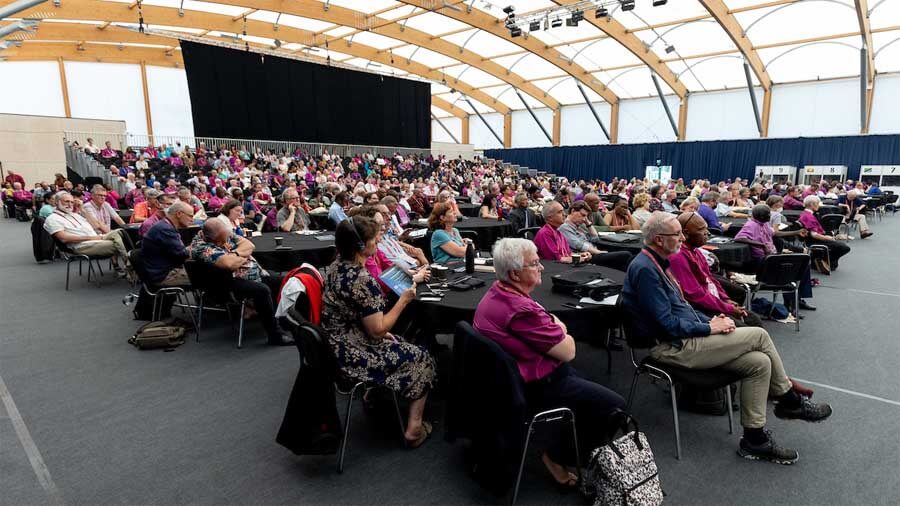
    [Episcopal News Service – Canterbury, England] In the second Lambeth Conference plenary session on July 31, 2022, primates, bishops and other church leaders talked about how to prevent and heal from abuse in the church, and how to create a common culture of safety across the variety of cultural contexts that make up the Anglican Communion.

    After hearing from Safe Church administrators, Archbishop of Canterbury Justin Welby, and a victim of clergy sexual abuse, the bishops considered the draft Lambeth Call on Safe Church, which commits provinces to a plan for preventing and addressing abuse. Accepting that the specifics may be tailored to each province or diocese but the principles need to be shared, the bishops approved the draft call to move forward to its final phase, when it will be revised to include feedback that they have provided.

    The fundamental issue is the misuse of power, not sex

    In the plenary, Welby said the problem of abuse in the church “has been the biggest, most powerful burden of this role that I’ve faced over the last 10 years.”

    Abuse, he said, is not limited to any region, culture or context – although “it is largely a problem of men.”

    “The fundamental issue of Safe Church is the misuse of power. It’s not even, normally, particularly about sex. It’s about power – the ability of someone to do what they like with someone who is weaker,” he said.

    Safe Church steps taken by the Anglican Communion

    Garth Blake, chair of the Anglican Communion Safe Church Commission, provided an overview of the progressive steps the communion has taken to prevent abuse in any form – including sexual, emotional and spiritual abuse – in churches. At the 2008 Lambeth Conference, “the abuse of power within society and the church and its disproportionate impact on women and children” emerged as a theme that generated guidelines and recommendations over the next decade.

    In 2012, the Anglican Consultative Council adopted the Charter for the Safety of People within the Churches of the Anglican Communion, encouraging all provinces to take on its five commitments:

    • Providing pastoral support where there is abuse.
    • Effectively responding to abuse.
    • Teaching methods of safe pastoral ministry through education and training.
    • Assessing the suitability of potential church leaders through background checks and other methods.
    • Promoting a culture of safety to prevent abuse.

    That charter is the basis for the ACC’s creation of the Safe Church Commission in 2016. The ACC endorsed a protocol for provinces to share information about the suitability of potential ordinands or lay leaders for ministry. The protocol suggests a framework for provinces to report instances of proven abuse, or credible allegations, so that potentially abusive clergy or lay leaders cannot continue ministry in another province.

    The ACC adopted a further set of guidelines in 2019, developed by the Safe Church Commission, for churches to enhance the safety of children and vulnerable adults in the provinces of the communion. The ACC requested that each province adopt and implement the charter, protocol and guidelines at the 2019 meeting.

    The draft Call on Safe Church would affirm that provinces commit to taking all of those steps, implementing them in a way that suits their local context.

    Bishops assented to the Safe Church call

    Bishop Tim Thornton, chair of the Lambeth Calls Subgroup, said at an evening news conference that the bishops had “assented to the call unanimously,” though the process they are using to register their approval or disapproval has changed. For the first call on July 30, bishops used electronic voting devices to submit one of three possible responses to the Call on Mission and Evangelism.

    However, Thornton said, based on feedback from bishops, the conference will no longer use the devices. Instead, bishops will discuss the drafts in small groups, up to six of which will be randomly selected to present their thoughts verbally during the session. Then they will be asked to affirm or object by voice, and if there is a clear consensus that the call should move forward, it will advance to a final draft incorporating all the bishops’ feedback.

    Safe Church Guidelines to be implemented by province

    Thornton clarified that there will not be a numerical count of votes. When asked what would happen if there is not a clear consensus, Thornton cited Welby as saying that “if the majority are saying no, in effect, then the call will not be taken forward, and the work will be noted, but it won’t go forward to the next phase.”

    The guidelines and protocols that the Safe Church call affirms do not prescribe specific actions or rules, and that is by design, said Blake, the Safe Church Commission chair.

    “Why ‘guidelines’? Because of 165 countries and all those different legal systems, we cannot have a prescriptive set of rules. But we can have guidelines which need to be contextualized to each province, and we tested the suitability of those guidelines through a broad membership on the commission throughout all parts of the world. And part of my role as chair was to say, ‘This draft of the guideline, does this work in your province?’”

    Bishop Cleophas Lunga of the Diocese of Matabeleland in Zimbabwe, part of the Church of the Province of Central Africa, said being able to implement the guidelines in a locally relevant way was critical, partially because legal and procedural systems in Zimbabwe often don’t correlate easily with those in other parts of the world.

    “We are now, as the province of Central Africa – and I’m sure other provinces in Africa will follow us in suit – to begin to use the guidelines that we have managed to put together, so that they can be adapted to our context, and include the parts that we’ve [already been] using, to make the whole safeguarding measures comprehensive,” he said. “So this is a welcome idea.”

    —Egan Millard is an assistant editor and reporter for Episcopal News Service. He can be reached at emillard@episcopalchurch.org.

    Lambeth Conference: God's Church for God's World

    What is the Lambeth Conference?

    Every bishop of the Anglican Communion is invited to the Lambeth Conference, which is convened by the Most Reverend Justin Welby, The Archbishop of Canterbury. The Lambeth Conference has met since 1867, happens once-a-decade, and is a significant event in the life of the Anglican Communion.

    The conference will explore church and world affairs. Outcomes of the conference will shape the life of the Anglican Communion in the decade ahead.

    Anglican Compass Rose

    The Anglican Communion

    The Anglican Communion has no central authority figure or body. It is made up of 42 autonomous members or provinces. Each member church makes its own decisions in its own way.

    However, their decision-making bodies are guided by recommendations from each of the four so-called Instruments of Communion

    The Secretariat, also known as the Anglican Communion Office, based in London, England support Anglicans and Episcopalians worldwide to carry out any requests from the Instruments and work to enable members of the Anglican Communion to fulfil their calling to be God’s people in the world.

    The Episcopal Church of the Redeemer: Worshiping God, living in community, reaching out to the world.

    Church of the Redeemer

    Church of the Redeemer: Worshiping God, living in community, and reaching out to the world around us. We are an Episcopal Church serving north King County and south Snohomish County, Washington. As you travel your road, go with friends walking the way of Jesus at Redeemer.

    Church of the Redeemer is at 6220 Northeast 181st Street in Kenmore, Washington. The campus is a short distance north of Bothell Way, near the Burke-Gilman Trail. The entrance looks like a gravel driveway. The campus is larger on the inside than it is on the outside. And we managed to hide a large building on the side of a hill that is not easily seen from the street.

    The Episcopal Church welcomes you.

  • Pray for the Lambeth Conference: Day 6

    Pray for the Lambeth Conference: Day 6

    Thank you for praying with us for the fifteenth Lambeth Conference – which will meet in Canterbury, the United Kingdom, between 26 July– 8 August 2022.

    Through this prayer guide we hope that the prayers we share here will encourage all who use it to unite in prayer for the bishops gathered in the Lambeth Conference.

    Pray for the Anglican Communion

    Bible Focus: 1 Peter 2: 1-12 – A holy people following Christ

    Present in 165 countries, the Anglican Communion is a diverse, global network of independent and interdependent churches. Representing a wide range of Christian traditions, cultures and languages, the conference will discuss the life of the Anglican Communion.

    A prayer from The Brotherhood of St Gregory, The Episcopal Church

    O God, by your grace and Spirit you have raised up witnesses and servants in many lands and cultures: Pour out your blessing upon the churches and provinces of the Anglican Communion, and upon their leaders as they gather for fellowship in the Lambeth Conference, that their diversity may enrich their common witness and service to the honor and glory of your name; through Jesus Christ our Lord. Amen

    A prayer from The Community of the Holy Name, Diocese of Zululand, Anglican Church of Southern Africa

    Holy omnipresent Father, who while you are in heaven,
    You looked down on earth and its surroundings.
    We pray for the Anglican Communion, spread throughout the world.
    We pray that you will pour out your Holy Spirit as you did at Pentecost.
    Help us Lord to have passion to read and receive your word.
    Send us revival and make us holy. Help us to give generously.
    We pray for the gifts of the Holy Spirit to operate freely Within the Anglican Communion.
    Make all your people realise the power of accepting
    Jesus Christ
    As the Lord and Saviour.
    Rise people who will visit those who are newly born again.
    We ask in Jesus Christ’s name.
    Amen

    What is the Lambeth Conference?

    Every bishop of the Anglican Communion is invited to the Lambeth Conference, which is convened by the Most Reverend Justin Welby, The Archbishop of Canterbury. The Lambeth Conference has met since 1867, happens once-a-decade, and is a significant event in the life of the Anglican Communion.

    The conference will explore church and world affairs. Outcomes of the conference will shape the life of the Anglican Communion in the decade ahead.

    Anglican Compass Rose

    The Anglican Communion

    The Anglican Communion has no central authority figure or body. It is made up of 42 autonomous members or provinces. Each member church makes its own decisions in its own way.

    However, their decision-making bodies are guided by recommendations from each of the four so-called Instruments of Communion

    The Secretariat, also known as the Anglican Communion Office, based in London, England support Anglicans and Episcopalians worldwide to carry out any requests from the Instruments and work to enable members of the Anglican Communion to fulfil their calling to be God’s people in the world.

    The Episcopal Church of the Redeemer: Worshiping God, living in community, reaching out to the world.

    Church of the Redeemer

    Church of the Redeemer: Worshiping God, living in community, and reaching out to the world around us. We are an Episcopal Church serving north King County and south Snohomish County, Washington. As you travel your road, go with friends walking the way of Jesus at Redeemer.

    Church of the Redeemer is at 6220 Northeast 181st Street in Kenmore, Washington. The campus is a short distance north of Bothell Way, near the Burke-Gilman Trail. The entrance looks like a gravel driveway. The campus is larger on the inside than it is on the outside. And we managed to hide a large building on the side of a hill that is not easily seen from the street.

    The Episcopal Church welcomes you.
  • Bishops discuss evangelism, mission and modern parallels to biblical exile

    Bishops discuss evangelism, mission and modern parallels to biblical exile

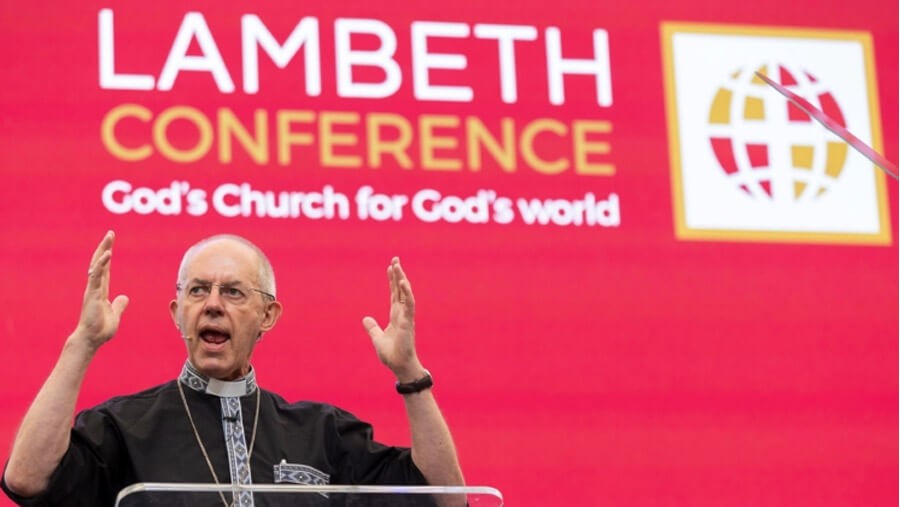
    [Episcopal News Service – Canterbury, England] The business portion of the Lambeth Conference got underway on July 30 as more than 650 bishops from across the Anglican Communion gathered at the University of Kent for Bible studies, presentations on mission and evangelism and a collective endorsement of a statement on those topics of the day.

    Archbishop of Canterbury Justin Welby, who convened the conference, chose the New Testament letter of 1 Peter to provide its biblical foundation. In the morning session, Welby offered the conference’s first Bible exposition, underscoring how the reading from Scripture finds the early Christians seeking hope through their belief in Jesus during a time of exile and persecution.

    Among the key themes found in 1 Peter, Welby said, are power and authority, hope and suffering, holiness, displacement and hospitality. “Although the world in which we live is completely different to that of Peter in the first century and although the world has shifted on its axis in the last 10 years with COVID and other things, the message of 1 Peter is absolutely still relevant,” Welby said. “For many of us, Peter touches on difficult topics, and we are not going to skip them. We’re going to talk about them.”

    The Lambeth Conference, though typically held once a decade, last met 14 years ago in 2008. Welby’s chosen theme for this gathering is “God’s Church for God’s World,” and the first day’s plenary session, on mission and evangelism, turned the focus outward, with a call to offer Jesus’ good news to the world, like a gift for those open to hearing it.

    But conference planners also have been aware of the need to look inward to address often seismic divisions within the Anglican Communion. Welby acknowledged the church’s fault lines in his reflections on 1 Peter.

    “We are united in our hope, in our love for Jesus absolutely,” he said. “But as a church – in common, by the way, with every global church – we are also divided, by the assumption that the key themes of 1 Peter mean the same for everyone, that my suffering is exactly the same as your suffering. But it is not.”

    The threat of persecution is a particularly consequential difference in how Anglicans around the world experience their faith, Welby noted. Belief in Jesus can be a matter of life and death in some provinces. “In this hall, many live in places of persecution, some of it violent and open, some of it slightly better concealed,” he said. “And it is difficult for those who do not experience persecution to understand the reality of the recipients of this letter.”

    Read the full text of Welby’s Bible exposition here.

    Theological divisions over human sexuality also have flared at this Lambeth Conference, as they did at the previous two, with conservative bishops now pushing for endorsement of their own resolution affirming majority opposition to same-sex marriage.

    Welby has stressed that the Lambeth Conference is not a legislative or governing body. And, though he avoided direct mention of the controversy during his Bible reflections, Welby urged bishops to join in listening, learning and “walking together” out of a shared love for God, despite their disagreements.

    “The call to us across the whole catholic church – the global church; I’m not just talking about Anglicans – is to stop our civil wars. There are enough in the world without having them in our church,” he said. “When we are one in Christ … divisions are rubbed of power. The power of Christ overcomes all that seeks to alienate, to fragment, to make for fear.

    “We may be disparate. We are divided. But we have a common identity that is over everything, that we belong to Jesus Christ.”

    He concluded by asking the bishops: “What is the good news that you bring to this gathering?”

    Please accept YouTube cookies to play this video. By accepting you will be accessing content from YouTube, a service provided by an external third party.

    YouTube’s privacy policy

    If you accept this notice, your choice will be saved and the page will refresh.

    Planners of this Lambeth Conference, from July 26-August 8, 2022, instituted a “Lambeth Calls” process in lieu of resolutions, partly in recognition that neither Welby nor the Lambeth Conference has authority over its 42 member provinces, including The Episcopal Church. After daily discussions, the Lambeth Calls reports are to be finalized with a consensus-building process similar to voting, though planners have preferred not to describe it as a vote.

    After discussing the draft version of each of the Lambeth Calls, bishops will be given electronic devices to indicate their view in one of three ways: “This Call speaks for me,” “This Call requires further discernment” or “This Call does not speak for me.”

    The Lambeth Call on Mission and Evangelism was taken up July 30 as the first of the conference’s 10 calls, opening the conference on a unifying note. The draft text of the call includes the declaration: “Every church across the Anglican Communion joyfully shares this vocation to declare the good news of God’s salvation of the world in Christ Jesus.”

    The afternoon sessions in which the bishops discuss the calls are closed to the public and to reporters, though the Lambeth Conference released results of the first discussion later in the day. The call was endorsed by two-thirds of about 450 participating bishops, with another third favoring further discernment. It was not immediately clear why not all bishops attending the Lambeth Conference registered their views.

    Please accept YouTube cookies to play this video. By accepting you will be accessing content from YouTube, a service provided by an external third party.

    YouTube’s privacy policy

    If you accept this notice, your choice will be saved and the page will refresh.

    The topic also was developed during an open plenary earlier in the day, featuring the Church of England’s Archbishop of York Stephen Cottrell and Archbishop Tito Zavala of the Anglican Church of Chile.

    If McDonald’s makes hamburgers and Cadbury makes chocolate, Cottrell said, “the church of Jesus Christ makes disciples. That is our core business.”

    But disciples aren’t just converts, and discipleship isn’t just about going to church, he continued. “We make disciples, and disciples make peace,” he said. “We call that evangelism.”

    “What the world needs is what God has lavished upon us in Christ,” Cottrell said. It needs hope, and it needs reconciliation. It needs humility in the face of the damage done to the environment, he said, evoking what will be a major theme later in the conference. “What the world needs is the knowledge that peace can be found even with disagreement.

    “And dear sisters and brothers, isn’t this a particular opportunity before us this week? We can show the world that despite profound disagreement, what we have in Christ is love.”

    Zavala spoke of his experience emphasizing church planting in Chile, as a priest and now as archbishop. “Our God – Father, Son, Holy Spirit – is a missionary god,” he said, and church planting isn’t a calling that God is saving for us in heaven. It is the necessary work of Christians here on Earth, he said.

    Zavala also argued that Anglicans worldwide need to shift from being primarily maintenance-minded and work toward becoming a mission-minded church, always seeking new opportunities for growth. Much mission-minded work is led by the laity, he added, echoing a common refrain in The Episcopal Church about the importance of empowering lay leaders.

    “We have not been called by God to close churches. We have been born to plant churches,” he said while describing his work expanding a congregation in Santiago that eventually grew to spin off new congregations established by some of the initial congregation’s members. From that experience, his province has developed a “mother church” model for starting new congregations.

    From the beginning of any newly formed congregation, Zavala prompts the local leaders to consider: “What will be your next church planting project?”

    The plenary session closed with an encouragement among bishops to discuss briefly with those sitting next to them how such a calling is experienced in their local contexts, tying in Welby’s earlier emphasis on the importance of learning from each other’s stories.

    Bishop Jacque Boston of the Diocese of Guinea in the Province of West Africa, speaking with Episcopal News Service, described how the local context can differ significantly just within his own diocese, even as his diocese and province worlds apart in some ways from what many other Anglicans and Episcopalians experience.

    Boston’s country is overwhelmingly Muslim, so the Anglican Church faces strong resistance from most of fellow citizens to Christian appeals, he told Episcopal News Service. Christians in some parts of the country also suffer discrimination for their beliefs, he said. He doesn’t fear persecution personally, partly because he is based in the southern part of the country, which is more tolerant of the minority Christians.

    “It’s very difficult,” he said, adding that the Anglican diocese also struggles with lack of resources to support evangelism efforts.

    The draft Lambeth Call on Mission and Evangelism includes 10 specific requests that bishops will be encouraged to take back to their dioceses. Several of them require no financial commitment, allowing them to transcend disparities in resources among Anglican provinces. “Each diocese and every church to seek fervently to be renewed by the wonder and power of the good news of Christ,” the first request says. Another calls on Episcopalians and Anglicans to discern “how to bear faithful witness to Christ and authentically proclaim the Gospels.”

    Prayer plays a large role. “We pray for each other in this ministry and commit to listen to, learn from and find encouragement together in this Call,” one of the items says.

    Other parts of the Call on Mission and Evangelism identify more tangible actions, such as training and deploying evangelists, and the final item asks the Anglian Communion’s secretary general “to support and monitor progress in these areas with the help of the Commission on Evangelism and Discipleship.”

    —David Paulsen is an editor and reporter for Episcopal News Service. He can be reached at dpaulsen@episcopalchurch.org.

    Lambeth Conference: God's Church for God's World

    What is the Lambeth Conference?

    Every bishop of the Anglican Communion is invited to the Lambeth Conference, which is convened by the Most Reverend Justin Welby, The Archbishop of Canterbury. The Lambeth Conference has met since 1867, happens once-a-decade, and is a significant event in the life of the Anglican Communion.

    The conference will explore church and world affairs. Outcomes of the conference will shape the life of the Anglican Communion in the decade ahead.

    Anglican Compass Rose

    The Anglican Communion

    The Anglican Communion has no central authority figure or body. It is made up of 42 autonomous members or provinces. Each member church makes its own decisions in its own way.

    However, their decision-making bodies are guided by recommendations from each of the four so-called Instruments of Communion

    The Secretariat, also known as the Anglican Communion Office, based in London, England support Anglicans and Episcopalians worldwide to carry out any requests from the Instruments and work to enable members of the Anglican Communion to fulfil their calling to be God’s people in the world.

    The Episcopal Church of the Redeemer: Worshiping God, living in community, reaching out to the world.

    Church of the Redeemer

    Church of the Redeemer: Worshiping God, living in community, and reaching out to the world around us. We are an Episcopal Church serving north King County and south Snohomish County, Washington. As you travel your road, go with friends walking the way of Jesus at Redeemer.

    Church of the Redeemer is at 6220 Northeast 181st Street in Kenmore, Washington. The campus is a short distance north of Bothell Way, near the Burke-Gilman Trail. The entrance looks like a gravel driveway. The campus is larger on the inside than it is on the outside. And we managed to hide a large building on the side of a hill that is not easily seen from the street.

    The Episcopal Church welcomes you.
  • Pray for the Lambeth Conference: Day 5

    Pray for the Lambeth Conference: Day 5

    Thank you for praying with us for the fifteenth Lambeth Conference – which will meet in Canterbury, the United Kingdom, between 26 July– 8 August 2022.

    Through this prayer guide we hope that the prayers we share here will encourage all who use it to unite in prayer for the bishops gathered in the Lambeth Conference.

    Opening service day

    The official opening of the conference will be marked by a special service at Canterbury Cathedral. Bishops attending the Lambeth Conference have travelled from all around the world to take part in this event.

    Conference discussions later in the day will explore the importance of safe church.

    A prayer from The Community of the Gospel, the Episcopal Church

    O good and gracious God, we come with joyful hearts of expectation, offering prayers to you for unity, strength, and great success at the Lambeth Conference. As the bishops of your church gather to seek your direction, to share with each other, and to carry out your will, we pray, dear Lord, that you continue to fill them with the Spirit of love, and that it is manifested in the transformed lives of these shepherds, and the flock to whom they minister. And then, Lord, it is our plea, that the transformed children of your Kingdom would, through missionary zeal, seek to transform others, by your love flowing through us. These mercies we ask, in the name of the one loved us to death; Jesus the Christ. Amen

    What is the Lambeth Conference?

    Every bishop of the Anglican Communion is invited to the Lambeth Conference, which is convened by the Most Reverend Justin Welby, The Archbishop of Canterbury. The Lambeth Conference has met since 1867, happens once-a-decade, and is a significant event in the life of the Anglican Communion.

    The conference will explore church and world affairs. Outcomes of the conference will shape the life of the Anglican Communion in the decade ahead.

    Anglican Compass Rose

    The Anglican Communion

    The Anglican Communion has no central authority figure or body. It is made up of 42 autonomous members or provinces. Each member church makes its own decisions in its own way.

    However, their decision-making bodies are guided by recommendations from each of the four so-called Instruments of Communion

    The Secretariat, also known as the Anglican Communion Office, based in London, England support Anglicans and Episcopalians worldwide to carry out any requests from the Instruments and work to enable members of the Anglican Communion to fulfil their calling to be God’s people in the world.

    The Episcopal Church of the Redeemer: Worshiping God, living in community, reaching out to the world.

    Church of the Redeemer

    Church of the Redeemer: Worshiping God, living in community, and reaching out to the world around us. We are an Episcopal Church serving north King County and south Snohomish County, Washington. As you travel your road, go with friends walking the way of Jesus at Redeemer.

    Church of the Redeemer is at 6220 Northeast 181st Street in Kenmore, Washington. The campus is a short distance north of Bothell Way, near the Burke-Gilman Trail. The entrance looks like a gravel driveway. The campus is larger on the inside than it is on the outside. And we managed to hide a large building on the side of a hill that is not easily seen from the street.

    The Episcopal Church welcomes you.
  • Pray for the Lambeth Conference: Day 4

    Pray for the Lambeth Conference: Day 4

    Thank you for praying with us for the fifteenth Lambeth Conference – which will meet in Canterbury, the United Kingdom, between 26 July– 8 August 2022.

    Through this prayer guide we hope that the prayers we share here will encourage all who use it to unite in prayer for the bishops gathered in the Lambeth Conference.

    Pray for mission and evangelism

    Bible Focus: 1 Peter 1: 1-25 – Called in to hope and holiness

    Learning from 1 Peter’s vision of church, the day will explore mission and evangelism in the Anglican Communion, as part of the Global Church.

    A prayer from The Church Mission Society. Church of England – working with partners across Africa, Asia, Europe, Latin America and the Middle East

    Lord, as you have entered into our life and death and in all the world you call us into your death and risen life. Forgive us our sins; and draw us we pray, by the power and encouragement of your Spirit, into an exchange of gifts and needs, joys and sorrows, strength and weakness with your people everywhere; that with them we may have grace to break through every barrier, to make disciples of all peoples and to share your love with everyone for your glory’s sake. Amen

    What is the Lambeth Conference?

    Every bishop of the Anglican Communion is invited to the Lambeth Conference, which is convened by the Most Reverend Justin Welby, The Archbishop of Canterbury. The Lambeth Conference has met since 1867, happens once-a-decade, and is a significant event in the life of the Anglican Communion.

    The conference will explore church and world affairs. Outcomes of the conference will shape the life of the Anglican Communion in the decade ahead.

    Anglican Compass Rose

    The Anglican Communion

    The Anglican Communion has no central authority figure or body. It is made up of 42 autonomous members or provinces. Each member church makes its own decisions in its own way.

    However, their decision-making bodies are guided by recommendations from each of the four so-called Instruments of Communion

    The Secretariat, also known as the Anglican Communion Office, based in London, England support Anglicans and Episcopalians worldwide to carry out any requests from the Instruments and work to enable members of the Anglican Communion to fulfil their calling to be God’s people in the world.

    The Episcopal Church of the Redeemer: Worshiping God, living in community, reaching out to the world.

    Church of the Redeemer

    Church of the Redeemer: Worshiping God, living in community, and reaching out to the world around us. We are an Episcopal Church serving north King County and south Snohomish County, Washington. As you travel your road, go with friends walking the way of Jesus at Redeemer.

    Church of the Redeemer is at 6220 Northeast 181st Street in Kenmore, Washington. The campus is a short distance north of Bothell Way, near the Burke-Gilman Trail. The entrance looks like a gravel driveway. The campus is larger on the inside than it is on the outside. And we managed to hide a large building on the side of a hill that is not easily seen from the street.

    The Episcopal Church welcomes you.
  • ‘A wave of love’

    ‘A wave of love’

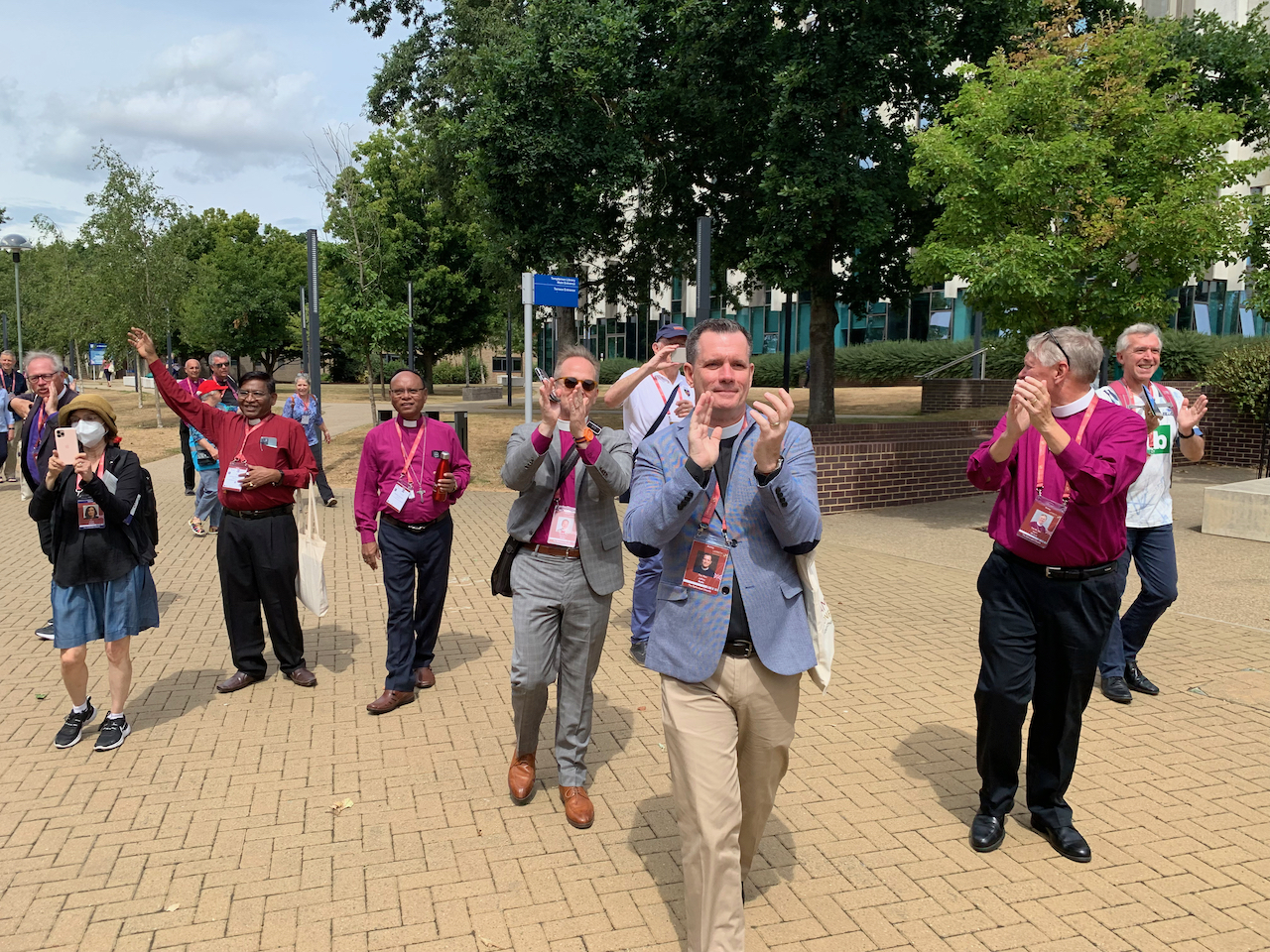
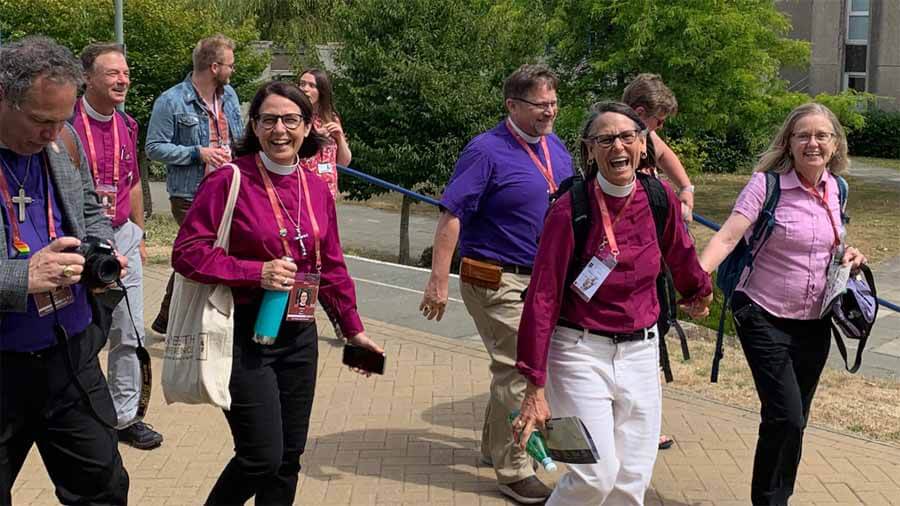
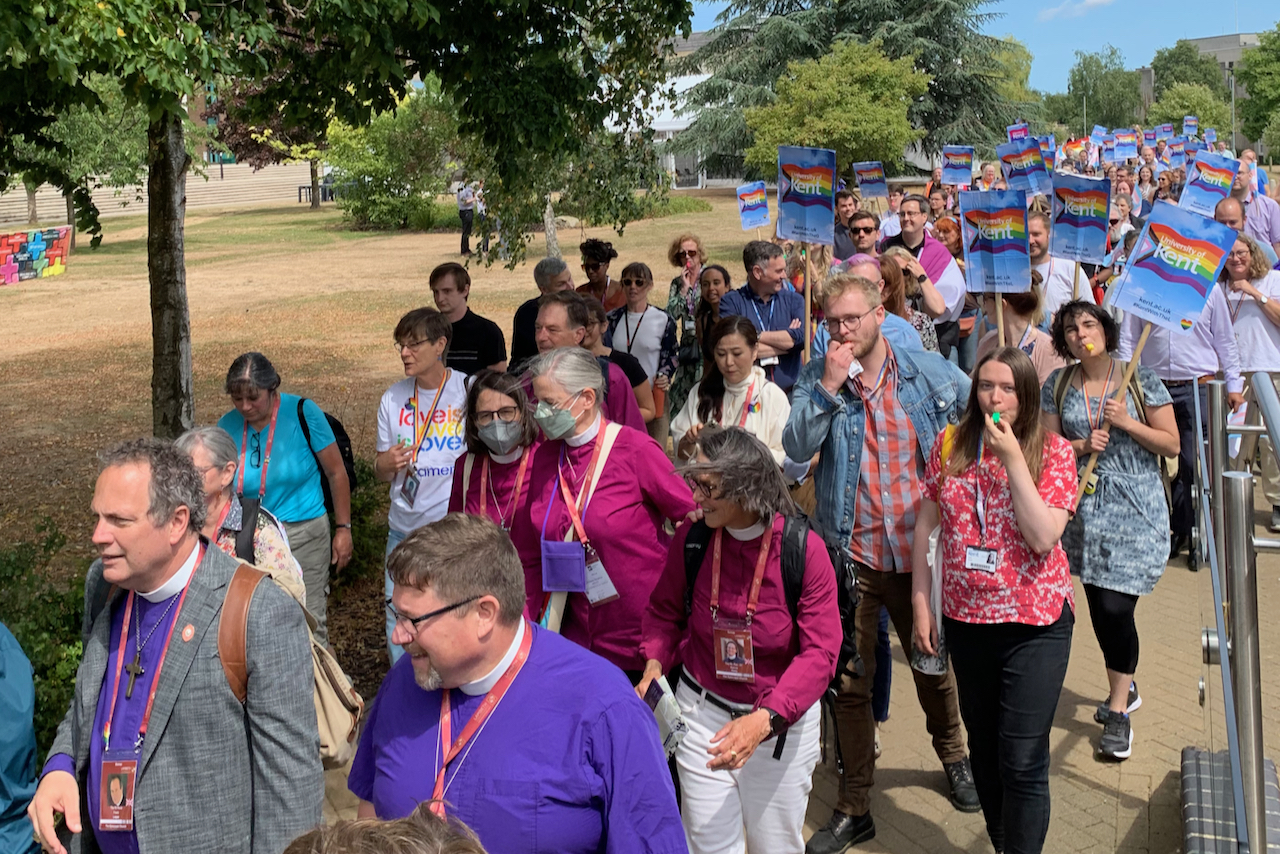
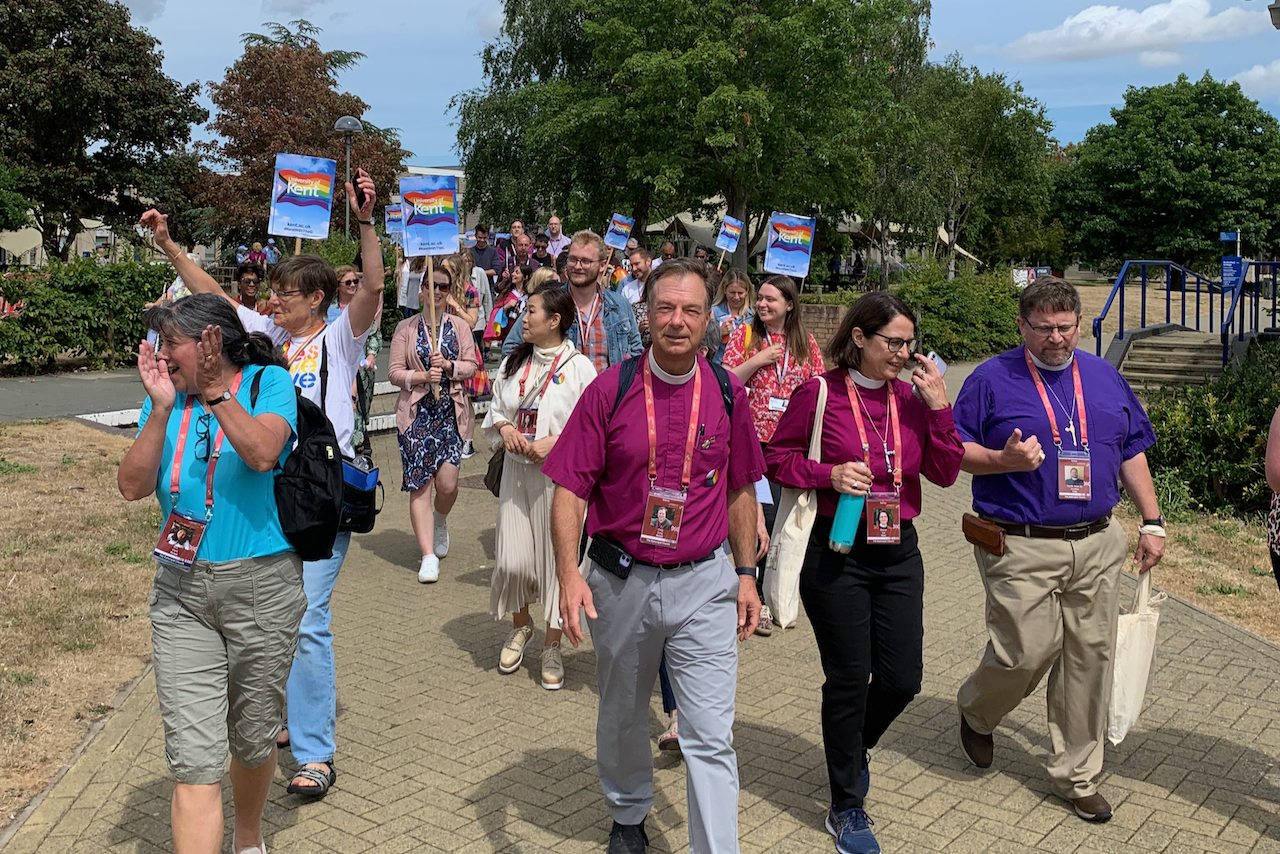
    [Episcopal News Service – Canterbury, England] Over a dozen Episcopal bishops joined a march across the campus of the University of Kent, site of the Lambeth Conference, on July 27, 2022, to show support for LGBTQ+ inclusion as the topic once again looms large over the once-a-decade gathering of bishops from across the Anglican Communion, underway here through August 8.

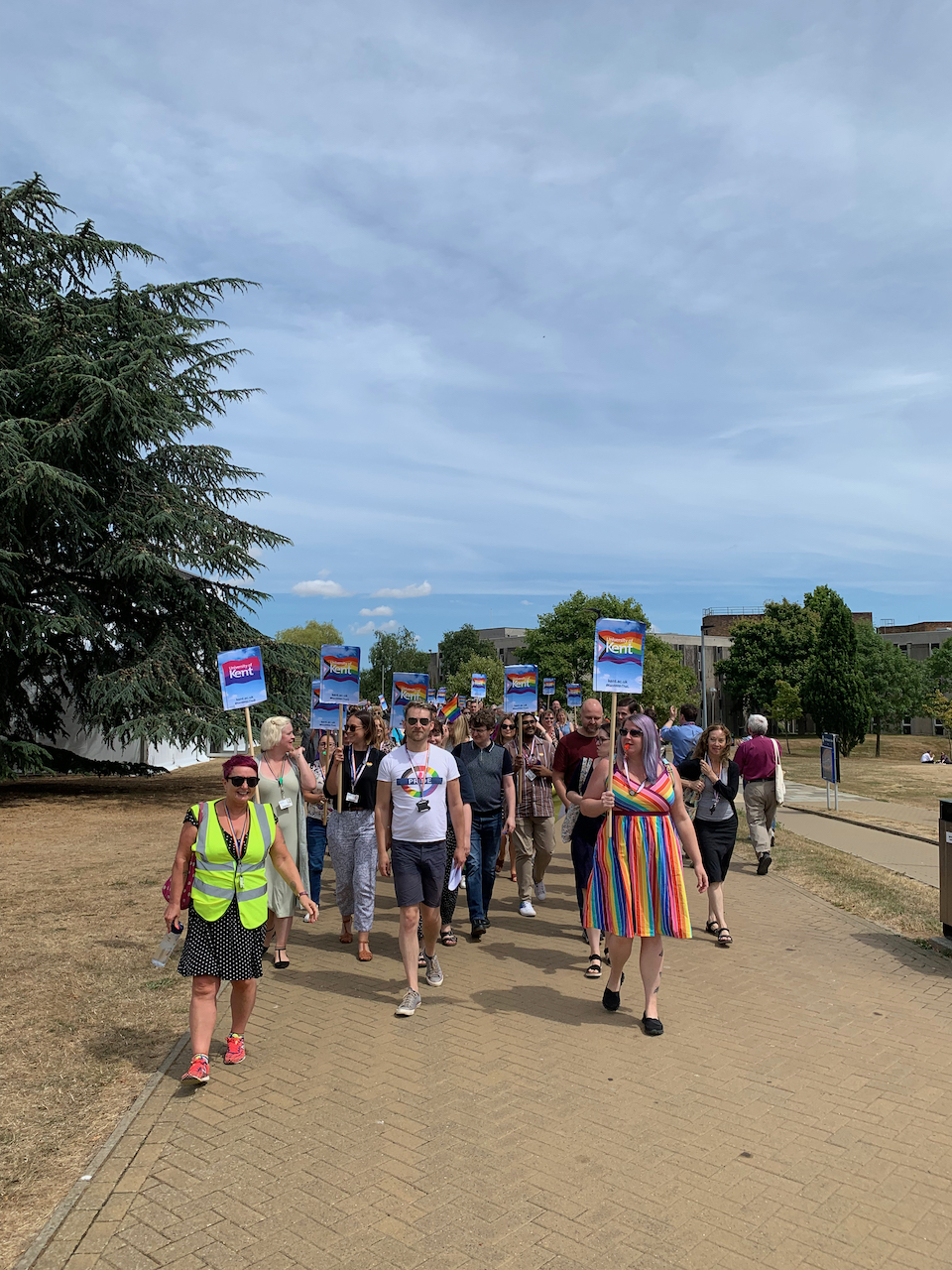
    The raucous sound of whistles and drums accompanied the procession throughout the campus, punctuated by cheers from onlookers. The bishops’ purple shirts barely stood out among the stream of rainbow flags and stickers, signs, trans pride flags and colorful outfits. Some bishops marched with their same-sex spouses, who were not invited to participate fully in the conference as bishops’ opposite-sex spouses are but who are invited to attend some events as observers.

    The march drew at least 100 people. Photo: Egan Millard/Episcopal News Service

    The march on the conference’s first official day was organized by the university’s LGBT+ Staff Network and brought together over 100 university students and staff, clergy and their spouses, local residents and other supporters. It had been planned months in advance as part of the university’s parallel programming during the conference, which it is hosting despite its objections to how the conference is handling LGBTQ+ issues.

    University staff and students led the march. Photo: Egan Millard/Episcopal News Service

    Welcome from the march organizers at Kent University

    “We warmly welcome the gathering of voices from diverse backgrounds, cultures, and outlooks to the Lambeth Conference and, as a University, we intend to learn from and, where appropriate, add our voice to the discussion of the vital questions under discussion,” university administrators wrote in June.

    “Alongside this we are clear that the position of the worldwide Anglican Communion on the place of LGBT+ people within the Church and wider society does not fit with our deeply held values of equality, inclusion, tolerance, and mutual respect. We say that openly and unambiguously.”

    Some 650 bishops and their spouses from 42 Anglican provinces and 165 countries are gathered in Canterbury for the conference. It does not have legislative authority, but is intended, through common study of world issues and matters impacting the Christian faith – as well as fellowship and worship – to shape the life of the communion in the coming decade. This is the 15th such gathering held in 155 years.

    Onlookers cheered as the march went by. Photo: Egan Millard/Episcopal News Service

    Views on same-sex marriage vary widely throughout the communion, with The Episcopal Church leading the way toward full marriage equality and full inclusion of LGBTQ+ people.

    The university pledged to hold events that responded to and engaged with the debate over LGBTQ+ inclusion in Anglican churches. The march kicked off a day-long “Rainbows in Religion” symposium that included presentations and panel discussions on the topic.

    Newly elected Connecticut Bishop Jeffrey Mello applauds as he and other bishops join the march. Photo: Egan Millard/Episcopal News Service

    Though the march’s organizers had singled out Archbishop of Canterbury Justin Welby’s decision not to invite the same-sex spouses as the main motivation for the march, it took on added significance after a statement saying the Anglican Communion “as a whole” rejects same-sex marriage was added to one of the draft documents – “Lambeth calls” – that bishops will vote on. The language was altered on July 26 to eliminate the most divisive language and to reflect the lack of consensus on the issue across the communion.

    Episcopal Church bishops who participated

    Among the marchers from The Episcopal Church were New York Assistant Bishop Mary Glasspool, the first openly lesbian bishop in the Anglican Communion, and several other bishops whose spouses were not invited. At the end of the march, one of the university organizers addressed them specifically, telling them, “You are welcome here” as the crowd applauded.

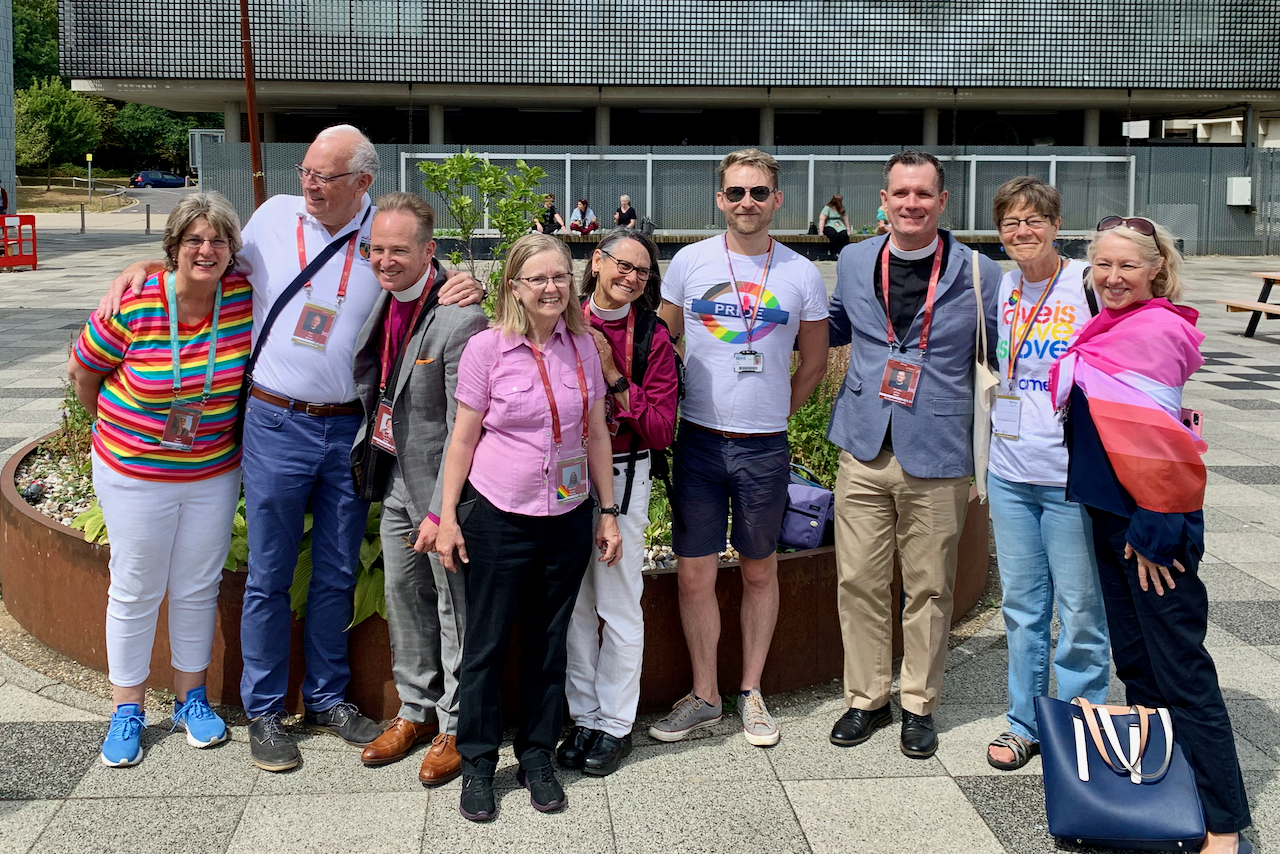
    March organizers pose with bishops and spouses, including the Rev. Thomas Mousin and Bishop Thomas Brown, second and third from left. Photo: Egan Millard/Episcopal News Service

    Maine Bishop Thomas Brown marched with his husband, the Rev. Thomas Mousin.

    “Whenever there’s a sense of welcome, there’s a sense of joy. And what I felt was that this university community came together to say, ‘We are glad you’re here,’” Brown told Episcopal News Service.

    “It’s delightful to be here – it’s just like a wave of love,” Mousin added. “It’s wonderful that we’ve received it.”

    —Egan Millard is an assistant editor and reporter for Episcopal News Service. He can be reached at emillard@episcopalchurch.org.

    Lambeth Conference: God's Church for God's World

    What is the Lambeth Conference?

    Every bishop of the Anglican Communion is invited to the Lambeth Conference, which is convened by the Most Reverend Justin Welby, The Archbishop of Canterbury. The Lambeth Conference has met since 1867, happens once-a-decade, and is a significant event in the life of the Anglican Communion.

    The conference will explore church and world affairs. Outcomes of the conference will shape the life of the Anglican Communion in the decade ahead.

    Anglican Compass Rose

    The Anglican Communion

    The Anglican Communion has no central authority figure or body. It is made up of 42 autonomous members or provinces. Each member church makes its own decisions in its own way.

    However, their decision-making bodies are guided by recommendations from each of the four so-called Instruments of Communion

    The Secretariat, also known as the Anglican Communion Office, based in London, England support Anglicans and Episcopalians worldwide to carry out any requests from the Instruments and work to enable members of the Anglican Communion to fulfil their calling to be God’s people in the world.

    The Episcopal Church of the Redeemer: Worshiping God, living in community, reaching out to the world.

    Church of the Redeemer

    Welcome to Church of the Redeemer: Worshiping God, living in community, and reaching out to the world. We are an Episcopal Church serving north King County and south Snohomish County, Washington. As you travel your road, go with friends walking the way of Jesus at Redeemer.

    Church of the Redeemer is at 6220 Northeast 181st Street in Kenmore, Washington. The campus is a short distance north of Bothell Way, near the Burke-Gilman Trail. The entrance looks like a gravel driveway. The campus is larger on the inside than it is on the outside. And we managed to hide a large building on the side of a hill that is not easily seen from the street.

    The Episcopal Church welcomes you.
Maundy Thursday, April 2, 2026. Services at 12:00 noon and 7:00 pm. Gethsemane Watch Vigil from about 8:30 pm to 9:30 pm.

Good Friday, April 3, 2026: Services at 12:00 noon and 7:00 pm.

Holy Saturday worship at 9:30 am.

The Great Vigil of Easter, Saturday, April 4, 2025. Service at 8:00 pm. This is the night....

The 3rd Sunday of Easter (Year A), April 19, 2026. Services at 8:00 am (no music) and 10:30 (music). Education classes for adults (9:15 am) and children (9:30 am).

Episcopal Church of the Redeemer
Privacy Overview

Cookie information is stored in your browser and performs functions such as recognizing you when you return to our website and helping our team to understand which pages of the website are visited. We aren't using cookies to determine your web browsing habits, but others can.