Category: General Convention

  • Book of Common Prayer definition broadened

    Book of Common Prayer definition broadened

    [Episcopal News Service – Baltimore, Maryland] The House of Bishops moved forward with a plan to expand and clarify what exactly the Book of Common Prayer is, ending hours of discussion with an unanimously adopted resolution on July 9. The House of Deputies concurred the following evening with a minor amendment, sending it back to the bishops for a final vote.

    A larger issue that we’re trying to deal with … is we have all kinds of authorizations and all kinds of trial usages, and it’s kind of a mess.

    Bishop Jeffrey Lee

    The resolution – an amended version of A059, which had garnered increasing attention in the weeks leading up to General Convention – would amend Article X of the Constitution of The Episcopal Church, which lays out how the Book of Common Prayer can be revised but has never specifically provided for authorized liturgies that are not proposed revisions to the existing book.

    Purpose of A059

    A059, concurred on by the House of Deputies, for the first time, defines the Book of Common Prayer as “those liturgical forms and other texts authorized by the General Convention.” In other words, liturgies that are not in the current prayer book – such as same-sex marriage rites and gender-expansive liturgies – could be elevated to “prayer book status,” whether they are replacing parts of the prayer book or standing on their own.

    “What A059 is about, really, is acknowledging that common prayer is evolving,” said the Rt. Rev. Jeffrey Lee, bishop provisional of Milwaukee, chair of the House of Bishops’ Committee on Prayer Book, Liturgy & Music and one of the architects of A059. “And it creates a framework for that evolution to happen, including the inclusion of a number of different rites in a curated collection.”

    The discussions in the House of Bishops on July 8 and 9 – as well as in legislative committee meetings leading up to convention – mostly focused on parsing out the mechanics of what A059 would and would not do. In its current form, A059 would not change the status of the 1979 prayer book or of the various liturgies authorized by General Convention that are not in it. It would, however, set the canonical framework for future evaluation and reorganization of those liturgies.

    The debate, though, went beyond that to touch on more philosophical questions like the meaning of the word “book” in the 21st century, and the concept of “common prayer” itself. Discussion on July 8 veered into the theological and political origins of the Book of Common Prayer, from Thomas Cranmer and Queen Elizabeth I through the formation of The Episcopal Church after the American Revolution.

    “The cat is already out of the bag,” Lee said. “The idea of the prayer book [evolving from] a book bound and physically present in a pew to a curated collection of texts that lives online – that’s already the case, perhaps with different understandings of authorization. But we decided to do that when we first decided that you could cut and paste a PDF.”

    Factors in the development of A059

    Primary factors in the development of A059 included a desire for official liturgies with an expansive understanding of gender and sexuality, preparation for future prayer book revision and concern about the proliferation of other liturgies in various states of authorization. Over a dozen liturgical texts have been “authorized” – for trial use, experimental use, or simply “made available” – by General Convention over the years. However, Article X currently only addresses convention’s ability to revise all or some of the existing Book of Common Prayer. It says nothing about authorization of other liturgies not directly related to the existing prayer book, a category that encompasses many of these other texts, like “Enriching Our Worship.”

    “A larger issue that we’re trying to deal with … is we have all kinds of authorizations and all kinds of trial usages, and it’s kind of a mess,” Lee said.

    All authorized Episcopal liturgies have been compiled together at episcopalcommonprayer.org, which was created by the Task Force on Liturgical and Prayer Book Revision. Resolution A058, which was passed by both houses, designates the site as “the official liturgical website of The Episcopal Church.”

    The original version of A059, Lee said, was “an attempt to clarify what authorization has the weight of the Book of Common Prayer and what other rites might not have that. … What’s being proposed in A059 is not the creation of a wiki-prayer book.”

    The effort originated at the 2018 General Convention, where A068 created the liturgical revision task force, with the intention that it would not necessarily lead to an entirely new edition of the prayer book but propose revised liturgies with inclusive and expansive language. Existing liturgies, some deputies and bishops had argued, use gendered language that is exclusive and unnecessary.

    At this convention, A059 – which was proposed by the Task Force on Liturgical & Prayer Book Revision – was introduced by Lee’s prayer book committee in a version that proposed a process by which new liturgies could achieve prayer book status. That version was ultimately replaced with a substitute developed by a group of bishops including Lee, Texas Bishop Andrew Doyle and Ohio Bishop Mark Hollingsworth.

    The substitute left the specific process of authorizing new texts open to future canonical definition, focusing just on the constitutional change that would enable such work. It leaves in place the requirement that any prayer book changes must be approved by two successive General Conventions, and specifies that any changes must be authorized for trial use first.

    In response to concerns that the resolution might be interpreted as demoting or restricting the 1979 prayer book, the substitute includes additional clarifying language.

    “The Book of Common Prayer in this Church is intended to be communal and devotional prayer enriched by our church’s cultural, geographical, and linguistic contexts. The Book of Common Prayer shall contain both public worship and private devotion,” it reads.

    “The Book of Common Prayer, as now established or hereafter amended by the General Convention, shall be in use in all the Dioceses of this Church.”

    Constitutional change, not canonical

    Since A059 is a constitutional and not a canonical change, it would not alter the status of any existing authorized liturgies. The amended version passed by the house would create a working group to propose canonical changes that would clarify or alter the status of the rites that have been authorized for trial or experimental use over the last few decades. That working group would present those recommendations to the 81st General Convention. Resolution A059, if it passes the House of Deputies, would not take effect until then because it needs two successive readings.

    Lee, Doyle and Hollingsworth had encouraged the house not to delay acting on A059 or referring it back to another body because of the timing requirements for constitutional and canonical requirements, which Bishop Sean Rowe, the House of Bishops’ parliamentarian, explained.

    “Let’s say we do pass it in 2022 and in 2024, [new] canons are ready to go,” he said, describing the ideal scenario. “If we [don’t pass] it here, we can’t do anything with it until 2027. So, it’s the difference between doing something in two years or waiting six years.”
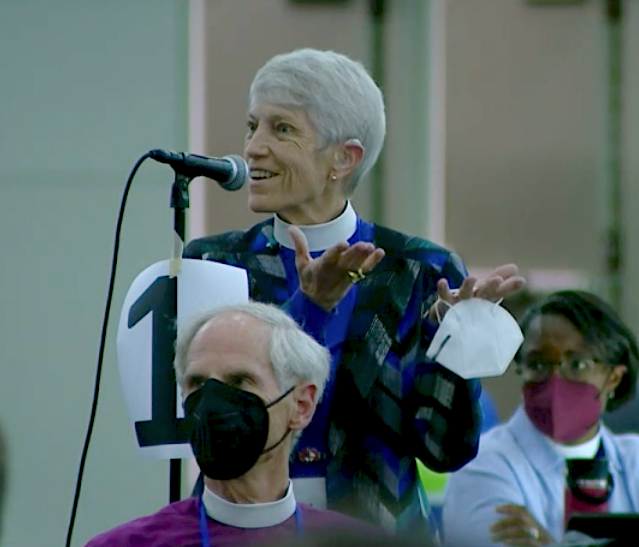
    New York Assistant Bishop Mary Glasspool speaks during discussion on A059 on July 8, 2022 at the 80th General Convention in Baltimore, Maryland. Source: General Convention Office

    Consensus and approval

    As discussion moved into the evening on July 9, consensus around the amended resolution emerged and bishops rose to thank the team of 12 bishops who crafted it.

    “I think this resolution is brilliant,” said New York Assistant Bishop Mary Glasspool. “I’m amazed – we’re in this four-day General Convention and somehow squeezing into that intensity has driven us deep. This is the best conversation that I’ve been a part of in the 11 years that I’ve been bishop and coming to these meetings.”

    The resolution passed on a voice vote that was unanimous, Presiding Bishop Michael Curry confirmed for the record.

    On the evening of July 10, the House of Deputies considered a lightly amended version of A059, which specified that the working group would have nine members and a budget of $30,000, in addition to making a procedural wording fix. After 20 minutes of discussion — with testimony split between supporting and opposing — the amended A059 was concurred, sending it back to the House of Bishops, which passed the final version on July 11.

    —Egan Millard is an assistant editor and reporter for Episcopal News Service. He can be reached at emillard@episcopalchurch.org.
    General Convention of the Episcopal Church

    What happens at General Convention?

    The legislative process of General Convention is an expression of The Episcopal Church’s belief that, under God, the Church is ordered and governed by its people: laity, deacons, priests, and bishops.

    The General Convention is the Church’s highest temporal authority. As such, it has the following power:

    • Amend the Constitution and Canons of the Episcopal Church
    • Amend the Book of Common Prayer and to authorize other liturgical texts
    • Adopt the budget for the Church
    • Create covenants and official relationships with other branches of the Church
    • Determine requirements for its clergy and other leaders
    • Elect its officers, members of the Executive Council, and certain other groups
    • Delegate responsibilities to the Interim Bodies of The Episcopal Church
    • Carry out various other responsibilities and authority
    The Episcopal Church of the Redeemer: Worshiping God, living in community, reaching out to the world.

    Church of the Redeemer

    Church of the Redeemer: Worshiping God, living in community, and reaching out to the world around us. We are an Episcopal Church serving north King County and south Snohomish County. We welcome you be with us as we walk the way of Jesus.

    Church of the Redeemer is at 6220 Northeast 181st Street in Kenmore, Washington. We are a short distance north of Bothell Way, near the Burke-Gilman Trail. The entrance looks like a gravel driveway. The campus is larger on the inside than it is on the outside. And we managed to hide a large building on the side of a hill that is not easily seen from the street.

    The Episcopal Church welcomes you.
  • Rachel Taber-Hamilton elected VP of HOD

    Rachel Taber-Hamilton elected VP of HOD

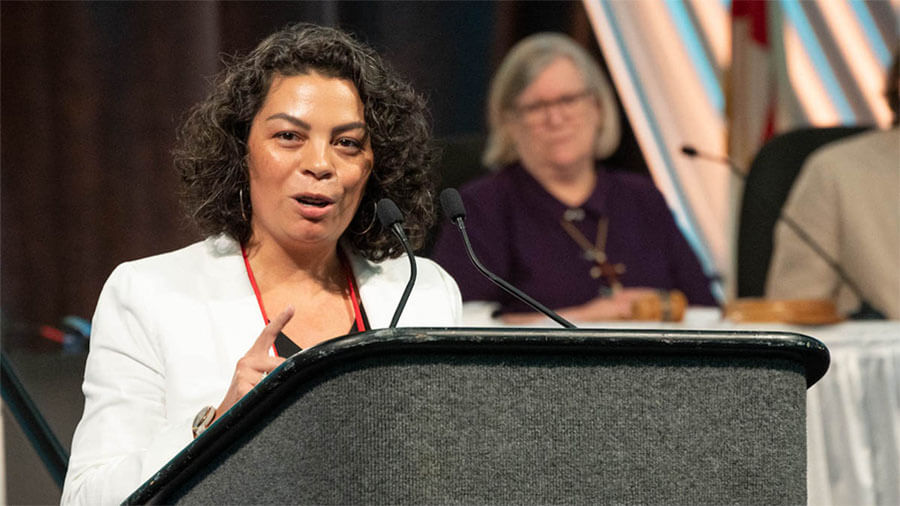
    [Episcopal News Service – Baltimore, Maryland] The House of Deputies on July 10, 2022, elected the Rev. Rachel Taber-Hamilton, Rector of Trinity in Everett, Washington, as its vice president. She is the first ordained woman, and only the third woman, to serve in this capacity since the role of deputies’ vice president was created in 1964.

    I’m looking forward with such joy and such humble gratitude to being able to be in a position to support the work of the House of Deputies, to care for all of you, and assure that every voice may be brought to bear.

    The Rev. Rachel Taber-Hamilton

    Taber-Hamilton, who is Shackan First Nation, joins President-Elect Julie Ayala Harris, a Latina lay woman from the Diocese of Oklahoma, to be the first people of color serving together as leaders of the House of Deputies. Their elections mark the first time two women will lead the house.

    Taber-Hamilton is an Indigenous priest in the Diocese of Olympia, and she succeeds the Hon. Byron Rushing, who has served since 2012. She The other candidate was the Rev. Edwin Johnson of Massachusetts.

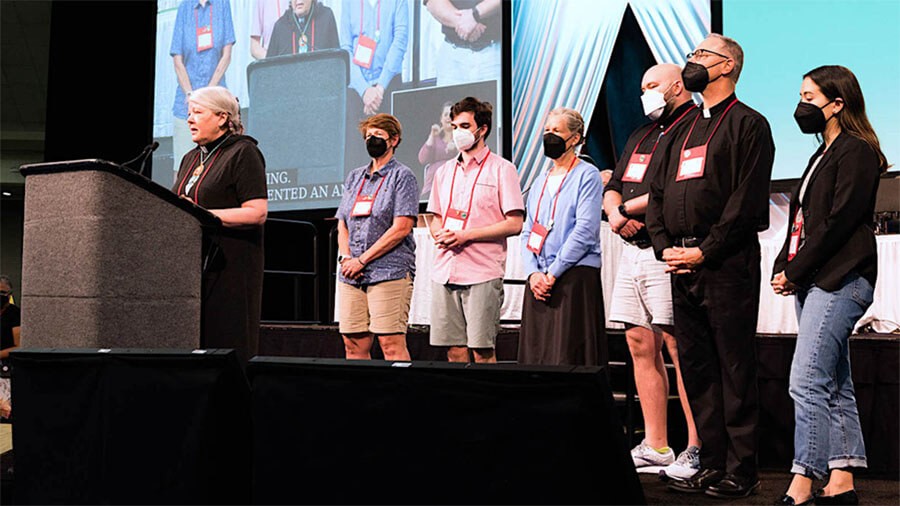
    After her election, Taber-Hamilton was joined on the platform by other Olympia deputies as she was greeted by the house with a standing ovation. [Our rector, the Rev. Jed Fox, is third from the right in the picture.]

    She said, “I’m looking forward with such joy and such humble gratitude to being able to be in a position to support the work of the House of Deputies, to care for all of you, and assure that every voice may be brought to bear. I also have such a deep commitment to supporting our [newly-elected] President Julia [Ayala] Harris, and the continued development of our lay ministers in the church, who I believe will be a significant aspect of our adaptive future.”

    — Melodie Woerman

    The Rev. Rachel Taber-Hamilton

    Raised in a multi-cultural and mixed-race heritage of First Nations (Shackan, British Columbia), Pennsylvania Dutch and Scots-Irish, Rachel Taber-Hamilton has had a life-long passion for cross-cultural communication, preservation of traditional life ways and folk traditions, social diversity and ethnic ministries. She has over 25 years of experience in working with the needs of diverse communities, providing leadership and consultation in recovery processes related to community and organizational trauma.

    The Rev. Rachel Taber-Hamilton

    Rachel holds a BA in Theater Arts from SUNY Geneseo, an MA in Cultural Anthropology from the University of Alaska Fairbanks, an MDiv from Loyola University in Chicago. Her post-graduate work at Indiana University was in the area of Folklore Studies, specializing in the role of symbol systems and folk heroes within processes of transformational cultural change and adaptive community identity.

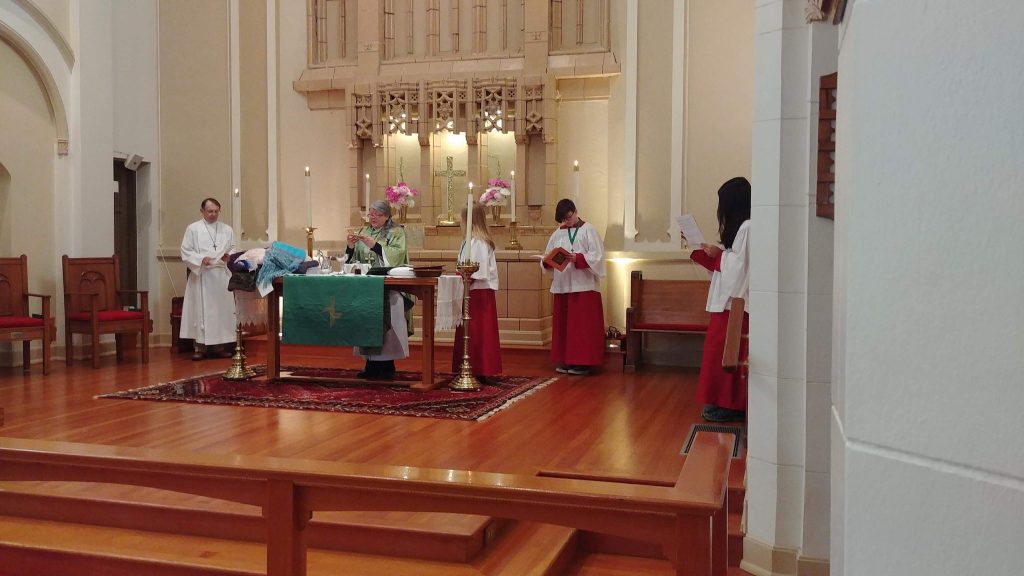
    The Rev. Rachel Taber-Hamilton at the altar of Trinity Episcopal Church in Everett, Washington.

    Ordained as a priest in 2004, Rachel has served throughout her tenure in the Diocese of Olympia on various diocesan councils and committees of the General Convention of The Episcopal Church. She is a committed advocate for social justice concerns and restorative justice in civic policy development. Rachel is currently Rector of Trinity Episcopal Church in Everett, WA, which serves as a hub congregation supporting advocacy work for refugees and immigrants in the Episcopal Diocese of Western Washington.

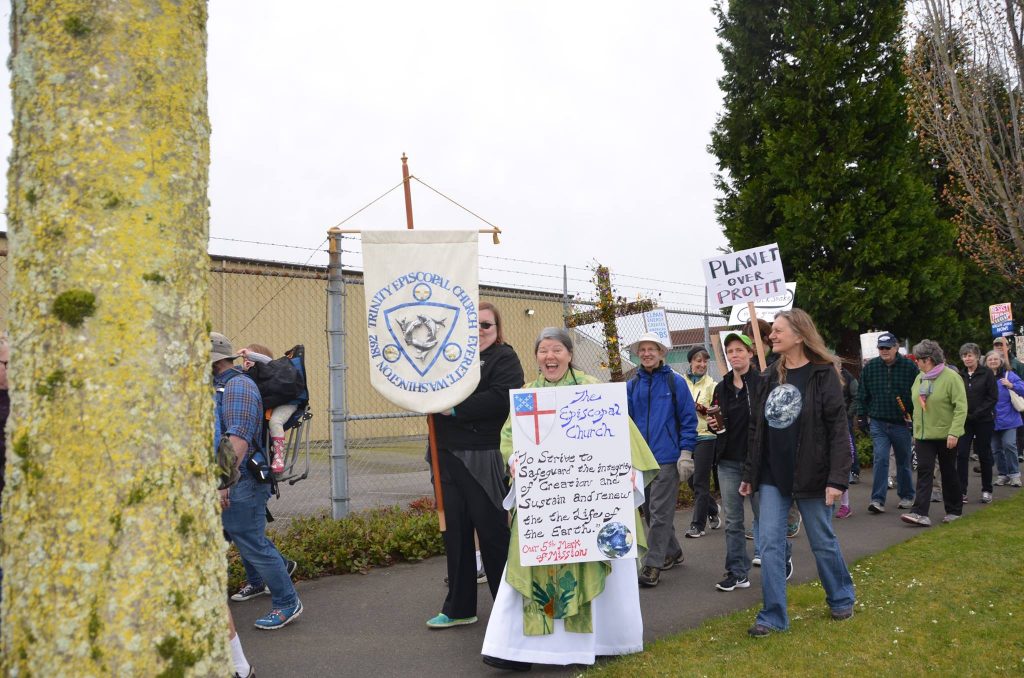
    The Rev. Rachel Taber-Hamilton participating in a march.

    Text and pictures below the headline from the website of Trinity Episcopal Church in Everett, Washington.

    General Convention of the Episcopal Church

    What happens at General Convention?

    The legislative process of General Convention is an expression of The Episcopal Church’s belief that, under God, the Church is ordered and governed by its people: laity, deacons, priests, and bishops.

    The General Convention is the Church’s highest temporal authority. As such, it has the following power:

    • Amend the Constitution and Canons of the Episcopal Church
    • Amend the Book of Common Prayer and to authorize other liturgical texts
    • Adopt the budget for the Church
    • Create covenants and official relationships with other branches of the Church
    • Determine requirements for its clergy and other leaders
    • Elect its officers, members of the Executive Council, and certain other groups
    • Delegate responsibilities to the Interim Bodies of The Episcopal Church
    • Carry out various other responsibilities and authority
    The Episcopal Church of the Redeemer: Worshiping God, living in community, reaching out to the world.

    Church of the Redeemer

    Church of the Redeemer: Worshiping God, living in community, and reaching out to the world around us. We are an Episcopal Church serving north King County and south Snohomish County. We welcome you be with us as we walk the way of Jesus.

    Church of the Redeemer is at 6220 Northeast 181st Street in Kenmore, Washington. We are a short distance north of Bothell Way, near the Burke-Gilman Trail. The entrance looks like a gravel driveway. The campus is larger on the inside than it is on the outside. And we managed to hide a large building on the side of a hill that is not easily seen from the street.

    The Episcopal Church welcomes you.
  • Julia Ayala Harris elected president of HOD

    Julia Ayala Harris elected president of HOD

    [Episcopal News Service – Baltimore, Maryland] The House of Deputies elected Julia Ayala Harris, lay deputy from Oklahoma, as its new president during its morning session on July 9, 2022, at the 80th General Convention of the Episcopal Church.

    Ayala Harris, elected on the third ballot, will succeed the Rev. Gay Clark Jennings, who is finishing up her third and final term. After the vote, Jennings invited Ayala Harris to come to the front of the convention hall and address the House of Deputies. She was joined there by the rest of the Oklahoma delegation.

    Keep being the church geek that you are. Dolly Parton has the saying ‘figure out who you are and then do it on purpose.’ Be a church geek on purpose.

    Julia Ayala Harris

    “I am unbelievably honored to be able to follow President Jennings,” Ayala Harris said. She thanked the deputies for electing her while describing herself as a “church geek.”

    “You have sent the message to church geeks everywhere; that if you try hard and you read the canons and you read all the minutes, that you can actually make a huge difference on this church,” she said.

    “And I want to give a shout out to the church geeks at home watching that I saw on Twitter this morning. I [too] been there watching General Convention, thinking someday I’ll be a deputy, someday I’ll be on a legislative committee. And I think this is speaking to you that you will someday be here doing this with us. Keep being the church geek that you are. Dolly Parton has the saying ‘figure out who you are and then do it on purpose.’ Be a church geek on purpose.”

    Ayala Harris offers thanks

    Ayala Harris also thanked the other four deputies who stood for election. “I want to express my deepest gratitude to the other candidates on this historic slate,” she said. “It is a brave and vulnerable and I applaud all of us for doing this in such a way that I think inspires our church as we move into the future. Thank you all for saying yes to this call.”

    Ayala Harris will take over for Jennings when the final gavel sounds in the House of Deputies on July 11. Each president is limited to three consecutive three-year terms. Jennings has served one year longer than expected because the pandemic prompted a one-year postponement of the 80th General Convention.

    “I don’t think anyone will be able to fill your shoes,” Ayala Harris told Jennings. “Thank you for your faithful service to this church, to your own vision and to all the change that you are brought for justice, for inclusion, for Jesus.”

    Ayala Harris thanked her family members, whom she said watching over the internet. “Thank you for supporting me and believing in me when I didn’t believe in myself. Even though you don’t know what that ‘president of House of Deputies’ is or does.”

    Then she told the house, “get ready to roll up your sleeves because we got a lot of work to do between now and the 81st General Convention,” which convenes in the summer of 2024.

    Youngest, most diverse slate

    Deputies elected Ayala Harris from the youngest, most diverse slate ever presented to the house for the presidential election. She led on each of the first two ballots and was elected on the third ballot with 417 votes, 21 more than were needed.

    The other four candidates were the Rev. Devon Anderson, rector of Trinity Episcopal Church in Excelsior, Minnesota; the Rev. Edwin Johnson, rector of St. Mary’s Episcopal Church in Dorchester, Massachusetts; Ryan Kusumoto, a deputy from the Diocese of Hawai’i, and the Very Rev. Ward Simpson, dean of Calvary Cathedral in Sioux Falls, South Dakota.

    The role of the president of the House of Deputies

    The president’s role has been changing since 1964, when the convention gave the position a three-year term instead of simply being elected to preside during convention. In addition to chairing the House of Deputies during convention, the president also is canonically required to serve as vice chair of Executive Council and vice president of the Domestic and Foreign Missionary Society, or DFMS, the nonprofit corporate entity through which The Episcopal Church owns property and does business. He or she has a wide swath of appointment powers. The president also travels around the church, speaking at conferences and other gatherings and meeting with deputies and other Episcopalians.

    After the election, Ayala Harris told Episcopal News Service that increasing the diversity of interim bodies will be one of her immediate priorities, as she pushes for greater inclusion of people of color, non-English speakers, people with disabilities and LGBTQ+ Episcopalians in the church’s governance.

    She brings her own experience to that work, as a working-class Latina who came to the Episcopal Church as an adult after being raised in the Roman Catholic Church. Though not a “cradle” Episcopalian, she has spent the past 21 years getting involved in Episcopal Church governance at all levels, including most recently as a member of Executive Council, the church’s governing body between meetings of General Convention. She also has spent the past 20 years working professionally in the nonprofit sector.

    “I am overwhelmed by everyone’s support,” she told ENS.

    Vice presidential election

    The deputies will elect their vice-president July 10. The only candidate to come forward publicly for vice president is the Rev. Rachel Taber-Hamilton, Diocese of Olympia, though others could declare their candidacies by 6 p.m. July 9.

    The two positions, filled by election during each meeting of convention, cannot be held by members of the same order, clergy or lay. Because Ayala Harris is a layperson, only clergy deputies can be on the ballot for vice president.

    This also will be the first time the House of Deputies has elected a new president since the 79th General Convention in 2018 approved a financial compensation plan for the position. Previously an uncompensated volunteer, the president is now considered a contractual employee and paid a fee for her work, set annually by Executive Council.

    Jennings’ compensation is set at $223,166 for 2022, making her the lowest paid of the church’s officers. The president is considered an independent contractor and receives no employee benefits, though the position has a travel budget and a paid assistant.

    The vice president remains an unpaid volunteer position.


    Outgoing President Jennings

    Jennings, in her sermon for Morning Prayer earlier on July 9, referenced the decision by the 79th General Convention to compensate the person who holds the position of president. She credited that change for producing “the youngest and most diverse slate in the church’s history.” Encouraging generational change in church leadership is one of her proudest accomplishments as president, she said. She also mentioned the 2015 General Convention vote for marriage equality and the church’s #MeToo work in 2018 as highlights during her tenure.

    After Ayala Harris’ election, Jennings shared a story from her own childhood, about how she once was in a second-grade play and got to act the role of the Ugly Duckling’s mother.

    “Lame duck, quack quack quack,” she joked. “But there’s still a few more days of work to do.”

    —The Rev. Mary Frances Schjonberg retired in July 2019 as senior editor and reporter for Episcopal News Service. David Paulsen is an editor and reporter for Episcopal News Service. He can be reached at dpaulsen@episcopalchurch.org.

    PHOD Election Results and Acceptance Speech From President-Elect Julia Harris – #GC80 Clips

    General Convention of the Episcopal Church

    What happens at General Convention?

    The legislative process of General Convention is an expression of The Episcopal Church’s belief that, under God, the Church is ordered and governed by its people: laity, deacons, priests, and bishops.

    The General Convention is the Church’s highest temporal authority. As such, it has the following power:

    • Amend the Constitution and Canons of the Episcopal Church
    • Amend the Book of Common Prayer and to authorize other liturgical texts
    • Adopt the budget for the Church
    • Create covenants and official relationships with other branches of the Church
    • Determine requirements for its clergy and other leaders
    • Elect its officers, members of the Executive Council, and certain other groups
    • Delegate responsibilities to the Interim Bodies of The Episcopal Church
    • Carry out various other responsibilities and authority
    The Episcopal Church of the Redeemer: Worshiping God, living in community, reaching out to the world.

    Church of the Redeemer

    Church of the Redeemer: Worshiping God, living in community, and reaching out to the world around us. We are an Episcopal Church serving north King County and south Snohomish County. We welcome you be with us as we walk the way of Jesus.

    Church of the Redeemer is at 6220 Northeast 181st Street in Kenmore, Washington. We are a short distance north of Bothell Way, near the Burke-Gilman Trail. The entrance looks like a gravel driveway. The campus is larger on the inside than it is on the outside. And we managed to hide a large building on the side of a hill that is not easily seen from the street.

    The Episcopal Church welcomes you.
  • Full agenda awaits four-day 80th General Convention

    Full agenda awaits four-day 80th General Convention

    [Episcopal News Service] The long wait is over. The 80th General Convention is about to get underway.

    After a one-year postponement because of the COVID-19 pandemic, The Episcopal Church’s governing body will convene July 8-11, 2022, in Baltimore, Maryland. This meeting, which stands as The Episcopal Church’s largest churchwide gathering, will look quite a bit different from past meetings.

    For starters, it was shortened from eight to four days and the legislative process streamlined, to reduce the risk of coronavirus transmission among bishops and deputies. Committees concluded their work in advance online, so the House of Bishops and House of Deputies could devote the in-person gathering to legislative sessions. All attendees must wear masks indoors, provide proof of vaccination and commit to daily tests for infections. The convention hall will be closed to exhibitors and other visitors, and church-affiliated organizations were asked not to schedule parallel meetings in Baltimore during General Convention.

    Long gone are the church’s pre-pandemic expectations of drawing 10,000 to Baltimore for some or all of the 80th General Convention. Instead, up to 1,200 are expected to attend this scaled-down gathering, according to the Rev. Michael Barlowe, secretary of General Convention and head of the church’s General Convention Office.

    “I can’t say enough about how fabulous the people of Baltimore have been,” Barlowe said in an interview with Episcopal News Service, and he added that the location of the Baltimore Convention Center in the city’s Inner Harbor is ideal. “There’s just plenty of things to do outdoors,” Barlowe said. “For an urban environment, I can’t think of any place that’s better situated.”

    https://twitter.com/jordantrumble/status/1544739572998979584
    https://twitter.com/davidsibley/status/1544707761681731584

    General Convention typically convenes every three years as a hub for legislative activity, networking and fellowship. As the church’s primary, bicameral governing body, it splits its authority between the House of Bishops and House of Deputies, with deputations from all 112 of the church’s dioceses and mission areas. Three dioceses, Cuba, Honduras and Venezuela, have said they aren’t sending deputations to Baltimore for this meeting.

    Among General Convention’s responsibilities is approval of a triennial churchwide budget, as well as hundreds of additional resolutions covering everything from liturgical revisions to the church’s positions on public policy issues, from food insecurity to paid family leave to comprehensive immigration reform. It also is a time for churchwide elections, and this year, deputies will elect a new president and vice president.

    To make a shorter convention possible, committees were advised to focus on critical church governance matters and other top legislative priorities while deferring other actions until 2024, when Louisville, Kentucky, is scheduled to host the 81st General Convention.

    “As we head into this 80th General Convention, I want to call my fellow Episcopalians to prayer for this important work before us – that we may carry it out with grace, hope, wisdom and love,” Presiding Bishop Michael Curry said in a written statement to ENS. “I invite us all to see Christ at the center of all we are doing and say Yes to his invitation to become a church that looks and loves just like Jesus.”

    The General Convention Office starts planning for the triennial meeting at least three years in advance – nearly from the moment the previous convention ends – and a scaled-down meeting is still a major undertaking, Barlowe said. “The infrastructure for putting on General Convention is essentially the same whether it’s four legislative days or nine legislative days.”

    He and his office’s staff arrived in Baltimore on July 1 to ensure equipment made it to Baltimore and to prepare to move into the convention center. The process involves setting up tables and chairs, but also computer systems, broadband internet nodes and electric supply throughout the two separate meeting halls for bishops and deputies. Because of COVID-19, seating will be spread out more than at past conventions, and there will be no visitor galleries.

    Despite the one-year postponement, Barlowe’s office had been planning a full-fledged 80th General Convention until this spring, when concerns about the continuing threat of coronavirus transmission prompted Curry and the Rev. Gay Clark Jennings, president of the House of Deputies, to endorse a scaled-back version. The goal was to find a way to proceed with an in-person meeting in Baltimore, while enhancing safety precautions.

    “There are no guarantees, but the measures that have been adopted have exceeded by far the CDC recommendations for meetings of this kind,” Barlowe said. “The convention center itself will have state-of-the-art air filters that actually exceed standards that you see in many hospitals.”

    With that level of air filtration and conditioning, his advice to bishops and deputies is to bring a sweater. “It will probably be cooler than many people like,” he said.

    Scaling down the gathering in Baltimore, however, will not save money. Church leaders have said it in fact will cost about $1.1 million more. Much of that total is tied to the church’s guarantee of a certain number of stays at hotels in Baltimore, an estimated liability of up to $750,000.

    Even so, Barlowe praised his office’s staff for minimizing the loss. Until the decision in May to scale down the convention, they had successfully navigated the one-year postponement without “losing one penny,” he said.

    One silver lining to the postponement was the increased time that legislative committees had to review proposed resolutions. Beginning in February, hearings were held online for the first time, open to anyone interested in participating remotely on Zoom. About 2,500 people attended the meetings and hearings of General Convention’s two dozen legislative committees.

    The General Convention Office expects to apply lessons learned from hosting those online meetings to its facilitation of future meetings of church governing bodies. In Baltimore, bishops and deputies also will consider a resolution, A097, that commends the online meetings as “an experiment that can help the Episcopal Church learn more about how to adapt its structures and governance to the post-COVID world.” The resolution asks Executive Council to study the process. Another resolution, A098, would create a task force to conduct similar examination of online tools for collaboration.

    Could the 80th General Convention have followed an online or hybrid model? That “was a real possibility when we first talked about this in summer of 2020,” Barlowe said, but some church leaders raised concerns that such an arrangement wasn’t allowed under the church’s canons.

    Such ambiguity appears unlikely to be resolved anytime soon. “There’s no resolution before this General Convention to ask for the canonical clarity of providing hybrid conventions or online conventions,” Barlowe said.

    Before the pandemic, this General Convention had been expected to generate an estimated $20 million or more in economic activity for Baltimore through hotel stays, meals at restaurants and other local spending. Barlowe did not yet have an updated economic impact estimate for the scaled-down 80th General Convention.

    ENS will have a team of reporters and editors in Baltimore providing continuous coverage of the 80th General Convention through July 11. Here is an overview of what to expect as business gets underway.

    How to watch online

    All worship services and legislative sessions for the four days will be livestreamed on the GC80 Media Hub. This in-house video portal also will feature videos of the daily media briefing and interviews with bishops and deputies, produced by the Office of Communication.

    The resolutions

    The 79th General Convention in 2018, held in Austin, Texas, fielded a record number of resolutions, more than 500. The number of resolutions proposed for the 80th General Convention topped 400, Barlowe said, though many of them will be voted on in batches through consent calendars rather than taken up individually.

    Floor debates are expected only on more controversial measures or on actions that church leaders want to raise to greater prominence, such as a resolution condemning Russia’s war on Ukraine.

    The text of all proposed resolutions, their status and the daily schedules for their consideration can be found on the General Convention Office’s Virtual Binder at vbinder.net.

    https://twitter.com/scottagunn/status/1544713325673648133

    Leadership elections

    Five deputies have declared their candidacies for House of Deputies president, and there is one candidate so far for vice president.

    Jennings is finishing up her third and final term and, according to term limits established by The Episcopal Church’s Canons, will step down at the end of General Convention. The election will take place on General Convention’s second day, July 9. The five declared candidates are the Rev. Devon Anderson, Diocese of Minnesota; Julia Ayala Harris, Diocese of Oklahoma; the Rev. Edwin Johnson, Diocese of Massachusetts; Ryan Kusumoto, Diocese of Hawai’i, and the Very Rev. Ward Simpson, Diocese of South Dakota.

    Byron Rushing of the Diocese of Massachusetts, the current vice president, is completing his third term as well and cannot run again, so deputies will also elect his successor, on the third day, July 10. The only candidate to come forward publicly for vice president is the Rev. Rachel Taber-Hamilton, Diocese of Olympia.

    The two positions cannot be held by members of the same order. If a priest is elected president, for example, only lay deputies will be on the ballot for vice president. It is still possible additional candidates will come forward, though they would have had to apply by March 8 and agree to background checks.

    The House of Deputies website lists biographical information on the candidates and video of candidate forums.

    Worship services

    Morning worship services are scheduled on each of the four days of the 80th General Convention. The House of Bishops and House of Deputies will worship separately. No large revival event is planned like the one held at the 79th General Convention in Austin.

    Worship will be Eucharist on July 8 and 10, while Morning Prayer is scheduled for July 9 and 11. All services will start at 8:30 a.m. and will be livestreamed on the media hub.

    Sermons for each of the four days will be presented as prerecorded videos in the two houses. Curry will preach for the opening Eucharist, followed by Jennings on July 9. Maryland Bishop Eugene Sutton is the July 10 preacher, and the final service will feature a sermon by the newly elected president of the House of Deputies.

    Some issues to follow

    General Convention’s legislative committees discussed a wide range of issues at their meetings and hearings, some of which are heading to the floors of the House of Bishops and House of Deputies for final votes. Full ENS coverage of the committees’ work is available here. Some highlights follow:

    • Proposed budget for 2023-24: Leaders of the Joint Standing Committee on Program, Budget and Finance will present the committee’s proposed $100 million two-year spending plan at 2:30 p.m. July 10. It is expected to be the only time the bishops and deputies will meet together, following canonical requirements of a joint session.
    • Racial equity coalition: Creation of a new Episcopal Coalition for Racial Equity and Justice was the centerpiece of a package of racial reconciliation proposals issued in March by a working group formed by the church’s presiding officers. General Convention also will consider renewing the initiative known as Becoming Beloved Community.
    • Indigenous boarding schools: Resolution A127, also proposed by the presiding officers’ working group, combines three resolutions. It would commit the church to investigating its past complicity with the federal Indigenous boarding school system and promote healing.
    • Prayer book language: Numerous resolutions were considered and recommended by General Convention’s committees on Prayer Book, Liturgy and Music. One of them, A126, is scheduled to be taken up July 8 in the House of Deputies. It would call for liturgical materials to be scanned for “colonialist, racist and white supremacist, imperialist and nationalistic language” as the church carries out future revisions.
    • Full communion agreements: The committees on Ecumenical and Interreligious Relations have recommended adoption of resolutions that would put The Episcopal Church one step closer to full-communion agreements with the Evangelical Lutheran Church in Canada (Resolution A092) and the Church of Sweden (Resolution A137).  “Full communion” means that members can receive sacraments in each other’s churches, and clergy of one church are eligible to serve congregations of the other. In addition, bishops of both churches are to be invited to participate in each other’s services of ordination.
    • Diocesan merger: The House of Deputies is scheduled to conclude its first day by taking up Resolution D050, which would allow the Fort Worth-based Episcopal Church in North Texas to combine with the Diocese of Texas – a reunion, since the two dioceses share historical roots. The reunion requires approval of both houses.

    – David Paulsen is an editor and reporter for Episcopal News Service. He can be reached at dpaulsen@episcopalchurch.org.

    General Convention of the Episcopal Church

    What happens at General Convention?

    The legislative process of General Convention is an expression of The Episcopal Church’s belief that, under God, the Church is ordered and governed by its people: laity, deacons, priests, and bishops.

    The General Convention is the Church’s highest temporal authority. As such, it has the following power:

    • Amend the Constitution and Canons of the Episcopal Church
    • Amend the Book of Common Prayer and to authorize other liturgical texts
    • Adopt the budget for the Church
    • Create covenants and official relationships with other branches of the Church
    • Determine requirements for its clergy and other leaders
    • Elect its officers, members of the Executive Council, and certain other groups
    • Delegate responsibilities to the Interim Bodies of The Episcopal Church
    • Carry out various other responsibilities and authority
    The Episcopal Church of the Redeemer: Worshiping God, living in community, reaching out to the world.

    Church of the Redeemer

    Church of the Redeemer: Worshiping God, living in community, and reaching out to the world around us. We are an Episcopal Church serving north King County and south Snohomish County, Washington. As you travel your road, go with friends walking the way of Jesus at Redeemer.

    Church of the Redeemer is at 6220 Northeast 181st Street in Kenmore, Washington. The campus is a short distance north of Bothell Way, near the Burke-Gilman Trail. The entrance looks like a gravel driveway. The campus is larger on the inside than it is on the outside. And we managed to hide a large building on the side of a hill that is not easily seen from the street.

    The Episcopal Church welcomes you.
  • Watch 80th General Convention on Media Hub

    Watch 80th General Convention on Media Hub

    All are welcome to watch livestream worship and legislative sessions of The Episcopal Church’s 80th General Convention in Baltimore, July 8-11, 2022. The sessions—in English and Spanish—will be available on the church’s GC80 Media Hub.

    The sessions of the House of Deputies and House of Bishops, as well as media briefings from the Office of Public Affairs and #GC80 Daily Show videos, will also be available on demand on the Media Hub for those not able to watch the livestream.

    Worship services will take place in each house, with pre-recorded sermons shown in each.

    Convention livestream schedule

    Daily livestream coverage is scheduled as follows (all times are Eastern):

    Friday, July 8

    • 8:30-10 a.m.: Opening Eucharist
    • 10 a.m.-12:30 p.m.: Legislative Session
    • 2:30-5:30 p.m.: Legislative Session
    • 7:30-9:30 p.m.: Legislative Session (as needed)

    Saturday, July 9

    • 8:30-9:30 a.m.: Morning Prayer
    • 9:30 a.m.-12:30 p.m.: Legislative Session
    • 2:30-5:30 p.m.: Legislative Session
    • 7:30-9:30 p.m.: Legislative Session (as needed)

    Sunday, July 10

    • 8:30-10 a.m.: Sunday Eucharist
    • 10 a.m.-12:30 p.m.: Legislative Session
    • 2:30-5:30 p.m.: Legislative Session (includes Joint Standing Committee on Program, Budget and Finance budget presentation to a joint session of the House of Bishops and House of Deputies)
    • 7:30-9:30 p.m.: Legislative Session (as needed)

    Monday, July 11

    • 8:30-9:30 a.m.: Morning Prayer
    • 9:30 a.m.-12:30 p.m.: Legislative Session
    • 2:30-5 p.m.: Legislative Session

    Resources

    The #GC80 Daily Show, produced by the Office of Communication, showcases the good work of Episcopal leaders and initiatives from around the church.

    Find additional information and helpful links on the following:

    General Convention of the Episcopal Church

    What happens at General Convention?

    The legislative process of General Convention is an expression of The Episcopal Church’s belief that, under God, the Church is ordered and governed by its people: laity, deacons, priests, and bishops.

    The General Convention is the Church’s highest temporal authority. As such, it has the following power:

    • Amend the Constitution and Canons of the Episcopal Church
    • Amend the Book of Common Prayer and to authorize other liturgical texts
    • Adopt the budget for the Church
    • Create covenants and official relationships with other branches of the Church
    • Determine requirements for its clergy and other leaders
    • Elect its officers, members of the Executive Council, and certain other groups
    • Delegate responsibilities to the Interim Bodies of The Episcopal Church
    • Carry out various other responsibilities and authority
    The Episcopal Church of the Redeemer: Worshiping God, living in community, reaching out to the world.

    Church of the Redeemer

    Church of the Redeemer: Worshiping God, living in community, and reaching out to the world around us. We are an Episcopal Church serving north King County and south Snohomish County, Washington. As you travel your road, go with friends walking the way of Jesus at Redeemer.

    Church of the Redeemer is at 6220 Northeast 181st Street in Kenmore, Washington. The campus is a short distance north of Bothell Way, near the Burke-Gilman Trail. The entrance looks like a gravel driveway. The campus is larger on the inside than it is on the outside. And we managed to hide a large building on the side of a hill that is not easily seen from the street.

    The Episcopal Church welcomes you.
The 13th Sunday after Pentecost, August 23, 2026. Services at 8:00 am (no music) and 10:30 (music).

Episcopal Church of the Redeemer
Privacy Overview

Cookie information is stored in your browser and performs functions such as recognizing you when you return to our website and helping our team to understand which pages of the website are visited. We aren't using cookies to determine your web browsing habits, but others can.