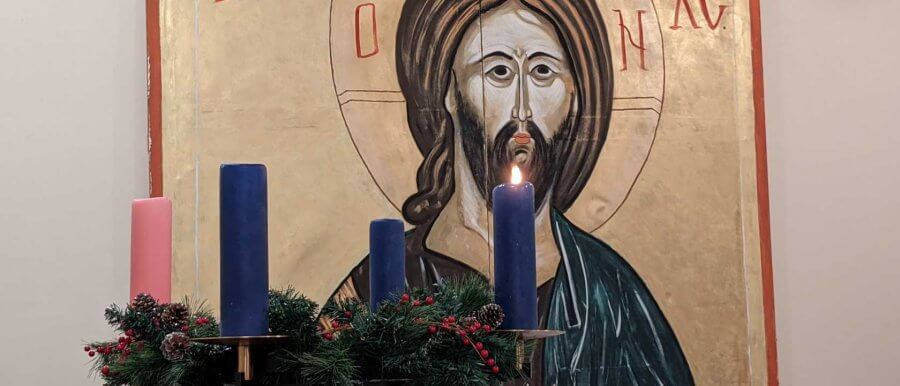
In this third episode of season 5 of Prophetic Voices: Preaching and Teaching Beloved Community, we speak with Episcopalians committed to the Beloved Community about the texts for Advent 3. The texts covered in this episode are Isaiah 35:1-10, Canticle 15, and Matthew 11:2-11.
The Rev. Christopher McNabb, SMMS, program officer for recruitment and engagement for the Neighbor-to-Neighbor program of Episcopal Migration Ministries. He lives in Seattle, Washington, with his rescue pup, Lucky.
The Rev. Canon Dr. Lauren Stanley, canon to the ordinary in the Episcopal Diocese of South Dakota. She has been ordained for 25 years and has served in Virginia, Pennsylvania, Sudan, Haiti, and on the Rosebud Indian Reservation in South Dakota.
Prophetic Voices is hosted by the Rev. Isaiah “Shaneequa” Brokenleg, The Episcopal Church’s staff officer for Racial Reconciliation. For more information on Becoming Beloved Community, visit iam.ec/becomingbelovedcommunity.
Prophetic Voices: Preaching and Teaching Beloved Community
Across our church and our society, we are having profound dialogues about race, truth, justice, and healing. Coming this Advent, Prophetic Voices: Preaching and Teaching Beloved Community explores where that dialogue intersects with our faith. Join us and our invited guests as we share prophetic voices and explore the readings for each week of Advent and Christmas Day through the lens of social justice.
You’ll hear ancient texts interpreted in new ways, find fodder for preaching and teaching, and make present day connections to the prophetic voices of the Bible. This podcast will help us rethink how we hear, see, and interact with the lectionary readings, refocusing from the rush of the Christmas season to the voice crying out in the wilderness.
Welcome to Church of the Redeemer: Worshiping God, living in community, and reaching out to the world. We are an Episcopal Church serving north King County and south Snohomish County, Washington. As you travel your road, go with friends walking the way of Jesus at Redeemer.
Church of the Redeemer is at 6220 Northeast 181st Street in Kenmore, Washington. We are a short distance north of Bothell Way, near the Burke-Gilman Trail. The entrance looks like a gravel driveway. The campus is larger on the inside than it is on the outside. And we managed to hide a large building on the side of a hill that is not easily seen from the street.
In this second episode of season 5 of Prophetic Voices: Preaching and Teaching Beloved Community, we speak with Episcopalians committed to the Beloved Community about the texts for Advent 2. The texts covered in this episode are Isaiah 11:1-10, Psalm 72:1-7, 18-19, and Matthew 3:1-12.
Our guests this week are the following:
The Rev. Jazzy Bostock, a kanaka maoli woman serving St. John the Baptist and Maluhia Lutheran Church in Waianae, Hawaii. She and her wife have a small homestead, consisting of raised garden beds, a flock of hens, a hive of bees, a dog, and a cat. They are foster parents, currently awaiting their next placement.
The Rev. Phil Hooper, SMMS, curate at Trinity Episcopal Church, Fort Wayne, in the Diocese of Northern Indiana. Phil has interests in writing and exploring contemplative spirituality.
Prophetic Voices is hosted by the Rev. Isaiah “Shaneequa” Brokenleg, The Episcopal Church’s staff officer for Racial Reconciliation. For more information on Becoming Beloved Community, visit iam.ec/becomingbelovedcommunity.
Prophetic Voices: Preaching and Teaching Beloved Community
Across our church and our society, we are having profound dialogues about race, truth, justice, and healing. Coming this Advent, Prophetic Voices: Preaching and Teaching Beloved Community explores where that dialogue intersects with our faith. Join us and our invited guests as we share prophetic voices and explore the readings for each week of Advent and Christmas Day through the lens of social justice.
You’ll hear ancient texts interpreted in new ways, find fodder for preaching and teaching, and make present day connections to the prophetic voices of the Bible. This podcast will help us rethink how we hear, see, and interact with the lectionary readings, refocusing from the rush of the Christmas season to the voice crying out in the wilderness.
Welcome to Church of the Redeemer: Worshiping God, living in community, and reaching out to the world. We are an Episcopal Church serving north King County and south Snohomish County, Washington. As you travel your road, go with friends walking the way of Jesus at Redeemer.
Church of the Redeemer is at 6220 Northeast 181st Street in Kenmore, Washington. We are a short distance north of Bothell Way, near the Burke-Gilman Trail. The entrance looks like a gravel driveway. The campus is larger on the inside than it is on the outside. And we managed to hide a large building on the side of a hill that is not easily seen from the street.
In this first episode of season 5 of Prophetic Voices: Preaching and Teaching Beloved Community, we speak with Episcopalians committed to the Beloved Community about the texts for Advent 1. The texts covered in this episode are Isaiah 2:1-5, Romans 12:11-14, and Matthew 24:36-44.
Our guests this week are the following:
The Rev. LaClaire Atkins, an alumnus of Church Divinity School of the Pacific who works in the hospitality sector and is currently momma to an amazing son.
Fr. Halim Shukair, who hails from Beirut, Lebanon, and is the priest-in-charge at Mother of the Savior Church, an Arabic-speaking congregation, and assistant priest at Christ Episcopal Church, Dearborn, Mich. Fr. Halim has interests in interfaith dialogue and contemplative life.
The Rev. Rachel Taber-Hamilton, who is of Indigenous, Shackan First Nation and European heritage. She is rector of Trinity Episcopal Church in Everett, Wash., serves as the vice-president of the House of Deputies, and cofounded the Circles of Color advocacy network in the Diocese of Olympia.
Prophetic Voices is hosted by the Rev. Isaiah “Shaneequa” Brokenleg, The Episcopal Church’s staff officer for Racial Reconciliation. For more information on Becoming Beloved Community, visit iam.ec/becomingbelovedcommunity.
Prophetic Voices: Preaching and Teaching Beloved Community
Across our church and our society, we are having profound dialogues about race, truth, justice, and healing. Coming this Advent, Prophetic Voices: Preaching and Teaching Beloved Community explores where that dialogue intersects with our faith. Join us and our invited guests as we share prophetic voices and explore the readings for each week of Advent and Christmas Day through the lens of social justice.
You’ll hear ancient texts interpreted in new ways, find fodder for preaching and teaching, and make present day connections to the prophetic voices of the Bible. This podcast will help us rethink how we hear, see, and interact with the lectionary readings, refocusing from the rush of the Christmas season to the voice crying out in the wilderness.
Welcome to Church of the Redeemer: Worshiping God, living in community, and reaching out to the world. We are an Episcopal Church serving north King County and south Snohomish County, Washington. As you travel your road, go with friends walking the way of Jesus at Redeemer.
Church of the Redeemer is at 6220 Northeast 181st Street in Kenmore, Washington. We are a short distance north of Bothell Way, near the Burke-Gilman Trail. The entrance looks like a gravel driveway. The campus is larger on the inside than it is on the outside. And we managed to hide a large building on the side of a hill that is not easily seen from the street.
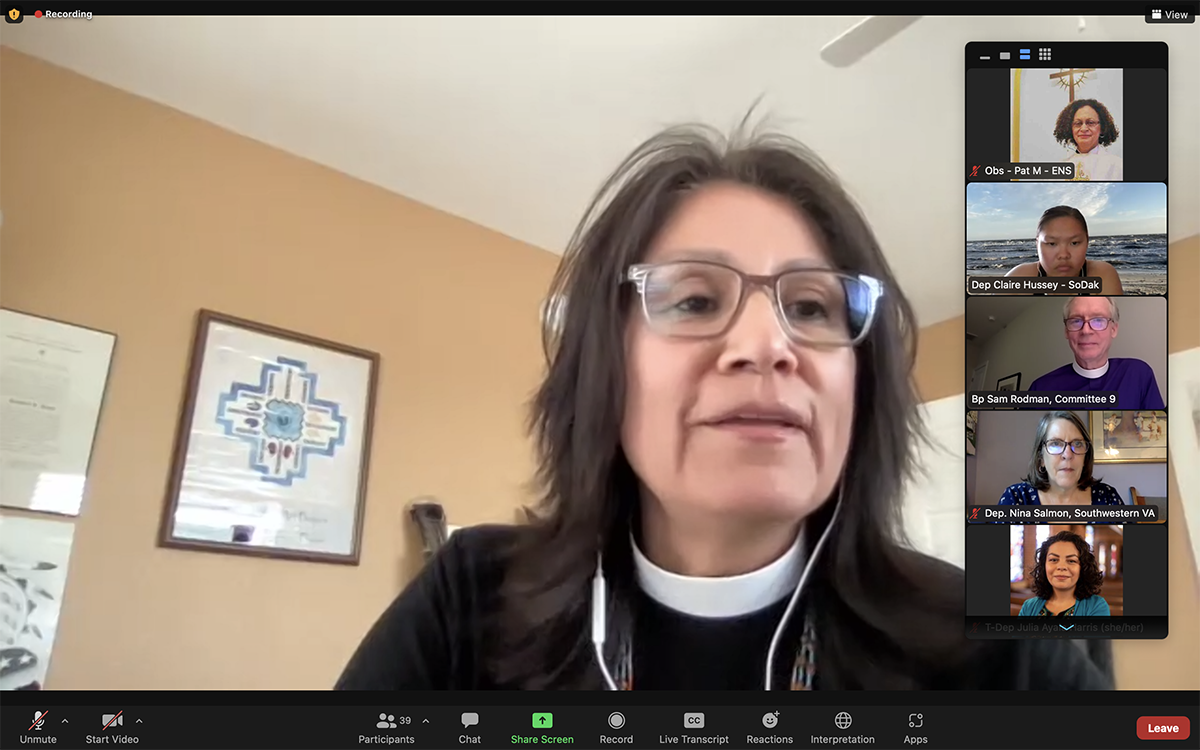
[Episcopal News Service] General Convention’s committees on Racial Justice and Reconciliation received testimony about resolutions to further and extend Beloved Community and the healing of intergenerational trauma resulting from the destructive effects of racism and white supremacy during a May 11, 2022, online hearing. The committees also engaged in discussion about appropriate inclusive language to refer to People of Color.
For the first time, two-dozen bishops’ and deputies’ committees are holding hearings together online in advance of the upcoming 80th General Convention. The triennial convention is the church’s governing body, where final resolutions are considered and voted on by both the House of Bishops and the House of Deputies. Select for a schedule of online hearings.
Julia Ayala Harris, chair of The Episcopal Church’s Standing Committee on Mission and a candidate for the president of the House of Deputies, told committee members that the “time is right to make a reality” Resolution A125, which would establish a voluntary Episcopal Coalition for Racial Equity and Justice among dioceses and congregations.
The proposed coalition was first unveiled in March in a report produced by the Presiding Officers’ Working Group on Truth-Telling, Reckoning and Healing. Presiding Bishop Michael Curry and the Rev. Gay Clark Jennings, president of the House of Deputies, created the working group last year to sharpen the church’s focus on confronting its past complicity with racist systems and the lingering legacy of white supremacy embedded in institutions like the church. The coalition also is seen as a remedy to the church’s uneven track record of prioritizing racial reconciliation, at the churchwide level and across its more than 100 dioceses. The proposal also calls on the church to set aside $2 million annually to carry out the work.
The Rev Cornelia Eaton.
Boarding school terror
The Rev. Cornelia Eaton described her mother’s terror at being sent to a New Mexico boarding school during the May 11 hearing.
The Rev. Cornelia Eaton, canon to the ordinary in the Navajoland Area Mission and part of its General Convention deputation and a member of Executive Council, described her mother’s terror at being sent to a New Mexico boarding school when supporting Resolutions A127 and A128. The resolutions call for “a comprehensive investigation of the church’s ownership and operation of Episcopal-run Indigenous boarding schools” and would also facilitate healing from their effects, respectively.
Eaton said A127, which also calls for the hiring of one or more research fellows to work with The Archives of The Episcopal Church to assist the investigation, would help Native people “move toward healing and reconciliation which, for many, will take time. This is another beginning for the church to respond to reparations and restore healing justice in God’s kingdom.”
Eaton’s mother was told she could not speak the Navajo language at the school. “She said, ‘I did not understand a word of English. I did not know how to respond to the teachers. Because I did not know how to speak English, I would just start crying.’”
If they did speak in Navajo, they were whipped. Her mother often cried herself to sleep at night, Eaton said. “I remember asking my mother how she continued to carry on the Navajo language and culture. At the boarding school, when she cried underneath the covers, she would speak to God in our Navajo language. She said that’s how she kept the Navajo language in her heart. To this day, she still speaks to us in the Navajo language. And I am grateful to her that she spoke to us in this language in a way that I am continuing today to speak it fluently.”
In July 2021, Curry and Jennings issued a statement lamenting the church’s involvement in operating Indigenous boarding schools and called Executive Council to deliver a comprehensive proposal for addressing the legacy of Indigenous schools at the 80th General Convention. The presiding officers called for earmarking resources for independent research in the archives of The Episcopal Church, options for developing culturally appropriate liturgical materials and plans for educating Episcopalians across the church about this history, among other initiatives.
Resolution A127 would allocate $125,000 and Resolution A128, would allocate $300,000 to invest in community-based spiritual healing centers to address intergenerational trauma through mental health and substance abuse counseling, traditional forms of healing and other services desired by the local community.
Eaton, program director for the Hozho Wellness Center, a ministry of the Navajoland Area Mission, noted that native people are at greater risk of dying by suicide than other Americans. Both resolutions, proposed by the Presiding Officers’ Working Group on Truth Telling, Reckoning and Healing, speak to the need for healing from intergenerational trauma. “I understand that healing won’t be easy,” she said. “However, we need to go through it in order for us to come back into harmony with one another.”
When testifying in support of Resolution C036 which proposes $2 million to extend the work of the Beloved Community, Miriam Casey, said the funding has assisted the Diocese of Northern California in three important efforts over the past three years: the creation of racial reconciliation workshops; funding basic instructional needs of an underfunded elementary school serving primarily Latino, immigrant and undocumented children; and hiring an Indigenous-led consulting firm to lead congregations through the process of developing land acknowledgments that build on meaningful relationships with the local Native communities.
“This process will be a model for other churches in our diocese,” said Casey, representing the diocesan Commission for Intercultural Ministries. “These projects were about telling the truth about racial inequities in our communities, imagining what it would be like if those inequities were not present, growing in our capacity to love and taking action to address inequities created by racism,” said Casey, noting that the efforts would not have been possible without funding from the Becoming Beloved Community grants.
South Dakota Deputy Claire Hussey.
Use of the term “people of color”
Discussion of Resolution A131, proposed by the Presiding Officers’ Working Group on Truth Telling, Reckoning and Healing would establish the phrase “people of color” when referring to communities in the church, that do not exclusively identify as white.
The Rev. Nina Salmon, Southwest Virginia deputy and committee secretary, sparked lively discussion when she asked if the term “BIPOC” or Black, Indigenous and people of color was a preferable term.
The Rev. Leon Sampson, a deputy from Navajoland Area Mission, and others told the meeting that BIPOC leaves out references to Latino and Asian Americans and is considered offensive. “I feel like it takes away from the uniqueness of our history. It takes away from the historical racial ideology that has happened.”
New York Deputy Diane Pollard, a member of Executive Council, said she found the acronym offensive and exclusionary. “So many of us, who do this work have been working so long to be inclusive. Reducing everyone to five letters for the convenience of society to me, there is something very wrong about that.”
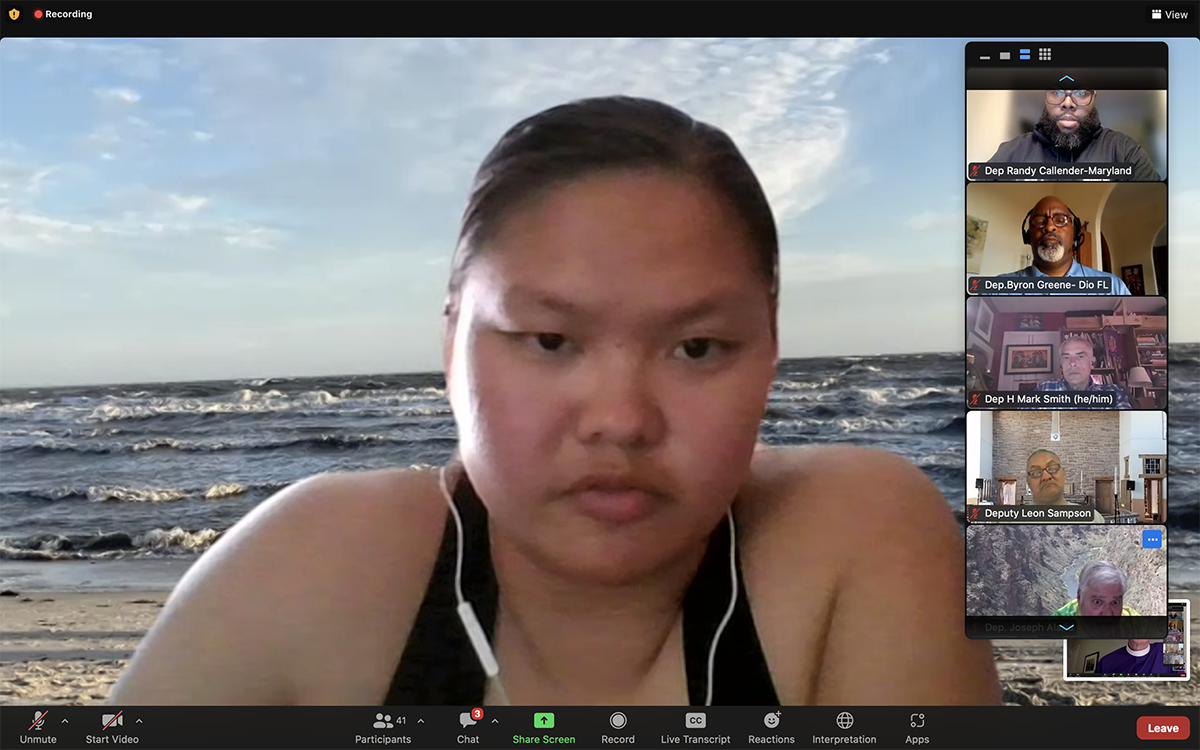
South Dakota Deputy Claire Hussey testified to her dislike of the acronym BIPOC.
South Dakota Deputy Claire Hussey, the assistant committee secretary, said: “As a young adult, an Asian American, I don’t really appreciate the term BIPOC. That makes it seem like if you are Black, or if you are Indigenous, you are somehow separate from people of color. Then you’re lumping in people like Latina, Latinx, Asian American, anyone else that is not identifying themselves as white into the separate category that’s not as important to recognize as Black or Indigenous. If we switch over to ‘people of color’ … that makes it sound like we’re all people that are not in that racial majority. And I think that inclusivity is important because it puts all of those ethnicities and a sort of united understanding that no, none of us, are truly in that racial majority.”
–The Rev. Pat McCaughan is a correspondent for Episcopal News Service, based in Los Angeles.
Church of the Redeemer
Welcome to Church of the Redeemer: Worshiping God, living in community, and reaching out to the world. We are an Episcopal Church serving north King County and south Snohomish County, Washington. As you travel your road, go with friends walking the way of Jesus at Redeemer.
Church of the Redeemer is at 6220 Northeast 181st Street in Kenmore, Washington. We are a short distance north of Bothell Way, near the Burke-Gilman Trail. The entrance looks like a gravel driveway. The campus is larger on the inside than it is on the outside. And we managed to hide a large building on the side of a hill that is not easily seen from the street.
Three years after launching Sacred Ground, a dialogue series on race, racism, and whiteness with more than 20,000 participants thus far, The Episcopal Church’s Racial Reconciliation and Justice Team is releasing a comprehensive evaluation report, updated curriculum and resources, and expanded licensing that invites people in other denominations/faiths to start their own Sacred Ground circles.
“Everywhere I travel, people are bursting to tell me about the transformational impact Sacred Ground has had in their lives,” said Episcopal Church Presiding Bishop Michael Curry. “The Lord is building Beloved Community through this movement, and in its updated and expanded form, Sacred Ground will help many thousands more take the next steps in the lifelong work of racial healing.”
Take action on racial justice, not just preach about it
In partnership with the Union of Black Episcopalians, Sacred Ground worked with Christina Pacheco of Indígena Consulting Inc. in 2021 to conduct surveys and focus groups with more than 2,900 participants, facilitators, and organizers of the film- and readings-based series that includes circle groups throughout the U.S. (84 dioceses were represented among survey respondents).
The resulting 63-page report is designed to help Sacred Ground facilitators, organizers, and churchwide staff discover what they can do to create the best outcomes for circles. It includes a detailed breakdown of questions and results, charts, graphs, and numerous quotes from respondents.
Among other findings, the survey showed overwhelmingly that Sacred Ground has had a powerful impact on participants’ knowledge, attitudes, and emotional capacity. It has prompted action such as initiating “racial reckoning” conversations in one’s family, supporting Black businesses, holding listening sessions with Indigenous people, and joining county-level policing accountability projects. The survey also reflected a desire for more guidance in this area.
“It has helped us take action on racial justice, not just preach about it,” a Sacred Ground organizer is quoted as saying in the evaluation report.
While the program was especially designed to help White people talk with each other about race, the survey showed that participants of color also found the experience valuable for their own learning and transformation.
Updates to Sacred Ground
These and other survey results—as well as a curriculum review by volunteers, consultants, and advisors—informed changes, updates, and additions to the Sacred Ground program that include the following:
A list of best practices for organizing and facilitating Sacred Ground circles, including a recommendation for more interracial circles.
“We Bless You,” a 22-minute invitational video produced collaboratively with the Union of Black Episcopalians that speaks to those discerning whether to participate in a circle, and whether to form a White or interracial circle.
A revised session 10 and new session 11 to help address the desire for help in moving from reflection to action.
Curriculum additions, such as some related to the history of Indigenous boarding schools.
Higher visibility of theological reflections in the program.
Deeper Dive, a list of supplementary videos and readings for those who want to go further in their learning and exploration.
In addition to the updated curriculum, Sacred Ground’s three-year licenses for videos and readings have been renewed, with an expansion for other local-level faith groups that would like to offer the program without direct Episcopal Church involvement.
One Sacred Ground facilitator is quoted in the report as saying: “Thank you. However painful it is to see what our country has done wrong, I am glad to have become informed of the truth. I hope everyone can have access to this program.”
Sacred Ground is a film- and readings-based dialogue series on race, grounded in faith. Small groups are invited to walk through chapters of America’s history of race and racism, while weaving in threads of family story, economic class, and political and regional identity.
The 11-part series is built around a powerful online curriculum of documentary films and readings that focus on Indigenous, Black, Latino, and Asian/Pacific American histories as they intersect with European American histories.
Sacred Ground is part of Becoming Beloved Community, The Episcopal Church’s long-term commitment to racial healing, reconciliation, and justice in our personal lives, our ministries, and our society. This series is open to all, and especially designed to help white people talk with other white people. Participants are invited to peel away the layers that have contributed to the challenges and divides of the present day – all while grounded in our call to faith, hope and love.
Public Affairs Office of the Episcopal Church
The Public Affairs Office provides statistics, biographies, photos, background information, and other resources to media representatives reporting on the mission and ministries of The Episcopal Church.
Welcome to Church of the Redeemer: Worshiping God, living in community, and reaching out to the world. We are an Episcopal Church serving north King County and south Snohomish County, Washington. As you travel your road, go with friends walking the way of Jesus at Redeemer.
Church of the Redeemer is at 6220 Northeast 181st Street in Kenmore, Washington. We are a short distance north of Bothell Way, near the Burke-Gilman Trail. The entrance looks like a gravel driveway. The campus is larger on the inside than it is on the outside. And we managed to hide a large building on the side of a hill that is not easily seen from the street.
In this fifth episode of season 4 of Prophetic Voices: Preaching and Teaching Beloved Community, we speak with Episcopalians committed to the Beloved Community about the texts for the Easter Vigil. The texts covered in this episode are Exodus 14:10-31, 15:20-21, and Luke 24:1-12. Our guests this week are:
The energetic Nick Gordon, the United Thank Offering‘s Julia Chester Emery intern working with the Reconciliation, Justice, and Creation Care team. He is a college student attending New York University and is a Vestry and altar guild member at St. John’s in the Village Church in New York City. He is also a current member of the Diocese of New York’s Committee to Elect a Bishop and Antiracism Committee.
The Rev. Lydia Simmons, from Lead, South Dakota, missioner for Camp and Young Adult Ministries for the Diocese of South Dakota and rector of Christ Church Episcopal in Lead. Her labradoodle puppy, Luna, loves to contribute to all aspects of her ministry, including in the background of most conversations!
Prophetic Voices is hosted by the Rev. Isaiah “Shaneequa” Brokenleg, The Episcopal Church’s staff officer for Racial Reconciliation. For more information visit Becoming Beloved Community.
Find the episode online or wherever you listen to podcasts.
Prophetic Voices: Preaching and Teaching Beloved Community
Across our church and our society, we are having profound dialogues about race, truth, justice, and healing. Coming this Advent, Prophetic Voices: Preaching and Teaching Beloved Community explores where that dialogue intersects with our faith. Join us and our invited guests as we share prophetic voices and explore the readings for each week of Advent and Christmas Day through the lens of social justice.
You’ll hear ancient texts interpreted in new ways, find fodder for preaching and teaching, and make present day connections to the prophetic voices of the Bible. This podcast will help us rethink how we hear, see, and interact with the lectionary readings, refocusing from the rush of the Christmas season to the voice crying out in the wilderness.
Welcome to Church of the Redeemer: Worshiping God, living in community, and reaching out to the world. We are an Episcopal Church serving north King County and south Snohomish County, Washington. As you travel your road, go with friends walking the way of Jesus at Redeemer.
Church of the Redeemer is at 6220 Northeast 181st Street in Kenmore, Washington. We are a short distance north of Bothell Way, near the Burke-Gilman Trail. The entrance looks like a gravel driveway. The campus is larger on the inside than it is on the outside. And we managed to hide a large building on the side of a hill that is not easily seen from the street.
In this fourth episode of season 4 of Prophetic Voices: Preaching and Teaching Beloved Community, we speak with Episcopalians committed to the Beloved Community about the texts for Good Friday. The texts covered in this episode are Psalm 22 and John 18:1-19:42. Our guests this week are the following:
Betty Peterson, who serves at-risk babies and moms as a nurse and social worker for the Brightstart program. She comes to us from the Orthodox faith tradition and attends Transfiguration Greek Orthodox Church in Sioux Falls, South Dakota, where she is a chanter.
Dr. Enid LaGesse, who is here because of the sacrifices of her enslaved ancestors and those of the Anacostan and Piscataway on whose stolen sacred land she now lives. Enid brings more than 30 years of diversity, equity, and inclusion leadership experience to her current role as the co-chair of the Race and Social Justice Committee for the Episcopal Diocese of Washington. She facilitates workshops on anti-racism, intersectionality, and interfaith dialogue.
Prophetic Voices is hosted by the Rev. Isaiah “Shaneequa” Brokenleg, The Episcopal Church’s staff officer for Racial Reconciliation. For more information visit Becoming Beloved Community.
Find the episode online or wherever you listen to podcasts.
Prophetic Voices: Preaching and Teaching Beloved Community
Across our church and our society, we are having profound dialogues about race, truth, justice, and healing. Coming this Advent, Prophetic Voices: Preaching and Teaching Beloved Community explores where that dialogue intersects with our faith. Join us and our invited guests as we share prophetic voices and explore the readings for each week of Advent and Christmas Day through the lens of social justice.
You’ll hear ancient texts interpreted in new ways, find fodder for preaching and teaching, and make present day connections to the prophetic voices of the Bible. This podcast will help us rethink how we hear, see, and interact with the lectionary readings, refocusing from the rush of the Christmas season to the voice crying out in the wilderness.
Welcome to Church of the Redeemer: Worshiping God, living in community, and reaching out to the world. We are an Episcopal Church serving north King County and south Snohomish County, Washington. As you travel your road, go with friends walking the way of Jesus at Redeemer.
Church of the Redeemer is at 6220 Northeast 181st Street in Kenmore, Washington. We are a short distance north of Bothell Way, near the Burke-Gilman Trail. The entrance looks like a gravel driveway. The campus is larger on the inside than it is on the outside. And we managed to hide a large building on the side of a hill that is not easily seen from the street.
The Rev. Phil Hooper, SMMS, curate at Trinity Episcopal Church, Fort Wayne, in the Diocese of Northern Indiana.
The Rev. Shug Goodlow, Diocesan Missioner for Racial Reconciliation and Justice in the Diocese of Missouri. Shug serves as the assistant rector at St. Martin’s Episcopal Church in Ellisville. When not involved in church matters, you’ll find her working in community theatre productions.
Prophetic Voices is hosted by the Rev. Isaiah “Shaneequa” Brokenleg, The Episcopal Church’s staff officer for Racial Reconciliation. For more information visit Becoming Beloved Community.
Find the episode online or wherever you listen to podcasts.
Prophetic Voices: Preaching and Teaching Beloved Community
Across our church and our society, we are having profound dialogues about race, truth, justice, and healing. Coming this Advent, Prophetic Voices: Preaching and Teaching Beloved Community explores where that dialogue intersects with our faith. Join us and our invited guests as we share prophetic voices and explore the readings for each week of Advent and Christmas Day through the lens of social justice.
You’ll hear ancient texts interpreted in new ways, find fodder for preaching and teaching, and make present day connections to the prophetic voices of the Bible. This podcast will help us rethink how we hear, see, and interact with the lectionary readings, refocusing from the rush of the Christmas season to the voice crying out in the wilderness.
Welcome to Church of the Redeemer: Worshiping God, living in community, and reaching out to the world. We are an Episcopal Church serving north King County and south Snohomish County, Washington. As you travel your road, go with friends walking the way of Jesus at Redeemer.
Church of the Redeemer is at 6220 Northeast 181st Street in Kenmore, Washington. We are a short distance north of Bothell Way, near the Burke-Gilman Trail. The entrance looks like a gravel driveway. The campus is larger on the inside than it is on the outside. And we managed to hide a large building on the side of a hill that is not easily seen from the street.
In this second episode of season 4 of Prophetic Voices: Preaching and Teaching Beloved Community, we speak with Episcopalians committed to the Beloved Community about the texts for Palm Sunday. The texts covered in this episode are Luke 19:28-40, and Luke 22:14-23:56 and Psalm 31:9-16. Our guests this week are the following:
The Rev. Jazzy Bostock, a priest in the Diocese of Hawaii serving St. John the Baptist Episcopal Church and Maluhia Lutheran Church, both on the west side of O’ahu.
The Rev. Winnie Varghese, rector of St. Luke’s Episcopal Church in Atlanta, Georgia. She has served in multiple churchwide roles, including as a member of executive council and as voting secretary of General Convention.
The Rev. Jean Mornard, rector of Grace Episcopal Church in Huron, Diocese of South Dakota (home of the world’s largest ringneck pheasant!). She is originally from Duluth, Minnesota, and grew up in a suburb of St. Paul.
Prophetic Voices is hosted by the Rev. Isaiah “Shaneequa” Brokenleg, The Episcopal Church’s staff officer for Racial Reconciliation. For more information visit Becoming Beloved Community.
Find the episode online or wherever you listen to podcasts.
Prophetic Voices: Preaching and Teaching Beloved Community
Across our church and our society, we are having profound dialogues about race, truth, justice, and healing. Coming this Advent, Prophetic Voices: Preaching and Teaching Beloved Community explores where that dialogue intersects with our faith. Join us and our invited guests as we share prophetic voices and explore the readings for each week of Advent and Christmas Day through the lens of social justice.
You’ll hear ancient texts interpreted in new ways, find fodder for preaching and teaching, and make present day connections to the prophetic voices of the Bible. This podcast will help us rethink how we hear, see, and interact with the lectionary readings, refocusing from the rush of the Christmas season to the voice crying out in the wilderness.
Welcome to Church of the Redeemer: Worshiping God, living in community, and reaching out to the world. We are an Episcopal Church serving north King County and south Snohomish County, Washington. As you travel your road, go with friends walking the way of Jesus at Redeemer.
Church of the Redeemer is at 6220 Northeast 181st Street in Kenmore, Washington. We are a short distance north of Bothell Way, near the Burke-Gilman Trail. The entrance looks like a gravel driveway. The campus is larger on the inside than it is on the outside. And we managed to hide a large building on the side of a hill that is not easily seen from the street.
In this first episode of season 4 of Prophetic Voices: Preaching and Teaching Beloved Community, we speak with Episcopalians committed to the Beloved Community about the texts for Ash Wednesday. The texts covered in this episode are Isaiah 58:1-12, Psalm 103, and Matthew 6:1-6, 16-21. Our guests this week are the following:
The Rev. Dr. Hillary Raining, rector of St. Christopher’s Church in Gladwyne, Diocese of Pennsylvania, and creator of The Hive online spirituality and wellness digital community.
The Rev. Canon Lydia Bucklin, from Marquette, Michigan, and Canon to the Ordinary for Discipleship and Vitality with the Episcopal Diocese of Northern Michigan. She is also the director of the Mutual Ministry Initiative at Virginia Theological Seminary.
Sr. Madeliene Mary, prioress at the Community of St. Mary, Southern Province and a religious for 51 years. She is a spiritual director and helps people explore the connections between faith, care for creation, and Benedictine spirituality.
Prophetic Voices is hosted by the Rev. Isaiah “Shaneequa” Brokenleg, The Episcopal Church’s staff officer for Racial Reconciliation. For more information visit Becoming Beloved Community.
Find the episode online or wherever you listen to podcasts.
Prophetic Voices: Preaching and Teaching Beloved Community
Across our church and our society, we are having profound dialogues about race, truth, justice, and healing. Coming this Advent, Prophetic Voices: Preaching and Teaching Beloved Community explores where that dialogue intersects with our faith. Join us and our invited guests as we share prophetic voices and explore the readings for each week of Advent and Christmas Day through the lens of social justice.
You’ll hear ancient texts interpreted in new ways, find fodder for preaching and teaching, and make present day connections to the prophetic voices of the Bible. This podcast will help us rethink how we hear, see, and interact with the lectionary readings, refocusing from the rush of the Christmas season to the voice crying out in the wilderness.
Welcome to Church of the Redeemer: Worshiping God, living in community, and reaching out to the world. We are an Episcopal Church serving north King County and south Snohomish County, Washington. As you travel your road, go with friends walking the way of Jesus at Redeemer.
Church of the Redeemer is at 6220 Northeast 181st Street in Kenmore, Washington. We are a short distance north of Bothell Way, near the Burke-Gilman Trail. The entrance looks like a gravel driveway. The campus is larger on the inside than it is on the outside. And we managed to hide a large building on the side of a hill that is not easily seen from the street.