Opening remarks by the Presiding Bishop to the Executive Council
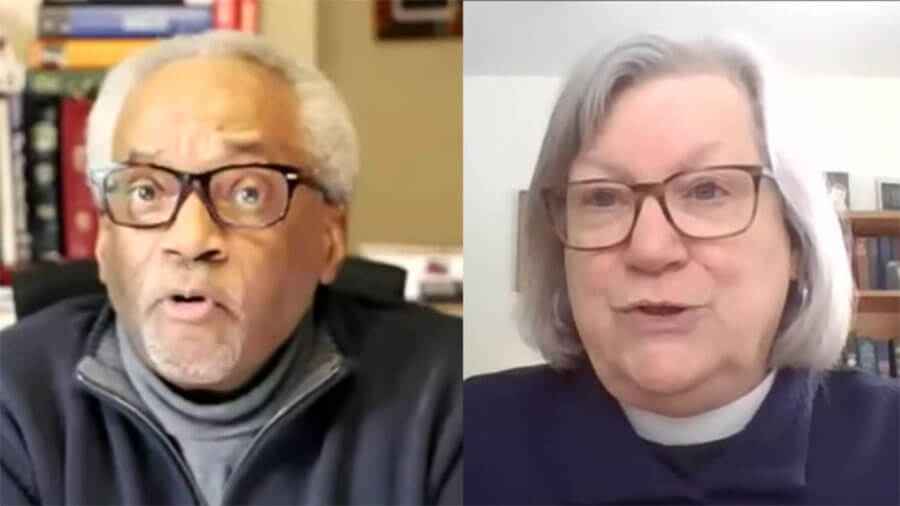
The following is a transcript of the opening remarks of Presiding Bishop Michael Curry at the Executive Council of The Episcopal Church, meeting virtually through Jan. 27. These remarks have been lightly edited for clarity. The text is from the Public Affairs Office of the Episcopal Church.
Desire to meet together
It is good to be together, I wish we were in Cleveland right now, I wish we were all together, but we will be together very soon.
Part I: Weeping at the reading, interpreting, application of God’s Word
Recently I was talking to a good friend who suggested that I needed to take a look at the reading from Nehemiah appointed for last Sunday (Nehemiah 8:1-10).
In the text, Ezra the priest reads the law of God to the people. And the text says that when he reads it and interprets it and applies it to their lives, the people wept when they heard it. Why did they weep? My friend was right. That’s simply extraordinary! God’s word was read, interpreted, and applied to their lives, and the people wept! Why in God’s name did they weep?
They had been through a long period of dislocation, disorientation, and disequilibrium. Worse than a pandemic, but related. Their world had actually fallen apart when the Babylonian armies razed the Judea countryside, breached the walls of Jerusalem, desecrated the Temple King Solomon had built, and virtually destroyed Jerusalem.
Many of the people were then carted off to Babylon, to virtual servitude, a long, long way from home. As the exile went on, they forgot what home was like. The temple of Jerusalem became a distant memory.
In time many probably forgot the faith that gave them birth. Holy days sometimes went unobserved. Teachings unlearned. Traditions left unkept. They did what they could to survive on what they had. The deep spiritual and emotional pain of this is captured in one of the psalms that they have left us, Psalm 137, which says:
By the waters of Babylon—
we sat down and wept
and we remembered thee, O Zion,
when we remembered home.
On the willows
we hung up our harps.
For it was there that our captors
required of us a song,
tormenting us with the words,
‘Sing us one of the songs of Zion!’
But how, how shall we sing the LORD’s song
in a strange land?” (paraphrased)
And soon the very song was forgotten.
And then on that day years later in Jerusalem, Ezra read the Torah, God’s law for life; he interpreted it and applied it to them. And they remembered!
- They remembered their high calling.
- They remembered life that is more than mere survival.
- They remembered who they were and whose they were.
The congruence of their lives with their calling, their highest and noblest aspirations, ideals gave them something exile had taken away—a deep sense of a divine purpose for living.
In God‘s law they discovered who they were. And when you know that you can face anything, you can endure anything, you can bear any burden, with a sense of direction no matter how hard life can be.
Another way to say it is they found their soul, their core, the essence, their heart. And when that happens the word of Ezra in the rest of the text becomes true –
“Go your way,” he said to them, “eat the fat and drink sweet wine and send portions of them to those for whom nothing is prepared, for this day is holy to our LORD; and do not be grieved, for the joy of the LORD is your strength.”
Part II: Restoration of Christianity
In 2005 Huston Smith, who was himself a Christian, grown up the son of Methodist missionaries in Asia but who was a scholar of world religions, wrote one of his last books. In it he spoke of the renewal of genuine Christianity in our time in a process similar to that described when Ezra read the law. Part of what he said in that book was that Christianity would be revived, renewed, and restored as it rediscovers and reclaims its soul, its origin, its essence, found in the teachings, and the life and the spirit of Jesus of Nazareth. He called his book The Soul of Christianity: Restoring the Great Tradition.
The wisdom here is one of the reasons I believe passionately that we in our time must reclaim the teachings, and the example, and the spirit of Jesus of Nazareth and his way of love as our way of life.
Some years later, after Huston Smith had published his book, historian Jon Meacham followed a similar trajectory to Huston Smith and to Ezra—now for American democracy and society, to reclaim the high calling and noble ideals, in a book titled, interestingly enough, The Soul of America: The Battle for Our Better Angels.
To find our way as a nation that is more than a collection of individual self-interest, it will be necessary for us to claim the high calling of the ideals and principles at the core, the soul of the American experiment in representational democracy.
Part III: Imago Deo
Those ideals are found in such texts as the Declaration of Independence, Lincoln’s Gettysburg Address, King’s “Letter from a Birmingham Jail.” They are found, though imperfect it may be, in the Constitution of the United States, the Bill of Rights and subsequent amendments. But listen again to the words of the Preamble:
We the People of the United States, in Order to form a more perfect Union, establish Justice, insure domestic Tranquility, provide for the common defense, promote the general Welfare, and secure the Blessings of Liberty to ourselves and our Posterity, do ordain and establish this Constitution for the United States of America.
The ideal of democracy, while not perfectly lived out to be sure, offers the best hope yet devised for government that fosters human freedom, equal justice under law, the dignity and equality of every human being made as the Bible says in the image and likeness of God.
A cornerstone of that democratic ideal is and remains the right to vote. The right to vote is a fundamental human right grounded in the dignity and equality of human beings. I am thankful that this Executive Council previously has gone on record supporting, or advocating for the John R. Lewis Voting Rights Advancement Act, the Freedom to Vote Act, and/or other similar legislation that enhances and furthers the provisions and intention of the Voting Rights Acts of 1965.
But as you know from the news, this is not going to happen overnight, and it’s not going to happen easily. But we and other people of good will must work, we must persist, and we must labor on against the odds until the right to vote is fully protected and unencumbered by partisan self interest.
Like the story of the persistent widow that Jesus told, who would not let the judge get away with ignoring her, we must persist until justice rolls down like a mighty stream and righteousness like an ever-flowing brook.
But we must do something else. We must both advocate for these legislative remedies and also roll up our sleeves to do the hard and laborious work of nonpartisan—and please hear me when I say this; don’t anybody send me emails saying this is partisan since this is not a partisan rant—we must do the hard and laborious work of nonpartisan voter education, registration, and facilitation. And it’s hard work. And you wonder why is he saying this now? It’s January—the midterms aren’t till November. We can’t wait until November to start that work! We must start now.
The Office of Government Relations has begun an effort to do just that. It’s called Episcopal Activators. This is a practical effort to help people to vote in spite of encumbrances that may currently stand in the way for many in many of our states. We must help folks be able to cast an unencumbered ballot. We must do so in a nonpartisan way, but we must do it.
The right to vote is not merely a secular ideal. It is a fundamental human right grounded in the innate dignity and equality of every human being created, as the Bible says, in the image and likeness of God.
For this reason the passage of the foundational Voting Rights Bill of 1965 only occurred after long, protracted nonviolent struggle and protest.
It is salutary to remember that countless people were beaten and hospitalized on the successive marches in Selma. It is important to remember that on that March “Bloody Sunday,” 17 marchers were hospitalized by beatings from law enforcement. Several dozen were treated in hospitals and released.
And maybe it is most important to remember that in the Selma struggle for voting rights, four nonviolent protesters and children of God involved in voter registration were killed:
- Jimmie Lee Jackson, a local Baptist deacon
- The Rev. James Reeb, a Unitarian minister
- Viola Liuzzo, a housewife who volunteered from Detroit
- Jonathan Myrick Daniels, an Episcopal seminarian
They gave their lives for the right to vote. But they were martyrs who gave their lives for the cause of our God-given human right and dignity. “We hold these truths to be self-evident, that all men are created equal. That they are endowed—not by a parliament, not by a government—endowed by their Creator with certain unalienable rights.” That is not simply a secular ideal, that is an ideal born of the God who made all human beings equally imago dei, in the image of God. And we who are followers of Jesus Christ, we who are citizens of this country, we who are people of good will and human decency of any stripe or type, must not, cannot, and we will not allow their sacrifice to be in vain.
Amen.

Opening remarks by the President of the House of Deputies to the Executive Council
The following are the opening remarks of President of the House of Deputies Gay Clark Jennings at the Executive Council of The Episcopal Church, meeting virtually through January 27, 2022. The text is from the Public Affairs Office of the Episcopal Church.
Welcome to the Executive Council meeting
Welcome to this virtual meeting of Executive Council, which was originally supposed to be an in-person meeting in Cleveland, near where I live. I was looking forward to having you all here, but now I confess to some relief that you are all home and, I hope, safe on Zoom.
In addition to the omicron surge, which is still contributing to a shortage of healthcare capacity here in the Cleveland area, we are in the midst of the snowiest January in several years, with some parts of town having received more than 25 inches so far. Plus, the temperature tomorrow isn’t going to get out of the teens. While I know that those of you from Erie and Buffalo and Minneapolis scoff at those numbers, those of us who live here are very glad that we didn’t spend Sunday afternoon at the airport trying to retrieve you from your delayed flights. We have lovely weather here in Cleveland for a couple of weeks in June and a couple of weeks in October, and we warmly invite you to visit us then.
Brant Lee to speak to the Executive Council
Even though you weren’t able to travel to Northeast Ohio in person for this meeting, I am proud to say that we’re still bringing some of the best of our region to you via Zoom. Tomorrow afternoon we will hear from Professor Brant Lee, assistant dean of diversity and social justice initiatives at the University of Akron Law School, faithful lifelong Episcopalian, Wordle master, a member of the Task Force on Theology of Social Justice Advocacy that served during this never-ending triennium, and a member of the Presiding Officers’ Advisory Group on Beloved Community Implementation.
Brant’s scholarly focus is on race and complex systems, and before joining the law school faculty, he served as counsel to the U.S. Senate Judiciary Committee and in the White House as acting deputy staff secretary and special assistant to the president. Brant holds a bachelor’s degree in philosophy from the University of California, Berkeley, a law degree from Harvard University, and a master’s degree in public policy from Harvard, and is much in demand as a teacher, speaker, and anti-racism trainer.
If it sounds like I’m bragging about him, I am. We are a fiercely proud people here in Northeast Ohio—it is what we do to pass the time while it is snowing—and I am delighted that Brant will be with us tomorrow to talk with us about dismantling racism.
Work to dismantle racism
At our October meeting, the focus of our work to dismantle racism involved hearing from the Indigenous Boarding Schools Ad Hoc Committee, which is working to investigate and address our church’s complicity with the schools that decimated so many Native American families and communities.
Earlier this month, the presiding bishop and I both had the amazing opportunity to continue our listening by attending Winter Talk, a yearly gathering that highlights the ministry of Indigenous people in our church. During Winter Talk, we heard heartbreaking stories from leaders who have helped bring home the remains of children who died at boarding schools in the late 19th and early 20th centuries. These stories, which you will never forget once you hear them, underscore the need for us to face the truth of our church’s historic complicity in the boarding school system.
Winter Talk was held online this year due to COVID-19, and as a result, you can visit the Episcopal Church’s YouTube channel to watch recordings of this powerful event. I commend that to you. I am grateful to Brad Hauff, missioner for Indigenous Ministries, and all of the leaders who made Winter Talk possible despite pandemic restrictions, and I am grateful to the Joint Standing Committee on Mission Within the Episcopal Church for its ongoing work to deliver to our April meeting a comprehensive proposal for how we can address the legacy of Indigenous schools at General Convention and beyond.
LGBTQI+ issues
Several times during this triennium, which we should perhaps now be calling an Olympiad, we have also reckoned with the church’s historic and ongoing complicity with homophobia, transphobia, and other discrimination and abuse against our LGBTQI+ siblings. With thanks to Julia Ayala Harris and the Mission Within Committee, we will have a chance at this meeting to listen deeply to several LGBTQI+ leaders and allies in our church who can help us better understand the ways in which we can continue the journey toward full inclusion, mindful that distorted forms of Christianity are, even today, too often toxic, and even lethal, to LGBTQI+ people.
I look forward to welcoming Deputy Cameron Partridge, Rowan Larson, Gwen Fry, Lauren Kay, Kit Wang, Shaneequa Brokenleg, Deputy Sarah Lawton, and Iain Stanford to our meeting this afternoon to help educate us about gender identity and talk with us about the experiences of transgender and non-binary children of God.
Upcoming General Convention
As we peer at one another through our Zoom screens, surely you are wondering about our plans for General Convention, which is scheduled for just under six months from now. While the presiding bishop and I have every hope that it will be possible to hold General Convention in Baltimore from July 7-14, we have recently formed a scenario planning group made up of leaders in both the House of Bishops and House of Deputies and key staff people.
This group, which Canon Michael Barlowe has agreed to convene, will keep a close watch on public health data and guidance and provide the presiding bishop and me with various options for holding the 80th General Convention in a way that safeguards all of us who will participate and all those who will host us in airports, hotels, restaurants, and convention facilities.
We will provide you and the members of both houses of General Convention with updates once we have had the opportunity to consider the scenarios presented to us and consult with the Joint Standing Committee on Planning and Arrangements.
Work in uncertain times
Friends, these are hard and uncertain times. During this meeting, I pray that we can be generous and patient with one another, remembering that our call is not to make the church the most comfortable place it can be for ourselves, but to bring The Episcopal Church ever closer to the Beloved Community we are called to be. As the gospel reading for last Sunday reminded us, our job is “to bring good news to the poor… to proclaim release to the captives and recovery of sight to the blind, to let the oppressed go free, to proclaim the year of the Lord’s favor.” Let us follow Jesus in that holy work this week and always.

Executive Council of the Episcopal Church
The Executive Council of the General Convention, an elected body representing the whole church, carries out the programs and policies adopted by General Convention. Its job is to oversee the ministry and mission of The Episcopal Church. This includes oversight responsibility for the work done by the Domestic and Foreign Missionary Society as well as the disposition of funds and other property in accordance with the canons of The Episcopal Church and the resolutions, orders, and budgets adopted or approved by the General Convention. Also included is oversight responsibility for the work of the Office of General Convention.
The Executive Council is composed of 20 members elected by General Convention (four bishops, four priests or deacons, and 12 laypersons) and 18 members elected by province (one clergy, one lay person per province).
The presiding bishop and the president of the House of Deputies are the chair and vice chair. The other officers of the Executive Council are ex-officio with seat and voice but no vote.
View the roster of members.
Church of the Redeemer
Welcome to Church of the Redeemer: Worshiping God, living in community, and reaching out to the world. We are an Episcopal Church serving north King County and south Snohomish County, Washington. As you travel your road, go with friends walking the way of Jesus at Redeemer.
Church of the Redeemer is at 6220 Northeast 181st Street in Kenmore, Washington. We are a short distance north of Bothell Way, near the Burke-Gilman Trail. The entrance looks like a gravel driveway. The campus is larger on the inside than it is on the outside. And we managed to hide a large building on the side of a hill that is not easily seen from the street.
The Episcopal Church welcomes you.