Author: Bob Chapman

  • Presiding Bishop Rowe responds to travel ban, immigration crackdown

    Presiding Bishop Rowe responds to travel ban, immigration crackdown

    [Episcopal News Service] Presiding Bishop Sean Rowe released a letter to The Episcopal Church on June 11, 2025. The letter responds to a series of Trump administration policies on migration and immigration. This includes the use of the military for crowd control at protests.

    Federal agents conducted immigration enforcement raids in Los Angeles on June 6, 2025. Afterwards, protesters clashed with law enforcement in parts of the city over the weekend. Trump, against the wishes of California leaders, ordered the California National Guard to deploy thousands of soldiers to assist. His administration also has deployed Marines to the city to secure federal properties. California leaders have sued the Trump administration to reverse the decision to send in troops.

    Rowe’s letter is titled “Acting Faithfully in Troubling Times.” It calls such military deployments “a dangerous turn” in President Donald Trump’s attacks on his political opponents and his administration’s ongoing immigration crackdown. Rowe also amplified a statement issued June 10 by the bishops of California’s six Episcopal dioceses.

    Trump also has faced criticism for a separate policy, restricting travel to the United States from 19 countries. Rowe, in his letter, said he had written to Anglican leaders in those countries expressing his concern about Trump’s new travel ban.

    “At its best, our church is capable of moral clarity and resolute commitment to justice. I believe we can bring those strengths to bear on this gathering storm,” said Presiding Bishop Rowe.
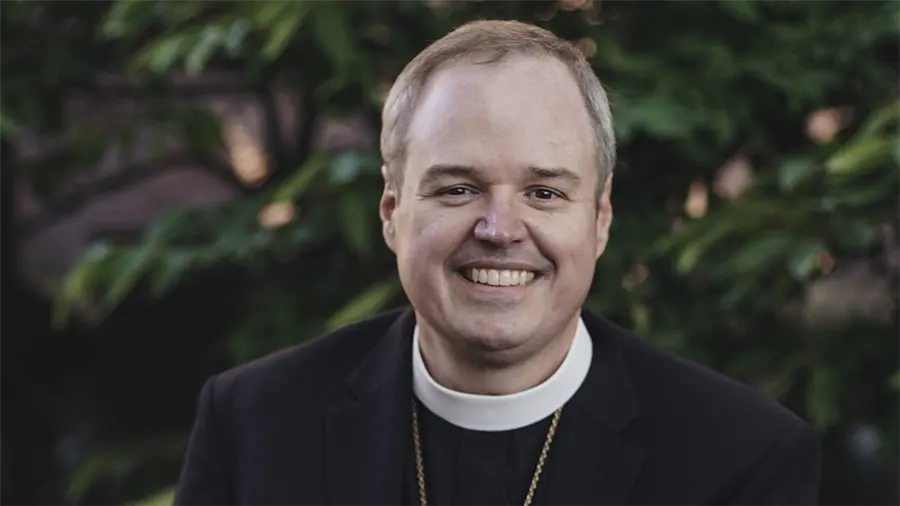
    Presiding Bishop Sean Rowe

    Presiding Bishop Rowe’s letter, “Acting Faithfully in Troubling Times”

    Dear people of God in The Episcopal Church:

    I am writing to you from Geneva, where I am meeting with global partners at the World Council of Churches and the United Nations Refugee Agency. As we have discussed how our institutions might act faithfully and boldly in these turbulent times, I have been reflecting on how we Episcopalians can respond to what is unfolding around us as followers of the Risen Christ whose first allegiance is to the kingdom of God, not to any nation or political party.

    The events of the last several days lend urgency to this spiritual challenge. Earlier this week, President Trump’s executive order banning or restricting travel from 19 countries went into effect. This order impacts countries that are home to dioceses of The Episcopal Church and many of our Anglican Communion partners, and I have written to the bishops and primates in those countries to express our concern.

    The unwarranted deployment of the National Guard and U.S. Marine Corps on the streets of Los Angeles also signals a dangerous turn. As the bishops of California have written, these military deployments risk escalating the confrontations unnecessarily and set a dangerous precedent for future deployments that heighten tensions rather than resolve them. As Christians committed to strive for justice and peace among all people, we know that there is a better way.

    What we are witnessing is the kind of distortion that arises when institutions like the military and the State Department are turned on the people they were meant to protect. These mainstays of the federal government, designed to safeguard civil society and promote peace and stability, are now being weaponized for political advantage.

    The violence on television is not our only risk. We are also seeing federal budget proposals that would shift resources from the poor to the wealthy; due process being denied to immigrants; and the defunding of essential public health, social service, and foreign aid programs that have long fulfilled the Gospel mandate to care for the vulnerable, children, and those who are hungry and sick.

    With all of this in mind, we are finding ways to respond as Christians to what we see happening around us. We are exploring options to support litigation challenging the travel ban on the ground of religious freedom; advocating for federal spending that safeguards the welfare of the most vulnerable; caring for immigrants and refugees in our congregations and communities; and standing in solidarity with other faith groups. In short, we are practicing institutional resistance rooted not in partisan allegiance, but in Christian conviction.

    At its best, our church is capable of moral clarity and resolute commitment to justice. I believe we can bring those strengths to bear on this gathering storm. Churches like ours, protected by the First Amendment and practiced in galvanizing people of goodwill, may be some of the last institutions capable of resisting the injustice now being promulgated. That is not a role we sought—but it is one we are called to.

    In Geneva, I have been reminded that we are part of a global communion of hope in the Risen Christ. We do not stand alone as we live by our baptismal promises: to persevere in resisting evil, to strive for justice and peace among all people, and to respect the dignity of every human being. In these troubling times, may we find courage and resilience in our identity as members of the Body of Christ.

    Yours in Christ,

    The Most Rev. Sean Rowe
    Presiding Bishop
    The Episcopal Church
    The Episcopal Church of the Redeemer: Worshiping God, living in community, reaching out to the world.

    Church of the Redeemer

    Church of the Redeemer: Worshiping God, living in community, and reaching out to the world around us. We are an Episcopal Church serving north King County and south Snohomish County, Washington. As you travel your road, go with friends walking the way of Jesus at Redeemer.

    Church of the Redeemer is at 6220 Northeast 181st Street in Kenmore, Washington. The campus is a short distance north of Bothell Way, near the Burke-Gilman Trail. The entrance looks like a gravel driveway. The campus is larger on the inside than it is on the outside. And we managed to hide a large building on the side of a hill that is not easily seen from the street.

    The Episcopal Church welcomes you.
  • Episcopal and Bavarian Lutheran churches sign full-communion agreement

    Episcopal and Bavarian Lutheran churches sign full-communion agreement

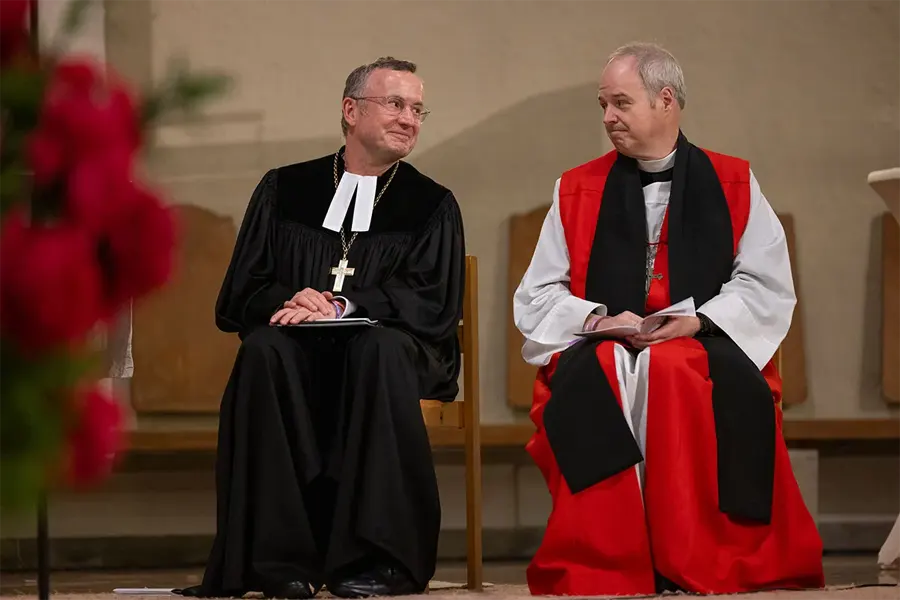
    [Episcopal News Service] Presiding Bishop Sean Rowe and Bishop Christian Kopp, head of the Evangelical Lutheran Church in Bavaria, signed the Augsburg Agreement on June 7 following a Pentecost-eve Eucharist at St. Matthew’s Lutheran Church in Munich, Germany.

    The full-communion agreement, also referred to as “Sharing the Gifts of Communion,” was a decade in the making, with former Presiding Bishop Katharine Jefferts Schori and former head of the Bavarian church, Bishop Heinrich Bedford-Strohm, starting the conversation in 2013 so “that our two churches might find a path toward deeper relationship.”

    The agreement establishes “a new foundation for ecumenical relationships between Lutheran and Anglican Churches,” according to the text.

    Sermon about the agreement

    In his sermon, the presiding bishop referenced the Holy Spirit – who appeals to people in their diversity who speak different languages and come from different places – and who comes as an advocate to bind human beings to one another and “prove wrong” the ways of the world that seek to divide rather than unite them.

    “Today, as we sign the declaration of full communion between the Evangelical Lutheran Church in Bavaria and The Episcopal Church, we too are proving wrong the ways of the world. We have worked long and hard to finalize this agreement, and along the way we have reached across our differences to deepen our appreciation of one another and the ways we have served God over time,” Rowe said.

    “Our theologies may have differed over the course of our histories, but we are united in our desire to offer to the world a model of leadership that is, in today’s world, deeply countercultural. We share the belief that we must place the needs of the most vulnerable, the rejected, and the marginalized at our center, and that this gospel imperative must shape the way we lead and the choices we make as institutions.”

    Ecumenism, by definition, implies that Christians form relationships and work together in common mission and toward unity. Full-communion partnerships allow members of both churches to receive the sacraments in the other body …  allow for interchangeability of clergy, allowing them to officiate at services and celebrate the sacraments with equal authority in either church. Since the 1970s, the Episcopal and Lutheran churches in Bavaria have been worshipping and praying together. The agreement marked a meaningful step forward between the two churches, formalizing the longstanding relationship.

    “Christians live together in a worldwide community in the name of Jesus Christ. This community needs vivid signs of interaction, fellowship and mutual commitment. I’m very glad that our churches are currently living this communion in such a lively and respectful way,” Kopp told ENS. “I’m deeply moved that we are now, and will continue in the future, to share the Holy Supper together. I’m also eagerly looking forward to everything we will do together in the future — for peace in our countries and for the visible impact of the Christian faith in the lives of many people around the world.”

    Bavaria is one of 16 states, the largest geographically, in Germany. The Evangelical Lutheran Church in Bavaria is part of the larger Protestant Church in Germany. The Convocation of Episcopal Churches in Europe has 23 congregations, parishes and missions across Europe. In Bavaria, it has one congregation in Munich, Church of the Ascension, and two smaller missions, St. Boniface in Augsburg and St. James the Less in Nuremberg. The missions meet in Lutheran churches.

    Full communion agreements

    In The Episcopal Church, full communion agreements require changes to its canons (Title 1, Canon 20, Section 1). The 81st General Convention adopted Resolution A037 authorizing the agreement. The Evangelical Lutheran Church in Bavaria’s synod adopted its resolution in 2022.

    “Agreements like the one we have signed with our Bavarian Lutheran siblings are hopeful signs of unity as we witness so much fragmentation around us. In a time when our circles of belonging have become increasingly like-minded, Christians are called to a John 17 model of unity for the sake of the Gospel,” said the Rev. Margaret Rose, ecumenical and interreligious deputy to the presiding bishop. “I look forward to how we will share our gifts of diversity, build bridges and work together for the flourishing of all.”

    The Episcopal Church has full-communion agreements with the following:

    • Evangelical Lutheran Church in America
    • The Moravian Church-Northern and Southern Provinces
    • The Mar Thomas Syrian Church of Malabar, India
    • The Old Catholic Churches of the Union of Utrecht
    • The Philippine Independent Church
    • The Church of Sweden
    • The Evangelical Lutheran Church in Canada

    Although the conversation between the Episcopal and the Bavarian churches began in 2013, the dialogue became official in 2018. The key question for this ecumenical relationship was the theology of ordained ministry, and particularly, the role of bishops in succession.

    The presence of “the historic episcopate, locally adapted in the methods of its administration” is one of the requirements outlined in the Chicago-Lambeth Quadrilateral, which is the framework for how The Episcopal Church and other denominations can reach full communion.

    During an online hearing before the 81st General Convention voted to adopt the resolution authorizing the full-communion agreement, theologian Oliver Schuegraf, an honorary canon theologian of Coventry Cathedral in England who helped draft the Augsburg Agreement, described the episcopate in the Lutheran body as “historic and an evangelical”; historic, in that it is passed down over time, and evangelical, in which preaching the Gospel has taken place unbroken from generation to generation. “It is absolutely clear that we have episcopé” he said, although it is exercised both by bishops and other church structures.

    The agreement called on existing documents, like “Porvoo Common Statement,” “Called to Common Mission,” and the “Waterloo Declaration,” and was adapted to Bavaria and the German context. Before the 2024 General Convention vote, the 79th General Convention approved the dialogue.

    “Churches rarely make decisions quickly. The Episcopal Church’s full-communion agreement with the Evangelical Church in Bavaria is a happy exception,” Jefferts Schori told ENS.

    “In spite of distinct geographic and linguistic differences, we have come to agreement and pledged to work together for the good of God’s people. Although ecumenical conversations began in the Reformation some 500 years ago, the initiative to seek this full-communion agreement bore fruit in about 15 years. Give thanks for the focused and clarifying work of the ecumenists in each church, who have helped us all to see God’s ever-new creative possibilities!”


    -Lynette Wilson is a reporter and managing editor of Episcopal News Service. She can be reached at lwilson@episcopalchurch.org.

    The Episcopal Church of the Redeemer: Worshiping God, living in community, reaching out to the world.

    Church of the Redeemer

    Church of the Redeemer: Worshiping God, living in community, and reaching out to the world around us. We are an Episcopal Church serving north King County and south Snohomish County, Washington. As you travel your road, go with friends walking the way of Jesus at Redeemer.

    Church of the Redeemer is at 6220 Northeast 181st Street in Kenmore, Washington. The campus is a short distance north of Bothell Way, near the Burke-Gilman Trail. The entrance looks like a gravel driveway. The campus is larger on the inside than it is on the outside. And we managed to hide a large building on the side of a hill that is not easily seen from the street.

    The Episcopal Church welcomes you.
  • The bulletin insert for June 8, 2025

    The bulletin insert for June 8, 2025

    This is the weekly bulletin insert from Sermons That Work.

    Traveling the Way of Love: Bless

    “Traveling the Way of Love” Season 2 offers video stories of the ways people across The Episcopal Church participate in the seven Way of Love practices. Produced by the Office of Communication in partnership with Evangelism colleagues, it includes study guides to help congregations or small groups engage the stories and strengthen one another’s discipleship. Each week, we’ll share information about an episode, along with study questions suitable for congregational, small group, or personal reflection. You can find each episode and its discussion guide at iam.ec/TWOL2.

    People walking around a construction site.

    Episode 4: Bless

    Freely you have received; freely give.

    Matthew 10:8

    Jesus called his disciples to give, forgive, teach, and heal in his name. We are empowered by the Spirit to bless everyone we meet, practicing generosity and compassion and proclaiming the Good News of God in Christ with hopeful words and selfless actions. We can share our stories of blessing and invite others to the Way of Love.

    1. In this episode, host Chris Sikkema visits the Episcopal Farm Workers Ministry in Dunn, North Carolina. The ministry is a joint project of the Episcopal Diocese of East Carolina and the Episcopal Diocese of North Carolina that works with agricultural workers (farmworkers, meat processing plant workers, and workers from nurseries, packing houses, and poultry, swine, or livestock farms) and immigrant families in rural Eastern North Carolina. When asked about the needs of this community, Lucia Mondragón points out that she has learned that this community needs not just food but also affection. When you think about donating to a traditional outreach ministry such as a food pantry or soup kitchen, what would it look like for you to give the blessing of affection in addition to the sustenance of food? How does that challenge or resonate with your idea of “bless”? 

    2. As Chris reflected, one of the enduring images of the Christian life is that of individuals moving along the spokes of a wheel. We find that as we draw closer to the center—that is, to God—we, by necessity, grow closer to other people. This is the work of the Holy Spirit, and as Chris says, it happens in all sorts of groups and communities. Take a few moments to reflect on the ways that you and/or your faith community are practicing “bless” currently. Are they drawing you and your community closer to God and others? If not, how might your practice need to grow or morph? 

    3. “When they come, they bring their problems, and we need to hear them.” – Lucia Mondragón. Often, in our attempts to do the most good in the shortest amount of time, our practice of “bless” is stacked with to-do lists and busyness. But do we make time for listening? Do we make time to value the one story someone needs to share over the 10 things on our agenda? Do we value hearing as much as we value doing? If not, what might need to shift in our practice or understanding of “bless”?


    Weekly bulletin inserts

    This weekly bulletin insert provides information about the history, music, liturgy, mission, and ministry of The Episcopal Church. For more information, please contact us at stw@episcopalchurch.org.

    Sermons That Work from the Episcopal Church

    Sermons That Work

    For more than 20 years, Sermons That Work, a ministry of The Episcopal Church’s Office of Communication, has provided free sermons, Bible studies, bulletin inserts, and other resources that speak to congregations across the Church. Our writers and readers come from numerous and varied backgrounds. Small house churches, sprawling cathedrals, and everything between use the resources that Sermons That Work provides.

    The Episcopal Church of the Redeemer: Worshiping God, living in community, reaching out to the world.

    Church of the Redeemer

    Church of the Redeemer: Worshiping God, living in community, and reaching out to the world around us. We are an Episcopal Church serving north King County and south Snohomish County, Washington. As you travel your road, go with friends walking the way of Jesus at Redeemer.

    Church of the Redeemer is at 6220 Northeast 181st Street in Kenmore, Washington. The campus is a short distance north of Bothell Way, near the Burke-Gilman Trail. The entrance looks like a gravel driveway. The campus is larger on the inside than it is on the outside. And we managed to hide a large building on the side of a hill that is not easily seen from the street.

    The Episcopal Church welcomes you.
  • Episcopal Church blesses, commissions Pride Month celebrations

    Episcopal Church blesses, commissions Pride Month celebrations

    [Episcopal News Service] The Episcopal Church kicked off Pride Month celebrations and affirmations of LGBTQ+ people with a special livestreamed Eucharist. The service came from the Chapel of Christ the Lord at the Episcopal Church Center in New York, New York.


    Presiding Bishop Sean Rowe presided in person at the June 1, 2025, service. It served as a blessing and formal commissioning for Episcopalians and Episcopal congregations to observe Pride Month.

    The preacher was the Rev. Cameron Partridge, rector of St. Aidan’s Episcopal Church in San Francisco, Diocese of California. He is a trans man. Partridge preached preached remotely.

    “Let us love one another, not even thoughor despite our queerness, our transness but because of the unique human beings God has created us to be and to become,” Partridge said during his sermon. “In the face of so many who refuse to know us, may our love, our lives reflect the glory of God upholding us, transforming us, strengthening us, and charging us to make our way forward in this moment, together.”

    Read Partridge’s entire sermon here.

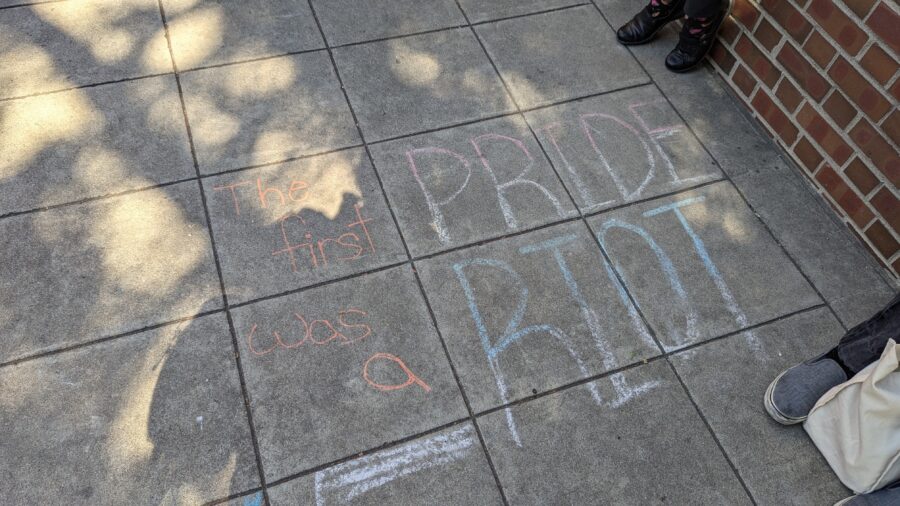
    The first Pride was a riot. Written on the sidewalk of a United Church of Christ in Berkeley, California.
    The first Pride was a riot. Written on the sidewalk of a United Church of Christ in Berkeley, California.

    History of celebrating Pride Month

    People have celebrated Pride Month nationwide since June since 1970. It began after the Stonewall riots, a series of gay liberation protests. This took place one year prior between June 28 and July 3, 1969. The riots started in response to a police raid at the Stonewall Inn, a gay bar in New York’s Greenwich Village neighborhood.

    In 1999, former President Bill Clinton commemorated the Stonewall riots’ 30th anniversary by declaring June as Gay and Lesbian Pride Month. June 28 is International LGBT Pride Day, though various communities celebrate throughout June.

    “LGBTQ+” stands for lesbian, gay, bisexual, transgender and queer/questioning. The “+” sign represents the many other sexual orientations and gender identities that are not explicitly included in the acronym. This includes intersex, asexual, two-spirit and more.

    People use inclusive terms and its variations, such as “LGBTQIA2S+” and others, to acknowledge the diverse and expansive spectrum of human sexuality and gender expression.

    The service began with a recorded performance by Trinity Church Wall Street’s choir of “Epilogue: Meet Me Here.” It is from “Considering Matthew Shepard,” Craig Hella Johnson’s Grammy-nominated three-part oratorio. Johnson composed the work as a musical response to the murder of Matthew Shepard. He was a young gay man who in 1998 was beaten and tortured to death because of his sexuality. Shepard’s parents held onto his ashes for 20 years out of fear his grave would be vandalized before they were safely interred at Washington National Cathedral.

    This year’s Pride Month is taking place as hate crimes targeting LGBTQ+ people continue to increase worldwide. Anti-LGBTQ+ bills continue to be introduced nationwide, with six additional anti-trans bills passing since May 30.

    Episcopal Church welcome and affirmation of the LGBTQ+

    Since The Episcopal Church formally began to welcome and affirm LGBTQ+ people in 1976 through acts of General Convention. Episcopal dioceses, congregations, organizations, and individuals continue to advocate for LGBTQ+ rights. LGBTQ+ people also now serve in multiple clergy and lay leadership roles, including bishops.

    Many churches sponsor and march in their local Pride parades and festivals. Many others display the rainbow flag despite the risk of vandalism.

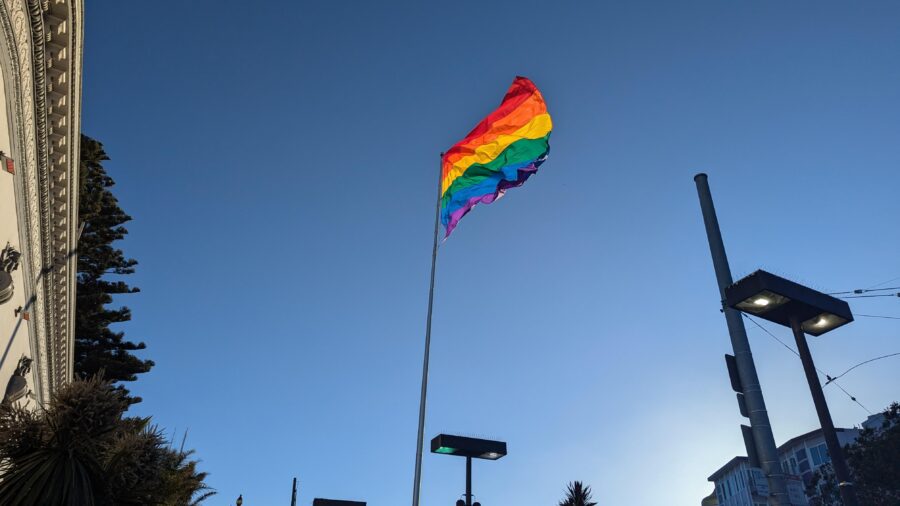
    Pride Flag at Harvey Milk Plaza at the corner of Market and Castro Street in San Francisco.
    Pride Flag at Harvey Milk Plaza at the corner of Market and Castro Street in San Francisco.

    The Rainbow Flag

    Gilbert Baker and other artists first designed the Rainbow Flag by in 1978. Harvey Milk, the first openly gay man elected to public office in California, commissioned it. It originally had 8 stripes. Now, the flag has 6-stripes, because of the difficulty in getting two of the original colors. The flag reflects the diversity of the LGBTQ+ community and the spectrum of human sexuality and gender.

    More Episcopal churches are also now flying the Progress Pride flag (see cover photo). It a variation on the traditional 6-stripe Pride flag. In addition to the base, it added the following:

    • A white, pink and light blue chevron to represent the transgender community.
    • A brown chevron to represent communities of color.
    • A black chevron to represent the 42.3 million people who’ve died by HIV/AIDS since 1981, many of whom were LGBTQ+.
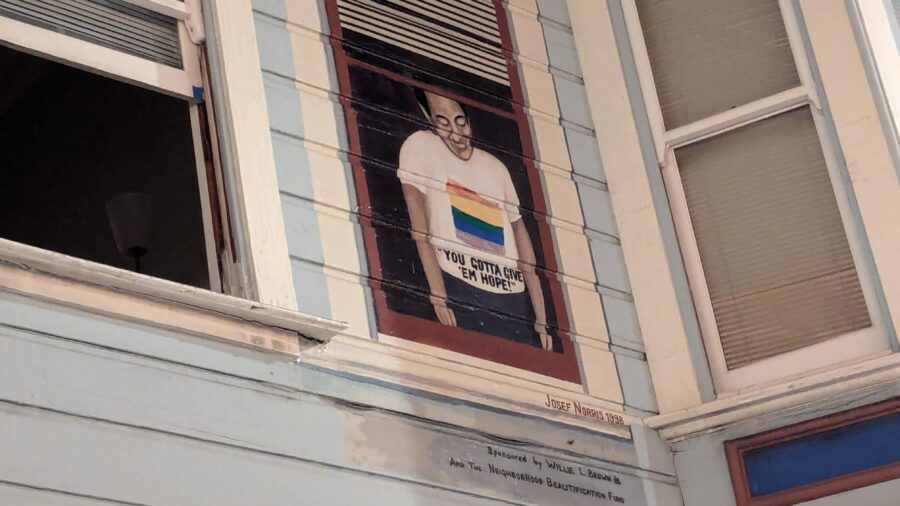
    A painting of Harvey Milk looking down on Castro Street from his former apartment.
    A painting of Harvey Milk looking down on Castro Street from his former apartment.

    About this Pride Month service

    “Pride gives us an opportunity to remember the struggles, celebrate the joy, and give thanks for the love of God that binds us together and makes us one,” Rowe wrote in a message printed in the service bulletin. “Especially this year, Pride provides an opportunity to stand against injustice and fear by proclaiming that LGBTQ+ people are beloved children of God and cherished members of The Episcopal Church and the Body of Christ.”

    New Testament readings included passages from Acts 1:1-11 and Revelation 22. The Gospel reading was John 17:20-26 – Jesus prays for all believers.

    The service also included a recording of All Saints Episcopal Church in Pasadena, California’s choir performing “In the Midst of New Dimensions.” This a hymn written and composed by Julian B. Rush, an ordained minister in the United Methodist Church.

    During the commissioning, adapted from the Book of Occasional Services, Rowe addressed the congregation. “You have been called to ministries of the church, to be carried out in communities, congregations, dioceses and all the places in which you serve. Will you faithfully do so to the honor of God and the benefit of the church?”

    The congregation replied: “We will.”

    Shaneequa Brokenleg, the presiding bishop’s staff officer for racial reconciliation and a Lakota “winkte,” or “two-spirit,” sang an original work called “Creator God, We Cry to You.”

    “Hear our prayer for all who serve across your church, for all who doubt and all who search, for all who seek, for all who find, for open hearts and open minds, for justice, peace and equity… .”

    Native American cultures generally have a broader understanding of gender identity than European cultures. The Lakota language does not use gendered pronouns. In addition, they see the two-spirit as reconcilers and healers.

    The service also included Prayers of the People wrote by the church’s Task Force on LGBTQ+ Inclusion. “For communities that honor queer and transgender lives, and for voices that proclaim your gospel of love and transformation. Strengthen your Church with power through your Spirit, especially where it has caused harm or withheld blessing. Teach us to walk in love, as Christ loved us, and to be faithful stewards of your reconciling grace. … For all who carry hidden wounds, who live with chronic pain, illness, addiction, or despair. For LGBTQ+ youth and elders, especially those cut off from family or care. Let your Spirit bring healing, courage, and companionship.”

    The Episcopal Church has special Pride Month resources available on its website. This includes a downloadable Pride shield, short videos highlighting the church’s advocacy and support, social media graphics, and more.

    Gay is the package

    During his sermon, Partridge recalled while a student at Bryn Mawr College in Pennsylvania interviewing an openly gay priest for an essay on the conflict of sexuality in The Episcopal Church in the 90s. Partridge asked the priest, “Do you see [being gay] as integral to your ministry or do you see it as somewhat a part of you that isn’t necessarily in the forefront?”

    The priest replied, “People say to you, ‘oh, I love you even though you are gay.’ And my answer is, ‘on the contrary, you love me because I am gay. That the things that you love about me – my warmth, my empathy, my identification with the marginalized, my passion for justice, my humor – all of those things have been shaped by the experience of being gay. So if you love me, not only is being gay part of the package. In a very, very real spiritual sense, gay is the package.”


    Shireen Korkzan is a reporter and assistant editor for Episcopal News Service. You can reach this reporter at at skorkzan@episcopalchurch.org.

    The Episcopal Church of the Redeemer: Worshiping God, living in community, reaching out to the world.

    Church of the Redeemer

    Church of the Redeemer: Worshiping God, living in community, and reaching out to the world around us. We are an Episcopal Church serving north King County and south Snohomish County, Washington. As you travel your road, go with friends walking the way of Jesus at Redeemer.

    Church of the Redeemer is at 6220 Northeast 181st Street in Kenmore, Washington. The campus is a short distance north of Bothell Way, near the Burke-Gilman Trail. The entrance looks like a gravel driveway. The campus is larger on the inside than it is on the outside. And we managed to hide a large building on the side of a hill that is not easily seen from the street.

    The Episcopal Church welcomes you.
  • The bulletin insert for June 1, 2025

    The bulletin insert for June 1, 2025

    This is the weekly bulletin insert from Sermons That Work.

    Traveling the Way of Love: Turn

    “Traveling the Way of Love” Season 2 offers video stories of the ways people across The Episcopal Church participate in the seven Way of Love practices. Produced by the Office of Communication in partnership with Evangelism colleagues, it includes study guides to help congregations or small groups engage the stories and strengthen one another’s discipleship. Each week, we’ll share information about an episode, along with study questions suitable for congregational, small group, or personal reflection. You can find each episode and its discussion guide at iam.ec/TWOL2.

    To everything turn, turn, turn.

    Episode 3: Turn

    As Jesus was walking along, he saw Levi son of Alphaeus sitting at the tax booth, and he said to him, ‘Follow me.’ And he got up and followed him.

    Mark 2:14

    Like the disciples, we are called by Jesus to follow the Way of Love. With God’s help, we can turn from the powers of sin, hatred, fear, injustice, and oppression toward the way of truth, love, hope, justice, and freedom. In turning, we reorient our lives to Jesus Christ, falling in love again and again.

    1. In this episode, host Chris Sikkema visits the Rev. Rita Powell and Alden Fossett at Harvard University. Together, they discuss what it means to practice “pausing” in a society that often demands exhaustion as a mark of worthiness. Where in your life could you press pause as part of a spiritual practice of “turn”?

    2. When we choose to turn and pause, we have the opportunity to listen to people and places that often are overlooked or exploited. Rita and Alden shared stories of leading their communities to pause and listen to both the natural world and the stories of enslaved people. Whose stories and experiences are overlooked in your context? What would it take to practice listening deeply to those stories and experiences?

    3. As the host says, when we can make something right, we are called to do so. The Episcopal Chaplaincy at Harvard hosts a series of meals out on the sidewalk as a way of making right previous church practices that excluded people from entering our doors as full members of our communities. By hosting a meal on the street, The Episcopal Chaplaincy community is turning from a tradition of oppression and gatekeeping toward a way of being that is open, just, and free for all.  As you think about your community of faith and personal practice of turning, what action steps can you take to make something right? What outward and visible sign can you signal that reflects a commitment to turning toward Jesus and his way of love?


    Weekly bulletin inserts

    This weekly bulletin insert provides information about the history, music, liturgy, mission, and ministry of The Episcopal Church. For more information, please contact us at stw@episcopalchurch.org.

    Sermons That Work from the Episcopal Church

    Sermons That Work

    For more than 20 years, Sermons That Work, a ministry of The Episcopal Church’s Office of Communication, has provided free sermons, Bible studies, bulletin inserts, and other resources that speak to congregations across the Church. Our writers and readers come from numerous and varied backgrounds. Small house churches, sprawling cathedrals, and everything between use the resources that Sermons That Work provides.

    The Episcopal Church of the Redeemer: Worshiping God, living in community, reaching out to the world.

    Church of the Redeemer

    Church of the Redeemer: Worshiping God, living in community, and reaching out to the world around us. We are an Episcopal Church serving north King County and south Snohomish County, Washington. As you travel your road, go with friends walking the way of Jesus at Redeemer.

    Church of the Redeemer is at 6220 Northeast 181st Street in Kenmore, Washington. The campus is a short distance north of Bothell Way, near the Burke-Gilman Trail. The entrance looks like a gravel driveway. The campus is larger on the inside than it is on the outside. And we managed to hide a large building on the side of a hill that is not easily seen from the street.

    The Episcopal Church welcomes you.
  • The bulletin insert for May 18, 2025

    The bulletin insert for May 18, 2025

    This is the weekly bulletin insert from Sermons That Work.

    Traveling the Way of Love: Worship

    “Traveling the Way of Love” Season 2 offers video stories of the ways people across The Episcopal Church participate in the seven Way of Love practices. Produced by the Office of Communication in partnership with Evangelism colleagues, it includes study guides to help congregations or small groups engage the stories and strengthen one another’s discipleship. Each week, we’ll share information about an episode, along with study questions suitable for congregational, small group, or personal reflection. You can find each episode and its discussion guide at iam.ec/TWOL2.

    Worship at Palmer Memorial Church.

    Episode 1: Worship

    When he was at the table with them, he took bread, blessed and broke it, and gave it to them. Then their eyes were opened, and they recognized him.

    Luke 24:30-31

    When we worship, we gather with others before God. We hear the Good News of Jesus Christ, give thanks, confess, and offer the brokenness of the world to God. As we break bread, our eyes are opened to the presence of Christ. By the power of the Holy Spirit, we are made one body, the body of Christ sent forth to live the Way of Love.

    1. In this episode, host Chris Sikkema visits Palmer Memorial Episcopal Church in Houston, Texas, and chats with the Rev. Ryan Hawthorne about what worship means to her. Hawthorne emphasizes that worship is not just a communal practice, but a deeply personal one. She invites individuals to find the worship practices that resonate with their soul, which might include worshipping within a church community. What worship practices deeply touch your soul?

    2. The call to gather and worship within the Christian tradition, as understood through the Episcopal lens, is a call to “the collective.” It is a call to come together across generations and all sorts of messy human experiences to pray, offer praise and thanksgiving, proclaim the Gospel, and promote justice, peace, and love. What voices are missing from your worship experience? How could it be a more “collective” experience?

    3. Palmer’s former senior warden, Dr. Danna Kurtin, spoke about the importance of curiosity when it comes to practicing worship on the Way of Love. Being curious about our neighbors, other traditions, and the ways God is moving in the world through changing culture are just some of the things that can influence our worship experience. Where might the Holy Spirit be asking you – as an individual or as a faith community – to be curious and to stretch in your practice of worship?


    Weekly bulletin inserts

    This weekly bulletin insert provides information about the history, music, liturgy, mission, and ministry of The Episcopal Church. For more information, please contact us at stw@episcopalchurch.org.

    Sermons That Work from the Episcopal Church

    Sermons That Work

    For more than 20 years, Sermons That Work, a ministry of The Episcopal Church’s Office of Communication, has provided free sermons, Bible studies, bulletin inserts, and other resources that speak to congregations across the Church. Our writers and readers come from numerous and varied backgrounds. Small house churches, sprawling cathedrals, and everything between use the resources that Sermons That Work provides.

    The Episcopal Church of the Redeemer: Worshiping God, living in community, reaching out to the world.

    Church of the Redeemer

    Church of the Redeemer: Worshiping God, living in community, and reaching out to the world around us. We are an Episcopal Church serving north King County and south Snohomish County, Washington. As you travel your road, go with friends walking the way of Jesus at Redeemer.

    Church of the Redeemer is at 6220 Northeast 181st Street in Kenmore, Washington. The campus is a short distance north of Bothell Way, near the Burke-Gilman Trail. The entrance looks like a gravel driveway. The campus is larger on the inside than it is on the outside. And we managed to hide a large building on the side of a hill that is not easily seen from the street.

    The Episcopal Church welcomes you.

  • Farewell Barbecue for Fr. Jed Fox and his family

    Farewell Barbecue for Fr. Jed Fox and his family

    Come celebrate and say farewell to Fr. Jed Fox and his family. They are preparing to start a new adventure in Grand Rapids, Michigan. We are having a potluck on Saturday, May 31, 2025, from 4:00 pm to 7:00 pm in the Parish Hall. The church will provide main dishes. Sign up on the sheets posted at the back of the church to bring a side dish or dessert. 

    We look forward to having you join us in this celebration for Fr. Jed and his family!

    Saint Mark's Episcopal Church, Grand Rapids, Michigan

    St. Mark’s Episcopal Church, Grand Rapids, Michigan

    St. Mark’s Episcopal Church is an inclusive community of faith, reflecting Christ’s love, ministering to all who hunger in body, mind, and spirit. 

    At St. Mark’s, we will create a vibrant spiritual community where worship, accessibility, belonging, formation, and a commitment to social justice enable us to love and serve all God’s people.

    In beautiful downtown Grand Rapids, Michigan, St. Mark’s Episcopal Church is a growing, welcoming, and affirming community of faith in a vibrant urban community. In our worship and in our service to the community, we proclaim that all people are worthy of God’s love. We celebrate and uphold the dignity of all people whose ethnicity, cultural heritage, and denominational traditions are examples and celebrations of God’s love. We welcome visitors and parishioners from all social, political, and educational backgrounds, and all abilities, sexual orientations, and gender identities. We affirm all people and celebrate diversity, as we work to fulfill God’s love for all people as a community of faith. 

    The Episcopal Church of the Redeemer: Worshiping God, living in community, reaching out to the world.

    Church of the Redeemer

    Church of the Redeemer: Worshiping God, living in community, and reaching out to the world around us. We are an Episcopal Church serving north King County and south Snohomish County, Washington. As you travel your road, go with friends walking the way of Jesus at Redeemer.

    Church of the Redeemer is at 6220 Northeast 181st Street in Kenmore, Washington. The campus is a short distance north of Bothell Way, near the Burke-Gilman Trail. The entrance looks like a gravel driveway. The campus is larger on the inside than it is on the outside. And we managed to hide a large building on the side of a hill that is not easily seen from the street.

    The Episcopal Church welcomes you.
  • What is next for Church of the Redeemer?

    What is next for Church of the Redeemer?

    Peace be with you. As the Father has sent me, so I send you. (John 20:21b)

    During the Easter season, we will use our Adult Education time to discuss what is next for Church of the Redeemer. When setting up this series, it was because of our work with Relèven. However, after Easter our rector accepted a new call and will be leaving Church of the Redeemer

    The Rev. Cristi Chapman, Canon to the Ordinary (Bishop), will be with us on Sunday, May 18, 2025. Along with preaching at both services, she will available to answer questions at 9:30 am.

    The Rev. Canon Cristi Chapman

    The Rev. Cristi Chapman was appointed by Bishop Philip LaBelle to serve as the Canon to the Ordinary in December 2024. Cristi works collaboratively with the Bishop, clergy and other diocesan leaders, and the diocesan staff to develop a culture of faithful discipleship that serves to build up the Body of Christ in the diocese. As the Canon to the Ordinary, she does the following:

    • Serves as the chief advisor to the Bishop.
    • Is the lead resource for clergy and congregations in transition.
    • Advises clergy, congregations, and Governing Bodies on a variety of matters.
    • Serves as Chief of Staff for the Office of the Bishop.
    The Episcopal Church of the Redeemer: Worshiping God, living in community, reaching out to the world.

    Church of the Redeemer

    Church of the Redeemer: Worshiping God, living in community, and reaching out to the world around us. We are an Episcopal Church serving north King County and south Snohomish County, Washington. As you travel your road, go with friends walking the way of Jesus at Redeemer.

    Church of the Redeemer is at 6220 Northeast 181st Street in Kenmore, Washington. The campus is a short distance north of Bothell Way, near the Burke-Gilman Trail. The entrance looks like a gravel driveway. The campus is larger on the inside than it is on the outside. And we managed to hide a large building on the side of a hill that is not easily seen from the street.

    The Episcopal Church welcomes you.
  • Episcopal Church will not resettle Afrikaners

    Episcopal Church will not resettle Afrikaners

    [Episcopal News Service] When a small group of white South Afrikaners, whom the Trump administration has deemed refugees, arrive in the United States this week, they will be assisted by some nonprofit agencies that historically have contracted with the U.S. government to do that resettlement work.

    Episcopal Migration Ministries will not be one of them.

    The Episcopal Church, according to a letter issued May 12 by Presiding Bishop Sean Rowe, has declined the Trump administration’s request to participate in the fast-tracked immigration of Afrikaners, part of the white minority in South Africa that formerly governed the country until the end of the extreme racial segregation of apartheid in 1994. EMM has not assisted any new arrivals since early this year, when the Trump administration halted the broader federal resettlement program indefinitely.

    Reasons for not settling the Afrikaners

    Millions of people worldwide are identified by the United Nations as refugees escaping war, famine or religious persecution in their home countries. EMM has resettled nearly 110,000 such refugees over nearly 40 years, but “in light of our church’s steadfast commitment to racial justice and reconciliation and our historic ties with the Anglican Church of Southern Africa, we are not able to take this step” of assisting the Trump administration in resettling Afrikaners, Rowe said after consulting with Anglican Archbishop Thabo Makgoba of Cape Town.

    Instead, The Episcopal Church will formally end all federal resettlement work when its contract expires at the end of this fiscal year, on Sept. 30. EMM, after further reducing its staff, will continuing operating as a church-based ministry to serve the needs of refugees already in the U.S., as well as asylum-seekers and other migrants.

    EMM had been one of 10 nongovernmental agencies, many of them associated with religious denominations, that facilitated refugee resettlement through the federal program created in 1980. Refugees traditionally have been among the most thoroughly vetted of all immigrants and often waited for years overseas for their opportunity to start new lives in the United States.

    The Afrikaners, about 50 of whom were scheduled to begin arriving in the United States as early as May 12, were screened and cleared for travel in the three months since Trump signed a February 7 executive order accusing South Africa’s Black-led government of racial discrimination against the white minority group. Afrikaners number about 3 million in a country of 63 million people.

    “It has been painful to watch one group of refugees [the Afrikaners], selected in a highly unusual manner, receive preferential treatment over many others who have been waiting in refugee camps or dangerous conditions for years,” Rowe said in his letter.

    Other refugees blocked

    When Trump took office, some refugees who had waited their turn to be resettled and received clearance to travel to the United States had their travel plans revoked after the president signed his executive order halting the resettlement program. Trump said the United States “lacks the ability to absorb large numbers of migrants, and in particular, refugees, into its communities” despite successful efforts by EMM and the other resettlement agencies to ramp up their resettlement operations during the Biden administration.

    Until the program was suspended, the United States had opened its doors to up to 125,000 refugees a year, with the largest numbers originating from the Congo, Afghanistan, Syria, Venezuela and Burma. Many had fled war-torn regions like Sudan, while others came from countries where citizens now face persecution for their past support of the United States military.

    “I am saddened and ashamed that many of the refugees who are being denied entrance to the United States are brave people who worked alongside our military in Iraq and Afghanistan and now face danger at home because of their service to our country,” Rowe said. “I also grieve that victims of religious persecution, including Christians, have not been granted refuge in recent months.”

    The federal refugee resettlement program has long had bipartisan support. EMM and the other contracted agencies have provided a range of federally funded services for the first months after the refugees’ arrivals, including English language and cultural orientation classes, employment services and school enrollment, and they helped covered costs such as food and rent as the refugees began to establish new lives and contribute to their adopted communities.

    Wind down of EMM services

    Trump’s executive order suspending the program was one of the first actions he took after returning to office on January 20, 2025. In the order, he claimed without evidence that refugees had become a costly burden on American communities.

    On January 31, EMM responded by announcing plans to wind down its core resettlement operations and lay off 22 employees while shifting its focus to other efforts. “While we do not know exactly how this ministry will evolve in our church’s future, we remain steadfast in our commitment to stand with migrants and with our congregations who serve them,” the Rev. Sarah Shipman, EMM’s director, said at the time.

    Trump’s order gave no indication when, if ever, the congressionally enacted program would resume, other than “such time as the further entry into the United States of refugees aligns with the interests of the United States.”

    Less than three weeks later, the president’s executive order on South Africa pledged “humanitarian relief” to Afrikaners but it did not specify how the interests of the United States would be served by granting refugee status to white South Africans and expediting their resettlement in the United States.

    The executive order accuses the South African government of “rights violations” toward Afrikaners, specifically a law allowing the seizure of property without compensation in certain circumstances. South African President Cyril Ramaphosa has rejected such claims.

    “We should challenge the completely false narrative that our country is a place in which people of a certain race or culture are being targeted for persecution,” Ramaphosa said in a March message.

    Needs of refugees globally

    Global resettlement needs have only increased in recent years. The refugees who are resettled in the United States typically are fleeing war, persecution and other hardships in their home countries. The United Nations High Commissioner for Refugees estimates there are more than 32 million such refugees worldwide, and tens of millions more have been displaced within their home countries.

    While invoking civil rights to justify Afrikaners’ resettlement in the United States, the Trump administration’s continued suspension of all other refugee resettlement has effectively ended what previously had been a lifeline for millions of people deprived of civil rights in other nations, often due to religious persecution. Many Vietnamese refugees, for example, are members of that country’s minority Christian community and have fled to refugee camps rather than face threats of imprisonment or execution for their faith.

    “As Christians, we must be guided not by political vagaries, but by the sure and certain knowledge that the kingdom of God is revealed to us in the struggles of those on the margins,” Rowe said in his May 12 letter. “Jesus tells us to care for the poor and vulnerable as we would care for him, and we must follow that command. Right now, what that means is ending our participation in the federal government’s refugee resettlement program and investing our resources in serving migrants in other ways.”

    Rowe added that EMM will continue to serve migrants through diocesan partnerships, collaboration with other Anglican provinces around the world, and through local outreach to refugees who are continuing to get settled in American communities. “You can contribute to this new work by making a donation on the Episcopal Migration Ministries website,” Rowe said.

    Reaction of other agencies

    Other refugee resettlement agencies, while agreeing to help receive the Afrikaners, have criticized the Trump administration for its selective resettlement polices.

    “We are concerned that the U.S. government has chosen to fast-track the admission of Afrikaners, while actively fighting court orders to provide life-saving resettlement to other refugee populations who are in desperate need of resettlement,” Rick Santos, president and CEO of Church World Service, said in a May 9 statement.

    “By resettling this population, the government is demonstrating that it still has the capacity to quickly screen, process and depart refugees to the United States,” Santos said. “It’s time for the administration to honor our nation’s commitment to the thousands of refugee families it abandoned with its cruel and illegal executive order.”

    Shipman, the EMM director, issued a statement later May 12 amplifying Rowe’s letter and expressing “our grief at these developments.”

    “At the same time, we want to acknowledge the profound legacy of this ministry,” Shipman said. “Looking ahead, we will continue to support dioceses and ministry networks around the church in responding to global migration and protecting the rights of all migrants. Though our work will take new forms, we will persist in our efforts to serve the most vulnerable.”


    – David Paulsen is a senior reporter and editor for Episcopal News Service based in Wisconsin. He can be reached at dpaulsen@episcopalchurch.org.

    Episcopal Migration Ministries

    Episcopal Migration Ministries

    Episcopal Migration Ministries is a key program within the Division of Public Policy, Partnership and Witness. Through Episcopal Migration Ministries, we support dioceses and ministry networks around the church in responding to global migration, serving communities, and protecting the rights of all migrants.

    Dioceses throughout The Episcopal Church work together and in partnership to serve migrants from sending and receiving communities. We offer a range of services and ministries and recognize the complex factors leading to migration. In partnership with churches around the Anglican Communion, we educate and advocate for conditions where no one is forced to migrate, and if they must, they are able to do so with dignity.

    In the name of these refugees, aid all refugees.
    The Episcopal Church of the Redeemer: Worshiping God, living in community, reaching out to the world.

    Church of the Redeemer

    Church of the Redeemer: Worshiping God, living in community, and reaching out to the world around us. We are an Episcopal Church serving north King County and south Snohomish County, Washington. As you travel your road, go with friends walking the way of Jesus at Redeemer.

    Church of the Redeemer is at 6220 Northeast 181st Street in Kenmore, Washington. The campus is a short distance north of Bothell Way, near the Burke-Gilman Trail. The entrance looks like a gravel driveway. The campus is larger on the inside than it is on the outside. And we managed to hide a large building on the side of a hill that is not easily seen from the street.

    The Episcopal Church welcomes you.
  • The bulletin insert for May 11, 2025

    The bulletin insert for May 11, 2025

    This is the weekly bulletin insert from Sermons That Work.

    Reflections on the Resurrection

    Quick response code subscribe to the Sermons That Work podcast to listen to Easter reflections from the newest bishops in the Episcopal Church.

    During the Easter season, Sermons That Work is pleased to present reflections from some of the newest bishops of The Episcopal Church on the resurrection of our Lord. Check back each week for a brief exploration of how Jesus Christ’s rising from the grave changes everything. To listen to this reflection, scan the QR code on this page and subscribe to the Sermons That Work podcast.


    Week 4

    Easter first happened in a cemetery. Not under the sparkling sunlight of a spring morning. Not in a field of pastel tulips. Not tangled in a prolonged cellophane celebration. Easter happened in a cemetery. Surrounded by death. Incubated by stubborn shadows. Carried in a broken heart. Greeted quite unexpectedly by a woman who no longer dreamed dreams.

    Mary Magdalene was a brave, bold woman. But even brave, bold women can be devastated by the shocking violence of this world. And on Easter morning, she was devastated. Though there was breath in her lungs and blood in her heart, in a way, Mary died with Jesus – because violence is never an isolated incident; there is always collateral damage; it spreads like a disease.

    But resurrection is contagious too. And on Easter, Mary came back to life with Jesus. In a cemetery, in the midst of death, there was life. Pulsing with resurrection, Mary was brave enough to see more than emptiness in the empty tomb. She had the courage to be the first citizen of the Easter world to show her resurrection, to walk her tear-stained cheeks into a locked room of downcast disciples, who knew nothing but the empty tomb, who had not yet experienced resurrection life, and testify: “I have seen the Lord!”

    It was a stunningly audacious statement given the circumstances. She journeyed to the graveyard to visit a corpse. She found the body missing. Before she ever spoke a word about resurrection, she told a story of grave robbers. And as that bad situation grew worse, she lingered to weep while the guys went home.

    But then Easter happened, in a cemetery, where the dying and the burying happen. Because that was where Easter was needed. And it is still needed. In this Good Friday world, in this world in which the dying and the burying happen, in this world in which despair holds a place of prominence, we need a Church that has experienced Easter, and has felt the breath of the Risen Christ. We need Christians who are brave enough and bold enough, to show the world their resurrection.

    We do not have to settle for a Good Friday world. We do not have to accept the death and violence, the nightmares and the despair. We do not have to resign ourselves to the scourge of war, to the plague of addiction, to shelter-in-place drills in kindergarten classrooms, to partisan discord, to racism and hateful prejudice. Those things are all too real, but they are not the reality God wants for us or for this world.

    And that is the miracle of Easter: Easter happens in this world, with these heartaches. Easter happens in the shadow of the cross. It happens in the cemetery. It is watered by tears. It does not deny the reality of pain and death; Easter defies pain and death. It is the sun that scatters the clouds. It is a dream so much truer than any nightmare.

    The Easter God is daring us to dream that impossible dream. To believe that impossible dreams can come true. In this world. God is calling us to listen for the voice of the Risen Christ, still whispering resurrection, still speaking forth new life, in this world. Jesus is still telling that ancient and eternal story – a story in which love wins, and life is stronger than death, and hope is never in vain.

    This is the story that means to transform your life and spill from your lips. Be brave enough to see more than emptiness in that empty tomb; be daring enough to dream impossible dreams. And then be foolish enough to live as if those dreams will come true.

    The Rt. Rev. The Rt. Rev. Jeremiah D. Williamson

    The Rt. Rev. Jeremiah D. Williamson

    The Rt. Rev. Jeremiah D. Williamson

    The Rt. Rev. Jeremiah D. Williamson is the tenth Bishop of the Episcopal Diocese of Albany. He is married to, Jennifer, a United Methodist pastor. They have two sons and a small dog.


    Weekly bulletin inserts

    This weekly bulletin insert provides information about the history, music, liturgy, mission, and ministry of The Episcopal Church. For more information, please contact us at stw@episcopalchurch.org.

    Sermons That Work from the Episcopal Church

    Sermons That Work

    For more than 20 years, Sermons That Work, a ministry of The Episcopal Church’s Office of Communication, has provided free sermons, Bible studies, bulletin inserts, and other resources that speak to congregations across the Church. Our writers and readers come from numerous and varied backgrounds. Small house churches, sprawling cathedrals, and everything between use the resources that Sermons That Work provides.

    The Episcopal Church of the Redeemer: Worshiping God, living in community, reaching out to the world.

    Church of the Redeemer

    Church of the Redeemer: Worshiping God, living in community, and reaching out to the world around us. We are an Episcopal Church serving north King County and south Snohomish County, Washington. As you travel your road, go with friends walking the way of Jesus at Redeemer.

    Church of the Redeemer is at 6220 Northeast 181st Street in Kenmore, Washington. The campus is a short distance north of Bothell Way, near the Burke-Gilman Trail. The entrance looks like a gravel driveway. The campus is larger on the inside than it is on the outside. And we managed to hide a large building on the side of a hill that is not easily seen from the street.

    The Episcopal Church welcomes you.
The 13th Sunday after Pentecost, August 23, 2026. Services at 8:00 am (no music) and 10:30 (music).

Episcopal Church of the Redeemer

Privacy Overview

Cookie information is stored in your browser and performs functions such as recognizing you when you return to our website and helping our team to understand which pages of the website are visited. We aren't using cookies to determine your web browsing habits, but others can.