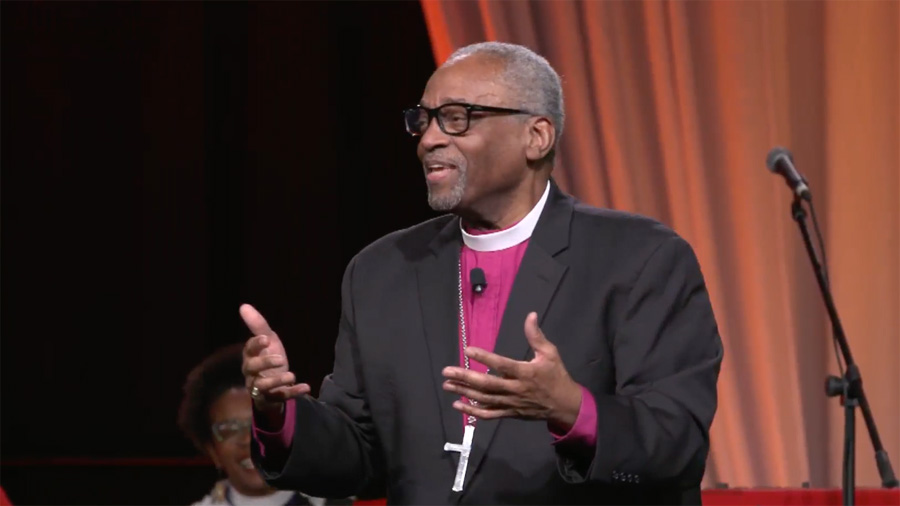
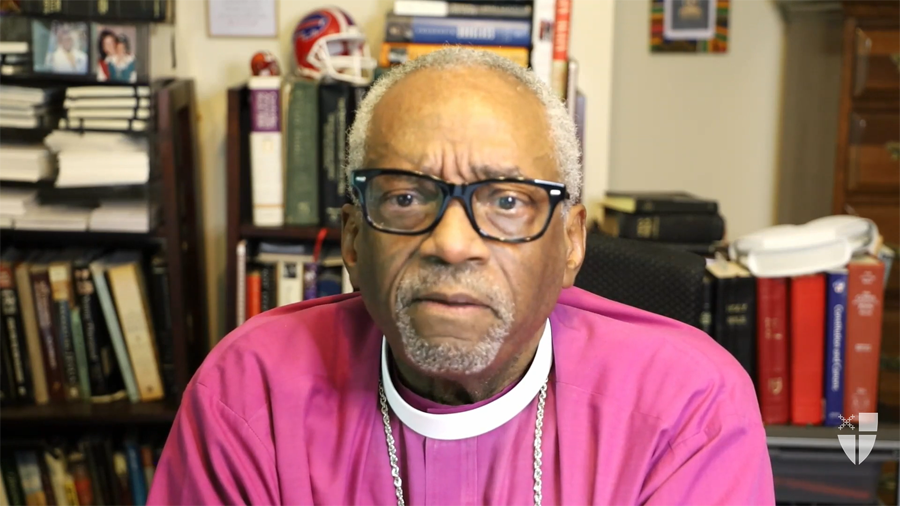
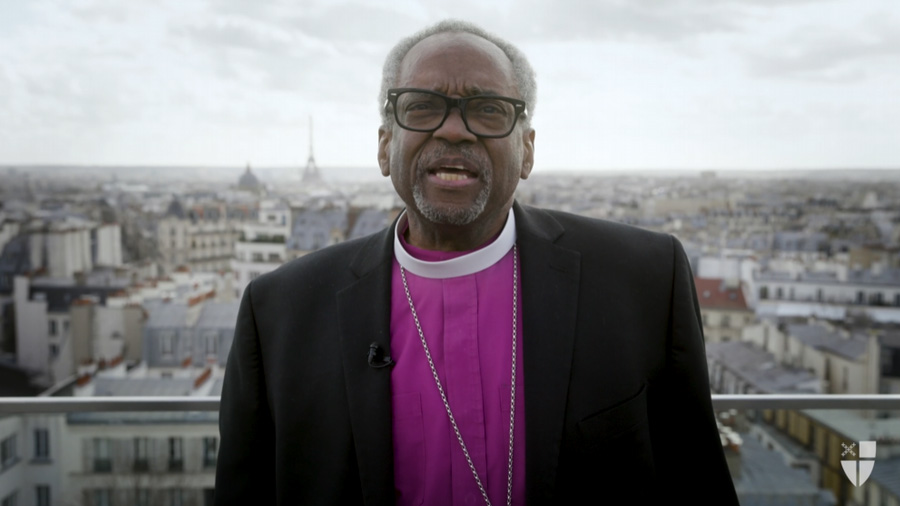
The following is a transcript of the opening remarks of Presiding Bishop Michael Curry to the House of Bishops, meeting virtually from September 19 through September 22, 2023.
St. Paul usually began his letters with words similar to these addressed originally to the church at Rome: “First, I thank my God through Jesus Christ for all of you…” So in that spirit, allow me to offer a few words of thanksgiving.
For Brian Cole, Ednice Baerga, and all the members of our Planning Committee, for our chaplains, interpreters, and all the members of the staff and the General Convention Office. Thank you!
I also give thanks for you, this community of bishops and spouses. Thank you for your patience, your well wishes, your texted jokes, and above all for your prayers for me and my family. I am thankful that the issues with my heart are being managed and monitored, and that issues with this internal bleeding from this tumor on my right adrenal gland will get addressed with tomorrow’s surgery. I’m going to be fine, come what may, I’m going to be fine because we have a God, and God is real. So, God willing, I fully expect, with a short recovery time, to be back full time. In all things, to God be the glory!
Lastly, I want to thank Mike Klusmeyer, who a year ago held off his retirement to help us out serving as canon to the presiding bishop for Mission Within The Episcopal Church. He would like to retire by Nov. 1, and he does so with my deep gratitude. So, thank you, Mike; thank you, Marsha. And may God bless and keep you both on your retirement journey.
I know how important this role is for our ministry as bishops and for the work of this House. While this canon will only serve likely through the end of my tenure, I am mindful that this will be during a General Convention year and the transition to the 28th presiding bishop. I have therefore commissioned a small task group to:
Identify a pool of potential persons to be considered for this position.
Narrow that field.
Contact persons to assess both their interest and availability.
Present two or three names for me to consider.
Members of this task group are Andy Doyle, who has agreed to serve as the convenor; Jennifer Baskerville-Burrows, Mary Kostel, Mark Stevenson, and Ruth Woodliff-Stanley. They have agreed to begin their work with this announcement. Thank you to each one; thank you.
Several months ago, the Planning Committee designed our time around the theme, “The Vocation of Bishop Now.” That word “now” is important. Now, in this present moment. Now, in these days in which we live. Now, in the cultures where serve. Now, “for such a time as this,” as Queen Esther says in the Bible. This is not an easy time to be a follower of Jesus. It’s not an easy time to live by love. It’s not an easy time to be a bishop. It’s not an easy time to be the church. It’s not an easy time to be a leader in any endeavor; and frankly, it’s not an easy time just to be human.
The timely theme of “The Vocation of Bishop Now” invites us to wrestle with some issues that are before us:
First, thoughtful engagement with clergy discipline—for bishops, priests, and deacons—upholding both the values of Title IV and the value of seeking and speaking “the truth in love,” holding each other accountable for our sins of omission or commission, and striving with all that we can muster by God’s grace toward becoming God’s beloved community on Earth as it is in heaven.
Second, our context demands that we must help the church to face and engage the reality of decline—lovingly, wisely, strategically, and courageously. It demands that at the same time we must support and encourage healthy and vibrant ongoing and emerging communities of faith, and it demands that we are called to be “prisoners of hope,” as the Bible says, sentries of new possibilities, messengers of good news, and apostles and midwives of resurrection.
This is not easy. The times are not easy. But this is hard and holy work, and we can only do it together—as bishops, clergy and lay people, as the baptized people of God. We cannot, however, do this by ourselves, no matter how smart, how matter how capable, no matter who we are; we cannot do this by ourselves alone. We need God, we need Jesus, we need the Holy Spirit of the living God who, Jesus said, “will lead [us] in all truth.” Simply put, we need God, and we need each other.
In the 18th chapter of Matthew when Jesus was teaching about the hard and holy work of becoming beloved community, he pointed to this truth when he said, “Wherever two or three are gathered together in my name, there I am in the midst of them.” We need God, and we need each other.
I would dare say that Jesus was pointing to this when over and over again the four Gospels—hear that: the four Gospels, over and over again—record Jesus declaring in a variety of ways that the love of God and love for each other is God’s way of life, God’s dream for his human family, God’s vision for God’s entire creation. We need God, and we need each other. “You shall love the Lord your God and your neighbor as yourself.”
And I suspect that our baptismal covenant may well be getting at this when we promise to follow Jesus in God’s way of love and life with these simple words: “I will, with God’s help.” We need God, and we need each other.
Archbishop Tutu frequently quoted St. Augustine of Hippo who is reputed to have said: “By God’s self, God won’t. By ourselves, we can’t. But together with God, we can!”
So God love you, God bless you, and you have a blessed meeting. And I’ll be seeing you on the other side of surgery. Amen.
Episcopal Church Presiding Bishop Michael Curry underwent a scheduled on September 20, 2023, to remove his right adrenal gland and an attached mass, which was identified as the source of two prior instances of internal bleeding.
He is now out of surgery and resting, and he will be in the intensive care unit of the hospital for about 24 hours. More information will be shared as it becomes available.
Please continue to uphold Bishop Curry, his family, and his whole medical team in your prayers.
Being a Christian is not essentially about joining a church or being a nice person, but about following in the footsteps of Jesus, taking his teachings seriously, letting his Spirit take the lead in our lives, and in so doing helping to change the world from our nightmare into God’s dream. ―Michael Curry, Crazy Christians: A Call to Follow Jesus
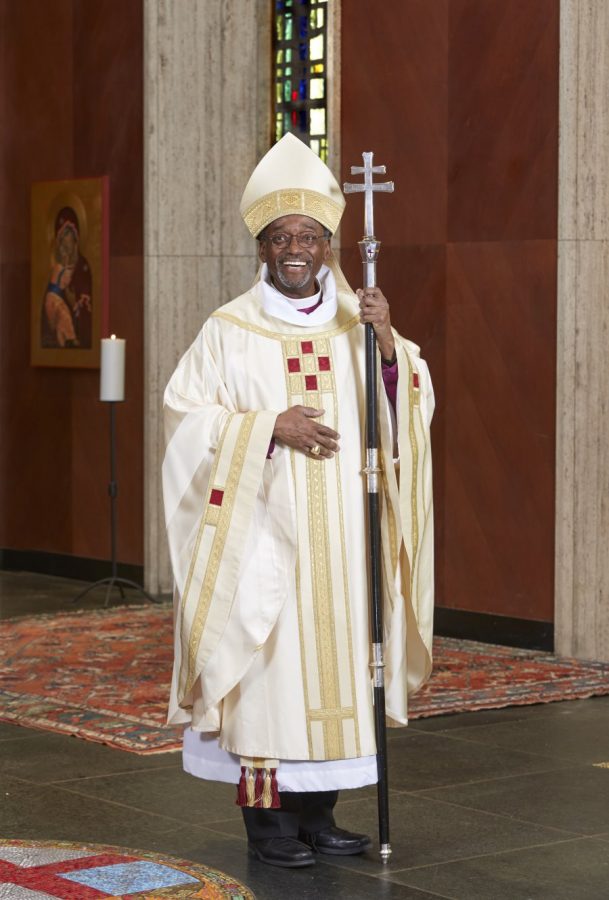
The Most Rev. Michael Bruce Curry is Presiding Bishop and Primate of The Episcopal Church. He is the Chief Pastor and serves as President and Chief Executive Officer, and as Chair of the Executive Council of the Episcopal Church.
Presiding Bishop Curry was installed as the 27th Presiding Bishop and Primate of The Episcopal Church on November 1, 2015. He was elected to a nine-year term and confirmed at the 78th General Convention of The Episcopal Church in Salt Lake City, Utah, on June 27, 2015.
Church of the Redeemer: Worshiping God, living in community, and reaching out to the world around us. We are an Episcopal Church serving north King County and south Snohomish County, Washington. As you travel your road, go with friends walking the way of Jesus at Redeemer.
Church of the Redeemer is at 6220 Northeast 181st Street in Kenmore, Washington. The campus is a short distance north of Bothell Way, near the Burke-Gilman Trail. The entrance looks like a gravel driveway. The campus is larger on the inside than it is on the outside. And we managed to hide a large building on the side of a hill that is not easily seen from the street.
Curry’s doctors were able to intervene in this instance. His medical team is assessing the risks and benefits of surgically removing his right adrenal gland and an attached mass, which may be the source of the internal bleeding. The release calls on the church to “please pray for the doctors’ discernment.”
“I am so grateful for your prayers,” Curry said. “I expect that the work of the medical team will lead to healing that will make a difference. Fervent prayer plus good medical care is a powerful combination. In all things God is good.”
Following his earlier hospitalization, Curry continued to work on a reduced schedule from his home in Raleigh, North Carolina. He made two appearances in July at the Episcopal Youth Event and the It’s All About Love festival, both held in Baltimore, Maryland.
Curry is expected to be discharged on August 22.
This story will be updated as Episcopal News Service receives more information.
Episcopal News Service
Episcopal News Service (ENS) offers in-depth reporting of local, regional, national and international news for Episcopalians and others interested in the church’s mission and ministry. Episcopal News Service is the official news source of the Episcopal Church.
Church of the Redeemer
Church of the Redeemer: Worshiping God, living in community, and reaching out to the world around us. We are an Episcopal Church serving north King County and south Snohomish County, Washington. As you travel your road, go with friends walking the way of Jesus at Redeemer.
Church of the Redeemer is at 6220 Northeast 181st Street in Kenmore, Washington. The campus is a short distance north of Bothell Way, near the Burke-Gilman Trail. The entrance looks like a gravel driveway. The campus is larger on the inside than it is on the outside. And we managed to hide a large building on the side of a hill that is not easily seen from the street.
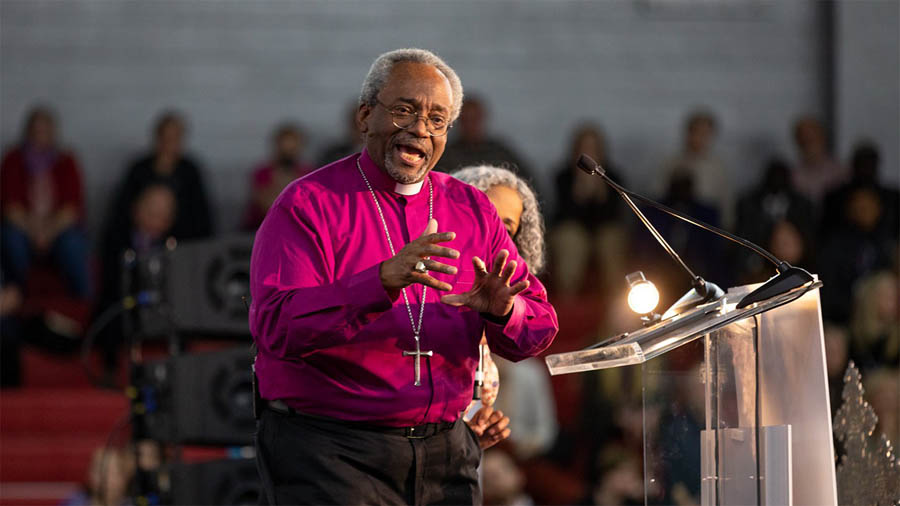
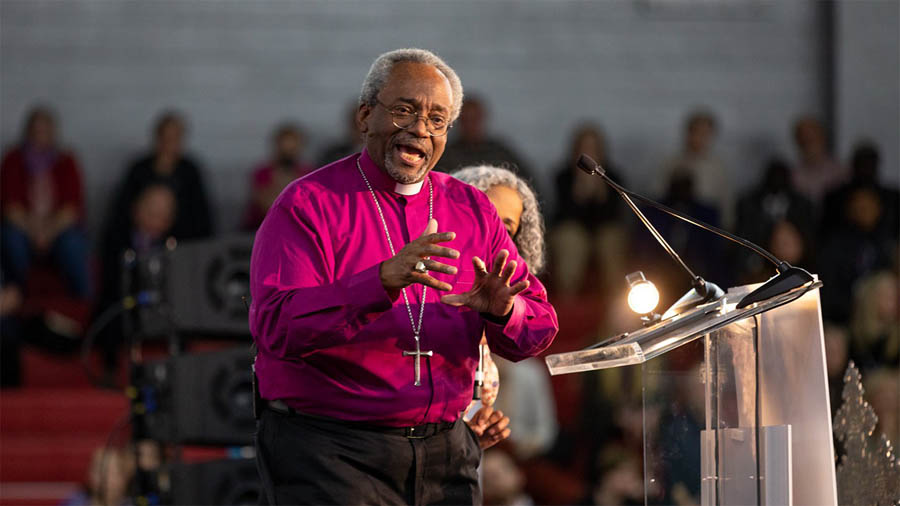
Episcopal Church Presiding Bishop Michael Curry delivered the opening sermon July 9, 2023, to hundreds of Episcopalians gathered in Baltimore, Maryland, for “It’s All About Love,” a churchwide festival focused on worship, learning, community, and action.
The following is a lightly edited transcript of the Presiding Bishop’s remarks.
Bless you. Bless you. Thank you, bless you, God love you. You’re very dear. Bless you.
Oh, God love you. But I’ve got to tell you, ya’ll going to have me come after those brothers? And after this gang? We’ve got some good music here. I thank God for you all. Thank God for you. Thank God for you. And I just want to thank everybody who’s made this week, this festival of the Jesus Movement, possible. Everybody from Stephanie and Jerusalem and their entire team and all of the local folk here in Baltimore, in the Diocese of Maryland. Oh yeah, yeah. Give them a shout-out. Yeah, give them a shout-out.
I want to thank President Julia Ayala Harris, who is with us. She’s here. There she is in the front row, president of the House of Deputies. She is with us. She told me before we came out that it was one year ago today that she was elected president of the House of Deputies in this very room, in this very room. And it is so wonderful to see so many friends, both old friends—in terms of from the past; I don’t mean your age—but to see both old friends and to make new ones. And I’m only with you for today, and I’ll go back and continue to make my contributions to the American Medical Association. I expect to be at their next gathering to win an award for meritorious contribution.
But I say all that to say thank you. I thank you for your prayers. You have no idea, well, maybe you do, what they mean and how they matter. Because prayer really does matter. It matters. And I can tell you in the mystery of God, I don’t know how it all works out, I just know that it does.
And I have felt prayed up and have actually sometimes felt your prayers going in and out of CAT scan machines … But I thank you for your prayers and for your continued witness to the love of God that we have known in Jesus Christ. And that matters, I’m here to tell you….
So I do want to just say a few words about why we’re here, why it matters, and what a difference it makes.
A friend of mine, Dr. Charles Marsh, who teaches at UVA, University of Virginia, who actually did some of his seminal writing here in Maryland—I think he was teaching at Loyola at the time. But one of his books, he wrote at the Episcopal cathedral here. And I got to know him back then. And I used to joke with him because he went to the cathedral, and I was the director over at St. James’. I said, now you go over to the cathedral because the cathedral is a good church. But if you want a revival, you want a revival, come on over to St. James’. Yes. But in one of his books, titled “The Beloved Community,” he’s telling the story of Fannie Lou Hamer, who was one of the most incredible people of the Civil Rights movement, the Mississippi Freedom Party.
Fannie Lou Hamer was a character. She was an incredible woman. And he was telling her story, and he then pivots and talks about Jesus because she talked about Jesus. And at one point he said, inspired by the witness of Fannie Lou Hamer, he says in his book, Jesus began the most revolutionary movement in human history. It was a movement of people whose lives were committed to the God who is unmerited, undeserved, unconditional love, and who were committed to following this Jesus of Nazareth into living that love in their lives. And for the sake of the world.
It is all about love. And when you listen to Jesus of Nazareth, he points us to God, who the Bible says is love. And at one point, he said in John 13, “A new commandment I give you”—Moses gave you 10; I’ve got one more—“A new commandment I give you that you love one another as I have loved you.” Love one another as God loves us. Love one another as Jesus loves all the little children of the world. Love one another as the Spirit, that sweet, sweet Spirit—sweet, sweet Spirit, who, when the Spirit shows up, we will leave this place and know we have been loved and can love—love one another as I have loved you. For by this, everyone will know that you are my disciples that you love one another, that you love the loveless, that you care for others, that you witness to God’s justice. That you try to help somebody along the way. That you help somebody and don’t hurt them. And if you hurt them, own it. Get up, ‘fess up. And then get up. Love one another.
Now, that was just introductory remarks, but I realize that some notable folk interpreted what Jesus was saying when he says, “A new commandment I give you that you love one another, for by this, everyone will know that you are my disciples.” It was this saying was attributed to Prime Minister Disraeli. It was also attributed to Mahatma Gandhi, but I never met either one of them. I heard it at a concert from Jimi Hendrix. And I don’t know if Jimi was actually consciously doing a riff off Jesus, but the Spirit was moving. And he may not have even known it.
Because when Jimi, I think, heard Jesus say, “A new commandment I give you that you love one another”—and then after he says all of that, toward the end of these sayings, he says, “In this world you will have tribulation, but be of good cheer, I have overcome the world.” And Jimi heard that saying about the power of love. And he said this—like I said, I didn’t hear Gandhi say it, and I didn’t hear the prime minister say it, but I heard Jimi say it. I was a teenager, and I heard Jimi say it. This was before the internet.
Jimi said it this way: “When the power of love overcomes the love of power”—y’all with me now? “When the power of love overcomes the love of power, then the world will know peace.” Oh, oh, then the world, then the world, then the world will know peace. Then there will be justice. Then truth will be told in public squares. Then we will learn how to lay down our swords and shield down by the riverside and study war no more.
“When the power of love”—repeat after me—“When the power of love overcomes the love of power, then the world will know peace.” It is all about love. Oh, turn and tell your neighbor, it’s all about love. Go on, tell them. It’s all about love. All about love. All about love. It’s all about love.
Something dawned on me when I was getting ready for this, and I don’t think it was the medicines that I’m taking, but I hadn’t thought about it before. But it dawned on me that in that last week of Jesus’ earthly life, before the crucifixion, it dawned on me that Jesus was entering Jerusalem, which was a center of the Roman empire occupying Palestine. He was going to the heart of the beast in the Middle East. Did you like that? And he went there, it dawned on me, to confront an empire in love with power, with the power of love.
That’s why he went there. And when he went there, he deliberately provoked the empire that was in love with its power … Jesus entered Jerusalem on Palm Sunday, right? And he did it timing it with the entrance of Pontius Pilate, the governor of Rome. Pilate was coming in from the west side of the city, having been in his palace at Fortress Antonia. Jesus came in on the eastern side of the city, the Mount of Olives in that area.
This, this was Rosa Parks. That’s what’s going on here. This was a nonviolent demonstration of the power of love. That’s what’s going on. And I’ve got to tell you, it was a demonstration of the power of love at risk to himself. And during this week, when Jesus is in the midst of this confrontation—and it goes on all week; if you read the Gospels in Holy Week, Jesus, folk are fussing with him all the time. And at one point they send somebody to Jesus, a wolf in sheep’s clothing, a lawyer. Any lawyers here? Come on, come on, raise your hand, I know you’re here, but we need lawyers. We need good ones.
But this lawyer comes to Jesus. You know this story. It’s in Matthew 22. Lawyer comes to Jesus and he says, “Jesus, what is the greatest law in the entire legal edifice of Moses?”
And Jesus says, he reaches back to the Hebrew scriptures, reaches back to Moses and Deuteronomy and Leviticus, reaches back to the Torah. He reaches back and he says, from the Shema, “Hear, O Israel, the Lord our God,” is what he said—“You shall love the Lord your God with all your heart, soul, mind, and strength. This is the first and great commandment.” Then he turns to Leviticus, “and you shall love your neighbor as yourself.”
On these two—love of God, love of neighbor, and while you’re at it, love yourself. But on these, he says, depend all the law, hangs all the law and the prophets. Which is a way of saying, this is the supreme court. Well, the real one, the real one. Yes. This is God’s supreme court, right? This is the supreme law of God, if you will. Right? This is it. You shall love the Lord your God and love your neighbor as yourself. Love the Lord God who made you and created you and who is at the source of your life and in whom you live and move and have your being. Love your neighbor as yourself. You don’t have to like them. But love them, care for them. Seek their good, their wellbeing.
Let me tell you, it means—I’m going to get in trouble now; I blame the medicine—it means that if you’re a Democrat, you’ve got to find a way to love a Republican. All right? And if you’re Republican, you’ve got to find a way to love a Democrat. And if you’re an Independent, you can go either way you want, but love somebody. Love God. Love your neighbor. Love yourself. This, Jesus says this in Holy Week, two days after he entered on the donkey. And while you’re at it, love yourself. You have to love yourself. Because you are called to love who and what God loves. And God loves his children. All of them, all of us. So, love yourself.
Some of y’all have heard me say this before. I’m learning to love Michael Curry. I have a habit I get every morning that I get up. Even when I was in the hospital; I was in the hospital, they had me wired up and all sorts of stuff. And I had my wife, I mean, she came in at some point. I said, “You got a mirror in your purse?” And I’m wired up and got oxygen things in and all this stuff. And they take, you know, they had a vampire down there drinking up all the blood. But anyway, and so, you know, I wasn’t looking, you know, all that pretty. And she took out the mirror; she didn’t know what I was doing. I said, “Put it in front of my face.” And I said, “Wait, put it closer.” I said, “Wait a minute. Denzel Washington, is that you?”
Love yourself, even if it’s an illusion. Love yourself. Love the Lord your God. Love your neighbor. Love yourself. Jesus entered Jerusalem to confront the love of power with the power of love. And if you look at what he says—and I’m going to move on—but if you look at what he says later on, in the Gospel of John at the last Supper, he talks incessantly about love. I mean, he’s going to be killed in a little while. And he says, “By this,” the text says, “by this, everyone will know that you are my disciples. A new commandment I give you that you love one another. As the Father has loved me so have I loved you. Now abide in my love. Greater love has no one than this, but that they give up their life for their friends. And I have called you friends.”
Love, as Judas is slithering out the room. Love, as they will abandon him. Love, as he is arrested. Love, as he is tried and convicted for crimes he never committed. Love, as he is tortured. Love, as nails are hammered through hands … Love, as he bleeds to death on the cross. Love, as a mama is holding her baby, lifeless in her arms. Love, as Joseph of Arimathea and Nicodemus put him in the tomb. Love on that Holy Saturday when nothing was happening. What a horrible time.
And then love went early in the morning. Folk felt the earth quake. Love. When the sisters got up and went to the tomb and asked, “Who will roll away the stone for us?” One of them said, “I don’t know, but we got to go.” Love when they got there and the stone was rolled away, the tomb was empty. Love. He was alive. Love. He had been raised from the dead. Love. This is all about love.
And then if you still didn’t get it, at the end of John’s Gospel in chapter 21, he has a conversation with Peter, and he says, “Peter, do you understand?” Peter says, “I don’t know what you mean.” He says, “Simon, son of John, do love me?” Three times he asked him. It’s all about love. Because when the power of love overcomes the love of power, then the world will know peace.
A few years ago, some of you may know, a few years ago, I was at a wedding. It was a small family affair. But anyway, and I can tell you this now, while I was there, you know, sitting in the chapel before getting up and preaching—and they asked me not to stray too far from the pulpit; I felt like a caged tiger; I couldn’t get out. But after the service was over, I got on the plane, the flight to come back. And I can’t tell you how many times it happened in those first couple of weeks when someone would say—I had preached on love—somebody had said over and over again, I didn’t know Christianity was about love.
I heard it over and over. I’m not exaggerating, over and over again. And I realized that Christianity needs a revival. Christianity itself needs a revival, a revival to the teachings of this Jesus for whom love was at the very center of those teachings. And it dawned on me that maybe, maybe this Episcopal Church—don’t you worry about the parochial statistics; don’t you worry about all the facts and figures. If we love God and love our neighbor and love ourselves, we will work our way even out of our misery. Don’t you worry about it now. That’s all about love, all about love. All about love.
I know, I know, somebody’s thinking, preacher, this sounds good—in church. It’s a tough world out there. And you know, it is tough. … I’ve been ordained over 40 years, been in the church since I was baptized as a baby. I’ve got a lot of experience in the church. I told a senator, I said, “Well, I know it’s tough here on Capitol Hill, but I invite you to come and hang out with some church folk.” Oh, yeah.
So anyway, I can imagine somebody’s thinking, OK, this love thing is nice, you know, in church, if you will; it’s nice, you know, in Bible study; it’s nice when we’re in prayer. And it is, it is. But can it work in the real world? Can it work in the world of power politics? Can it work in the world of economics? Can it work in a world often bent on self-service and lack of care or concern by anybody else? Don’t believe me—ask the climate scientist; can it work in this kind of world in which we live? I understand part of the problem is that we have cheapened love. Dietrich Bonhoeffer talked about cheap grace. I think we need to pay attention also to cheap love. Because that’s what’s got people confused.
During the pandemic, like you, I was at home. I actually did at one point ask myself a question—I said, what does a presiding bishop do at home? I’m so used to getting on airplanes, going places. I said, what do I do when I can’t go anywhere? I felt like a caged tiger. And so I finally developed a rhythm when I realized you can’t stay on Zoom for five hours or your brain will fry. I started taking off some time in the afternoon just to kind of rest and sleep actually, but rest and take a quick nap and then pick it up and work some more. At about 12, 12:30, somewhere thereabouts, I would go downstairs. Sharon, my wife Sharon, would be watching TV. And some of you may know, at 12:30, soap operas begin. And she’s watching “The Young and the Restless.” Yeah, channel 7. And then, “The Bold and the Beautiful.” And so I went down and actually started watching myself, and you do get addicted. And after a little while, if I missed one, I’d ask her, “Well, what was Sophie doing with Johnny?” But I realized something when I was watching these soap operas. I mean they really are funny. What I love about them is every year at Christmas, after they’ve been cutting each other down and stabbing each other in the back, they get around with the glittering bulbs on the Christmas tree and they sing, “Oh, come, all ye faithful.”
But listening to these soaps, these folk were talking about love all the time. At one point I sat down and counted the number of times they used “love” or were referencing love. They talk about it all the time. And it occurred to me, sometimes folk get confused when they hear that word “love” because in English, we’ve only got one word for it. In the Greek, biblical Greek, there are three, actually four, different words that talk about the nuances and different kinds of love, eros, philia, and agape. But in English, we’ve just got the word love. And so they’re just using love all over the soap opera. And I wonder if folk get confused when they hear, “God so loved the world that he gave his only begotten son”—if they hear Jeremy on “The Bold and the Beautiful.” And that’s part of the problem.
But the truth is, love is God’s GPS, God’s global positioning satellite, to help us find a way to life as God intended. That’s what love is. I was reading an article, last week, the week before, it was on CNN online. It was about a Black family in Indianapolis. Husband, wife, and three children. The father is a minister. Their 25-year-old child came out as a transgender woman. And the family wrestled with, what do we do? And they finally realized, and they’re still wrestling with it, but they finally realized, this is our daughter.
This is what the father said: “This hasn’t been an easy transition as a father. I told Kiah, ‘There’s a difference between agreement and acceptance.’ For me, nope, I don’t agree. I do accept because that is my baby. I had to really dig deep to understand love. I thought I knew, but my baby has taught me to really reevaluate and reimagine love and what love is.” And then, and this really happened, “…the Lord spoke very audibly to me and said, ‘You’ve got to let love lead.’”
Let love lead, and love your child. Let love lead, and let her find the life abundant meant for each. Let love lead to help you heal old wounds. Let love lead, and you’ll find life as God intended because love is God’s GPS. It’s God’s global positioning satellite that will lead you to the heart of God, the heart of the world, the heart of yourself.
It’s all about love. I can tell you, I ain’t no spring chicken anymore, but I was rector here at St. James’. I was cute, I was thin, had no gray hair. Well, they gave me some gray hair. And I’ve been at this a long time, and I really am convinced that Jesus is the way. And that his way is the way of unselfish, sacrificial love. It can lift us up when the gravity of life pulls us down. It can help and heal when nothing else can. And it can lift up and liberate when nothing else will. There’s power in love, and we underestimated it, confusing the Bible with a soap opera.
My grandma—now I grew up Episcopalian; I know y’all don’t believe that, but it’s true—but my grandma, who may be the most profound spiritual influence on me, was a dyed-in-the-wool … North Carolina Baptist. They used to sing a song in grandma’s church. You know how it goes: “I was sinking deep in sin, far from the distant shore, very deeply stained within, sinking to rise no more. But the master of the sea heard my despairing cry, from the waters lifted me—now safe am I.”
And then folk would sing, “Oh, love lifted me, love lifted me, when nothing else would help, love lifted me.” That’s what we’re talking about. Love is the power of God to lift up and liberate his children, to help and heal us when we don’t have the power to do it by ourselves.
Well, let me bring this to a conclusion, or somewhere near one. I decided a while back, a couple months ago actually, that I was going to create a metric for my job performance as presiding bishop. You know, for job performance, you have to have metrics so that you can assess and determine how did you meet the metrics. And I figured it probably makes sense for me to set one rather than having Executive Council or General Convention do it. Smart move, let me tell you. So I figured out, well, what metric could I use? And I finally came up with one.
Before I retire, I want to get every Episcopalian, or most of them, or a goodly number of them, or the few and the proud—anyway, get as many Episcopalians as I can to know at least one verse of Scripture. Just one. And “Jesus wept” does not count. Right? Just one. And so I came up with one. And here it is. It’s from first John, the epistle, first John chapter four, verses seven and eight. But I’m just going to give you one part of that. The text, it says, “Beloved, let us love one another because love is of God. And those who love are born of God and know God. Those who do not love do not know God”—and here it is—“because God is love.”
You hear what we just said? God is love. Not love is God. That’s a whole other … no, no. God is love. That is the most succinct, precise, clear theological statement of the nature and the being of God. It doesn’t get any better than that. God is love. And I’ve got to tell you, if God is love, it really is all about love. If God is love, you and I were made by the hand of love. If God is love, this world is made by the hands of love. And that means we were made to love and to be loved and to give love. And we will find our lives when we live in the love of God.
I’ve often told children this story, but allow me to just tell you quickly, one of the things I do, you know, when I’m not doing anything, is I watch “The Animal Planet” on TV. Yeah, it’s really great stuff. I mean it’s just, it’s fascinating. Because one thing is, if you want to learn about human beings, watch the animals. You can learn a whole lot about human psychology from the sociology of animals.
And on this one particular show, they were following a mother bear and her cubs. And I don’t know how they do this, but they actually get the cameras positioned so that they really can look at the animals. The animals don’t seem to care or don’t know. It’s a drone; the drone makes noise. I don’t know how they film these things. But anyway, they had this film. They were filming the mother bear and she was, you know, had her cubs; I assume they were in school and she was teaching them, you know, how to be bears and that kind of thing. And the truth is, all human beings, we all kind of learn by imitation.
So I guess they imitated mama bear. So they were in school, and then at one point it was like, she kind of gave them permission to play. We used to call it recess. And they all were just playing and wrestling with each other. And this one little cub decided to go off on his own. And so he was just hopping and playing and everything, and he kept wandering around and wandering off. And he really wasn’t paying attention until he realized he was lost. He was somewhere out in the forest, and he didn’t see mama, didn’t see sister and brother, and he looked perplexed; but then he said, ah, the heck with it, and he started playing again, and he was having a good old time.
And then all of a sudden you could see him stop with this look of horror, and the camera sort of panned back. And you could see that there was a wolf that had seen him, and the wolf was looking at him, kind of licking his chops. And little cub started backing up. And the wolf came forward; this really was going on. The wolf was coming forward. The little bear kept backing up. The wolf kept coming slowly. It was like the wolf was torturing him, kind of like seasoning your meat. The little bear was backing up, and the wolf kept coming forward, and the little bear backed into a tree. And he realized he was in trouble.
And he looked at the wolf, and the wolf stopped, paused. And you could almost see the cub trying to figure out, what do I do now? And you know how sometimes it’s helpful to figure out, what would Jesus do? Well, I assume the bear cub didn’t know Jesus. I mean, God loves him anyway, but he didn’t know Jesus. And I think he was thinking, what would mama do? What would mama bear do? And so he got up on his little paws, and raised his little hand. And he went, “Rawr,” and the wolf—I swear it looked like this; I may be reading into this—it looked like the wolf smiled.
I mean, it was as if the wolf smiled and said, “Oh, this is so cute; come on, do it again.” And he got up on his little haunches, raised his paw, and said, “Rawr,” and the wolf said, “Isn’t this something?” Then the wolf, you know, made the sign of the cross and said, “God is great. God is good. Let us thank him for our food.” And the little cub knew he was really in trouble then. And he got up on his haunches and raised his paw and one last time went, “Rawr.”
And the wolf had this look of terror on his face, and he turned around and ran. And the little cub had this look like–y’all remember George Jefferson? You remember how George Jefferson would do something, and he’d pat himself on the back and say, “Good one, George. Good one, George.” It was like the little cub just said, wow, I’m something else. And kind of patted himself on the back until he turned around and looked behind the tree. And there was mama bear behind the tree.
Barbara Harris, the late Bishop Barbara Harris, used to say, “The power behind you is greater than any problem ahead of you.” If you live in the love of God and the God who is love, there is no wolf in this world that can defeat you.
Oh, let me conclude it just by saying that the truth is that in a living relationship with the God who the Bible says is love—when we live in relationship with that God following in the footsteps of that Jesus who teaches us the way—when we do that there is no power in heaven or earth or under the earth that can stop this movement.
Paul said it this way: “I am persuaded that neither death nor life nor angels nor principalities, not things present, not things to come, not height, not depth, not anything else in all God’s grand and glorious creation shall ever be able to separate us from the love of God in Jesus Christ.” Oh, it’s all about love. It’s all about love. Power. Power and love. Because love links us to the God who made us. That’s what Jesus was talking about.
But with this, I will sit down. Archbishop Tutu used to say often—I don’t know whether he made it up or stole it from somebody—but he used to say often, of how God works in the world, he would say, by himself, God won’t. By ourselves, we can’t. But together with God, we can. The God who the Bible says is love.
Together with the God who is the source of love and life, together with God we can; we can make poverty history together in partnership with God. We can do justice and love mercy and walk humbly with our God. Together with God we can clean up this environment so that there is plenty good room for all of God’s children. Together with God we can create societies and a world where everybody is treated as God’s somebody. Together with God we can create a world where justice really does roll down like a mighty stream and righteousness like an ever-flowing stream. Together with God, we can learn how to lay our swords and shields down by the riverside, to study war no more. When the power of love overcomes the love of power, then the world will know peace.
God love you. God bless you. And may God hold us all in those almighty hands of love. Amen.
Presiding Bishop Michael Curry
Being a Christian is not essentially about joining a church or being a nice person, but about following in the footsteps of Jesus, taking his teachings seriously, letting his Spirit take the lead in our lives, and in so doing helping to change the world from our nightmare into God’s dream. ―Michael Curry, Crazy Christians: A Call to Follow Jesus
The Most Rev. Michael Bruce Curry is Presiding Bishop and Primate of The Episcopal Church. He is the Chief Pastor and serves as President and Chief Executive Officer, and as Chair of the Executive Council of the Episcopal Church.
Presiding Bishop Curry was installed as the 27th Presiding Bishop and Primate of The Episcopal Church on November 1, 2015. He was elected to a nine-year term and confirmed at the 78th General Convention of The Episcopal Church in Salt Lake City, Utah, on June 27, 2015.
Church of the Redeemer: Worshiping God, living in community, and reaching out to the world around us. We are an Episcopal Church serving north King County and south Snohomish County, Washington. As you travel your road, go with friends walking the way of Jesus at Redeemer.
Church of the Redeemer is at 6220 Northeast 181st Street in Kenmore, Washington. The campus is a short distance north of Bothell Way, near the Burke-Gilman Trail. The entrance looks like a gravel driveway. The campus is larger on the inside than it is on the outside. And we managed to hide a large building on the side of a hill that is not easily seen from the street.
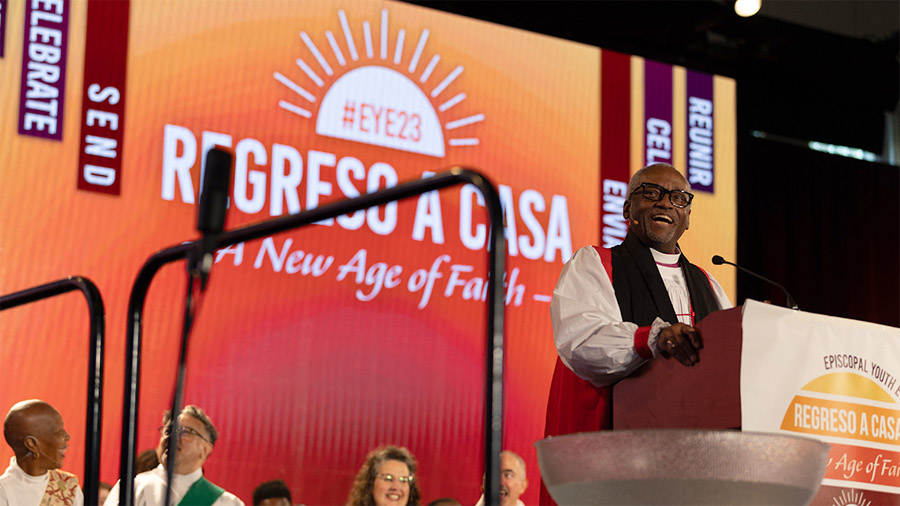
[Episcopal News Service — College Park, Maryland] As soon as Presiding Bishop Michael Curry’s face appeared onscreen, the room erupted in cheers. Hundreds of attendees at the Episcopal Youth Event, or EYE, had eagerly awaited his arrival for worship on July 6, 2023, and celebrated as he took the stage to preach.
“I don’t have the mobility that I used to have,” said Curry, 70, who was admitted to the hospital in May and continues to receive treatment for heart conditions. His appearance at EYE is one of just two in-person events on his schedule this month, in addition to a July 9 appearance at It’s All About Love in Baltimore. His normal liveliness, though, appeared little diminished as he took center stage at EYE, and the crowd of young people responded with frequent applause.
“It was a really cool experience because I’ve never been to any sort of big kind of church or big worship before,” said Nico Pastore, a 16-year-old from the Diocese of Hawaii whose home church numbers around 40 people and often worships in Hawaiian as well as English.
Some youth at EYE said they have met Curry before at events across the country, and some have only seen him on social media. Even before his in-person appearance, cardboard cutouts of Curry also have been a notable presence at EYE . Some attendees told Episcopal News Service their parents are jealous that they get to see him preach.
Presiding Bishop Curry’s Sermon at the Episcopal Youth Event
Curry’s sermon invoked the biblical story of Esther, picking up where Missouri Bishop Deon Johnson, the opening keynote speaker, left off the day before. The presiding bishop emphasized the courage and serendipitous timing that characterizes the story of the Jewish woman who risks her life to save her people from annihilation.
“We need some Esthers today,” Curry repeated. He drew connections between the plight of Esther’s community and injustice today, which requires young people to stand up and act.
“We know some folks are put down,” Curry said. “We know some folks are mistreated. We know that nations invade other nations, but who knows? Perhaps you were born and made for such a time as this.”
And ain’t nobody supposed to be in the closet
One comment about Mordecai, Esther’s cousin, earned even more applause and cheers.
“Esther eventually became high up and became queen,” Curry said. “Mordecai told her one thing: ‘Don’t let anybody know you’re a Jew. Don’t let anybody know.’ He wanted her in the closet. And ain’t nobody supposed to be in the closet.”
For 17-year-old Julian Kofoot from the Diocese of Iowa, it was impressive that such a public, religious figure could make bold statements referring to LGBTQ+ acceptance.
“As a bisexual who’s been scared to come out my whole entire life to literally anybody, that really inspired me,” Kofoot said. “I should be my true, authentic self.”
The importance of loving yourself
To demonstrate the importance of loving yourself, Curry told the story of his old cat Muffin, which he adopted when he was a young priest in Cincinnati.
The rectory where Curry’s family lived at the time was infested with mice, so they adopted Muffin from a house where another dog and cat would terrorize Muffin, leaving her scared and missing patches of fur. Only after Muffin settled in the Curry household, where they showed her love, did she come out of her shell and kill the mice.
Response to the sermon at the Episcopal Youth Event
Mars Chappel, 15, and her friends Caitlin, Makenzie and Lilly from the Diocese of Maryland considered it a highlight of the sermon.
“He connected it in such a good way that was like, ‘this is a metaphor,’ and we were like, ‘oh my God, we thought it was just this one story,’” Chappel said.
The story also struck a chord for Jackson Burger of the Diocese of Northern California. In the past year, the 17-year-old has moved three different times, and he left his parents. He said the key to getting through is prioritizing his own well-being before he can help others.
“You need to make sure you’re doing OK in the mental health department before you can make sure other people are doing well in the mental health department,” Burger said. “And sometimes you need to call upon other people.”
James Ordona, an 18-year-old from Guam, also knows how important finding both self-acceptance and community support is.
“I never knew that this community, this church community of ours, was so openly wide,” said Ordona. He said that as a Filipino in Guam, he has experienced prejudice from others just based on what island he is from.
“Some Filipinos don’t accept me,” Ordona said. “They think I’m lesser than they are. So we had to move from different churches because they were somewhat scared or thinking we’re inferior. … So when we found [our current church] we found a place to be ourselves.”
The power of love
This is the power of love, according to Curry, the power to proclaim who you are and to value the humanity of those around you. “When love rules, everybody will be treated as God’s somebody no matter who they are,” Curry said. “When love rules, we will find life abundant and for each.”
—Logan Crews is an Episcopal Church Ecojustice Fellow and serves on the student leadership team of the World Student Christian Federation-United States.
Presiding Bishop Michael Curry
Being a Christian is not essentially about joining a church or being a nice person, but about following in the footsteps of Jesus, taking his teachings seriously, letting his Spirit take the lead in our lives, and in so doing helping to change the world from our nightmare into God’s dream. ―Michael Curry, Crazy Christians: A Call to Follow Jesus
The Most Rev. Michael Bruce Curry is Presiding Bishop and Primate of The Episcopal Church. He is the Chief Pastor and serves as President and Chief Executive Officer, and as Chair of the Executive Council of the Episcopal Church.
Presiding Bishop Curry was installed as the 27th Presiding Bishop and Primate of The Episcopal Church on November 1, 2015. He was elected to a nine-year term and confirmed at the 78th General Convention of The Episcopal Church in Salt Lake City, Utah, on June 27, 2015.
Church of the Redeemer: Worshiping God, living in community, and reaching out to the world around us. We are an Episcopal Church serving north King County and south Snohomish County, Washington. As you travel your road, go with friends walking the way of Jesus at Redeemer.
Church of the Redeemer is at 6220 Northeast 181st Street in Kenmore, Washington. The campus is a short distance north of Bothell Way, near the Burke-Gilman Trail. The entrance looks like a gravel driveway. The campus is larger on the inside than it is on the outside. And we managed to hide a large building on the side of a hill that is not easily seen from the street.
Episcopal Church Presiding Bishop Michael Curry offered the following pastoral word as a video message on June 30, 2023, at the end of LGBTQ+ Pride Month.
Text of pastoral word to the LGBTQ+ community
Hello to all of my friends in Christ and all of my friends of goodwill of many faiths. We’re here on the last day of Pride Month. And I wanted to take a moment to address all of my LGBTQ+ family members.
I want you to know that one of the most profound convictions in my heart, based on Holy Scripture, what I read in Scripture and hear in the life and teachings of Jesus of Nazareth, is that all of us—every human child of God—is made in the image of God with infinite value and worth, and that is not decreed by any government. It is decreed by almighty God. In Genesis chapter 1, God made human beings in God’s image and likeness. I believe that is true for all of us.
I’m mindful that this is a difficult time for our LGBTQ+ family and siblings, for my friends. More than 70 anti-LGBTQ+ laws have been enacted so far this year. And this morning’s Supreme Court decision will only add pain and difficulty.
In particular, we have seen our transgender siblings targeted. And if you are among them, I want you to know and remember that you are created by God, in the image of God, and that is God decreed.
This may feel like a moment of difficulty and darkness, and it is. And yet the work goes on. Our commitment to you as a church is unswerving.
I believe deep in my soul that God is always seeking to create a world and a society where all are loved, where justice is done, and where the God-given equality of us all is honored in our relationships, in our social arrangements, and in law.
This is a difficult time. I am mindful of another difficult time, in the 19th century, in the midst of the struggle—once again for human dignity and equality—in the midst of the struggle to bring chattel slavery in America to an end; in the midst of a century where this nation entered into a civil war; in the midst of a time when the Mexican American war was tearing much of the country apart.
In that context, James Russell Lowell penned a poem, part of which speaks of the cross as a scaffold. And he said this:
Though the cause of evil prosper, yet ‘tis truth alone is strong, though her portion be a scaffold, and upon the throne be wrong, yet that scaffold sways the future. And behind the dim unknown standeth God within the shadow, keeping watch above his own.
The hymn “Once to every man and nation,” excerpted and arranged from “The Present Crisis,” James Russell Lowell (1819-1891) by Garrett Horder in Hymns Supplemental to Existing Collections, 1896.
The Lord bless you and keep you. The Lord make his face to shine upon you and be gracious to you. The Lord lift up the light of his countenance upon you and give you his peace. May the blessing of God almighty, the Father, the Son, and the Holy Spirit be on you and remain with you and the entire human family, and all of God’s creation—this day and forevermore.
God love you.
Presiding Bishop Michael Curry
Being a Christian is not essentially about joining a church or being a nice person, but about following in the footsteps of Jesus, taking his teachings seriously, letting his Spirit take the lead in our lives, and in so doing helping to change the world from our nightmare into God’s dream. ―Michael Curry, Crazy Christians: A Call to Follow Jesus
The Most Rev. Michael Bruce Curry is Presiding Bishop and Primate of The Episcopal Church. He is the Chief Pastor and serves as President and Chief Executive Officer, and as Chair of the Executive Council of the Episcopal Church.
Presiding Bishop Curry was installed as the 27th Presiding Bishop and Primate of The Episcopal Church on November 1, 2015. He was elected to a nine-year term and confirmed at the 78th General Convention of The Episcopal Church in Salt Lake City, Utah, on June 27, 2015.
Church of the Redeemer: Worshiping God, living in community, and reaching out to the world around us. We are an Episcopal Church serving north King County and south Snohomish County, Washington. As you travel your road, go with friends walking the way of Jesus at Redeemer.
Church of the Redeemer is at 6220 Northeast 181st Street in Kenmore, Washington. The campus is a short distance north of Bothell Way, near the Burke-Gilman Trail. The entrance looks like a gravel driveway. The campus is larger on the inside than it is on the outside. And we managed to hide a large building on the side of a hill that is not easily seen from the street.
In recognition of World Refugee Day and Episcopal Migration Ministries’ Rainbow Initiative to support LGBTQ+ forced migrants, Presiding Bishop Michael Curry shared the following message:
Hello, I’m Michael Curry, presiding bishop of the Episcopal Church. June the 20th, as you may well know, is World Refugee Day. In thinking about that, I was particularly mindful this year of the passage found in the 25th chapter of Matthew’s Gospel. It’s where Jesus tells a parable, a story of judgment day, sometimes called the parable of the last judgment or the parable of the sheep and the goats.
When the Bible talks about judgment day in these kinds of context, it’s really trying to get us to grasp what really matters, what is important to God. And in this parable, Jesus says all the nations and peoples of the earth are assembled before the king on judgment day. To those who have clothed those who were naked, fed those who were hungry, welcomed those who were strangers, visited those in prison or in hospital or alone, he says, enter into the joys of the kingdom. Enter into the joys of heaven.
But the righteous ones who are welcomed into heaven respond in the parable by saying, well, wait a minute, when did we see you hungry and feed you, or naked and clothe you, or alone and visited you? When did we see you a stranger and welcome you?
And Jesus says, when you did it to the least of these who are members of my family, you have done it unto me, the human family, the human family of God. And when we care for one another, respond to one another’s needs, do what is just and kind and merciful and loving, we have done it unto God, God’s self.
In the month of June and on June the 20th, we observe World Refugee Day, a day to remind us and to encourage us and for us to rededicate ourselves to the task of welcoming the stranger: those who are refugees fleeing persecution, those who are fleeing famine and natural disaster, those who are fleeing war, those who have lost their homes and everything that they know and simply want to breathe free.
This year, we are also mindful that LGBTQ people in many countries are in additional danger. They are often threatened because of who they are, persecuted, and fleeing persecution.
The Episcopal Church has made a commitment through Episcopal Migration Ministries to do what we can for all refugees that we can help. But in particular, for those LGBTQ forced migrants who simply, like the rest of us, just want to live in love and peace, as the Bible says, with everyone sitting under their own vine or fig tree.
The Rainbow Initiative is an initiative of Episcopal Migration Ministries, particularly to reach out to people in that situation. That’s an additional commitment to our basic commitment to assist all refugees. And we do this work committed to the one named Jesus, who himself, with Mary and Joseph, was once a refugee.
As people helped the Holy Family to flee persecution, to find safety, so may we this year on World Refugee Day recommit our efforts and our commitments to do all that we can to welcome the stranger. Whereas you did it to the least of these who are members of my family, says Jesus, you have done it unto me.
God love you. God bless you. And may God hold us all in those almighty hands of love.
Being a Christian is not essentially about joining a church or being a nice person, but about following in the footsteps of Jesus, taking his teachings seriously, letting his Spirit take the lead in our lives, and in so doing helping to change the world from our nightmare into God’s dream. ―Michael Curry, Crazy Christians: A Call to Follow Jesus
The Most Rev. Michael Bruce Curry is Presiding Bishop and Primate of The Episcopal Church. He is the Chief Pastor and serves as President and Chief Executive Officer, and as Chair of the Executive Council of the Episcopal Church.
Presiding Bishop Curry was installed as the 27th Presiding Bishop and Primate of The Episcopal Church on November 1, 2015. He was elected to a nine-year term and confirmed at the 78th General Convention of The Episcopal Church in Salt Lake City, Utah, on June 27, 2015.
Church of the Redeemer: Worshiping God, living in community, and reaching out to the world around us. We are an Episcopal Church serving north King County and south Snohomish County, Washington. As you travel your road, go with friends walking the way of Jesus at Redeemer.
Church of the Redeemer is at 6220 Northeast 181st Street in Kenmore, Washington. The campus is a short distance north of Bothell Way, near the Burke-Gilman Trail. The entrance looks like a gravel driveway. The campus is larger on the inside than it is on the outside. And we managed to hide a large building on the side of a hill that is not easily seen from the street.
[Episcopal News Service] The Episcopal Church’s Office of Public Affairs released the following statement on May 30, 2023. It is information about medical care Presiding Bishop Michael Curry is receiving for internal bleeding and an irregular heartbeat.
Over Memorial Day weekend, Episcopal Church Presiding Bishop Michael Curry was admitted to the hospital in Raleigh, North Carolina, where he underwent testing for internal bleeding and a heart condition. He has been discharged and will be monitored while working on a reduced schedule from home.
Curry’s internal bleeding is under control, and additional test results are expected later this week. He has been receiving treatment for atrial fibrillation (AFib), which was detected in an annual physical. While in the hospital, Curry experienced two other episodes of irregular heartbeat, and he will wear a heart monitor to determine what further treatment is necessary.
Until he is cleared for air travel by his medical team, Curry will remain in Raleigh, resting and working from home on a reduced schedule. As more information becomes available regarding Curry’s health and schedule, his staff will provide updates.
Please pray for a full and speedy recovery—and for Curry’s medical team as they identify the best course of treatment.
Presiding Bishop Michael Curry
Being a Christian is not essentially about joining a church or being a nice person, but about following in the footsteps of Jesus, taking his teachings seriously, letting his Spirit take the lead in our lives, and in so doing helping to change the world from our nightmare into God’s dream. ―Michael Curry, Crazy Christians: A Call to Follow Jesus
The Most Rev. Michael Bruce Curry is Presiding Bishop and Primate of The Episcopal Church. He is the Chief Pastor and serves as President and Chief Executive Officer, and as Chair of the Executive Council of the Episcopal Church.
Presiding Bishop Curry was installed as the 27th Presiding Bishop and Primate of The Episcopal Church on November 1, 2015. He was elected to a nine-year term and confirmed at the 78th General Convention of The Episcopal Church in Salt Lake City, Utah, on June 27, 2015.
Episcopal News Service (ENS) offers in-depth reporting of local, regional, national and international news for Episcopalians and others interested in the church’s mission and ministry. Episcopal News Service is the official news source of the Episcopal Church.
Church of the Redeemer
Church of the Redeemer: Worshiping God, living in community, and reaching out to the world around us. We are an Episcopal Church serving north King County and south Snohomish County, Washington. As you travel your road, go with friends walking the way of Jesus at Redeemer.
Church of the Redeemer is at 6220 Northeast 181st Street in Kenmore, Washington. The campus is a short distance north of Bothell Way, near the Burke-Gilman Trail. The entrance looks like a gravel driveway. The campus is larger on the inside than it is on the outside. And we managed to hide a large building on the side of a hill that is not easily seen from the street.
Celebrating the gift of the Spirit on Pentecost to guide us “in the deeper ways of God’s love,” Presiding Bishop Michael Curry invites Episcopalians to pray for the hundreds of young people gathering July 4-8 at the Episcopal Youth Event (EYE) in College Park, Maryland. Some event sessions will be livestreamed for public viewing.
“We are in such a time as that, when the spirit that Jesus promised will lead us and guide us in the deeper ways of God’s love, and God’s way of life, not only for us, but for the entire human family, until the way of life as Jesus taught us becomes our way of life,” Curry said. “It is the way of love, and the Bible says, ‘God is love.’ And that makes beloved community possible.”
Celebrating its 40th anniversary in 2023, EYE is the church’s second-largest event after General Convention, drawing nearly 1,500 young people ages 15-19 from every province. Typically held every three years, this will be the first gathering since 2017, due to the COVID-19 pandemic.
This year’s dual-language theme for EYE—developed by the youth planning team, which seeks to emphasize welcome and invitation to all young people throughout the church—is “Regreso a Casa: A New Age of Faith.”
“Regreso a casa—returning home,” Curry said. “Returning home: faith in a new age, a new age of faith. The Spirit will guide us all. I am so looking forward to being with you.”
EYE programs focus on helping young people develop leadership skills, spiritual practices, and early stages of vocational discernment. In addition to meeting and socializing with other Episcopalians from around the world, EYE participants will spend time in worship, large-group presentations, small-group discussions, and workshops on a variety of topics. Learn more and view schedule.
Text of the Pentecost message
Regreso a casa, returning home. That is the theme of the upcoming EYE gathering of young people from throughout The Episcopal Church. I am so looking forward to being with you. Returning home: Faith in a new age, a new age of faith. That is the subtheme for this gathering.
I’m mindful that many years ago a woman named Phyllis Tickle—who was a dear friend of mine—died and entered eternal life with our Lord. Before she died, she finished one of her last books. And in that book she said that we in our time will find ourselves living in a time when we must rely on the Holy Spirit that Jesus promised us to lead us and guide us along the way.
At the Last Supper, Jesus said to his disciples, at one point in John’s Gospel he says, “There are many other things that I could have told you, but you can’t handle them right now. This much I will tell you: When I depart from you, I will send the Holy Spirit, and that spirit will lead you into all truth.”
We are in such a time as that, when the spirit that Jesus promised will lead us and guide us in the deeper ways of God’s love, and God’s way of life, not only for us, but for the entire human family, until the way of life as Jesus taught us becomes our way of life. Because it is the way of love. And the Bible says “God is love.” And that makes the beloved community possible.
So come and join us for our gathering. I can’t wait to be there with you.
Regreso a casa, returning home. An age of faith, the Spirit will guide us all.
God love you, God bless you, and see you in July.
Presiding Bishop Michael Curry
Being a Christian is not essentially about joining a church or being a nice person, but about following in the footsteps of Jesus, taking his teachings seriously, letting his Spirit take the lead in our lives, and in so doing helping to change the world from our nightmare into God’s dream. ―Michael Curry, Crazy Christians: A Call to Follow Jesus
The Most Rev. Michael Bruce Curry is Presiding Bishop and Primate of The Episcopal Church. He is the Chief Pastor and serves as President and Chief Executive Officer, and as Chair of the Executive Council of the Episcopal Church.
Presiding Bishop Curry was installed as the 27th Presiding Bishop and Primate of The Episcopal Church on November 1, 2015. He was elected to a nine-year term and confirmed at the 78th General Convention of The Episcopal Church in Salt Lake City, Utah, on June 27, 2015.
Church of the Redeemer: Worshiping God, living in community, and reaching out to the world around us.
We are an Episcopal Church serving north King County and south Snohomish County, Washington. As you travel your road, go with friends walking the way of Jesus at Redeemer.
Church of the Redeemer is at 6220 Northeast 181st Street in Kenmore, Washington. The campus is a short distance north of Bothell Way, near the Burke-Gilman Trail. The entrance looks like a gravel driveway. The campus is larger on the inside than it is on the outside. And we managed to hide a large building on the side of a hill that is not easily seen from the street.
“We are here in a world struggling to find its soul, but the light shines in the darkness, and the darkness has not, cannot, and will not overcome it,” Episcopal Church Presiding Bishop and Primate Michael B. Curry said in his Easter 2023 message. “Jesus lives. He has been raised from the dead. That is the message of Easter, and that is the good news of great tidings.”
The festive day of Easter is Sunday, April 9, 2023.
The following is the full text of the presiding bishop’s Easter 2023 message, lightly edited for clarity:
This is a different Easter message. I’ve shared Easter messages from Jerusalem some years ago, and I have shared Easter and Christmas messages from a variety of locations. Last year for Christmas, we were in San Diego. Today I’m in Paris, part of the Convocation of Episcopal Churches in Europe. We just finished a revival—over 50 young people and some 300-400 people from all over Europe who came for this revival service. It was a remarkable thing to behold and be part of.
The Convocation here in Europe is engaged in incredible ministries, with some joining together with Episcopal Relief & Development to make it possible for resettlement of those who are refugees from war and famine, particularly those who are refugees from Ukraine.
Thinking about it—I realize not only with this view—but with the reality of Easter looming on our horizon, John’s Gospel opens: “In the beginning was the Word, and the Word was with God, and the Word was God.” Then there is a point in which it says, of Christ coming into the world, “The light shines in the darkness and the darkness cannot overcome it.”
On that early Easter morning, John says in his 20th chapter, that early in the morning while it was still dark, Mary Magdalene and some of the other women went to the tomb. They went to the tomb after the crucifixion and burial of Jesus. They went to the tomb of their world having fallen apart. They went to the tomb of all their hopes and dreams having collapsed.
But they got up and they went anyway. They went to perform the rites of burial, to do for a loved one what you would want to do for them. They went, following the liturgies of their religion and their tradition, and, lo and behold, when they went, they discovered that, even in the darkness, the light of God’s love, the light of Jesus Christ—the light of Christ, as we say in the Great Vigil—in fact, was shining in the darkness, and the darkness did not overcome it.
Jesus had been raised from the dead. He was alive, and darkness and evil and selfishness could not stop him. Love—as the old song says—love lifted him up.
We are here in Paris, this wonderful city. While there are protests going on in the city—garbage has not been collected, and it’s all over the city—we are here in Paris, in Europe, with refugees streaming into this continent from all over the world, impacted by changes in weather pattern, impacted by war and famine. We are here in a world struggling to find its soul, but the light shines in the darkness, and the darkness has not, cannot, and will not overcome it. Jesus lives. He has been raised from the dead. That is the message of Easter, and that is the good news of great tidings. From Paris, I’m Michael Curry. God love you. God bless you, and the light shines in the darkness, wherever there is darkness. This little light of mine, I’m going to let it shine. Let it shine, let it shine, let it shine. Amen.
Presiding Bishop Michael Curry
Being a Christian is not essentially about joining a church or being a nice person, but about following in the footsteps of Jesus, taking his teachings seriously, letting his Spirit take the lead in our lives, and in so doing helping to change the world from our nightmare into God’s dream. ―Michael Curry, Crazy Christians: A Call to Follow Jesus
The Most Rev. Michael Bruce Curry is Presiding Bishop and Primate of The Episcopal Church. He is the Chief Pastor and serves as President and Chief Executive Officer, and as Chair of the Executive Council of the Episcopal Church.
Presiding Bishop Curry was installed as the 27th Presiding Bishop and Primate of The Episcopal Church on November 1, 2015. He was elected to a nine-year term and confirmed at the 78th General Convention of The Episcopal Church in Salt Lake City, Utah, on June 27, 2015.
Church of the Redeemer: Worshiping God, living in community, and reaching out to the world around us.
We are an Episcopal Church serving north King County and south Snohomish County, Washington. As you travel your road, go with friends walking the way of Jesus at Redeemer.
Church of the Redeemer is at 6220 Northeast 181st Street in Kenmore, Washington. The campus is a short distance north of Bothell Way, near the Burke-Gilman Trail. The entrance looks like a gravel driveway. The campus is larger on the inside than it is on the outside. And we managed to hide a large building on the side of a hill that is not easily seen from the street.
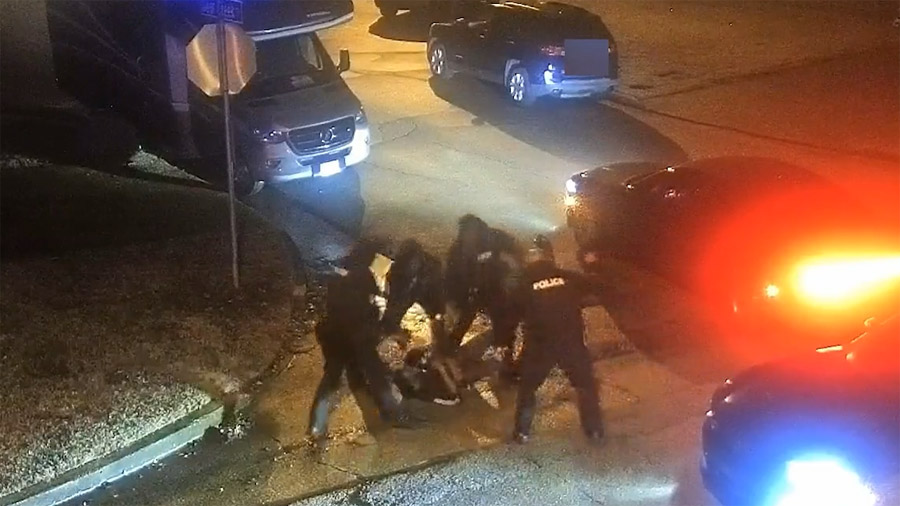
A pastoral word from Presiding Bishop Michael Curry on the death of Tyre Nichols.
Sense cannot be made of the murder of a young man at the hands of five men whose vocation and calling are to protect and serve. This was evil and senseless.
There is a passage from the Hebrew prophet Jeremiah, which is later quoted in Matthew’s Gospel when innocent baby boys are killed by an immoral dictator:
A voice is heard in Ramah, lamentation and bitter weeping. Rachel is weeping for her children; she refuses to be comforted for her children, because they are no more.
Jeremiah 31:15, Matthew 2:18
With the murder of Tyre Nichols, another mother, as in the biblical texts, weeps, with the mothers of Emmett Till, Trayvon Martin, Michael Brown, George Floyd, Breonna Taylor, Ahmaud Arbery, and so many others. A family grieves. A community fears. A nation is ashamed. Like the psalmist in the Bible, something in us cries out, “How long, O Lord, how long?” How long violence, how long cruelty, how long the utter disregard for the dignity and worth of every child of God? How long?
As if this wasn’t enough, there is another horrible dimension to what happened. Tyre Nichols was beaten, kicked, and cursed as if he was not a human being. Then, after he was lying on the ground, having called for his mother, they let him stay there for several minutes without anyone, including the police and EMT who were present, providing medical assistance. Not one Good Samaritan.
Jesus once told a story to teach about what it looks like to love one’s neighbor, which Moses and Jesus both said is a commandment of God. It’s a story about a man beaten nearly to death and left on the side of the road to die by people who knew what Moses taught about love for God and neighbor—and what the prophet Micah taught when he said that God requires three things of us: to do justice, to love kindness, and to walk humbly with your God.
Only one person stopped to help the man, and he did so without regard for the fact that they were of different religions, nationalities, ethnic groups, and even different politics. This second man was a Samaritan, and he helped because the man on the road was human. He helped because he was a fellow child of God. He helped because the man lying on the side of the road, regardless of race, class, clan, stripe, or type, was his brother. And the man who helped has been called the Good Samaritan.
The fundamental call and vocation of law enforcement officials, and indeed every one of us, is that of the Good Samaritan.
Here is where there is hope: The Good Samaritan in the parable of Jesus was not the last one.
There are Good Samaritans who are government officials in Memphis who, after assessing what happened, fired the offending officers, charged them with crimes against human life and dignity, and have committed to addressing systemic and cultural issues that created an environment in which this evil was enabled.
There are Good Samaritans doing what is necessary to radically reform the environment and culture of law enforcement—to create an atmosphere in which the dignity and worth of every human being is respected, protected, affirmed, and honored.
There are Good Samaritans in law enforcement, and other first responders, who often work while others sleep, laboring to protect and serve, at times risking their own lives for the neighbor they do not even know.
There are Good Samaritans, people of goodwill and human decency, who are peacefully protesting. There are Good Samaritans who are activists working tirelessly for the realization of communities and countries where there is truly, as the Pledge of Allegiance proclaims, “liberty and justice for all.”
While we grieve, we cannot give in or give up. Just throwing up our hands in despair is not an option lest we leave a brother, a sister, a sibling on the side of the road again. No, let more Good Samaritans arise so that Tyre Nichols’ death will not be in vain.
Please pray for Tyre’s family, the whole Memphis community, this nation, and world. But also pray for people to rise up like the Good Samaritan and work to create change so this never happens again.
And may the soul of Tyre, and the souls of all the departed, through the mercies of God, rest in peace and rise in glory. Amen.
The Most Rev. Michael B. Curry Presiding Bishop and Primate The Episcopal Church
Presiding Bishop Michael Curry
Being a Christian is not essentially about joining a church or being a nice person, but about following in the footsteps of Jesus, taking his teachings seriously, letting his Spirit take the lead in our lives, and in so doing helping to change the world from our nightmare into God’s dream.
Michael Curry, Crazy Christians: A Call to Follow Jesus
The Most Rev. Michael Bruce Curry is Presiding Bishop and Primate of The Episcopal Church. He is the Chief Pastor and serves as President and Chief Executive Officer, and as Chair of the Executive Council of the Episcopal Church.
Presiding Bishop Curry was installed as the 27th Presiding Bishop and Primate of The Episcopal Church on November 1, 2015. He was elected to a nine-year term and confirmed at the 78th General Convention of The Episcopal Church in Salt Lake City, Utah, on June 27, 2015.
Welcome to Church of the Redeemer: Worshiping God, living in community, and reaching out to the world. We are an Episcopal Church serving north King County and south Snohomish County, Washington. As you travel your road, go with friends walking the way of Jesus at Redeemer.
Church of the Redeemer is at 6220 Northeast 181st Street in Kenmore, Washington. The campus is a short distance north of Bothell Way, near the Burke-Gilman Trail. The entrance looks like a gravel driveway. The campus is larger on the inside than it is on the outside. And we managed to hide a large building on the side of a hill that is not easily seen from the street.