Tag: transgender

  • House of Bishops elects Armed Forces and Federal Ministries bishop suffragan and Navajoland provisional bishop, reaffirms trans rights

    House of Bishops elects Armed Forces and Federal Ministries bishop suffragan and Navajoland provisional bishop, reaffirms trans rights

    At The Episcopal Church’s House of Bishops spring gathering, 122 bishops gathered March 8-13, 2023, at Camp McDowell in Nauvoo, Alabama, for a time of retreat.

    Presiding Bishop’s opening sermon

    In his opening sermon, Presiding Bishop Michael Curry challenged the group by asking how they live into the fact that they are bishops of a church that is both “Good Friday and Easter,” where there is death and new life all at the same time.

    “Not one of us has ever been a bishop in this moment of the church’s life before; there are no experts; there’s nobody who knows how to do it,” Curry said, “but last time I checked my Bible, Jesus said, ‘Wherever two or three gather in my name, I’m going to show up.’”

    He added: “You and I have been called to be bishops, as Mordecai said to Esther, ‘for such a time as this,’ when Good Friday and Easter are indistinguishable. And this Jesus has the truth of eternal life.”

    Read full transcript of Curry’s sermon.

    Scheduled events during the spring gathering

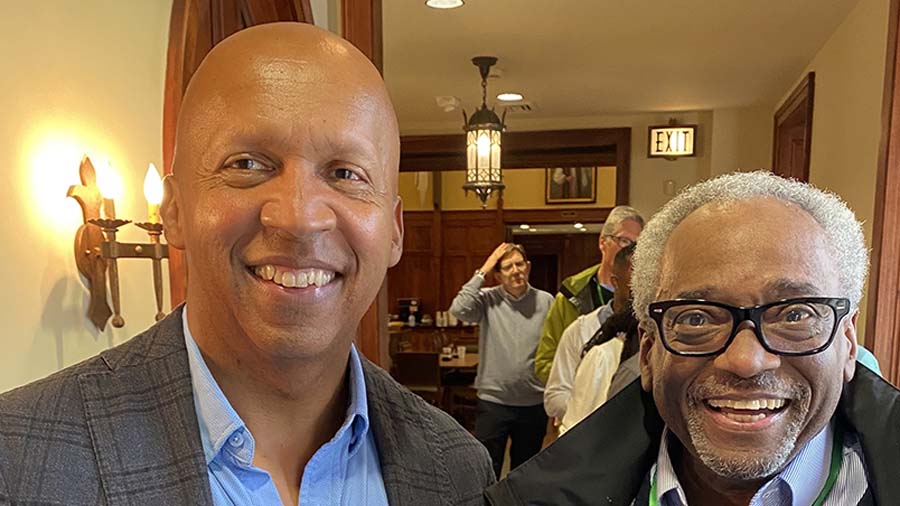
    Scheduled events included a day pilgrimage to Montgomery, Alabama, with visits to the Legacy Museum, the National Memorial for Peace and Justice, and conversation with Bryan Stevenson of the Equal Justice Initiative at St. John’s Episcopal Church.

     “We went to Montgomery not as tourists to consume, but as pilgrims to pray,” Curry said, reflecting on the visit. “We went on pilgrimage to holy places to remember those enslaved and abused in the institution of chattel slavery—and the martyrs and witnesses who labored for a society in which there is ‘liberty and justice for all.’ … We went as pilgrims following Jesus and his way of love.”

    The Very Rev. Miguelina Howell, chaplain to the House of Bishops and dean of Christ Church Cathedral in Connecticut, delivered a homily for Sunday Eucharist. She invited those present to reconsider traditional interpretations of the story in the Gospel of John of the Samaritan woman at the well.

    “Change begins from within at the personal and institutional levels,” Howell said. “The Samaritan woman was courageous, and her bravery did not translate into arrogance. She allowed herself to be vulnerable. She felt seen by Jesus. Jesus spoke to her soul. Jesus spoke to her story. She made the most of the encounter at the well.”

    Read full transcript of Howell’s sermon.

    Business meeting

    Bishop Suffragan for the Armed Forces and Federal Ministries

    In its March 12 business meeting, the House of Bishops elected the Rev. Ann Ritonia, former Marine Corps major, to the position of bishop suffragan for the Armed Forces and Federal Ministries. While the initial election was declared null and void due to a single ineligibly cast vote, Ritonia was then elected on the first ballot of the second election.

    Most recently, Ritonia served as rector of St. John’s Episcopal Church and Parish Day School in the Episcopal Diocese of Maryland. She is the recipient of the Navy Commendation Medal, the Navy Achievement Medal, the National Defense Service Medal, Meritorious Unit Commendations, and the Recruit Honor Graduate Award. Ritonia also served as a member of the Chaplain Selection Committee for Armed Forces and Federal Ministries for seven years.

    “I so look forward to working with the Rev. Ritonia,” said Curry. “We are very fortunate to have her coming on board, and I wish her every blessing in this crucial ministry.”

    Ritonia’s consecration date, pending consents, is set for September 30, 2023, at St. John’s Church, Lafayette Square.

    The bishop suffragan for Armed Forces and Federal Ministries is a Department of Defense-appointed Ecclesiastical Endorser with responsibility for Episcopal chaplains and congregations in the departments of Defense and Veterans Affairs, and the Federal Bureau of Prisons. The Office of Armed Forces and Federal Ministries supports federal chaplains who provide spiritual and day-to-day support for those in the military, Veterans Affairs hospitals, and prisons.

    Bishop Provisional of the Navajoland area mission

    Also in the business meeting, the House of Bishops confirmed the recommendation of the people of the Navajoland area mission to appoint the Rt. Rev. Barry Beisner as their bishop provisional. Beisner served previously as bishop of the Episcopal Diocese of Northern California, and, since 2019, has served as assisting bishop in Navajoland with a focus on the formation of new clergy—in collaboration with his wife, the Rev. Ann Hallisey.

    The Rt. Rev. Todd Ousley, bishop for pastoral development, referenced Resolution D080 from the 80th General Convention, which calls for the empowerment of The Episcopal Church in Navajoland to call its own leadership, including any necessary amendments to church canons at the 81st General Convention.

    Transgender support

    Recalling its March 2022 statement of love and continued support for transgender people and their families, the House of Bishops reaffirmed its commitment in a resolution responding to current legislative actions in 41 states targeting trans people. “We urge all in our church, in all the countries in which The Episcopal Church is found, to create safe spaces and shield all people from harassment based on gender identity, and to join in advocacy to protect them from discriminatory laws,” the resolution states.

    Honoring life and ministry of the Most Rev. Frank Griswold

    The bishops also passed a resolution honoring the life and ministry of the Most Rev. Frank T. Griswold III, the 25th presiding bishop of The Episcopal Church, who died on March 5. The resolution remembers Griswold for being a leader “who, rooted in the fullness of the human experience, encouraged us, in tracking down the Holy Ghost and in gathering up the fragments, to pray all our days, that we might grow more deeply into the love of and longing for God, and so might become prayer itself.”

    Read full transcript of Curry’s closing sermon.

    Article from the Episcopal Church Office of Public Affairs.
    A message from Lent from the Most Reverend Melissa Skelton, Bishop Provisional of the Diocese of Olympia to the people of the diocese.

    Church of the Redeemer

    Church of the Redeemer: Worshiping God, living in community, and reaching out to the world around us. We are an Episcopal Church serving north King County and south Snohomish County, Washington. As you travel your road, go with friends walking the way of Jesus at Redeemer.

    Church of the Redeemer is at 6220 Northeast 181st Street in Kenmore, Washington. The campus is a short distance north of Bothell Way, near the Burke-Gilman Trail. The entrance looks like a gravel driveway. The campus is larger on the inside than it is on the outside. And we managed to hide a large building on the side of a hill that is not easily seen from the street.

    The Episcopal Church welcomes you.

  • President Jennings supports Texan transgender rights in letter

    President Jennings supports Texan transgender rights in letter

    The Rev. Gay Clark Jennings is President of the House of Deputies of the General Convention of the Episcopal Church. This letter supporting Texan transgender rights was published on the House of Deputies website on February 24, 2022.

    President Jennings responds to Texas governor’s “cruel” letter

    Dear Deputies and Alternate Deputies,

    As you may have heard by now, Texas Governor Greg Abbott issued a letter Tuesday to state health agencies saying that medical treatments provided to transgender adolescents—widely considered the standard of care in medical circles—should be classified as “child abuse” under existing state law and reported as such.

    While it is not clear whether this order is enforceable, it is nonetheless a reprehensible statement that puts some of the most vulnerable children in our society, and their families, in grave danger. Denying the full humanity of transgender people, putting beloved children of God at risk, and threatening to separate loving families is cruel and antithetical to the way of Jesus.

    We must do all we can to protect the children whom Governor Abbott has targeted to advance his own political standing and, more broadly, to stop the wave of anti-transgender legislation sweeping across the United States.

    The General Convention of the Episcopal Church first called for equal protection under the law for gay and lesbian people in 1976 with Resolution A071 and expanded the call for equal protection to include transgender people in 2009 with Resolution D012. Subsequent conventions have reaffirmed these calls and passed numerous resolutions supporting the lives and ministries of transgender people in the church and the world.

    In March 2016, Presiding Bishop Michael Curry and I were lead signers on an amicus brief signed by 1,800 clergy and religious leaders in a U.S. Supreme Court case that sought, unsuccessfully, to restrict transgender people’s use of public restrooms. Later that year, we wrote to the church expressing our opposition to a so-called “bathroom bill” in North Carolina. And in 2017, as our church was preparing for the 79th General Convention in Austin, we twice wrote to Joe Strauss, a Republican legislator who was then speaker of the Texas House of Representatives, praising his opposition to Governor Abbott’s repeated attempts to pass a bathroom bill in Texas and asking him to spare us the difficult choice of reconsidering the location of convention. Thankfully, the bill did not pass.

    Our church’s progress in recognizing transgender people as beloved children of God has at times been too slow, and it is not yet complete. But the progress we have made is due in large part to the work of TransEpiscopal, and I commend you to their website and Facebook page.

    Last month, Executive Council heard from transgender, nonbinary and gender non-conforming Episcopalians who gave us a sense of the work that our church must still undertake. “I invite my beloved Episcopal Church to live fully into the stances, canonical changes and statements we have made over the years,” Deputy Cameron Partridge of the Diocese of California told the Executive Council. “These moves we have made at churchwide and diocesan levels and parish levels truly matter and I’m profoundly grateful for them. And I want to see them lived into consistently at all levels of our church’s life, especially the congregational level.”

    The situation in Texas is particularly egregious, but transgender children and their families all across the country have been under heightened attack since last year. The Human Rights Campaign reports that more anti-transgender legislation was filed at the state level in 2021 than at any time in modern history and predicts that 2022 will “eclipse even the brutality of last year.”

    No matter where transgender children of God are under threat, the Episcopal Church must stand with them in love and solidarity. To ensure that we are a church in which vulnerable people are not only welcomed, but also protected, Episcopalians must respond with our voices, our votes and our prayers. Here are four things we can all do:

    • Write your senators and tell them to pass the Equality Act, which would for the first time include sexual orientation and gender identity alongside race, gender, religion, national origin, age, and disability as protected classes where federal law bans discrimination.
    • Make it clear that your diocese, your congregation and your community welcome transgender people and their families and will strive to protect them. Where this is not the case, work to make it so.
    • Advocate against anti-transgender legislation when it comes before your state legislature. Write to your state elected officials and tell them that you support the dignity and equality of transgender people because of your faith, not in spite of it.
    • And please join me in praying for transgender children in Texas, for their parents and caretakers, and for all transgender people everywhere who face discrimination, intolerance, and bigotry.

    Faithfully,

    The Rev. Gay Clark Jennings
    President, House of Deputies

    The Rev. Gay Clark Jennings

    The Rev. Gay Clark Jennings

    The Rev. Gay Clark Jennings was elected president of the House of Deputies by her peers at the 77th General Convention of the Episcopal Church in 2012, and at the 78th General Convention in 2015, she was reelected by acclamation. She is the first ordained woman to hold the position.

    As president, Gay is committed to fostering a new generation of leaders in the Episcopal Church and encouraging the church’s work for justice through the actions of General Convention and the work of Episcopalians throughout the church. She works closely with the elected and appointed leaders who serve the church between conventions, with more than 850 members of the House of Deputies, and with the presiding bishop and other church leaders.

    Read more about the President of the House of Deputies.

    Church of the Redeemer

    Church of the Redeemer: Worshiping God, living in community, and reaching out to the world around us. We are an Episcopal Church serving north King County and south Snohomish County, Washington. As you travel your road, go with friends walking the way of Jesus at Redeemer.

    Church of the Redeemer is at 6220 Northeast 181st Street in Kenmore, Washington. We are a short distance north of Bothell Way, near the Burke-Gilman Trail. The entrance looks like a gravel driveway. The campus is larger on the inside than it is on the outside. And we managed to hide a large building on the side of a hill that is not easily seen from the street.

    The Episcopal Church welcomes you.
  • ‘My Name Is Pauli Murray’ brings trailblazing Episcopal saint’s story to a wider audience

    ‘My Name Is Pauli Murray’ brings trailblazing Episcopal saint’s story to a wider audience

    [Episcopal News Service] In the new documentary “My Name Is Pauli Murray,” filmmakers Betsy West and Julie Cohen paint a picture of an unsung trailblazer who remains relatively unknown despite her lasting influence on American society. Episcopalians know her as the first African American woman to be ordained a priest and as a pioneer in the struggles for racial and gender equality. But many may not know about other important aspects of her life, such as her struggle to come to terms with her gender identity in an era long before transgender people were accepted in mainstream society.

    When West and Cohen came across Murray’s story while working on their previous film (“RBG,” the Ruth Bader Ginsburg biopic), they wondered why such a pivotal figure wasn’t a household name.

    “‘Why didn’t we know this person?’ was the first question everybody asked,” West told Episcopal News Service, “and could we do something about it?”

    Murray is celebrated on July 1 in The Episcopal Church’s “Holy Women, Holy Men” calendar of saints, and an increasing number Episcopal leaders – especially Black and LGBTQ+ people – cite her as an influence. Trinity Church Wall Street and the Diocese of North Carolina are supporting partners of the Pauli Murray Center for History and Social Justice at Murray’s childhood home in Durham, North Carolina.

    The result, “My Name Is Pauli Murray,” premiered online in January 2021 at the Sundance Film Festival and is now playing in select theaters. Washington National Cathedral will screen the documentary for an in-person audience on September 30. It will stream on Amazon Prime beginning October 1. It will also be shown online the same day through the Church of the Heavenly Rest in New York, followed by a discussion with West and Presiding Bishop Michael Curry. The film, which incorporates excerpts from Murray’s diaries and memoirs, shows how she laid the groundwork for future achievements for racial and gender equality.

    Murray was undaunted by the fact that she was often the first and/or only Black woman in the positions she held. Fifteen years before Rosa Parks was arrested for refusing to move out of a whites-only section on a bus, Murray and a friend did the same in Virginia, though their case did not gain momentum the way Parks’ did. In her legal career, she was among the first to argue the unconstitutionality of “separate but equal” laws, an argument cited 10 years later in Brown v. Board of Education by Supreme Court Justice Thurgood Marshall, who called her book on segregation laws “the bible of the civil rights movement.” Ginsburg used Murray’s arguments in a brief she wrote – listing her as a co-author – while arguing Reed v. Reed, the 1971 Supreme Court case that banned gender discrimination based on the 14th Amendment’s equal protection clause.

    Part of what makes Murray significant today was her commitment to intersectionality: the idea that social justice movements for different groups should support each other rather than work alone. As a Black woman experiencing discrimination based on both her race and her gender – a situation she described as “Jane Crow” – Murray supported the civil rights and feminist movements. But intersectionality was not as common then as it is today, and Murray’s penchant for crossing boundaries is one reason she didn’t achieve wider renown, West said.

    “The civil rights movement was not as open to acknowledging the contributions of women as it should have been, and the women’s movement was pretty dense at times about recognizing the needs and the contributions of African American women,” West told ENS. “The concept of Jane Crow really is intersectionalism. It’s a brilliant way to express the double bind that African American women find themselves in, and it was certainly true for Pauli.”

    Another factor was Murray’s sexuality and gender identity. In her diaries, Murray described having relationships with women but feeling that she was not a lesbian but a man living in a female body. This experience would today be classified as gender dysphoria and might have led Murray to live as a transgender man or a nonbinary person, the film suggests. The film also considers what pronouns should be used to describe Murray, who used she/her pronouns to describe herself, though some today speculate that Murray would have preferred they/them or he/him. In any case, Murray did not have those options in the mid-20th century.

    “The difficulty of living a somewhat secret life – the problem of feeling so strongly of having a male identity in what everybody says is a female body and not being able to express that – plus having what would be considered lesbian relationships at a time when that was not accepted as well – may have caused Pauli to be a little bit less up front in taking leadership roles,” West speculates. “It didn’t stop Pauli, certainly, from speaking out, having contact with lots of very powerful, important people, but Pauli didn’t stick around to take the credit for a lot of the ideas.”

    The Episcopal Church is one place, West said, where Murray received due recognition.

    “A lot of people say, ‘Why didn’t I know about Pauli Murray?’ There are a lot of Episcopalians who know about Pauli Murray,” West told ENS. “The church has been one place that has lifted up Pauli’s name.”

    —Egan Millard is an assistant editor and reporter for Episcopal News Service.
    He can be reached at emillard@episcopalchurch.org.

    Source of this article.

    The poster for “My Name Is Pauli Murray.”

    Church of the Redeemer

    Welcome to Church of the Redeemer: Worshiping God, living in community, and reaching out to the world. We are an Episcopal Church serving north King County and south Snohomish County, Washington. As you travel your road, go with friends walking the way of Jesus at Redeemer.

    Church of the Redeemer is at 6220 Northeast 181st Street in Kenmore, Washington. We are a short distance north of Bothell Way, near the Burke-Gilman Trail. The entrance looks like a gravel driveway. The campus is larger on the inside than it is on the outside. And we managed to hide a large building on the side of a hill that is not easily seen from the street.

    The Episcopal Church welcomes you.


Maundy Thursday, April 2, 2026. Services at 12:00 noon and 7:00 pm. Gethsemane Watch Vigil from about 8:30 pm to 9:30 pm.

Good Friday, April 3, 2026: Services at 12:00 noon and 7:00 pm.

Holy Saturday worship at 9:30 am.

The Great Vigil of Easter, Saturday, April 4, 2025. Service at 8:00 pm. This is the night....

The 4th Sunday of Easter (Year A), April 26, 2026. Services at 8:00 am (no music) and 10:30 (music). Education classes for adults (9:15 am) and children (9:30 am).

Episcopal Church of the Redeemer
Privacy Overview

Cookie information is stored in your browser and performs functions such as recognizing you when you return to our website and helping our team to understand which pages of the website are visited. We aren't using cookies to determine your web browsing habits, but others can.